
Intro
Play is not a distraction from development; it is one of the main ways young children build the foundations for language, movement, self-regulation, and social understanding. In infancy and early childhood, playful interaction helps children learn what their bodies can do, how other people respond, and how to solve small problems in safe, repeated ways.
For babies and young children, the goal is not to make play feel educational in a narrow sense. The most effective support is usually warm, responsive, and appropriately simple: follow the child’s lead, offer safe materials, and stay emotionally available. That combination allows play to strengthen both skills and the parent-child relationship.
Highlights
Play supports multiple domains at once: cognitive, motor, social, emotional, and language development. It also helps children practice attention, flexibility, and early problem-solving.
Children learn best when adults balance freedom and guidance. Free play builds initiative, while guided play can gently extend learning without taking over.
Simple materials often work as well as expensive toys. Everyday objects, floor time, songs, and turn-taking games can be developmentally rich.
Responsive interaction matters as much as the activity itself. A baby learns from a caregiver’s timing, voice, facial expression, and predictable back-and-forth.
Too much structured time or passive screen use can crowd out the benefits of active, child-led play. A healthy routine leaves room for curiosity and movement.
Why play matters for early development
Play is a biologically meaningful activity in early childhood. It gives babies and young children repeated opportunities to practice sensorimotor integration—the brain’s coordination of sensation and movement—while also building memory, attention, and cause-and-effect understanding. These experiences help shape neural pathways during a period of rapid brain growth.
The American Academy of Pediatrics emphasizes that play supports healthy child development across domains, including physical growth, social competence, emotional regulation, and school readiness. In practical terms, that means a child is not only having fun; they are also rehearsing the skills needed to explore, communicate, and adapt.
Play is especially important because young children learn best through active participation. Instead of absorbing information passively, they test ideas: What happens if I shake this rattle? Can I reach the toy? Will my caregiver respond when I vocalize? Those small experiments are the building blocks of later learning.
Free play, guided play, and why both matter
There is no single best way to play. Free play is child-led and open-ended; the child chooses the activity, pace, and direction. This kind of play supports creativity, independence, and initiative because the child has to generate ideas and stay engaged without constant adult direction.
Guided play keeps the child in charge while an adult subtly shapes the environment or offers a gentle prompt. For example, a caregiver might place two cups near a baby and wait to see which one the child explores first, or ask a toddler, “Where should the doll go next?” Guided play is useful when you want to stretch a skill, such as naming objects, practicing turn-taking, or building early counting concepts.
Both approaches are valuable. Children need freedom to invent, but they also benefit from adults who can make play safer, richer, and more language-filled. The key is to avoid taking control too quickly; once the adult dominates the play, the developmental value can drop.
How adults support learning without taking over
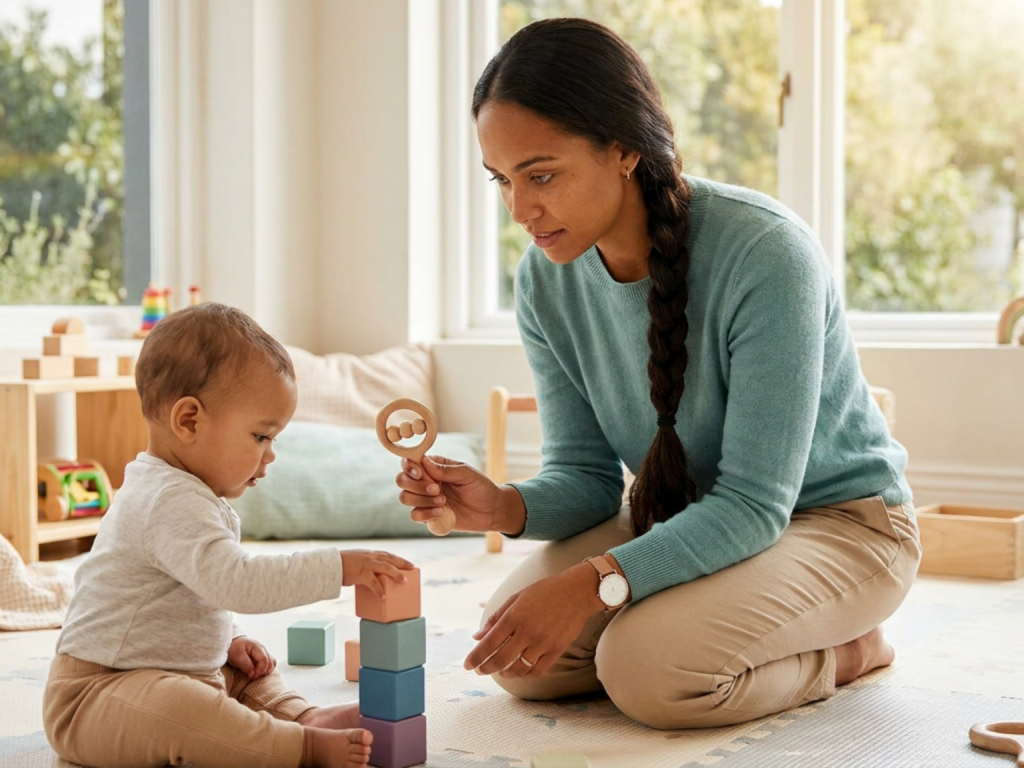
Supportive adults act more like responsive partners than instructors. They observe first, then join in at the child’s level. This can mean narrating what the child is doing, waiting for a pause before responding, or adding one small step to extend the play.
For a baby, that may look like making a face, waiting for a smile or vocal response, and then repeating the exchange. For a toddler, it might mean stacking blocks together, naming the colors, and letting the child knock them down. These are small moments, but they strengthen back-and-forth interaction, a foundation for later language and social development.
Useful adult behaviors include:
- Following the child’s attention instead of redirecting too quickly.
- Using simple, clear language that matches the child’s level.
- Offering one new idea at a time rather than many instructions.
- Allowing pauses so the child can initiate, imitate, or respond.
- Praising effort and curiosity more than performance.
This style of support also protects the emotional tone of play. When children feel understood rather than evaluated, they are more willing to explore and persist.
What play teaches about language and thinking
Play is a major engine of early language development. Babies and toddlers learn words best when language is tied to a meaningful activity: naming a toy, repeating a sound, describing an action, or labeling emotions in the moment. These exchanges create early language reciprocity—a pattern of vocalizing, pausing, and responding that resembles conversation long before full speech appears.
Play also supports executive functions such as working memory, cognitive flexibility, and inhibitory control. A child who remembers a rule in a simple game, changes strategy when something does not work, or waits for a turn is practicing the mental skills that later support classroom learning.
Another important feature of play is problem-solving. Children constantly encounter mini-problems: How do I get the ball under the chair? Why won’t the block tower stand? What happens if I push this button? With support, they learn that problems can be tested, adjusted, and solved through repeated attempts.
How play supports social and emotional growth
Play gives children a safe place to practice social behavior before expectations become more complex. Through play, they learn to share attention, imitate, negotiate, and repair small conflicts. Over time, these experiences support empathy and cooperation.
For babies, social development begins with simple exchanges: eye contact, vocal play, smiles, and turns. These early patterns are not trivial. They help the infant learn that other people are predictable and that interaction can be rewarding. That sense of predictability is part of what makes the relationship feel secure.
Play also helps with emotion regulation. Movement, rhythm, repetition, and soothing routines can help some children settle when they are overstimulated or frustrated. A caregiver’s calm presence matters here. When an adult stays regulated, the child has a model for how to recover from discomfort and return to engagement.
Practical ways to support play at home and in care settings
You do not need a perfect room or special equipment to support development through play. A safe floor space, a few age-appropriate objects, and consistent adult attention are often enough. For infants, simple sensory and motor experiences matter: reaching for a toy, tracking a face, grasping soft objects, kicking on a blanket, or practicing supervised tummy time while awake.
For toddlers and preschoolers, open-ended materials are especially useful. Blocks, cups, scarves, books, dolls, balls, and household items can become tools for imagination and learning. Try rotating a small number of materials rather than offering everything at once; too many choices can fragment attention.
It also helps to build play into ordinary routines. A song during cleanup, a naming game while dressing, or a pretend picnic at snack time can all support development. In group settings, caregivers can create predictable spaces for exploration while still allowing children to choose how to participate.
When possible, keep screen time from replacing active, interpersonal play. Passive viewing does not offer the same opportunities for turn-taking, movement, or responsive communication. If screens are used, they work best when they are limited, intentional, and not the main source of a child’s daily learning.
When to seek professional advice
- A baby is not making expected eye contact, vocalizations, or social responses.
- A child seems unable to engage in any back-and-forth play over time.
- Play is consistently limited by stiffness, floppiness, pain, or poor movement.
- A child loses previously gained play or language skills.
- You are concerned about hearing, vision, feeding, or global development.
- Your instincts say something is off, even if you cannot name it clearly.
Tools & Assistance
- Talk with your pediatrician or family doctor about developmental milestones and play concerns.
- Ask about early intervention services, developmental screening, or referral to a child development specialist.
- Use caregiver resources from ChildCare.gov for practical play ideas.
- Ask a pediatric therapist, speech-language pathologist, or occupational therapist if motor, sensory, or communication concerns arise.
- If your child attends child care, discuss guided play and daily routines with the care team.
FAQ
How much play does a baby need each day?
There is no single quota, but babies benefit from frequent short bursts of responsive play woven into awake time. Even a few minutes of attentive interaction repeated across the day can be meaningful.
Are educational toys necessary?
No. Many of the best developmental experiences come from simple objects, everyday routines, and responsive adult interaction. The toy matters less than how the child uses it and how the adult responds.
What if my child only wants one kind of play?
A strong preference is common, especially during transitions or periods of rapid development. Offer gentle variety without forcing it, and mention persistent concerns to a clinician if the pattern seems very narrow or rigid.
Can play help with speech and language?
Yes. Play creates natural opportunities for naming, turn-taking, imitation, and early conversation patterns. If language concerns persist, a speech-language pathologist can help assess them.
Should I stop using screens completely?
Not necessarily, but screens should not replace active, interactive play. If you use them, keep them limited and make sure most learning time still involves real human interaction and movement.
Sources
- American Academy of Pediatrics — The Importance of Play in Promoting Healthy Child Development and Maintaining Strong Parent-Child Bonds
- ChildCare.gov — Supporting Children's Learning Through Play
- NAEYC — The Power of Playful Learning in the Early Childhood Setting
Disclaimer
This article is for general educational purposes only and does not replace individualized medical advice. If you have concerns about a child’s development, movement, behavior, or language, please consult a qualified healthcare professional.
















Please log in to leave a comment.