
Intro
Newborn sensory play is not about structured lessons or expensive toys. In the first weeks of life, your baby’s most meaningful stimulation often comes from your face, voice, touch, smell, and the gentle rhythm of daily care. These small moments help the immature nervous system receive, organize, and respond to sensory information.
Because newborns have limited self-regulation and can become overstimulated quickly, the safest approach is brief, responsive, and closely supervised. If your baby was born preterm, has medical complexity, feeding difficulties, abnormal tone, hearing or vision concerns, or prolonged irritability, discuss activity choices with your pediatrician, neonatal clinician, health visitor, or pediatric therapist.
Highlights
Newborns learn best through simple, repeated, loving interactions rather than intense stimulation.
Face-to-face time, skin-to-skin contact, gentle voice, tummy time while awake, and safe textures can support early sensory development.
Short sessions are usually more effective than long ones because newborns fatigue and dysregulate easily.
Watching cues such as gaze aversion, hiccups, color change, yawning, finger splaying, or crying helps prevent overstimulation.
Understanding newborn sensory abilities
A newborn’s sensory system is functional but immature. Vision is blurry, with best focus at roughly face-to-feeding distance, which is one reason close face-to-face interaction is so powerful. Hearing is more developed; many newborns orient toward familiar voices, rhythmic speech, and gentle singing. Touch, smell, taste, vestibular input for balance, and proprioception for body awareness are also active from birth and strongly connected to comfort, feeding, regulation, and bonding.
In practical terms, sensory activities for newborns should be calm, brief, and embedded in caregiving. A newborn does not need a busy schedule. The brain is already processing light, sound, temperature, position, hunger, fullness, and caregiver contact. Your role is to offer safe, predictable input and to pause when your baby signals that the experience is becoming too much.
Think of sensory play as a conversation. You offer one small stimulus, such as your voice or a high-contrast object. Your baby responds by looking, stilling, rooting, wriggling, yawning, or turning away. You then adjust. This serve-and-return pattern supports responsive caregiving for sensory growth and helps your baby associate the world with safety.
Face-to-face visual play
For many newborns, the most engaging visual object is a caregiver’s face. Hold your baby close enough that your face is within their visual range, especially during alert periods after feeding or a diaper change. Speak softly, pause, and allow time for your baby to look, blink, or shift attention. Exaggerated but natural facial expressions can help, but avoid rapid movements or bright flashing toys.
Simple visual activities include:
- Slowly moving your face from the center to one side while watching whether your baby briefly tracks you.
- Holding a black-and-white or high-contrast card near your face for a few seconds.
- Placing a safe, colorful mobile where the baby can see it while awake and supervised, not where it can fall into the sleep space.
- Using daylight from a window indirectly, while avoiding direct sunlight into the baby’s eyes.
Newborns vary widely in how long they can visually attend. A few seconds of looking is meaningful. If your baby turns away, becomes fussy, or seems glazed, reduce stimulation. Visual play should never interfere with safe sleep: keep cribs and bassinets free of loose objects, and remove mobiles once a baby can reach or pull at them.
Voice, music, and gentle sound
Auditory activities can be deeply regulating when they are soft, predictable, and caregiver-led. Your voice is often more valuable than any toy. Talk during diaper changes, narrate what you are doing, sing a simple lullaby, or repeat your baby’s name in a warm tone. Newborns do not understand words yet, but they are learning rhythm, prosody, emotional tone, and turn-taking.
A rattle can be introduced cautiously. Use a soft sound, keep it at a distance, and move it slowly from one side to the other only when the baby is calm and awake. Avoid shaking toys close to the ears, startling noises, loud music, or continuous background sound. A newborn’s auditory system is vulnerable to excessive volume, and overstimulation may show up as crying, stiffening, gaze aversion, or sleep disruption.
Everyday sound routines are useful. You might use the same calm phrase before feeding, the same short song before sleep preparation, or quiet humming during burping. These repeated cues can help the newborn nervous system anticipate transitions. If your baby does not startle to loud sounds, does not respond to voice over time, or had risk factors for hearing loss, follow newborn hearing screening recommendations and consult a healthcare professional.
Touch, skin-to-skin contact, and texture exploration
Tactile input is central to newborn regulation. Skin-to-skin contact, when safe and supervised, can support warmth, bonding, and physiologic stability. Place the diapered baby upright on a caregiver’s bare chest, cover the baby’s back with a blanket, ensure the airway remains clear, and keep the adult awake and attentive. If either caregiver or baby is medically unwell, very sleepy, sedated, or recovering from a complicated birth, ask a clinician about safe positioning.
Gentle touch can also happen during routine care developmental moments. During a diaper change, pause to place your warm hands on the baby’s belly or feet. During dressing, describe the sensation of fabric moving over arms and legs. During bath preparation, keep temperature safe and transitions slow. Newborns can be sensitive to cold air, rough fabrics, sudden handling, or too much repositioning.
Texture play should be simple and hygienic. Offer a clean soft cloth, a smooth baby blanket edge, or a caregiver’s finger for the baby to grasp. You can gently brush a fabric across the sole of the foot or palm, then stop and observe. Avoid small objects, shedding materials, scented products, powders, essential oils, and anything that could wrap around fingers or toes. Texture exploration is not a test; it is a quiet opportunity for the baby to experience safe variation.
Supervised tummy time while awake
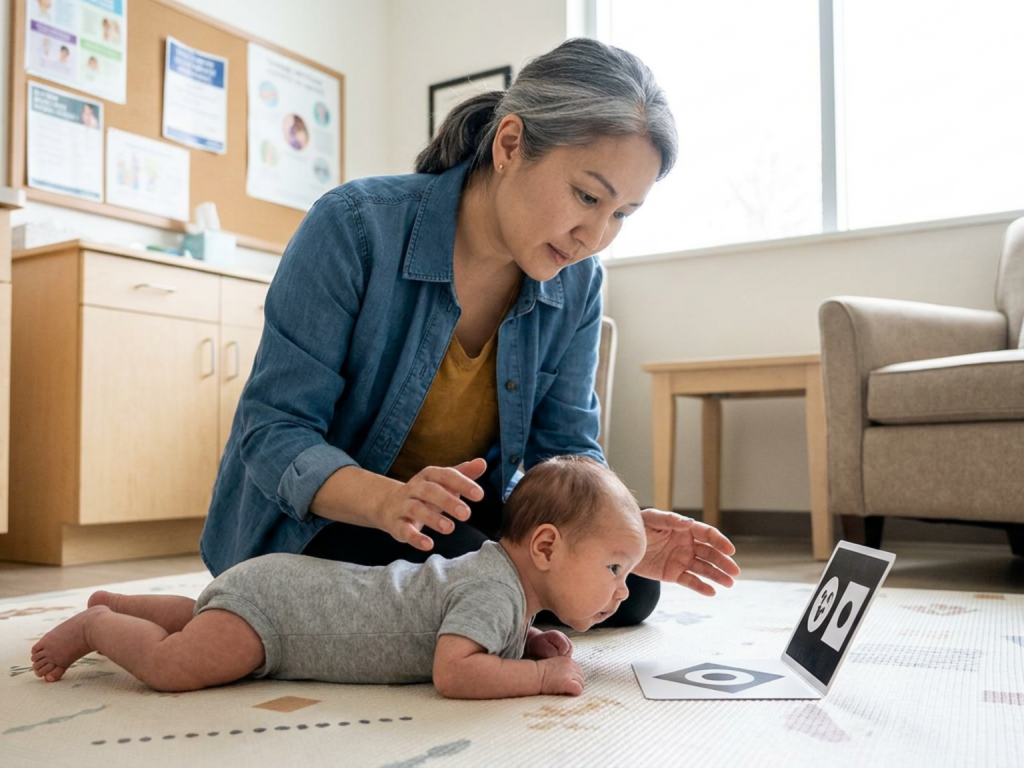
Supervised tummy time while awake is both a sensory and motor activity. It gives pressure through the chest, abdomen, arms, and hips; encourages head turning; and provides vestibular and proprioceptive input. For newborns, tummy time can start very gently: a minute or two on your chest while you recline, across your lap, or on a firm clean surface while you remain right beside the baby.
Keep sessions short and responsive. Some newborns tolerate only a few moments at first. You can place your face near the baby, talk softly, or position a high-contrast card to one side. If your baby becomes distressed, help them roll or lift them back into a comfortable position. Over time, frequent tiny sessions may be easier than one longer session.
Tummy time is only for awake, supervised periods. For sleep, follow safe sleep practices recommended by your healthcare team, generally placing babies on their backs on a firm, flat sleep surface without loose bedding. If your newborn has reflux symptoms, respiratory problems, congenital anomalies, recent surgery, abnormal muscle tone, or specific positioning instructions, ask a clinician before modifying tummy time routines.
Gentle movement and body awareness
Movement activities help newborns experience where their body is in space. This includes being carried, rocked gently, repositioned slowly, and allowed safe movement opportunities for babies on a firm surface. The key word is gentle. Newborn head and neck control is limited, so always support the head and avoid bouncing, shaking, or abrupt changes in position.
Try slow side-lying play while the baby is awake and supervised, alternating sides to give a different view of the room. You can bring the baby’s hands toward midline, let them grasp your finger, or gently bicycle the legs if the baby appears comfortable. During holding, vary positions between upright on your chest, cradle hold, and over-the-shoulder burping, as appropriate for feeding and medical guidance.
Some babies seek movement; others become unsettled quickly. Signs that movement input is too much include arching, splaying fingers, color change, hiccups, gagging, grimacing, or escalating crying. Stop, hold the baby close, reduce light and noise, and allow recovery. If your baby has persistent asymmetry, consistently turns the head only one way, seems unusually floppy or stiff, or has feeding and movement concerns together, consult a pediatric professional.
Using daily care as sensory play
You do not need a separate play program to support newborn sensory development. Feeding, diapering, bathing, dressing, burping, and settling already provide rich sensory input. The difference is intention: slow down when possible, make eye contact, use a calm voice, and watch your baby’s cues. Engaging baby during routine care can feel more realistic than trying to add another task to an already demanding day.
During feeding, your baby experiences smell, taste, touch, body position, temperature, and caregiver rhythm. During diaper changes, they feel air on the skin, surface pressure, leg movement, and your hands. During a bath, they process temperature, sound, touch, and vestibular input as their body is supported. These experiences are valuable when they are predictable and not rushed.
A simple pattern can help: prepare the environment, tell the baby what is about to happen, do one action at a time, pause, and notice the response. This approach is especially helpful for babies who were born preterm, spent time in neonatal care, or seem easily overstimulated. For preterm infants, corrected age for preterm infants may be more relevant than birth age when judging readiness for certain activities.
Reading cues and preventing overstimulation
Newborn sensory play should end before the baby becomes overwhelmed. Early disengagement cues include looking away, staring past you, yawning, sneezing, hiccuping, finger splaying, facial grimacing, fussing, or changes in breathing pattern. Later cues may include arching, frantic movement, inconsolable crying, color change, or difficulty settling. These signs do not mean you did anything wrong; they mean your baby’s nervous system needs less input.
To reset, reduce stimulation. Dim lights, lower noise, hold the baby securely, offer a familiar voice, and allow sucking or feeding if appropriate and cue-based. Some newborns recover quickly; others need a longer quiet period. Avoid trying many new activities at once, because it becomes hard to know what helped or overwhelmed your baby.
Seek medical advice if sensory responses seem extreme, persistent, or associated with other concerns such as poor feeding, lethargy, fever, respiratory difficulty, repeated vomiting, seizures, abnormal movements, or failure to wake for feeds. Sensory activities are supportive, but they are not a substitute for evaluation when a newborn may be unwell.
Safety cautions
- Never leave a newborn unattended during tummy time, bathing, texture play, or time on an elevated surface.
- Stop an activity if your baby shows distress, color change, breathing difficulty, limpness, or unusual movements.
- Avoid small objects, loose strings, scented oils, powders, loud toys, flashing lights, and anything that could obstruct the airway.
- Use back sleeping on a firm, clear sleep surface unless your healthcare professional gives different medical instructions.
- Consult a clinician before adapting activities for preterm infants, medically fragile newborns, or babies with feeding, tone, hearing, or vision concerns.
Tools & Assistance
- A pediatrician or family doctor for newborn health questions
- A certified lactation consultant or infant feeding specialist if feeding and regulation are difficult
- A pediatric physical or occupational therapist for tone, positioning, or sensory concerns
- A clean floor mat or firm blanket for supervised awake floor time
- A simple high-contrast card, soft cloth, and quiet rattle used only with supervision
FAQ
How long should sensory activities last for a newborn?
Often only a few seconds to a few minutes. Short, repeated, cue-based moments are usually better than long sessions.
Can I use toys for newborn sensory play?
Yes, but keep them simple and safe: a high-contrast card, soft cloth, or quiet rattle is enough. Your face, voice, and touch are usually the most valuable stimuli.
What if my baby cries during tummy time?
Pause and comfort your baby. Try shorter sessions on your chest or lap while awake and supervised. If distress is intense or persistent, ask your pediatrician or a pediatric therapist.
Are sensory activities different for preterm babies?
They may be. Preterm babies can have different regulation and medical needs, so corrected age and clinician guidance are important.
Can sensory play improve sleep?
Calm, predictable routines may support regulation, but sensory play should not be used to force sleep. Follow safe sleep guidance and seek help for significant sleep or feeding concerns.
Sources
- Raising Children Network — Newborn play: ideas and activities
- Pathways.org — Sensory Activities for 0-18 Months
- Raising Children Network — Newborn play: ideas and activities
Disclaimer
This article is for general educational purposes only and does not replace medical advice, diagnosis, or treatment. Always consult a qualified healthcare professional about concerns regarding your newborn.













Please log in to leave a comment.