
Intro
Baby development is not built only during special play sessions. It is shaped through hundreds of small, repeated moments: feeding, diaper changes, floor time, soothing, eye contact, movement, songs, and safe sleep routines. For many caregivers, this is reassuring: you do not need expensive toys or a perfect schedule to support your baby’s brain, body, language, and social-emotional growth.
This article offers practical, age-aware daily activities for the first year of life, with medical caution and flexibility. Babies vary widely, and preterm infants may follow milestones according to corrected age. If you are concerned about feeding, tone, vision, hearing, regression, or delayed milestones, discuss your observations with a pediatrician, family physician, health visitor, or developmental specialist.
Highlights
Ordinary routines are powerful developmental opportunities when they include warmth, responsiveness, and safe sensory input.
Tummy time, floor play, reaching, grasping, talking, singing, and reading can be adapted across the first year.
Responsive caregiving helps babies regulate stress, build trust, and connect sounds, faces, touch, and movement.
Safety matters: avoid shaking, supervise awake play, follow safe sleep guidance, and limit prolonged time in seats or swings.
Why everyday activities matter
Infant development is experience-dependent: the baby’s nervous system is continually organizing information from touch, sound, vision, movement, smell, feeding, sleep, and relationships. Research on infants’ everyday experiences shows that what babies repeatedly see, hear, and do forms the raw input for learning. This means that ordinary care is not “just care”; it is a biologically meaningful developmental environment.
How daily care supports development is easiest to see when you slow down a routine. During a diaper change, a baby hears language, feels changes in temperature and touch, watches facial expressions, practices gaze shifting, and learns that discomfort is followed by relief. During feeding, the baby coordinates sucking or eating, breathing, posture, satiety cues, eye contact, and emotional regulation. These repeated experiences help build neural networks related to motor control, attachment, sensory processing, communication, and self-regulation.
A supportive daily rhythm does not have to be rigid. Many babies thrive with a predictable but flexible pattern: feed, interact, move, rest, and repeat. The key is not constant stimulation. Babies also need quiet pauses, sleep, and protection from overload. A medically literate approach recognizes that development depends on both enrichment and regulation: enough input to learn, enough calm to integrate it.
Responsive interaction: the foundation of daily learning
Responsive caregiving for babies means noticing signals and responding in a timely, warm, and appropriate way. A baby may turn toward a voice, widen the eyes, kick excitedly, look away, arch, yawn, hiccup, cry, or become still. These cues are communication. When caregivers respond consistently, babies learn that social signals matter and that adults can help them regulate physiological arousal.
Daily activities can include “serve and return” moments. If your baby coos, pause and answer with a gentle sound. If the baby looks at a toy, name it. If the baby reaches, bring the object close enough for effort but not frustration. This back-and-forth supports early language development, attention, memory, and social reciprocity. It also strengthens secure attachment, which is not about never letting a baby cry, but about being reliably protective and emotionally available.
Engaging baby during routine care can be especially useful for busy families. Narrate what is happening: “I’m lifting your legs,” “Here is the warm cloth,” “You found your toes.” Use a calm voice and simple words. Over time, babies begin to associate repeated sounds with actions, body parts, people, and sensations. For infants with medical complexity, sensory sensitivity, or feeding challenges, these interactions may need to be shorter, slower, and guided by clinicians familiar with the child.
Motor development: safe movement every day
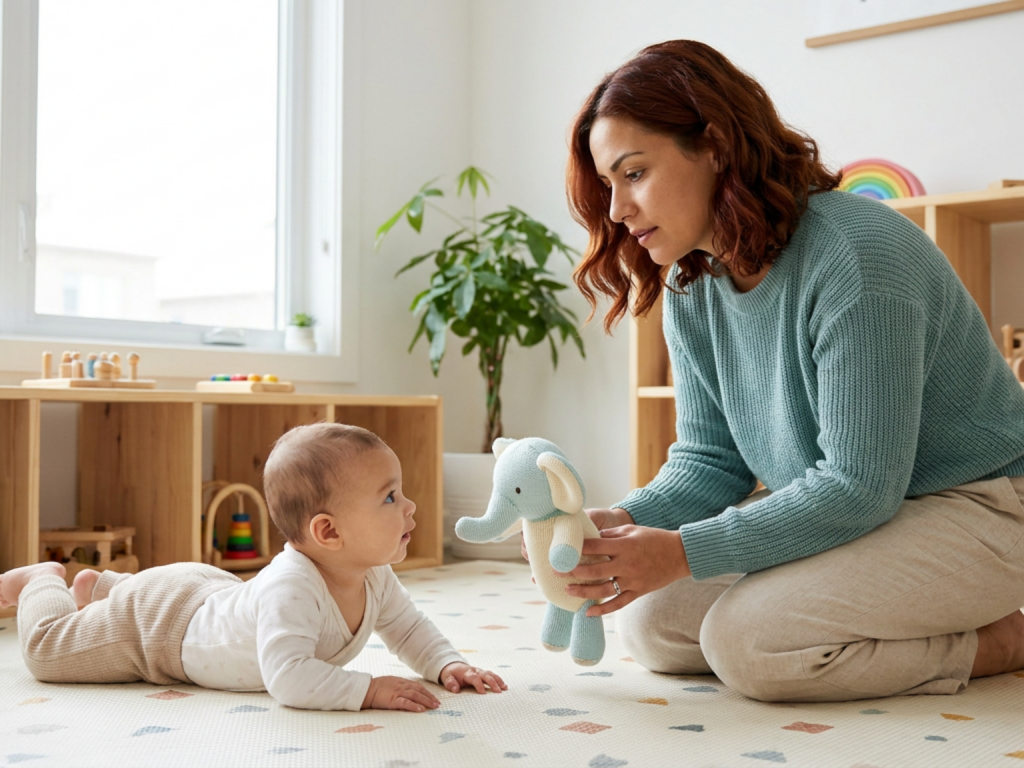
Motor development in the first year progresses from head control and midline orientation toward rolling, sitting, crawling or other forms of mobility, pulling to stand, and cruising. Babies need frequent opportunities to move against gravity on a safe surface. Supervised tummy time while awake is one of the most practical daily activities. It strengthens neck, shoulder, trunk, and upper limb muscles and helps prevent excessive pressure on one area of the skull.
Start with brief periods if your baby dislikes tummy time: chest-to-chest on a caregiver, a rolled towel under the chest if recommended, or a few minutes after a diaper change when the baby is alert. Gradually increase duration as tolerated. Always keep the baby awake and supervised. Tummy time is not for sleep.
Other safe movement opportunities for babies include side-lying play, reaching for a soft toy, kicking without restrictive clothing, supported sitting when developmentally ready, and floor exploration. Limit prolonged time in containers such as car seats outside travel, swings, bouncers, and positioning seats. These devices can be useful briefly, but they reduce spontaneous movement and varied postural practice when overused.
Daily baby care first year activities should respect the baby’s current abilities. Avoid pulling a young infant by the arms, forcing sitting before adequate trunk control, or using equipment that encourages standing before readiness. If you notice persistent stiffness, marked floppiness, strong asymmetry, loss of skills, poor head control beyond expected age ranges, or difficulty using one side of the body, seek professional evaluation rather than trying to correct it with home exercises alone.
Language and cognitive growth through talking, reading, and singing
Babies learn language long before they speak. They track rhythm, pitch, pauses, facial movement, and repeated words. Talking, reading, and singing during the day expose the baby to phonemes, social timing, vocabulary, and emotional tone. The goal is not academic instruction; it is warm, repeated communication.
Use everyday narration: describe washing hands, preparing a bottle, opening curtains, or putting socks on tiny feet. Pause so your baby can respond with gaze, movement, sound, or facial expression. Reading can begin in early infancy. Choose sturdy books with simple images, high-contrast patterns for younger babies, and familiar objects as the baby grows. It is fine if your baby mouths the book, turns away, or wants only one page. The interaction is the learning activity.
Singing is particularly useful because melody and rhythm capture attention and can support regulation. Lullabies, repetitive songs, and playful sound patterns help babies anticipate sequences. You can pair songs with routines: a diaper song, a bath song, or a short sleep transition song. Repetition is not boring for babies; it creates predictability and helps the brain detect patterns.
For bilingual or multilingual families, speaking the languages used naturally at home is beneficial. Babies can learn from multiple language systems when they receive rich, responsive interaction. If there are concerns about hearing, lack of response to sound, limited eye contact, or absence of vocalization progress, bring these observations to a healthcare professional.
Sensory play without overstimulation
Sensory development involves vision, hearing, touch, vestibular input, proprioception, smell, and taste as feeding expands. Daily sensory activities should be simple and safe: a soft cloth to touch, a rattle to track, a caregiver’s face to study, water splashing during a bath, or a walk outdoors with changing light and sound. Babies do not need loud electronic toys or constant entertainment.
Good sensory play follows the baby’s state. An alert, calm baby may enjoy looking at a face, reaching for a toy, or feeling different fabric textures. A tired or hungry baby may find the same activity overwhelming. Watch for overstimulation signs in babies: turning away, finger splaying, yawning, hiccups, fussing, gaze avoidance, arching, frantic movements, or sudden shutdown. These signals often mean the baby needs a break, dimmer light, less noise, holding, feeding, or sleep.
Safe toy choices are important. Use objects that are too large to choke on, free of small detachable parts, and appropriate for mouthing. Avoid strings, cords, button batteries, magnets, and damaged toys. Rotate a few items rather than presenting many at once. A wooden spoon, soft ball, crinkly cloth, or board book can be as developmentally useful as a specialized toy when paired with caregiver interaction.
For babies with prematurity, neurologic conditions, reflux discomfort, sensory processing differences, or complex medical histories, the threshold for overstimulation may be lower. Occupational therapists, physiotherapists, speech-language pathologists, and pediatric clinicians can help tailor activities safely.
Using care routines as developmental moments
Feeding, diapering, bathing, dressing, and sleep preparation happen many times a day, making them ideal for gentle developmental repetition. During feeding, follow hunger and fullness cues when possible. Responsive feeding supports interoception, the ability to notice internal body signals. In bottle-fed babies, paced feeding may be discussed with a clinician if there are concerns about gulping, coughing, reflux, or poor coordination. For breastfed babies, lactation support can help with latch pain, transfer concerns, or weight gain questions.
Diaper changes are opportunities for body awareness and social communication. Name body parts accurately, move slowly, and give the baby a moment to anticipate touch. During dressing, encourage reaching an arm through a sleeve or pushing a foot against your hand when age-appropriate. Bathing can support tactile and vestibular experiences, but it must be directly supervised at all times; infants can drown in very small amounts of water.
A predictable bedtime routine for babies can include dim light, a feed if part of the usual pattern, a brief book or song, a clean diaper, and placement on the back for sleep in a safe sleep space. Keep sleep surfaces firm, flat, and free of loose bedding, pillows, and soft objects according to local safe sleep guidance. Low-stimulation sleep transitions help babies shift from interaction to rest.
Routine care developmental moments should remain gentle. If a baby is crying intensely, hungry, unwell, or exhausted, the developmental goal is regulation, not performance. Holding, soothing, reducing stimulation, and seeking medical advice when symptoms are concerning are all valid and important developmental supports.
A flexible daily activity rhythm by age
From birth to about 3 months, focus on bonding, feeding support, safe sleep, brief supervised tummy time, gentle talking, face-to-face interaction, and noticing cues. Newborn head and neck support remains essential. Babies at this stage may tolerate only short play periods, and that is normal.
From about 3 to 6 months, many babies become more visually engaged and begin reaching, rolling attempts, hand-to-mouth exploration, and longer vocal exchanges. Offer floor time, rattles, soft books, mirror play with supervision, and songs with pauses for response. Encourage both sides of the body by placing interesting objects slightly to the left and right.
From about 6 to 9 months, sitting, transferring objects, babbling, and early mobility often expand. Daily activities may include peekaboo, object permanence games, safe mouthing toys, supported sitting play, and supervised exploration on the floor. If solids have started, mealtimes also become sensory and motor learning, but choking prevention and readiness matter.
From about 9 to 12 months, babies may crawl, pull to stand, cruise, imitate gestures, point, clap, or use early words. Offer containers to fill and empty, simple cause-and-effect toys, sturdy furniture for supervised pulling to stand if developmentally ready, and lots of shared attention: “You’re pointing at the dog.” Babyproofing becomes a developmental tool because safe exploration supports learning while reducing injury risk.
When to pause and seek advice
- Never shake a baby; if you feel overwhelmed, place the baby safely on their back in a crib and get help.
- Seek urgent care for breathing difficulty, blue color, seizures, severe lethargy, dehydration signs, or injury.
- Discuss loss of skills, persistent feeding difficulty, poor weight gain, marked asymmetry, or unusual muscle tone with a clinician.
- Use safe sleep practices for every sleep: back position, firm flat surface, and no loose bedding or soft objects.
- Avoid small objects, button batteries, strong magnets, cords, and unsupervised water exposure.
Tools & Assistance
- A simple daily observation notebook for feeding, sleep, play tolerance, and new skills
- A safe floor mat or clean blanket for supervised awake movement
- Board books, soft rattles, textured cloths, and large baby-safe toys
- Pediatric well-child visits for growth, hearing, vision, feeding, and developmental surveillance
- Local early intervention or child development services if concerns are identified
FAQ
How long should daily developmental play last?
Short, frequent moments are usually best. A few minutes of tummy time, talking, singing, or reaching play repeated across the day can be more useful than one long session, especially for young infants.
What if my baby does not like tummy time?
Start very briefly when the baby is alert, try chest-to-chest positioning, and build gradually. If distress is intense or you notice motor concerns, ask a pediatric clinician or physiotherapist for guidance.
Do babies need educational toys or screens?
No. Babies learn best through responsive human interaction, safe movement, touch, faces, voices, books, and real objects. Follow pediatric guidance on screen exposure and prioritize caregiver interaction.
How can I tell if my baby is overstimulated?
Common signs include looking away, yawning, hiccups, fussing, arching, finger splaying, frantic movement, or becoming unusually still. Reduce noise and light, pause play, and help the baby settle.
Should I compare my baby’s daily skills with milestone charts?
Milestones are useful screening guides, not a scorecard. Look for steady progress and discuss concerns, regression, or significant delays with a healthcare professional.
Sources
- Centers for Disease Control and Prevention (CDC) — Positive Parenting Tips: Infants (0–1 years)
- National Institutes of Health (NIH) / PubMed Central — Ten lessons about infants' everyday experiences
- Canadian Paediatric Society — Playtime with your baby: Learning and growing in the first year
Disclaimer
This article is for general educational purposes and does not replace individualized medical advice. Consult a qualified healthcare professional about concerns regarding your baby’s health, feeding, development, or safety.














Please log in to leave a comment.