
Intro
Stimulating a baby’s development at home does not require expensive toys, flashcards, or a packed schedule. In infancy, the most powerful developmental inputs are safe physical movement, warm responsive caregiving, language-rich interaction, sleep, feeding, touch, and repeated everyday routines.
Every baby develops at an individual pace, and development is influenced by gestational age, temperament, health history, sensory needs, and family context. The aim is not to accelerate milestones, but to create a safe, emotionally secure environment where the brain, body, and relationships can mature naturally.
Highlights
Babies learn best through responsive, face-to-face interaction, not formal lessons or screens.
Simple routines such as feeding, diaper changes, bathing, reading, and floor play can become powerful developmental moments.
Safe movement, including supervised tummy time while awake, supports motor control and sensory integration.
Watching for fatigue and overstimulation signs in babies helps parents balance stimulation with rest.
Start with connection: the baby’s brain learns through relationships
In the first year, development is deeply relational. A baby’s nervous system is immature, and caregiving helps regulate arousal, stress responses, feeding rhythms, sleep transitions, and social attention. When you respond consistently to crying, facial expressions, body movements, and vocalizations, you are not “spoiling” the baby; you are building a foundation for secure attachment and self-regulation.
Responsive caregiving for babies means observing cues and answering them in a predictable, warm way. If your baby turns toward your voice, pauses while feeding, stretches, fusses, or looks away, those are communicative signals. You can respond by speaking softly, changing position, pausing interaction, offering comfort, or allowing quiet time.
Face-to-face interaction is especially valuable. Hold your baby close, make gentle eye contact when they are alert, and copy their sounds or expressions. This back-and-forth pattern is sometimes called “serve and return”: the baby makes a signal, and the caregiver responds. These small exchanges support neural pathways involved in language, emotional regulation, social cognition, and attention.
Skin-to-skin contact, cuddling, rocking, and calm holding can also support physiologic regulation, including heart rate, temperature stability, and stress reduction. If a baby has been born preterm, has medical complexity, or has feeding or respiratory concerns, ask the pediatrician or neonatal follow-up team how to adapt handling and stimulation safely.
Use everyday routines as developmental practice
You do not need to separate “learning time” from ordinary care. Feeding, diapering, dressing, bathing, and settling for sleep are repeated many times a day, which makes them ideal opportunities for learning. How daily care supports development is often underestimated because the activities look simple, but repetition and emotional safety are exactly what the infant brain needs.
During diaper changes, name body parts and describe what you are doing: “I’m lifting your legs,” “Here is a clean diaper,” “Now your feet are free.” During feeding, watch for hunger cues and satiety cues rather than forcing a fixed amount. During dressing, gently move arms and legs through clothing while allowing the baby to feel changes in pressure, temperature, and position.
Predictable caregiving cues help babies anticipate what comes next. A short phrase before a bath, a soft song before sleep, or a consistent feeding position can make routines feel safer. Over time, these repeated patterns support memory, body awareness, and emotional regulation.
Daily activities for baby development can be brief and natural. A few minutes of singing while folding laundry, talking during a walk, or naming objects during a bath can be more useful than a long structured session that leaves the baby exhausted. The goal is not constant stimulation; it is frequent, responsive, developmentally appropriate interaction.
Support motor development with safe floor time and tummy time
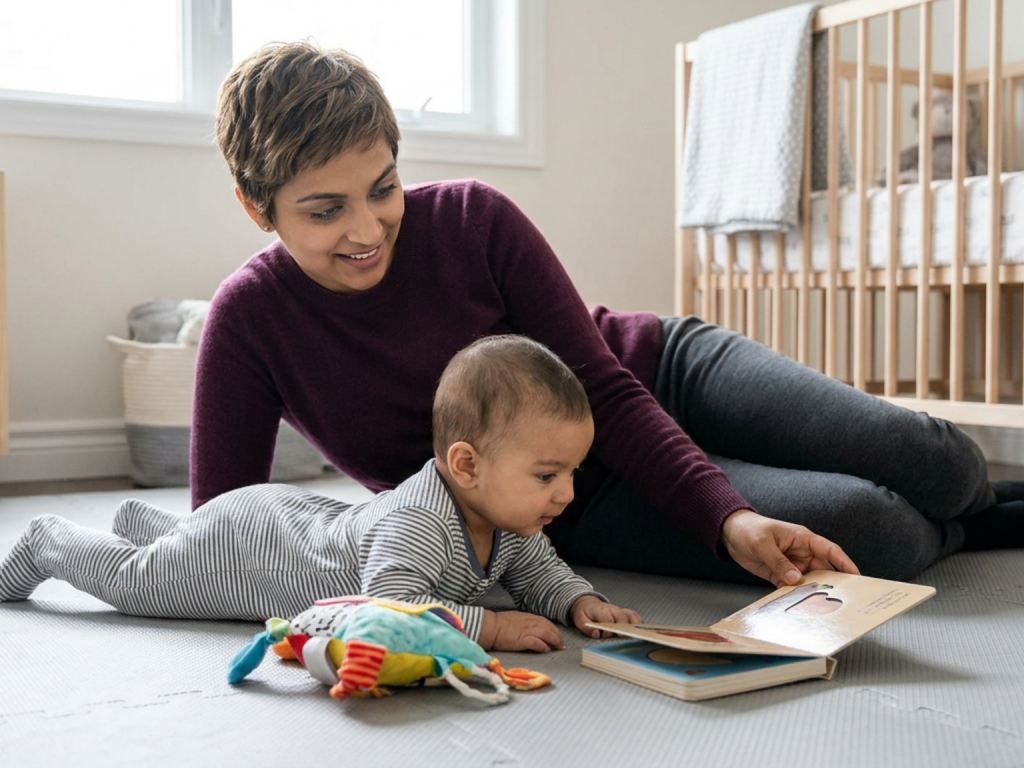
Motor development begins with head control, postural stability, visual tracking, and gradually increasing strength. Safe floor time for infants gives babies the opportunity to move against gravity, explore their hands and feet, shift weight, and develop coordination. A firm, clean surface with close supervision is usually better for active learning than prolonged time in seats, swings, or carriers.
Supervised tummy time while awake is important because it strengthens the neck, shoulder, trunk, and upper back muscles used later for rolling, sitting, crawling, and reaching. Start with very short sessions if the baby is young or dislikes the position. Even one or two minutes on your chest while you recline, or across your lap while you talk gently, can be a beginning. Increase gradually as tolerated.
Try these safe movement opportunities for babies:
- Place a high-contrast toy or your face slightly to one side to encourage head turning.
- Let the baby kick freely without tight clothing or restrictive equipment.
- Offer a soft rattle or textured toy near the hand, allowing attempts to reach rather than placing it directly into the palm every time.
- Change positions when awake: back, tummy, side-lying with supervision, upright holding, and being carried against your body.
Always follow safe sleep practices for infants: babies should sleep on their backs on a firm, flat sleep surface without loose bedding or soft objects. Tummy time is for awake, supervised periods only. If your baby has poor head control beyond expected age ranges, persistent asymmetry, unusual stiffness or floppiness, or difficulty feeding or breathing during positioning, discuss this with a healthcare professional.
Build early language development through talking, singing, and reading
Language development starts long before the first word. Babies learn the rhythm, melody, and social purpose of language from hearing familiar voices. Speak freely during the day: describe what you see, narrate routines, repeat your baby’s sounds, and pause as if you expect a response. These pauses matter because they teach turn-taking, attention, and social communication.
Early language development is supported by warm, exaggerated, infant-directed speech when it feels natural. You might say, “You found your hand,” “That was a big stretch,” or “I hear you telling me something.” Copying coos and babbles, then adding a new sound, creates a simple conversational loop.
Reading with a baby is not about finishing the book. Choose sturdy books with bright images, simple faces, high contrast, textures, or everyday objects. Hold the book where the baby can see it, use an animated but not overwhelming voice, point to pictures, and pause for kicking, looking, reaching, or vocalizing. If the baby mouths the book, turns away, or wants the same page repeatedly, that is still developmentally useful exploration.
Singing and rhymes add rhythm and repetition, which can support auditory processing and memory. Songs during diaper changes, bath time, or low-stimulation sleep transitions can become comforting cues. Avoid using screens as a substitute for interaction in infancy; babies learn more from live, responsive human communication than from passive video exposure.
Offer sensory stimulation without overwhelming the nervous system
Babies explore the world through sensory systems: touch, movement, vision, hearing, smell, taste, and proprioception, which is body-position awareness. At home, sensory stimulation should be varied but gentle. A baby does not need flashing lights, loud toys, or constant novelty. In fact, too much stimulation can make it harder for the infant nervous system to stay organized.
Simple sensory play may include soft fabrics, a crinkly cloth book, a smooth teether, gentle massage, warm bath water, or watching sunlight move across a wall. Let the baby look, listen, touch, and pause. When offering toys with different textures, ensure they are age-appropriate, too large to choke on, free of detachable small parts, and easy to clean.
Overstimulation signs in babies may include turning the head away, arching, finger splaying, hiccupping, yawning, fussing, crying, gaze avoidance, frantic movements, or difficulty settling. If you notice these signals, reduce input: dim lights, lower noise, stop passing the baby from person to person, hold them calmly, or give them a quiet break.
Temperament matters. Some babies enjoy social play and movement; others need slow transitions and shorter sessions. Medically fragile infants, preterm infants, and babies recovering from illness may have lower stimulation thresholds. For preterm babies, corrected age for preterm infants may be more useful than birth age when thinking about developmental expectations, but individual medical guidance is important.
Encourage social-emotional development through safe play and soothing
Play in infancy is not performance. It is shared attention, curiosity, movement, sound, and emotional connection. Peekaboo, gentle imitation, smiling, soft tickles if the baby enjoys them, and showing a toy then waiting for a response all strengthen social learning. Babies also learn from being comforted after distress, not only from being happy.
Crying is communication, but it can be stressful and sometimes difficult to interpret. Check common needs: hunger, diaper, temperature, burping, fatigue, pain, or desire for closeness. If the baby remains upset, try calm holding, rhythmic rocking, walking, swaddling when age-appropriate and safe, white noise at a safe volume, or a pacifier if used. Never shake a baby. If you feel overwhelmed, place the baby on their back in a safe sleep space and step away briefly while you regain control, or call another trusted adult.
Safe calming techniques for babies should be gentle and adapted to age. Avoid vigorous bouncing, unsafe sleep positioning, or adding pillows and blankets to “help” sleep. If crying is high-pitched, persistent, associated with fever, poor feeding, lethargy, breathing difficulty, vomiting, injury, or a caregiver’s concern that something is wrong, seek medical advice promptly.
Emotional development also depends on caregiver wellbeing. Postpartum depression, anxiety, trauma, sleep deprivation, and lack of support can make interaction feel difficult. Needing help does not mean you are failing. Pediatricians, family physicians, midwives, lactation professionals, mental health clinicians, and home-visiting programs can support both baby and caregiver.
Choose simple toys, avoid pressure, and know when to ask for help
The best developmental tools are often simple: your face, voice, hands, books, safe floor space, and a few age-appropriate objects. Rotate toys rather than offering many at once. A soft rattle, board book, mirror designed for infants, textured ring, or washable cloth can invite exploration without overwhelming the baby.
Be cautious with products marketed as making babies smarter or helping them reach milestones faster. Walkers, excessive time in swings, and long periods in restrictive devices can reduce natural movement practice and may create safety concerns. Baby equipment can be useful briefly when needed, but it should not replace supervised floor time, holding, or interaction.
Try to observe patterns rather than compare constantly. Milestone ranges are broad, and babies may focus on one skill while another develops more slowly. Still, developmental concerns deserve attention. Contact a healthcare professional if you notice loss of previously acquired skills, persistent feeding difficulty, poor visual tracking, very limited response to sound, unusual muscle tone, lack of social engagement, or concerns about movement asymmetry.
Developmental regression in babies, especially loss of social, motor, or communication skills, should be discussed promptly with a pediatric clinician. Early evaluation does not label a baby; it helps identify whether vision, hearing, neurologic, feeding, musculoskeletal, or environmental factors need support. Early intervention services, when appropriate, are designed to coach families in practical strategies at home.
When to seek medical guidance
- Call a healthcare professional promptly for fever in a young infant, breathing difficulty, poor feeding, lethargy, dehydration, injury, or persistent inconsolable crying.
- Seek advice if your baby loses previously acquired developmental skills or seems unusually floppy, stiff, or asymmetric.
- Never shake a baby; if crying feels unmanageable, place the baby safely on their back and get help.
- Use tummy time only when the baby is awake and supervised; follow safe sleep guidance for all sleep.
- For preterm or medically complex infants, ask clinicians how to adapt stimulation to corrected age and health needs.
Tools & Assistance
- A clean firm floor mat for supervised awake movement
- A few washable high-contrast or textured infant-safe toys
- Board books or cloth books for daily shared reading
- A simple routine tracker for sleep, feeding, crying, and developmental observations
- Pediatrician, health visitor, early intervention program, or lactation consultant when concerns arise
FAQ
How much stimulation does a baby need each day?
Short, frequent moments are usually best. Talk, hold, read, sing, and offer supervised movement during natural awake periods, then allow rest when the baby shows tiredness or overstimulation.
Is tummy time necessary if my baby dislikes it?
Tummy time helps build strength, but it can begin very gradually. Try brief sessions on your chest or lap while the baby is awake and calm, and ask a clinician if distress is intense or positioning seems difficult.
Do babies need educational videos or apps?
Infants learn best from live, responsive interaction. Talking, reading, singing, and playing with a caregiver are more developmentally useful than passive screen exposure.
What if my baby develops more slowly than other babies?
Variation is common, especially for babies born preterm or with health challenges. If you are concerned, discuss observations with your pediatrician rather than waiting or comparing online.
Can too much play overstimulate a baby?
Yes. Turning away, arching, fussing, yawning, gaze avoidance, or frantic movements can mean the baby needs a quieter environment, less handling, or sleep.
Sources
- Centers for Disease Control and Prevention (CDC) — Positive Parenting Tips: Infants (0–1 years)
- Mayo Clinic — Infant development: Birth to 3 months
- First Things First — First steps in reading: Tips for reading with baby
Disclaimer
This article is for informational purposes only and does not replace medical advice, diagnosis, or treatment. Always consult a qualified healthcare professional about concerns regarding your baby’s health or development.


















Please log in to leave a comment.