
Intro
Car seat safety can feel surprisingly complex, especially when your baby changes size, posture, and developmental abilities so quickly. The reassuring principle is that the safest seat is usually the one that fits your child’s age, weight, height, and developmental needs, is appropriate for your vehicle, and is used correctly every ride.
This guide explains car seat safety by age for babies and young children, with special attention to rear-facing travel, harness fit, transition timing, and situations that deserve input from a pediatrician, child passenger safety technician, or other qualified clinician. It is not about judging caregivers; it is about reducing preventable injury risk with practical, repeatable steps.
Highlights
Babies and toddlers should ride rear-facing as long as possible, until they reach the maximum height or weight limit allowed by their specific car seat.
Age matters, but height, weight, neuromuscular maturity, and the manufacturer’s instructions matter just as much when deciding when to change seats.
The back seat is the safest location for children, and children should remain in the back seat through age 12 whenever possible.
Harness position, chest clip placement, recline angle, and avoiding bulky clothing are small details that can make a major difference in crash protection.
Babies with prematurity, airway concerns, low tone, casts, or other medical needs may require individualized guidance before routine car travel.
Why age-based car seat safety matters
Motor vehicle crashes create rapid deceleration forces that can overwhelm a baby’s immature musculoskeletal system. Compared with adults, infants have a proportionally larger head, less developed cervical musculature, and more flexible bones and ligaments. In a crash, an incorrectly used seat can allow excessive movement of the head, neck, chest, or abdomen.
Age-based guidance is useful because it follows predictable developmental risk: newborns need airway protection and recline support, infants need rear-facing containment, toddlers still need protection for the head and spine, and older children need correct belt geometry. However, age alone should never be the only criterion. The label and manual for the specific car seat, the child’s measured weight and height, and the vehicle manual all matter.
A helpful way to think about transitions is this: do not move to the next stage because the child reaches a birthday; move only when the child has outgrown the safer current stage according to the seat’s limits. Many children can and should remain rear-facing beyond age 2 if their seat allows it.
Newborn to around 12 months: rear-facing only
For newborns and young infants, rear-facing travel is the standard safety position. A rear-facing seat supports the head, neck, and spine by spreading crash forces across the back of the seat shell. This is particularly important before robust head control and trunk stability develop.
Common options include an infant-only rear-facing seat or a convertible seat used in its rear-facing mode. Infant-only seats are often convenient because the carrier can be removed from the base, but they are not safer by default; correct fit and installation are what matter. Convertible seats may be used from birth if the newborn meets the manufacturer’s minimum weight and fit criteria.
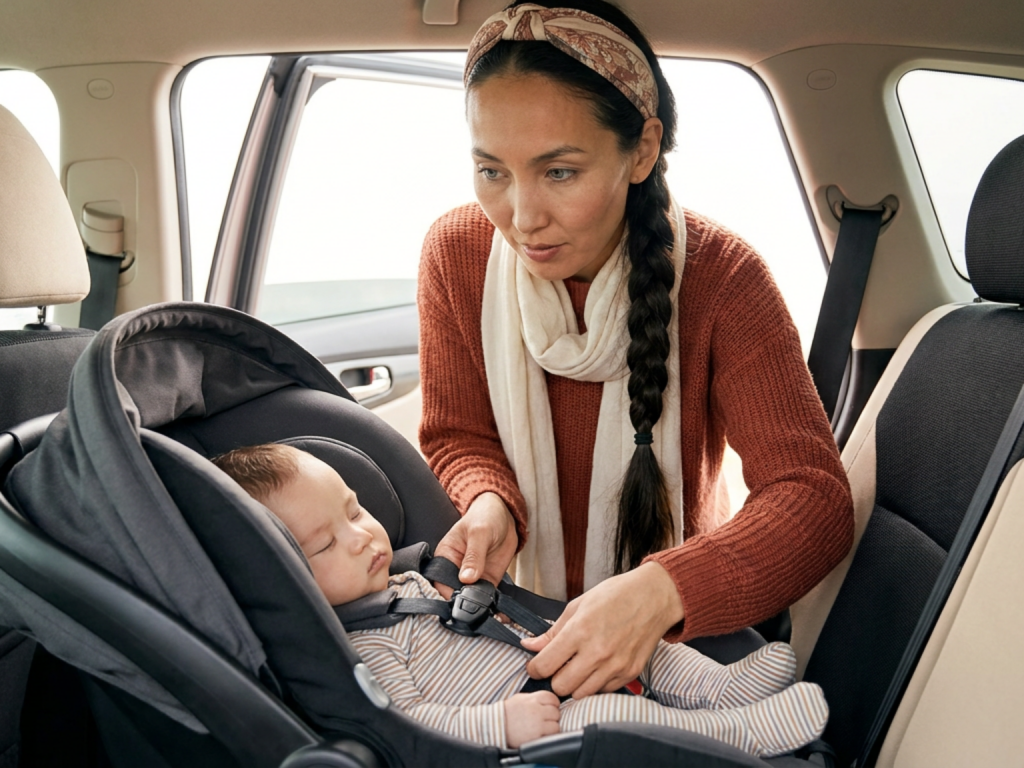
- The harness straps should usually come from at or below the baby’s shoulders when rear-facing, according to the seat instructions.
- The chest clip should sit at armpit level, not on the abdomen or near the neck.
- The harness should be snug enough that you cannot pinch slack at the shoulder.
- The recline angle should match the car seat’s newborn setting to help protect the airway.
- Bulky coats, thick bunting, and padded inserts not supplied by the manufacturer should not go under the harness.
Newborn head and neck support is not the same as adding extra cushions. Use only the inserts that came with the seat or that the manufacturer approves. If your baby slumps forward, has noisy breathing, color change, oxygen desaturation history, or was born premature, discuss safe positioning with the baby’s clinician before extended travel.
Infants and toddlers: stay rear-facing as long as the seat allows
After the first birthday, many caregivers wonder whether it is time to turn the seat forward. Current safety guidance emphasizes keeping children rear-facing as long as possible, until they reach the highest weight or height allowed by the car seat. This often extends well beyond the first year and may extend beyond age 2, depending on the seat and child.
It is common for toddlers’ legs to bend, cross, or rest against the vehicle seat while rear-facing. This can look uncomfortable to adults, but it is not usually a reason to turn the child forward. Rear-facing positioning continues to offer strong protection for the head, cervical spine, and torso in frontal and many side-impact crashes.
Signs that a child may be outgrowing an infant-only seat include reaching the seat’s maximum weight, reaching the maximum height, or having the top of the head too close to the top of the seat shell according to the manual. At that point, many children can move to a rear-facing convertible seat rather than forward-facing. This preserves the safety benefit while allowing more room and higher rear-facing limits.
Age 2 to preschool: forward-facing only after rear-facing limits are reached
Once a child has reached the rear-facing height or weight limit of the car seat, the next step is usually a forward-facing car seat with a harness and top tether. The harness restrains the shoulders and hips, while the top tether reduces forward head movement during a crash. Correct tether use is a critical but sometimes missed part of forward-facing installation.
A forward-facing seat is not simply an older-child convenience; it is a different crash-management system. The transition should happen because the child has physically outgrown rear-facing use, not because of leg position, family pressure, or a birthday. If your child is small for age, has low muscle tone, a neuromuscular diagnosis, or delayed motor milestones, ask a pediatric clinician or certified child passenger safety technician whether extended rear-facing remains feasible.
Caregivers often combine travel planning with age-appropriate infant routines, especially for long drives. That is sensible, but the car seat should not be used as a routine sleep space outside the vehicle. If the child falls asleep during travel, check positioning when safe to do so, and move the child to a safe sleep surface at the destination.
School-age progression: booster seats and adult seat belts
Although this article focuses on babies, understanding the later stages helps caregivers avoid rushing transitions. After a forward-facing harnessed seat is outgrown, many children need a belt-positioning booster seat. A booster raises the child so the vehicle lap and shoulder belt fit the skeleton correctly.
The lap belt should lie low across the upper thighs, not across the abdomen. The shoulder belt should cross the middle of the chest and shoulder, not the neck or face and not under the arm. A child is usually ready for the adult seat belt only when the belt fits correctly without a booster for the entire ride, the child can sit upright without slouching, and the knees bend naturally at the edge of the vehicle seat.
Children should ride in the back seat through age 12. This reduces risk from front airbags and frontal crash forces. Even a mature child who fits the seat belt may be safer in the rear seating position, depending on the vehicle and seating configuration.
Common mistakes that reduce protection
Most car seat problems are not caused by careless parenting. They happen because car seats are technical devices used in busy, tired, real-life conditions. Rechecking a setup is an act of protection, not a sign that you failed the first time.
- Loose installation: the seat should not move more than about one inch side to side or front to back at the belt path.
- Loose harness: a harness with pinchable slack may allow excess movement during a crash.
- Incorrect chest clip: the clip belongs at armpit level to help keep the harness on the strongest parts of the torso.
- Wrong belt path: rear-facing and forward-facing belt paths are often different on convertible seats.
- Unapproved accessories: aftermarket padding, strap covers, mirrors, or toys may interfere with tested performance.
- Bulky clothing: thick layers compress in a crash, leaving the harness effectively too loose.
When in doubt, use thin layers, buckle and tighten the harness, then place a blanket over the child if needed. Always check both the car seat manual and the vehicle manual, because installation rules can differ by model.
Medical situations that need extra caution
Some babies need more individualized car travel planning. Premature infants, babies with a history of apnea or bradycardia, infants with craniofacial differences, airway anomalies, hypotonia, certain cardiac or neurologic conditions, or those requiring casts or medical equipment may not fit or tolerate a standard car seat in the usual way.
In selected situations, clinicians may recommend an observed car seat tolerance screening before discharge or may discuss alternatives such as a medically indicated car bed. A car bed is not a convenience product; it is generally reserved for specific medical circumstances and should be used under professional guidance.
If your baby cries in the car, refluxes, or seems uncomfortable, do not loosen the harness or add positioning devices unless the seat manufacturer and healthcare team support that approach. Instead, stop in a safe place, assess feeding timing, diapering, temperature, and positioning, and ask for help if symptoms are persistent or concerning.
Practical checks before every ride
A brief routine can make car seat safety less overwhelming. Before driving, confirm that the seat is appropriate for the child’s current size, the harness is snug, the chest clip is positioned correctly, and the child is not wearing bulky clothing under the straps. For rear-facing seats, check that the recline indicator remains in the permitted range.
For longer trips, plan breaks for feeding, diaper changes, and supervised movement. Young babies should not remain in a semi-upright device for prolonged periods without breaks, especially if they have airway, feeding, or tone concerns. If the trip overlaps the Baby nap schedule by age, prioritize both safe restraint in the moving vehicle and safe sleep once you arrive.
Consider having your installation checked by a certified child passenger safety technician, particularly when changing vehicles, switching from infant-only to convertible seats, or moving from rear-facing to forward-facing. A skilled check can identify subtle issues such as lower-anchor weight limits, tether routing, seat belt locking methods, and recline incompatibility.
Safety warnings
- Never place a rear-facing car seat in front of an active passenger airbag.
- Do not turn a child forward-facing before the rear-facing height or weight limit is reached unless a qualified professional advises otherwise for a specific reason.
- Do not use a car seat after a moderate or severe crash unless the manufacturer and safety guidance confirm it is acceptable.
- Do not add aftermarket cushions, head supports, strap covers, or inserts that were not approved for the seat.
- Seek medical guidance if your baby has breathing difficulty, color change, poor tone, prematurity-related concerns, or special equipment needs in the car.
Tools & Assistance
- Schedule a car seat inspection with a certified child passenger safety technician.
- Read the car seat manual and the vehicle owner’s manual together before installation.
- Register the car seat with the manufacturer to receive recall notifications.
- Keep a written note of the seat’s height, weight, expiration date, and installation method.
- Ask your pediatrician for guidance if your baby has prematurity, airway, neurologic, orthopedic, or feeding concerns.
FAQ
When can my baby face forward in the car?
A baby or toddler should remain rear-facing until reaching the maximum rear-facing height or weight limit of the specific car seat. Many children can stay rear-facing beyond age 2.
Is it unsafe if my rear-facing toddler’s legs touch the vehicle seat?
Legs touching, bending, or crossing is common and usually not a reason to turn the child forward. Rear-facing still provides important head, neck, and spine protection.
Can my baby sleep in the car seat after we arrive?
The car seat is for travel safety in the vehicle, not routine sleep outside the car. Move the baby to a safe, flat sleep surface when you arrive, especially for newborns and young infants.
Should I use the lower anchors or the seat belt?
Either may be safe when used correctly, but do not use both unless both the vehicle and car seat manuals specifically allow it. Lower anchors also have weight limits, so check the manuals.
What if my baby was premature or has medical needs?
Ask the baby’s healthcare team before routine or long car travel. Some infants need positioning assessment, car seat tolerance screening, or specialized equipment.
Sources
- National Highway Traffic Safety Administration — Car Seat & Booster Seat Safety, Ratings, Guidelines
- Children's Hospital of Philadelphia — Car Seat Safety: Newborn to 2 Years
- Mayo Clinic — Car seat safety: Avoid 9 common mistakes
Disclaimer
This article is for general medical and safety education only and does not replace care from a pediatrician, emergency clinician, or certified child passenger safety technician. Seek professional guidance for individualized car seat decisions, especially for premature infants or babies with medical needs.
















Please log in to leave a comment.