
Intro
Social interaction milestones are the observable ways a baby learns to connect with other people: looking at faces, calming with a familiar caregiver, smiling socially, copying expressions, sharing attention, playing beside or with other children, and eventually using words and pretend play to participate in relationships. These milestones are part of social-emotional development in infancy, which depends on brain maturation, temperament, sensory processing, motor skills, language, caregiver responsiveness, and the child’s environment.
Milestones are helpful guideposts, not pass-fail tests. Babies vary widely, especially if they were born preterm, have medical complexity, or have had prolonged hospitalization. Still, noticing patterns over time can help families and clinicians support development early, when the infant brain is highly plastic and responsive to nurturing interaction.
Highlights
Social milestones begin in the newborn period with orientation to voices, faces, touch, feeding rhythms, and co-regulation with caregivers.
By the end of the first year, many babies use social communication intentionally: they may respond to their name, show preferences for familiar people, share attention, and use gestures.
Toddler milestones include imitation, parallel play, pretend play, turn-taking, emerging empathy, and increasing ability to follow simple social rules.
Delays, regression, or loss of previously acquired social skills should be discussed promptly with a pediatrician or developmental professional.
Responsive caregiving in infancy, predictable routines, and playful face-to-face interaction with babies are among the most powerful supports for social growth.
What social interaction milestones mean
Social interaction milestones describe how an infant or toddler engages with people and uses relationships to learn. They include affective behaviors, such as smiling or showing distress; communicative behaviors, such as eye contact, vocal turn-taking, gestures, and pointing; and play behaviors, such as imitation, shared attention, pretend play, and cooperation. In clinical terms, these skills sit within social-emotional development, but they are closely tied to language, cognition, motor control, sensory regulation, and attachment.
For example, a baby needs enough visual attention to look at a caregiver’s face, enough postural control to orient toward a person, enough auditory processing to respond to voice, and enough emotional regulation to stay engaged. A toddler learning turn-taking also relies on impulse control, receptive language, memory, and the ability to tolerate frustration. This is why developmental milestones often appear in clusters rather than as isolated achievements.
It is also important to distinguish a single behavior from a developmental pattern. A baby who avoids eye contact when tired, hungry, overstimulated, or ill may be communicating a need for regulation. A broader concern is when a child rarely seeks social contact, rarely responds to familiar voices, loses skills, or shows limited social reciprocity across many settings.
Birth to 3 months: regulation, recognition, and early connection
In the earliest months, social interaction is often subtle. Newborns are not socially skilled in the way older infants are, but they are biologically prepared for human connection. Many orient toward familiar voices, prefer face-like visual patterns, quiet with holding or feeding, and communicate through crying, body tone, gaze, and state changes. Caregivers provide co-regulation: they help the baby’s nervous system settle through touch, voice, warmth, feeding, and predictable responses.
By around 6 to 8 weeks, many infants begin to show a social smile. This is different from reflexive smiling during sleep; it is more clearly linked to seeing a caregiver’s face, hearing a voice, or experiencing a pleasurable interaction. Babies may also begin to hold gaze briefly, make soft cooing sounds, and show different responses to familiar and unfamiliar people.
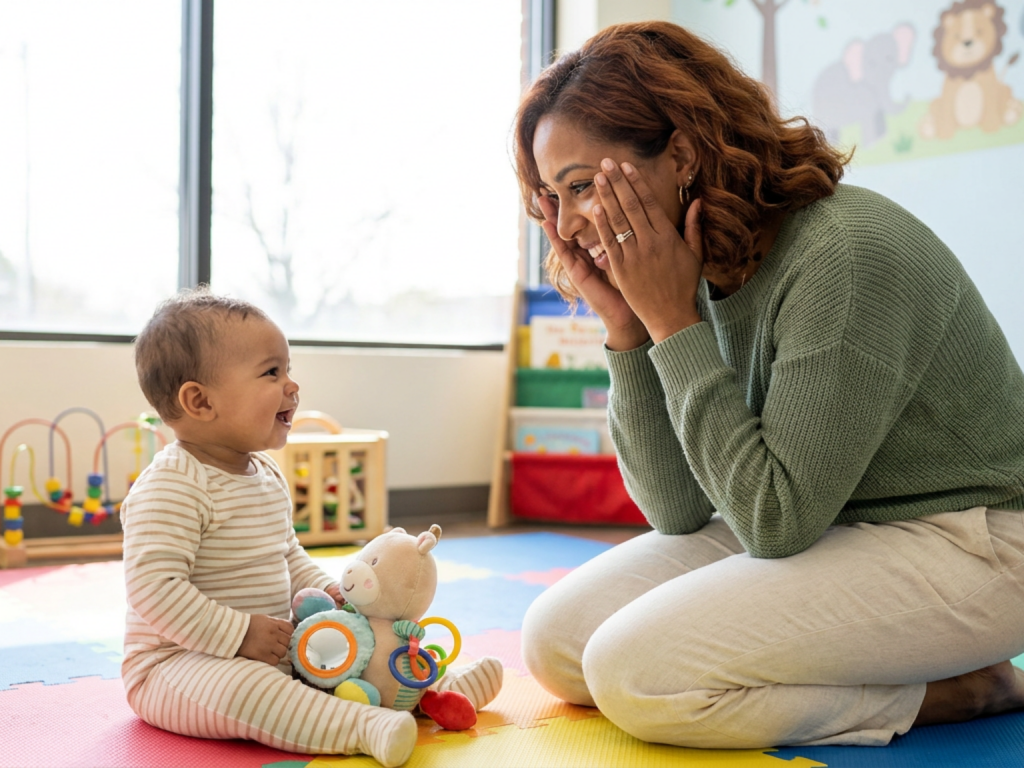
Support at this age is not about formal teaching. It is about sensitive repetition. Hold your baby where they can see your face, pause during cooing as if having a conversation, use a warm voice, and watch for cues that they need a break. Turning away, hiccuping, arching, yawning, color change, or fussing can mean the interaction has become too intense. Respecting these cues is an important part of infant social communication.
4 to 9 months: shared emotion, imitation, and social curiosity
From about 4 to 9 months, many babies become more visibly social. They may laugh, squeal, smile spontaneously at familiar people, enjoy playful routines, and show interest in mirrors, songs, and exaggerated facial expressions. They often begin to copy sounds or expressions, such as sticking out the tongue, raspberries, or simple vocal play. This imitation is a foundation for later communication and social learning.
Babies in this stage may also become more selective. They often recognize familiar caregivers and may show distress with unfamiliar people or new settings. This is not usually a problem; stranger anxiety and separation protest can reflect growing memory, attachment, and the ability to distinguish known from unknown. A baby may look to a caregiver’s face for reassurance, a behavior related to social referencing.
Everyday games are powerful here. Peekaboo teaches anticipation, object permanence, and shared enjoyment. Copying a baby’s sounds teaches reciprocity. Singing with pauses invites the baby to participate. If the baby looks away, reduce stimulation and try again later. The goal is a back-and-forth rhythm, not constant performance.
9 to 18 months: joint attention, gestures, and intentional communication
Between 9 and 18 months, social communication often becomes more intentional. Many babies respond to their name, raise their arms to be picked up, wave, clap, point, show objects, or look back and forth between an object and caregiver. These behaviors are important because they show joint attention: the child and adult are sharing focus on the same thing. Joint attention is a major bridge between early social engagement and later language.
A child may bring a toy to an adult not only for help, but to share interest. They may look at a caregiver after a surprising sound, offer a bite of food, imitate household actions, or become distressed when a trusted adult leaves. They may also begin simple social games, such as rolling a ball back and forth or making a silly sound repeatedly because it gets a reaction.
Caregivers can support this stage by narrating what the child is attending to rather than constantly redirecting. If the baby points at a dog, you might say, “You see the dog. The dog is barking.” If the baby hands you a block, respond with enthusiasm and wait to see what they do next. These small moments create a loop of attention, emotion, and meaning.
18 to 36 months: autonomy, pretend play, empathy, and peer interest
Toddlerhood brings rapid growth in social understanding. Many children begin to play near other children in parallel play, imitate peers, defend favorite toys, seek help from familiar adults, and test limits. They may start pretend play, such as feeding a doll, talking on a toy phone, making animal sounds, or pretending a block is food. Pretend play suggests symbolic thinking and supports language, emotional processing, and perspective-taking.
From 24 to 36 months, many toddlers show more complex social behaviors: taking turns with support, noticing when another child is upset, saying “mine,” offering comfort, following simple group routines, and beginning cooperative play. Their empathy is real but immature. A toddler may pat a crying peer one moment and grab a toy the next. This reflects developing self-regulation, not intentional cruelty.
Caregivers can help by naming feelings and modeling repair. For example: “You wanted the truck. Sam is sad because it was taken. Let’s give it back and find another one.” Brief, concrete language works better than long explanations. Predictable limits also help toddlers feel secure: “I won’t let you hit. You can stomp your feet here.” Social learning at this age requires many repetitions.
How milestones build on each other
Social development is cumulative. Early regulation supports attention. Attention supports face-to-face engagement. Engagement supports imitation. Imitation supports gestures, play, and language. Later, language and symbolic play support negotiation, friendship, rule-following, and cooperation. This is why clinicians often ask not only whether a child can perform one milestone, but how the child uses skills in relationships.
A baby who smiles, looks, vocalizes, and waits for a caregiver’s response is practicing the architecture of conversation before words emerge. A toddler who pretends to feed a stuffed animal is practicing representation and emotional understanding. A preschool-bound child who follows simple play rules is using memory, inhibition, and social motivation together.
Medical and developmental factors can influence this sequence. Prematurity, hearing differences, vision problems, feeding disorders, chronic illness, sleep disruption, neuromotor conditions, and neurodevelopmental differences may change how milestones appear. For preterm infants, clinicians often use corrected age in early milestone interpretation. If you are unsure which timeline applies to your baby, ask your pediatric clinician.
Supporting social interaction in daily life
Babies do not need expensive toys to develop socially. They need safe, responsive, repeated interactions with people who notice their cues. Short, warm exchanges throughout the day often matter more than long structured activities.
- Follow the baby’s lead. Comment on what they look at, touch, or vocalize about.
- Use serve-and-return interaction. When your baby smiles, babbles, points, or hands you something, respond and pause for their next “serve.”
- Create predictable routines. Songs before sleep, greetings after naps, and repeated games help babies anticipate social patterns.
- Encourage imitation. Copy your baby’s sounds and actions, then add one small variation.
- Read faces and body cues. If your baby looks overwhelmed, reduce noise, movement, or intensity.
- Offer safe peer exposure. For toddlers, brief playdates, library groups, or playground time can support peer observation and early cooperation.
Screen time is not a substitute for reciprocal interaction. Video calls with a responsive loved one can be socially meaningful for some children, but passive viewing does not provide the same back-and-forth learning as live human engagement.
When to seek professional guidance
Variation is common, but caregivers should trust their observations. Bring concerns to a pediatrician, family physician, health visitor, child development specialist, speech-language pathologist, audiologist, or early intervention program. You do not need to wait until a delay is severe to ask for developmental screening.
It is especially important to seek advice if a baby does not seem to notice caregivers, rarely responds to sound, has limited eye contact together with limited social responsiveness, does not smile socially by around the expected early infancy window, does not use gestures such as pointing or waving by the second year, or loses previously acquired social, language, or play skills. Regression deserves prompt evaluation.
A professional may recommend hearing or vision assessment, developmental screening questionnaires, observation of play and communication, or referral to early intervention services for infants and toddlers. These steps are not labels; they are ways to understand the child’s needs and provide support. Early help can benefit the child and also reduce caregiver stress.
Discuss concerns promptly
- Seek urgent professional advice for developmental regression or loss of previously acquired social skills.
- Ask for hearing and vision evaluation if your baby does not respond to voices, faces, or environmental sounds as expected.
- Consult a clinician if your infant rarely seeks comfort, rarely engages socially, or seems persistently difficult to soothe.
- Do not self-diagnose autism, attachment problems, or developmental delay from one behavior alone.
- If caregiver depression, anxiety, trauma, or exhaustion is affecting bonding, ask for support; parent wellbeing is part of infant care.
Tools & Assistance
- Routine pediatric well-child visits with developmental surveillance
- Standardized developmental screening questionnaires when recommended
- Early intervention services for infants and toddlers
- Hearing and vision assessment if social responses seem reduced
- Parent-infant groups, speech-language consultation, or child development clinics
FAQ
What is the first social interaction milestone?
Early milestones include calming with a familiar caregiver, orienting to voices and faces, and brief gaze engagement. A social smile commonly appears in early infancy and is one of the most recognizable first social milestones.
Is it concerning if my baby is shy with strangers?
Not usually. Stranger anxiety and separation protest can be typical signs that a baby recognizes familiar caregivers. Concern is greater when a child shows limited social responsiveness across familiar settings or loses skills.
Do toddlers need to play cooperatively with other children?
Young toddlers often begin with parallel play, playing near other children rather than truly with them. Cooperative play, turn-taking, and shared rules usually develop gradually with adult support.
Can prematurity affect social milestones?
Yes. For babies born preterm, clinicians may use corrected age when interpreting early milestones. Medical history, sensory differences, and feeding or sleep challenges can also influence social engagement.
When should I ask for developmental screening?
Ask whenever you feel concerned, especially if there is regression, limited response to name or sound, few gestures, minimal shared attention, or little interest in familiar people. Screening is a supportive tool, not a diagnosis by itself.
Sources
- NCBI Bookshelf — Developmental Stages of Social Emotional Development in Children
- Help Me Grow Minnesota — Social Emotional Milestones
- ZERO TO THREE — 24-36 Months: Social-Emotional Development
Disclaimer
This article is for general educational purposes and does not replace medical evaluation, diagnosis, or treatment. Consult a qualified healthcare professional about any concerns regarding your child’s development.















Please log in to leave a comment.