
Intro
At 8 months, many babies seem suddenly more purposeful: they may reach for you, protest when you leave, roll or crawl toward an interesting toy, and use their hands with much more precision. This is a period of rapid neuromotor maturation, sensory exploration, early communication, and growing social awareness. It can also be an emotional stage for caregivers, because development becomes easier to compare from one baby to another, even though normal variation remains wide.
This guide explains common 8 month baby milestones and development patterns while keeping an important clinical perspective: milestones are not a pass-fail test. They are observable skills that help families and healthcare professionals monitor neurologic, motor, language, cognitive, and social-emotional progress over time. If your baby was born preterm, ask your pediatrician whether to use corrected age when interpreting milestones.
Highlights
Many 8-month-olds can sit independently, reach with control, transfer objects between hands, and may begin crawling, scooting, or pulling toward standing.
Babbling often becomes richer at this age, with repeated sounds such as “ba,” “da,” or “ma,” even when these are not yet used as true words.
Separation anxiety, stranger wariness, and clear attachment behaviors are common signs of social-emotional growth, not bad habits.
Feeding usually includes breast milk or formula plus complementary foods, with attention to safe textures, iron-rich foods, and choking prevention.
Seek professional advice if your baby loses skills, cannot sit with support, seems unusually stiff or floppy, does not respond to sounds, or is not engaging socially.
What development looks like at 8 months
Eight months sits in the middle of the second half of infancy, when babies are becoming more mobile, more communicative, and more aware of their relationships. A baby at this age is building neural pathways through repeated movement, sound, touch, vision, and social interaction. The brain is integrating vestibular input for balance, proprioceptive input from muscles and joints, and visual-motor coordination for reaching and grasping.
A broader Normal baby development timeline can be helpful, but it should be interpreted with flexibility. Some babies crawl before they sit confidently; others sit beautifully but have little interest in crawling. Some use rolling, pivoting, bottom-shuffling, or commando crawling before hands-and-knees crawling. The pattern matters, but so does the overall quality of movement, symmetry, curiosity, responsiveness, and progression.
Developmental screening is usually based on repeated observations rather than one isolated moment. A baby who is tired, hungry, ill, overstimulated, or in an unfamiliar clinic room may not show their best skills. If you are concerned, videos from home can be useful to share with your child’s healthcare professional.
Gross motor milestones: sitting, crawling, and early standing
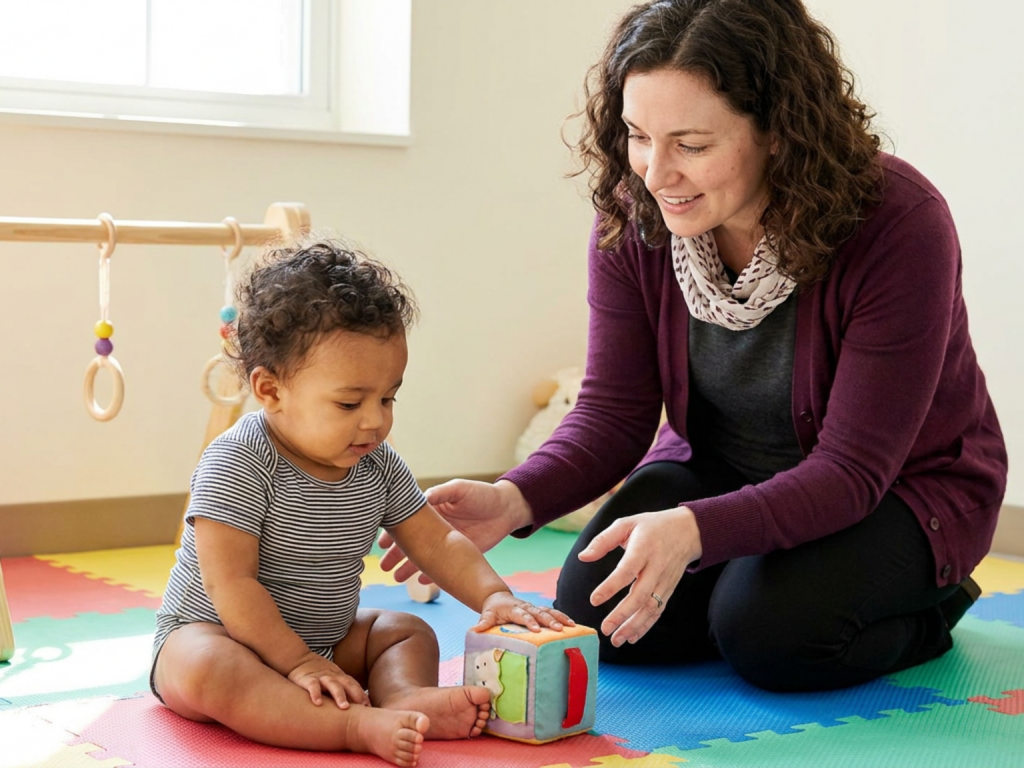
At around 8 months, many babies can sit without support for several minutes, rotate their trunk while sitting, reach for toys without immediately toppling, and move in and out of sitting with increasing control. This reflects improving core strength, postural control, and protective reactions such as putting a hand out to prevent a fall.
The Order of physical milestones is not identical for every child, but many babies progress from rolling to sitting, pivoting, crawling or scooting, pulling to stand, cruising, and eventually walking. Crawling may appear as rocking on hands and knees, pushing backward, army crawling on the belly, or moving with one leg tucked. These variations can be normal if the baby uses both sides of the body, gains strength over time, and remains interested in movement.
Pulling to stand may begin around this age, especially when a baby is motivated by furniture, a caregiver’s hands, or a favorite object. Standing practice should be baby-led and supervised. Walkers with wheels are not recommended in many safety guidelines because they can increase injury risk and do not teach healthy walking mechanics. Floor time is more useful than prolonged time in seats, bouncers, or restrictive devices.
Fine motor and sensory development
Fine motor development in infancy becomes especially visible at 8 months. Babies often transfer objects from one hand to the other, bang toys together, rake small safe objects toward themselves, and explore with fingers, palms, and mouth. The mature pincer grasp, using the thumb and index fingertip neatly, usually develops closer to 9 to 12 months, but early thumb-finger attempts may begin now.
Mouthing objects is still a major way babies learn. It provides sensory information about shape, texture, temperature, and resistance. Because this exploration is developmentally normal, safety matters: keep small objects, button batteries, magnets, coins, medication, and choking hazards completely out of reach.
- Offer toys that are large enough not to choke on, easy to clean, and varied in texture.
- Let your baby practice reaching across midline by placing toys slightly to one side.
- Encourage two-handed play with soft blocks, nesting cups, rattles, and board books.
- Use supervised mealtimes to support hand-to-mouth coordination with developmentally appropriate foods.
Communication and early language
At 8 months, communication is much more than words. Babies may babble in repeated syllables, squeal, laugh, growl, blow raspberries, and change vocal tone to get attention. They may respond to their name, pause when they hear “no,” turn toward familiar voices, and show excitement when a caregiver enters the room. Early language development depends heavily on responsive interaction: the baby makes a sound, the adult responds, and the baby learns that communication has power.
Babbling such as “mamama” or “dadada” is often practice rather than a true named word. Still, it is neurologically meaningful because it shows coordination of breath, vocal cords, oral muscles, hearing, memory, and social motivation. If a baby has had recurrent ear infections, does not startle or turn toward sounds, or seems to stop vocalizing, hearing evaluation may be appropriate.
You can support communication by narrating routines, pausing for your baby’s response, copying their sounds, reading short board books, singing repetitive songs, and using gestures such as waving. Avoid pressure to perform. Warm, turn-taking interaction is more useful than flashcards or passive screen exposure.
Cognitive and social-emotional milestones
Eight-month-olds are often fascinated by cause and effect. They drop objects to see what happens, shake toys to make noise, search briefly for partially hidden items, and repeat actions that produce an interesting response. These behaviors can look like mischief, but they are early problem-solving and memory development.
Object permanence, the understanding that people and objects continue to exist when out of sight, is emerging. This helps explain why separation anxiety often intensifies around this age. Your baby may cry when you leave the room, cling to you in unfamiliar places, or become cautious with strangers. These reactions are common signs of attachment and social discrimination.
Support your baby by using predictable goodbyes, calm reunions, and consistent routines. Peekaboo, hiding a toy under a cloth, and naming emotions can help your baby practice tolerating small separations. If your baby is extremely inconsolable, rarely seeks comfort, avoids eye contact most of the time, or shows a marked loss of social engagement, discuss this with a pediatric professional.
Feeding, growth, sleep, and teething
Most 8-month-old babies still rely on breast milk or infant formula as a major source of nutrition while gradually expanding complementary foods. Many are ready for soft finger foods if they can sit upright with good head control and manage textures safely. Iron-rich foods are especially important because iron stores from birth decline during infancy. Options may include iron-fortified cereals, pureed or soft meats, beans, lentils, eggs if tolerated, and other foods recommended by your healthcare professional.
Gagging can occur as babies learn textures and is different from choking, but choking is silent and dangerous. Foods should be soft, appropriately sized, and supervised. Avoid whole grapes, nuts, popcorn, hard raw vegetables, chunks of meat, sticky spoonfuls of nut butter, and other high-risk foods unless modified safely. Honey should be avoided before 12 months because of infant botulism risk.
Sleep varies widely. Some 8-month-olds sleep longer stretches; others wake because of separation anxiety, teething discomfort, illness, feeding patterns, or developmental changes. A predictable bedtime routine, safe sleep space, and consistent responses can help. Teething may cause drooling, chewing, and mild gum discomfort, but high fever, persistent diarrhea, or significant lethargy should not be attributed to teething without medical advice.
How to encourage development safely
Babies learn best through safe, responsive, repeated practice. The goal is not to accelerate development but to create opportunities for your baby’s nervous system and body to practice emerging skills. Safe floor play for babies is one of the most effective tools because it allows rolling, pivoting, reaching, crawling attempts, and balance reactions.
- Place toys just out of reach to motivate movement without causing frustration.
- Use supervised tummy time while awake, even if your baby now rolls independently.
- Read daily, even for a few minutes, using expressive voice and simple repetition.
- Offer safe household exploration, such as opening a low drawer filled with baby-safe items.
- Respond to babbles and gestures as meaningful communication.
Try to avoid comparing your baby constantly with siblings, friends, or social media examples. If you notice a persistent difference, write down what you observe: what the baby can do, what they cannot yet do, whether skills are improving, and whether movement or attention seems asymmetric. Specific observations are more helpful than general worry during a pediatric visit.
When to ask for professional guidance
Developmental concern does not mean something is definitely wrong. It means your baby deserves a closer look, and sometimes early support can make a meaningful difference. Pediatric clinicians may review growth, neurologic tone, vision, hearing, feeding, sleep, medical history, and family observations. They may recommend developmental screening questionnaires, hearing testing, physical therapy, occupational therapy, speech-language evaluation, or early intervention services for infants.
Contact a healthcare professional promptly if your baby loses previously acquired skills, stops babbling, stops making eye contact, becomes persistently weak or floppy, has marked stiffness, uses one side of the body much more than the other, cannot sit with help, or does not respond to sounds. Also seek urgent care for breathing difficulty, seizures, dehydration, significant lethargy, or injury from a fall.
Trust your instincts. Caregivers often notice subtle changes before anyone else. A supportive pediatric visit is not about blaming parents or labeling babies; it is about understanding the child’s developmental trajectory and making sure the right help is available if needed.
Call a professional if you notice
- Loss of previously acquired skills, such as stopping babbling or no longer sitting as before
- No response to loud sounds, familiar voices, or name after repeated attempts
- Persistent stiffness, floppiness, unusual posturing, or strong movement asymmetry
- Difficulty feeding, frequent choking, poor weight gain, or signs of dehydration
- No social engagement, very limited eye contact, or no interest in caregivers
- Any seizure-like episode, breathing difficulty, serious fall, or extreme lethargy
Tools & Assistance
- Keep a brief milestone journal with dates, new skills, feeding notes, and concerns
- Record short home videos of movement, babbling, and play to share at pediatric visits
- Use scheduled well-child visits for developmental screening and growth review
- Ask about early intervention services for infants if delays or regression are suspected
- Baby-proof the home before crawling, pulling to stand, and cruising increase
FAQ
Should my 8-month-old be crawling already?
Not necessarily. Many babies crawl around this age, but some use rolling, pivoting, scooting, or other movement patterns first. Ask your pediatrician if your baby is not gaining mobility, cannot sit with support, or uses one side much more than the other.
Is separation anxiety normal at 8 months?
Yes. Stranger wariness and distress when a caregiver leaves are common at this stage and reflect memory, attachment, and object permanence. Predictable routines and calm reunions can help.
How many words should an 8-month-old say?
Most 8-month-olds do not use true words consistently. Babbling, sound imitation, gestures, response to voice, and turn-taking are more typical communication markers at this age.
What foods are appropriate at 8 months?
Many babies can have breast milk or formula plus soft complementary foods, including iron-rich options and safe finger foods when developmentally ready. Texture and size should reduce choking risk, and honey should be avoided before 12 months.
When should I worry about delayed milestones?
Seek guidance if your baby loses skills, is not sitting with help, is not babbling, does not respond to sounds, seems very stiff or floppy, or shows persistent movement asymmetry. Early assessment is helpful and does not require a diagnosis.
Sources
- CDC — Baby Development: Your 8-Month-Old
- Pregnancy, Birth and Baby — Your baby's growth and development - 8 months old
- Raising Children Network — Baby development at 8-9 months
Disclaimer
This article is for general educational purposes and does not replace medical evaluation, diagnosis, or treatment. Consult your pediatrician or another qualified healthcare professional about concerns regarding your baby’s development, feeding, sleep, or health.
















Please log in to leave a comment.