
Intro
The first year of life is a period of remarkable neurodevelopment. A baby’s brain is not simply getting larger; it is building, strengthening, and pruning neural networks that support sensory processing, movement, attachment, sleep-wake rhythms, communication, memory, and emotional regulation. For parents and caregivers, this can feel both inspiring and intimidating. The reassuring truth is that everyday caregiving, feeding, talking, comforting, safe play, and responsive attention are powerful inputs for the developing brain.
This article explains what is happening biologically during baby development first year, how experience shapes neural circuits, and when to seek professional guidance. It is not meant to turn normal variation into worry. Infants develop at different rates, and pediatric clinicians can help interpret milestones in the context of birth history, prematurity, family history, growth, hearing, vision, and the baby’s overall health.
Highlights
Brain development begins before birth and continues for years, but the first year is especially sensitive to sensory, social, and caregiving experiences.
Synapses form rapidly in infancy; repeated safe, responsive interactions help strengthen useful neural pathways.
Movement, touch, vision, hearing, sleep, feeding, and emotional connection all contribute to early brain organization.
Milestones are ranges, not deadlines, but loss of skills, poor responsiveness, or major feeding and tone concerns should be discussed with a healthcare professional.
Parents do not need special programs to support the infant brain; consistent, loving, developmentally appropriate care is the foundation.
The first year is a sensitive window, not a race
Human brain development starts prenatally, accelerates through infancy, and continues into early adulthood. During the first year, neurons are already largely present, but connections between them are changing rapidly. Synaptogenesis, the formation of synapses between nerve cells, allows the infant brain to process new information with extraordinary plasticity. Plasticity means the brain can adapt to experience; it does not mean every moment must be optimized.
The early years are sometimes called sensitive periods because certain neural systems are especially receptive to environmental input. For example, infants become increasingly tuned to the speech sounds they hear regularly and to the faces they see most often. This tuning is efficient: the brain strengthens circuits that are useful in the baby’s actual environment. It is one reason warm interaction, speech, facial expression, and shared attention are biologically meaningful, not just emotionally pleasant.
At the same time, development is uneven. A baby may show rapid progress in social smiling while motor skills develop more slowly, or may focus intensely on rolling before babbling increases. Pediatric developmental screening helps clinicians look at the whole pattern rather than a single skill in isolation.
What changes inside the brain
In infancy, the brain grows quickly in volume and complexity. Glial cells support neurons, myelination improves signal transmission along nerve fibers, and neural networks become more specialized. Myelin, the fatty insulation around axons, helps messages travel faster and more efficiently. This is one reason motor control, visual tracking, and coordinated feeding gradually become smoother over the first months.
Synapses form in response to both genetic programming and experience. Repeated experiences strengthen certain pathways, while underused connections may later be pruned. Pruning is not a loss in a negative sense; it is part of making networks more efficient. A baby who repeatedly hears language, feels safe touch, tracks moving faces, practices reaching, and receives comfort when distressed is receiving patterned input that supports developing neural architecture.
Brain growth also depends on general health. Adequate nutrition, safe sleep, treatment of medical problems, protection from injury, and immunization against preventable infections all support the conditions in which the nervous system can mature. If feeding, growth, breathing, seizures, tone, or alertness are concerns, those are medical issues to discuss promptly with a clinician.
Senses, movement, and early learning
Newborns arrive ready to learn through the body. They recognize familiar voices, prefer high-contrast visual patterns, orient toward human faces, and use smell, touch, and rhythm to feel secure. Early learning is not academic; it is sensory-motor and relational. The brain learns, “When I cry, someone responds,” “This voice is familiar,” “My body can push against the floor,” and “This sound pattern belongs to my language environment.”
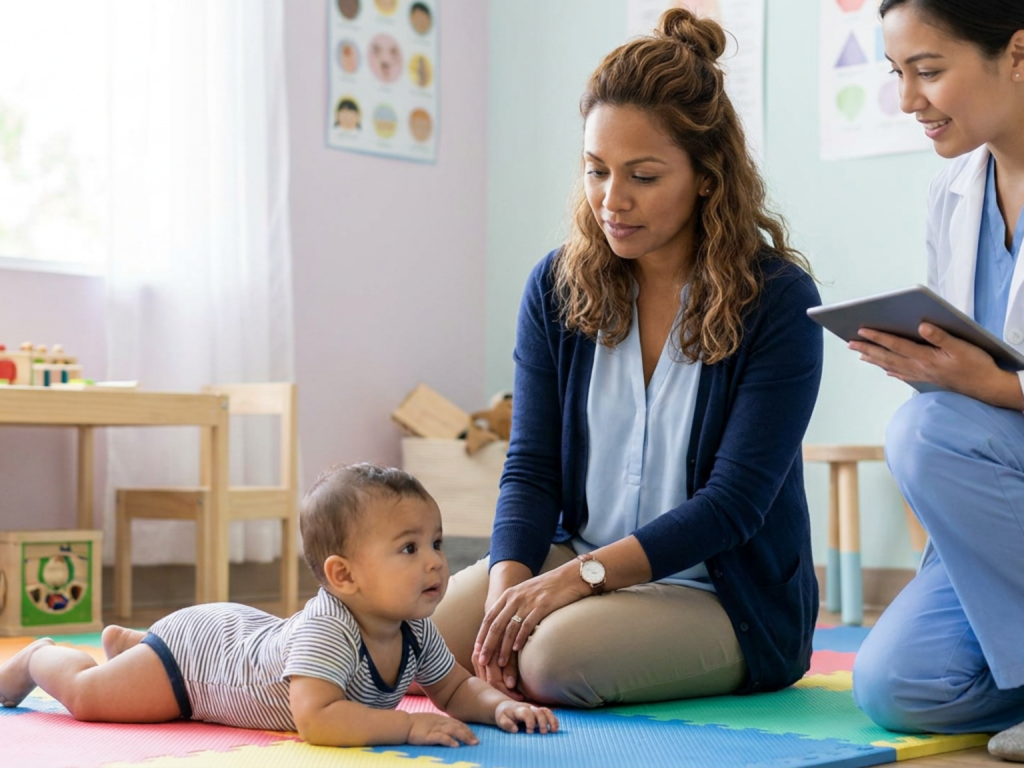
Supervised tummy time while awake is one practical example. It helps babies practice lifting the head, stabilizing the shoulders, and coordinating visual attention with posture. These are early building blocks for later rolling, sitting, reaching, and crawling. Babies who dislike tummy time often do better with very short, frequent sessions on a caregiver’s chest or a firm safe surface while awake and watched.
Safe floor time for infants also matters because babies need opportunities to move freely. Containers such as swings, seats, and carriers can be useful briefly, but prolonged restriction may reduce chances to practice antigravity movement and weight shifting. A simple blanket on the floor, with an attentive adult nearby, can be a rich neurologic environment.
Sensory learning includes limits. Some babies become overstimulated by noise, bright light, handling, or too much social interaction. Turning away, hiccupping, finger splaying, arching, fussing, or shutting down can be cues that the nervous system needs a break. Respecting those cues helps babies practice regulation with adult support.
Relationships are brain-building experiences
Responsive caregiving is one of the most important influences on early neurodevelopment. When an infant cries and a caregiver responds with feeding, holding, changing, soothing, or checking for illness, the baby’s stress physiology is moderated. This does not spoil a young infant. In the first months, babies do not cry to manipulate; crying is communication from an immature nervous system.
Serve-and-return interaction is a helpful way to think about early connection. The baby looks, coos, kicks, or reaches; the adult responds with eye contact, words, touch, or imitation. These back-and-forth exchanges support social cognition, language networks, attention, and emotional security. Skin-to-skin contact, gentle rocking, singing, and reading aloud can all be part of this pattern.
Caregivers also shape the baby’s developing stress response. Chronic, severe, unbuffered stress can affect neuroendocrine systems, including cortisol regulation. However, ordinary frustration, brief crying, and daily family imperfections are not the same as toxic stress. Babies benefit from “good enough” caregiving that is safe, consistent, and repair-oriented. If a caregiver feels persistently overwhelmed, depressed, anxious, or unable to respond safely, seeking support is a brain-health intervention for the baby as well as care for the adult.
Language, sound, and social attention
Early language development begins long before first words. In the first year, babies listen to rhythm, pitch, pauses, and repeated sound patterns. They gradually become better at distinguishing speech sounds used in their home language or languages. Talking during feeding, diaper changes, bathing, and walks exposes the brain to meaningful sound embedded in relationship.
Parents do not need flashcards or constant narration. Natural language is enough: naming what you are doing, responding to coos, pausing for the baby’s turn, reading simple books, and singing familiar songs. Infant-directed speech, sometimes called parentese, uses a higher pitch and exaggerated rhythm; many babies attend to it well, and it can support speech-sound learning.
Hearing is essential for spoken language learning. If a baby does not startle to sound, does not respond to voices, has recurrent ear infections, or did not pass newborn hearing screening, professional follow-up is important. Similarly, visual attention supports social learning. Concerns about persistent lack of eye contact, poor visual tracking, or unusual eye movements should be discussed with a pediatrician or pediatric eye specialist.
Sleep, feeding, and regulation
Sleep is deeply connected to brain development. Infant sleep is neurologically active, and sleep patterns mature gradually across the first year. Newborns sleep in short cycles; circadian rhythm becomes more organized over time with light exposure during the day, calm routines at night, and maturation of the nervous system. Safe sleep practices remain essential: babies should sleep on their backs on a firm, flat surface without loose bedding, pillows, or soft objects, according to current pediatric safety guidance.
Feeding also engages the brain. Sucking, swallowing, breathing coordination, smell, taste, satiety cues, and caregiver interaction all contribute to early regulation. Whether a baby is breastfed, formula-fed, or both, attentive feeding means watching the baby’s cues, supporting safe positioning, and seeking help for pain, poor transfer, choking, persistent coughing, dehydration signs, or inadequate weight gain.
Regulation is not something infants can manage alone. They borrow the adult nervous system. A calm voice, steady touch, reduced stimulation, and predictable caregiving help the baby move from distress toward stability. Over many repetitions, these experiences contribute to later self-regulation, though true independent emotional control takes years to mature.
Milestones and when to ask for help
Typical infant developmental milestones are useful guideposts, but they are not a precise timetable. In the first months, clinicians often look for increasing alertness, feeding coordination, visual engagement, social smiling, head control, and symmetrical movement. Later in the year, they assess rolling, sitting, reaching, transferring objects, babbling, social reciprocity, and early problem-solving such as looking for a hidden object.
Premature infants are often assessed using corrected age for premature infants, especially during the first two years. This means developmental expectations are adjusted based on the baby’s due date rather than the birth date. Medical complexity, NICU history, congenital conditions, hearing or vision differences, and family context can also influence how milestones are interpreted.
It is wise to seek medical advice if you notice loss of previously acquired skills, persistent feeding difficulty, very low or very stiff muscle tone, marked asymmetry, lack of response to sound, poor visual engagement, no social smile by around 3 months, or limited interaction with caregivers. These signs do not automatically mean a serious diagnosis, but they justify timely evaluation. Early intervention services for infants can support development when delays or risks are identified, and families do not need to wait until a problem becomes severe to ask about them.
Call your baby’s clinician promptly if you notice
- Loss of previously acquired skills or a clear developmental regression in babies.
- Poor feeding, dehydration signs, choking, persistent coughing with feeds, or inadequate weight gain.
- No response to loud sounds, limited visual tracking, or persistent lack of social engagement.
- Very floppy or very stiff muscle tone, marked asymmetry, or movements that concern you.
- Episodes concerning for seizures, abnormal breathing, extreme lethargy, or difficulty waking.
Tools & Assistance
- Keep a simple note of feeding, sleep, movement, sounds, and new skills to discuss at well-child visits.
- Use pediatric developmental screening questionnaires when offered and ask what the results mean.
- Create daily opportunities for talking, reading, singing, supervised tummy time, and safe floor play.
- Contact early intervention services for infants if your pediatrician recommends evaluation or if you have persistent concerns.
- Seek urgent medical care for breathing difficulty, seizure-like episodes, dehydration, or unusual unresponsiveness.
FAQ
Do I need special toys to support my baby’s brain development?
No. Simple, safe objects, faces, voices, touch, books, songs, and supervised movement are usually more valuable than complex toys. Interaction matters more than stimulation overload.
Is crying harmful to the brain?
Brief crying is a normal form of infant communication. What matters is that babies usually receive safe, responsive care. Persistent inconsolable crying, illness signs, or caregiver overwhelm should prompt support from a clinician or trusted helper.
How much should I talk to my baby?
Frequent natural speech during daily care is helpful. Describe what you are doing, respond to coos, read short books, and pause for your baby’s reactions. It does not need to be constant.
What if my baby was born premature?
Development is often interpreted using corrected age for premature infants. Ask your pediatrician which milestones to watch and whether additional follow-up, therapy, or early intervention is recommended.
When should I worry about milestones?
Ask for guidance if skills are lost, your baby is not engaging socially, feeding is difficult, movement seems very asymmetric, or hearing and vision responses seem limited. A clinician can decide whether evaluation is needed.
Sources
- PubMed Central / National Institutes of Health — Brain Development and the Role of Experience in the Early Years
- BrainFacts.org — The First Years of Life
- Mayo Clinic — Infant development: Birth to 3 months
Disclaimer
This article is for general educational purposes and is not a diagnosis or treatment plan. Always consult your pediatrician or another qualified healthcare professional about concerns regarding your baby’s development, feeding, behavior, or health.
















Please log in to leave a comment.