
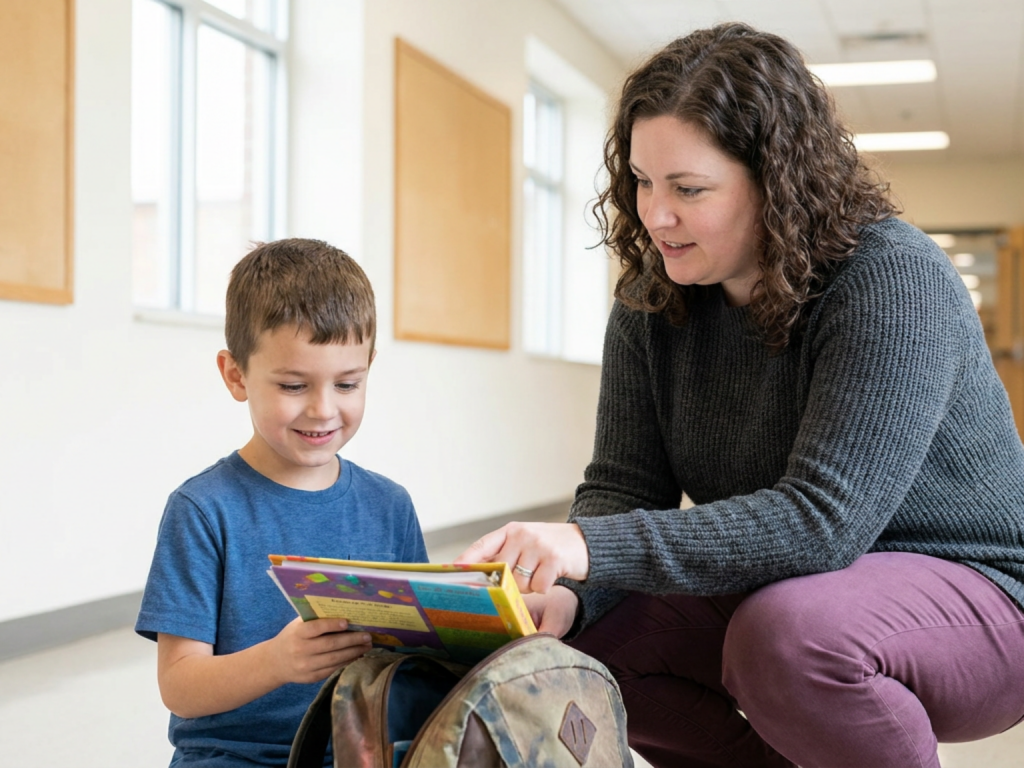
Intro
School age is a quiet revolution in parenting. A child who once needed constant hands-on help begins to spend long hours in classrooms, build friendships outside the family, compare abilities, manage rules from multiple adults, and develop a more private inner life. For caregivers, this stage can feel both relieving and disorienting: your child may need less physical care, but often needs more thoughtful coaching, emotional containment, and developmentally appropriate boundaries.
Parenting during the school-age years is not about withdrawing support or controlling every outcome. Research on parenting practices consistently points toward a balanced approach: warmth, predictable expectations, monitoring, and gradually expanding autonomy. This article explains how caregiving typically evolves from early elementary school through the preteen years, with attention to cognition, emotion regulation, peer relationships, school demands, behavior, and family wellbeing.
Highlights
School-age children need less direct physical management and more coaching, structure, and emotional scaffolding.
Warmth and consistent boundaries are associated with stronger academic, emotional, and social outcomes over time.
Autonomy should expand gradually, matched to the child’s developmental maturity, temperament, safety needs, and health context.
Parenting becomes more collaborative as children gain executive function, moral reasoning, and the ability to reflect on consequences.
Persistent distress, functional impairment, or safety concerns should be discussed with qualified healthcare or mental health professionals.
The parenting job changes, but the attachment need remains
By school age, many children can dress, feed themselves, follow classroom routines, and communicate needs more clearly. This can create the impression that they are becoming emotionally independent. In reality, secure caregiver connection remains a major protective factor. The form of support changes: instead of carrying the child through daily tasks, parents increasingly provide a secure base from which the child can explore school, friendships, hobbies, and identity.
Research reviews describe this transition as a movement away from high direct control and toward responsiveness, monitoring, and support for autonomy. Children still benefit from caregiver warmth, but they also need clear rules and predictable follow-through. The combination often described as authoritative parenting principles is not harsh control; it is high warmth paired with consistent expectations and respect for the child’s growing competence.
At this stage, a child may come home emotionally depleted after managing peer dynamics, academic demands, and adult expectations all day. Meltdowns after school are not automatically signs of poor behavior or poor parenting. They may reflect limited self-regulatory reserve. A calm reconnection routine, snack, rest, movement, and later conversation can be more effective than immediate interrogation about homework or behavior.
From managing behavior to teaching self-regulation
Preschool discipline often relies on immediate redirection, close supervision, and simple limits. School-age discipline can become more reflective. Children are increasingly able to understand cause and effect, perspective-taking, fairness, and delayed consequences, although these capacities remain immature and variable.
The goal is not merely compliance. It is internalization: helping the child build inhibitory control, emotional labeling, planning, and repair skills. Executive functions such as working memory, cognitive flexibility, and impulse control continue to mature throughout childhood and adolescence. A child may know a rule and still fail to apply it when tired, hungry, anxious, overstimulated, or socially pressured.
Helpful discipline in this period often includes:
- Clear expectations before the problem occurs: for example, explaining screen-time limits before the device is turned on.
- Logical consequences for children: consequences connected to the behavior, such as repairing a mess or pausing an activity that became unsafe.
- Brief emotional coaching: naming feelings without excusing harmful behavior.
- Repair after conflict: apologizing, problem-solving, and reconnecting after everyone is regulated.
- Consistency without rigidity: rules should be predictable, but parents can still account for illness, neurodevelopmental differences, grief, or major stress.
When caregivers respond with both empathy and limit-setting, children are more likely to learn that emotions are manageable and behavior remains accountable.
School becomes a second developmental environment
School age brings a major expansion of the child’s social and cognitive world. Teachers, peers, coaches, and classmates become important sources of feedback. Children begin to compare reading ability, athletic skill, popularity, appearance, language, and family norms. This can strengthen motivation, but it can also create shame, anxiety, perfectionism, or avoidance.
Parental knowledge matters here. Caregivers who understand developmental expectations, school routines, learning variability, sleep needs, and behavior patterns are better positioned to support school readiness and ongoing adjustment. This does not mean parents must become educational specialists. It means noticing patterns: Is homework distress disproportionate? Is the child avoiding school? Are reading, attention, coordination, or social communication difficulties interfering with daily function?
Practical support includes creating predictable routines, maintaining communication with teachers, protecting sleep, and separating effort from worth. Instead of asking only, “What grade did you get?” parents can ask, “What strategy helped?” or “Where did you get stuck?” This supports metacognition, the child’s ability to think about their own thinking.
If academic struggles are persistent, sudden, or associated with headaches, abdominal pain, sleep disruption, panic-like symptoms, bullying, or loss of interest, caregivers should consult appropriate professionals. This might include the child’s pediatric clinician, school psychologist, teacher, educational specialist, or licensed mental health clinician. The purpose is not to label the child casually, but to understand needs and supports.
Independence grows through graduated trust
One of the most visible ways parenting evolves school age is the gradual transfer of responsibility. Children may begin packing their school bag, managing simple chores, walking short familiar routes, choosing extracurricular activities, or handling parts of their morning routine. Age-appropriate independence is not a single milestone; it is a series of small handoffs.
A useful approach is “scaffold, practice, release, review.” First, the adult models or structures the task. Next, the child practices with support. Then the parent steps back while monitoring safety. Finally, parent and child review what worked and what needs adjustment. This pattern respects autonomy without abandoning the child to tasks they are not yet ready to manage.
Independence should be individualized. Chronological age alone is not enough. Consider temperament, impulsivity, anxiety level, health conditions, neighborhood safety, digital access, sleep quality, and the child’s demonstrated reliability. A cautious child may need encouragement to take manageable risks. A highly impulsive child may need more external structure for longer. Both needs are legitimate.
Parents sometimes worry that granting independence means losing influence. In practice, influence often increases when children experience parents as fair, emotionally available, and willing to listen. The school-age child who is allowed to practice decision-making in low-stakes situations is better prepared for higher-stakes decisions in adolescence.
Friendships, peer pressure, and social pain require coaching
School-age friendships can be joyful and intensely painful. Children encounter exclusion, teasing, loyalty conflicts, competition, and group norms. They may also begin to hide social difficulties from parents because of embarrassment or fear that adults will overreact.
Parents can help by staying curious before becoming directive. Instead of immediately calling another parent or telling the child what to do, start with reflective questions: “What happened next?” “How did you feel in your body?” “What do you wish you had said?” “Do you want comfort, ideas, or help from an adult?” This preserves trust while still allowing intervention when safety is at stake.
Social coaching may involve role-playing assertive language, distinguishing friendly teasing from cruelty, discussing consent and body boundaries, and helping children recognize manipulative behavior. It also includes teaching them how to be accountable when they hurt someone else. School-age children are still learning empathy under stress; they need adults who can address harm without defining them by their worst moment.
Bullying, threats, coercion, discrimination, sexualized behavior, or online exploitation require adult involvement. Parents should document concerns, communicate with the school, and seek professional guidance when emotional or physical safety is compromised.
Emotional development becomes more complex
School-age children can often describe emotions more precisely than younger children, but they may also experience new forms of distress: performance anxiety, social comparison, embarrassment, guilt, loneliness, and worries about family finances, illness, conflict, or global events. Their cognitive development allows more complex thinking, but not always enough perspective to interpret worries accurately.
Supportive parenting does not require eliminating every unpleasant emotion. Instead, it helps the child build affect tolerance, the ability to experience feelings without becoming overwhelmed or acting destructively. Parents can validate the feeling while holding a boundary: “I understand you are furious that screen time is over. I will not let you throw the tablet. We can take a break and talk when your body is calmer.”
Emotional labeling for children is especially useful because naming an emotion can help organize the experience. Over time, children learn the difference between anger and shame, worry and danger, disappointment and rejection. This improves communication and problem-solving.
Parents should also monitor their own stress physiology. Children are sensitive to caregiver tone, facial expression, and predictability. No parent stays calm all the time, and repair matters. A simple statement such as, “I yelled earlier; that was too much. I was frustrated, and I am working on handling it better,” models accountability without placing adult emotions on the child.
Digital life enters earlier than many parents expect
For many families, the school-age years are when digital independence begins: educational platforms, messaging, games, videos, and sometimes personal devices. Parenting must expand from physical safety to digital safety. Children may understand how to operate technology long before they understand privacy, persuasion, algorithms, advertising, or the permanence of shared content.
Digital parenting is most effective when it combines limits with conversation. Rules about device-free sleep, shared charging locations, privacy settings, content boundaries, and respectful communication are easier to enforce when they are explained and revisited. Parents can say, “My job is not to spy on you; my job is to help you learn safe habits until your judgment is stronger.”
Warning signs that digital use may need reassessment include sleep loss, escalating irritability when devices are removed, secrecy that prevents basic safety monitoring, exposure to frightening or sexual content, online bullying, or declining offline functioning. In such cases, consider speaking with a pediatric clinician, mental health professional, or school support team.
Parenting the school-age child also means caring for the family system
School-age parenting often occurs during a crowded season of adult life: work demands, caregiving for relatives, financial pressure, separation or divorce, housing stress, or health concerns. It is easy to interpret a child’s behavior as the main problem when the whole family system is overloaded.
Family routines that reduce conflict can be protective. Predictable mornings, regular meals when possible, bedtime structure, and visual schedules reduce cognitive load for both children and adults. These routines do not need to be elaborate. The most sustainable plans are usually simple, visible, and repeated.
Caregivers may also need professional help for parenting stress. Seeking support is not a failure; it is a safety and resilience strategy. Pediatric visits, family therapy, parent management programs, school counseling, occupational therapy, speech-language evaluation, and community supports can all be appropriate depending on the concern. The best support is collaborative and tailored, not blame-based.
When to seek extra help
- Seek urgent help if a child talks about self-harm, harming others, or feeling unsafe.
- Consult a pediatric clinician if sleep, appetite, headaches, abdominal pain, or school refusal persist.
- Involve school and mental health professionals when bullying, threats, coercion, or exploitation are suspected.
- Ask for assessment when learning, attention, communication, or motor difficulties significantly impair daily functioning.
- Get support if caregiver stress leads to frightening discipline, loss of control, or concerns about child safety.
Tools & Assistance
- Schedule regular brief check-ins with your child that are not focused only on school performance.
- Use visual routines for mornings, homework, chores, and bedtime to reduce repeated conflict.
- Maintain two-way communication with teachers and school support staff when patterns emerge.
- Create a family media plan that includes sleep protection, privacy rules, and device-free times.
- Contact a pediatric clinician or licensed mental health professional for persistent emotional, behavioral, or developmental concerns.
FAQ
How does parenting change when a child starts school?
Parents usually shift from constant hands-on management toward coaching, monitoring, routines, and emotional support. The child still needs warmth and boundaries, but also more chances to practice responsibility.
How much independence should a school-age child have?
Independence should increase gradually and depend on maturity, safety, temperament, health needs, and demonstrated reliability. Small responsibilities with review are usually safer than sudden freedom.
What discipline works best for school-age children?
Many children respond well to clear expectations, calm follow-through, logical consequences, and repair after conflict. Discipline should teach self-regulation and responsibility rather than rely only on punishment.
Should parents help with schoolwork every day?
Parents can provide structure, encouragement, and problem-solving support, but the goal is to build the child’s own skills. Persistent homework distress or academic difficulty should be discussed with teachers or appropriate professionals.
When is school-age anxiety or sadness a concern?
Concern increases when distress is persistent, worsening, or impairing sleep, appetite, school attendance, friendships, or family life. A pediatric or mental health professional can help assess what support is needed.
Sources
- PubMed Central / NIH — We Know Even More Things: A Decade Review of Parenting Research
- National Center for Biotechnology Information / NIH — Parenting Knowledge, Attitudes, and Practices
- University of Virginia Magazine — The Science of Parenting
Disclaimer
This article is for general educational purposes and is not a diagnosis, treatment plan, or substitute for medical, developmental, or mental health care. Consult a qualified healthcare professional for concerns about a child’s safety, behavior, learning, or emotional wellbeing.

















Please log in to leave a comment.