
Intro
Wanting your child to listen without yelling does not mean you are trying to become a perfectly calm parent. It means you are trying to replace a stressful cycle with communication that is more effective for the child’s developing brain and more sustainable for you. Most parents yell at times, especially when they are tired, late, worried, or overloaded. The goal is not shame; the goal is a plan.
Children often fail to listen for reasons that are not simple defiance: immature executive function, sensory overload, transition difficulty, hunger, fatigue, anxiety, or a mismatch between the adult’s expectation and the child’s developmental capacity. A yelling-free approach combines connection, clear instructions, predictable follow-through, and repair after conflict. It is warm, but it is not permissive.
Highlights
Children cooperate best when they feel connected and know exactly what is expected.
A calm voice works better when paired with proximity, eye contact when appropriate, and one clear direction at a time.
Positive reinforcement in parenting helps children repeat the behavior you want, instead of only learning what makes adults angry.
Consistent limits and emotional responsiveness can reduce power struggles without removing boundaries.
If behavior is severe, persistent, or unsafe, professional guidance can help identify medical, developmental, or mental health contributors.
Why yelling usually does not improve listening
Yelling can create short-term compliance because it activates a child’s threat-detection system. But stress arousal is not the same as learning. When a child’s sympathetic nervous system is highly activated, the brain is primed for fight, flight, freeze, or collapse responses. In practical terms, this can look like arguing, running away, laughing nervously, refusing, crying, or appearing to “shut down.”
Children also habituate. If yelling becomes a common signal that the adult finally “means it,” a child may learn to ignore calm requests and respond only when the volume rises. This is not always intentional manipulation; it can be a conditioned pattern in the family environment.
A calmer approach does not mean speaking softly from across the room while repeating the same request ten times. Effective calm parenting is active: you move close, reduce distractions, use clear language, and follow through consistently. This is the core of supportive discipline: warmth plus structure.
Connect first, ask second
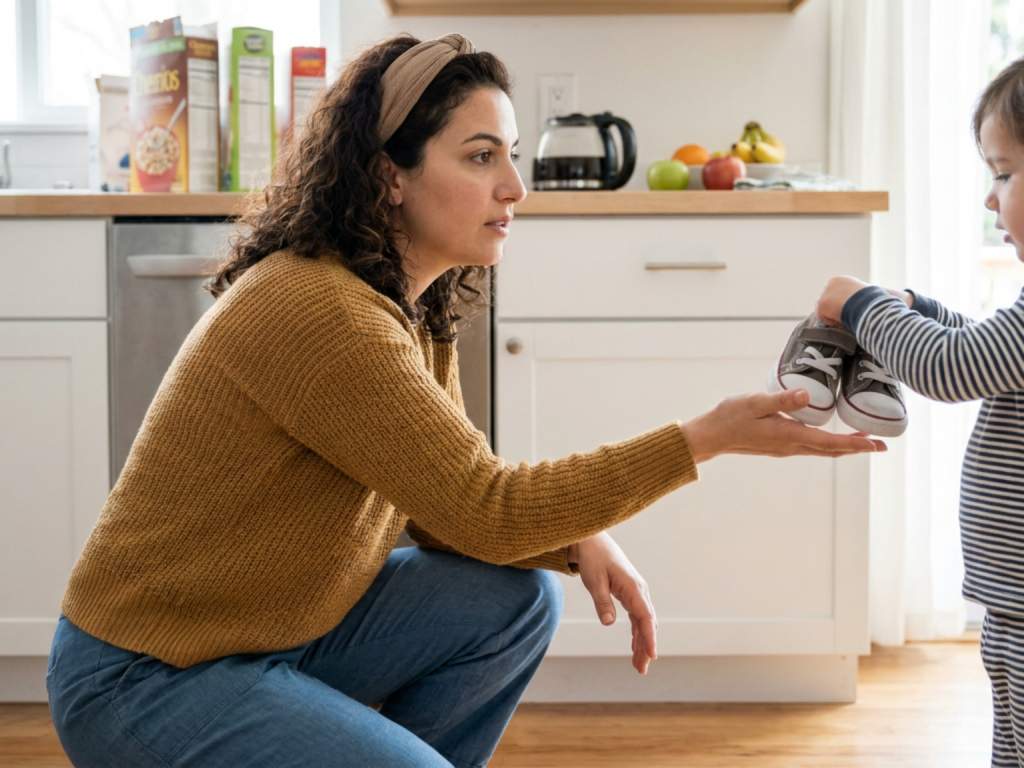
Many listening problems begin because the adult gives an instruction when the child’s attention is somewhere else. Before giving a direction, try a brief connection cue. This might be kneeling nearby, saying the child’s name once, touching the table beside them, commenting on what they are doing, or waiting until they look up. Eye contact can help some children, but it should not be forced, especially for children who find eye contact uncomfortable or distracting.
Examples include:
- “You are building a tall tower. I’m going to tell you what needs to happen next.”
- “I see you’re in the middle of your game. Pause and look toward me for one instruction.”
- “I’m close now. It’s time for shoes.”
This approach is sometimes described as “connect first, ask second.” It works because attention and emotional safety make cooperation more neurologically available. A child who feels seen is more likely to process the request instead of reflexively resisting it.
Give one clear direction at a time
Children, especially younger children, may not manage multi-step commands well because working memory and inhibitory control are still developing. Instead of saying, “Clean up, get your shoes, brush your teeth, and stop bothering your sister,” start with one concrete action.
Helpful directions are specific, observable, and positively stated when possible:
- Instead of “Stop making a mess,” try “Put the blocks in the blue bin.”
- Instead of “Don’t run,” try “Walk next to the cart.”
- Instead of “Be good,” try “Use a quiet voice and keep your hands on your own body.”
After giving the direction, pause. Many adults repeat too quickly, which can train children to wait through several reminders. A simple sequence is: get close, give the direction once, wait a few seconds, then help the child begin if needed. For a preschooler, “help begin” may mean placing the first block in the bin together. For an older child, it may mean saying, “Show me the first step.”
Use positive attention to make listening more rewarding
Children repeat behaviors that receive attention, especially intense attention. If a child receives long lectures, eye contact, and emotional intensity after refusing, but only minimal acknowledgment after cooperating, the family may accidentally reinforce the refusal pattern.
Shift attention toward the behavior you want. This does not require exaggerated praise. It can be brief, specific, and authentic:
- “You came the first time I called. That helped us leave calmly.”
- “You were upset and still put the tablet down. That took effort.”
- “You started with your socks. Good first step.”
Positive reinforcement in parenting is not bribery when it is used to teach and strengthen adaptive behavior. Some children benefit from visual routines, checklists, or token systems, especially when tasks are repetitive or difficult. The key is to reward the specific behavior you want to see again: starting, transitioning, using words, calming the body, or following a one-step direction.
Set limits without turning them into power struggles
Listening improves when children experience adults as predictable. A limit should be clear before the conflict escalates: “When the timer rings, screens are done,” or “If toys are thrown, the toys are put away.” Then the adult’s job is to follow through with as little emotional heat as possible.
Consistent limits and emotional responsiveness can exist together. You can validate feelings while holding the boundary:
- “You really want more time. It’s hard to stop. The tablet is still done.”
- “You’re angry that we’re leaving. I won’t let you hit. I’ll help your body move to the car.”
- “You wanted the red cup. Today the blue cup is what’s available.”
Logical consequences for children are most effective when they are related, respectful, and reasonable. If a child throws crayons, the crayons are put away for a period of time. If a child refuses to put on shoes, the adult may calmly help them put shoes on rather than argue for ten minutes. The goal is teaching cause and effect, not humiliation.
What to do when your child still ignores you
Even with excellent communication, children will not listen every time. When that happens, avoid escalating through repeated warnings. Try this sequence:
- Move close and reduce distractions. Turn off the television if needed, or stand between the child and the distraction without looming.
- State the direction once in simple language: “Blocks in the bin.”
- Offer limited choice if appropriate: “Do you want to start with the blocks or the cars?”
- Use a brief countdown only if it does not increase anxiety or opposition: “I’ll help in five seconds if you don’t start.”
- Follow through calmly: guide the first step, remove the item, or implement the stated consequence.
If your child becomes dysregulated, reduce language. A child in a high-arousal state may not process reasoning. Use short phrases: “You’re safe. I won’t let you hit. We’ll talk after.” After the storm passes, use repair after parent-child conflict: name what happened, take responsibility for your part if needed, and practice what to do next time.
Use time-outs carefully, if you use them at all
Some families use time-outs; others prefer time-ins or calm-down spaces. If time-outs are used, they should be brief, predictable, and free of shaming. They are not meant to frighten a child or withdraw love. They work best for specific behaviors such as aggression or unsafe behavior, not as a general response to every annoyance.
A safer structure is: one clear warning, immediate follow-through if the behavior continues, a short quiet period, then reconnection. Afterward, do not restart the lecture. Briefly practice the desired behavior: “Next time, say ‘I’m mad’ and move your hands away.”
For children with trauma histories, neurodevelopmental differences, anxiety, or significant separation distress, isolation-based discipline may worsen dysregulation. In those cases, ask a pediatrician, child psychologist, or licensed mental health professional about individualized behavioral strategies.
Look for hidden barriers to listening
Sometimes “not listening” is a clue, not a character flaw. Consider whether the child is hungry, sleep-deprived, overstimulated, constipated, in pain, worried, or struggling with hearing, language processing, attention, learning demands, or sensory input. A child who consistently melts down during transitions may need more predictability and visual cues. A child who “ignores” verbal instructions may need fewer words or a hearing evaluation.
Developmentally realistic expectations matter. Toddlers need physical guidance and repetition. Preschoolers need concrete instructions and rapid feedback. School-age children can handle more responsibility, but still need routines and scaffolding. Adolescents need autonomy, respectful tone, and collaborative problem-solving, not constant command-and-control interactions.
If difficult behavior is persistent across settings, causes safety risks, disrupts school or family functioning, or is accompanied by regression, sleep problems, severe anxiety, aggression, self-injury, or major mood changes, consult a healthcare professional. This article cannot determine whether a medical, developmental, or mental health condition is present.
Build routines that reduce the need for commands
The best way to get a child to listen is to reduce how often you need urgent listening. Family routines that reduce conflict make expectations visible and predictable. Morning charts, bedtime sequences, transition warnings, and prepared choices all lower cognitive load for both child and parent.
Try making routine steps external: pictures for younger children, written checklists for older children, and shared calendars for adolescents. Instead of saying “Get ready” repeatedly, point to the checklist and ask, “What’s next?” This shifts the interaction from parent-versus-child to child-with-plan.
Also plan for your own nervous system. If you know yelling is more likely when you are late, build in buffer time, prepare items the night before, or decide in advance which battles are not worth having. Parental calm consistency is easier when the environment supports it.
When to seek extra support
- Your child’s behavior is unsafe, aggressive, self-injurious, or escalating despite consistent strategies.
- Listening problems are paired with speech delay, hearing concerns, sleep disturbance, regression, or major school impairment.
- You feel unable to stop yelling, feel frightened by your own reactions, or worry you may hurt your child.
- Your child seems persistently anxious, depressed, withdrawn, or unusually irritable.
- Family conflict is causing significant distress or disrupting daily functioning.
Tools & Assistance
- Use a visual routine chart for mornings, bedtime, or transitions.
- Practice the sequence: connect, one clear direction, pause, follow through.
- Track patterns such as sleep, hunger, screen transitions, sensory overload, and time of day.
- Ask your pediatrician about hearing, sleep, developmental, or behavioral concerns when patterns persist.
- Consider parent management training, child therapy, or family therapy with a licensed professional.
FAQ
Is it realistic to never yell?
Most parents yell sometimes. The practical goal is to reduce yelling, repair when it happens, and build a more predictable communication pattern.
What should I say instead of repeating myself?
Move close, say one specific instruction, pause, then calmly help your child start or follow through with the stated limit.
Does listening without yelling mean there are no consequences?
No. Children need boundaries. The difference is that consequences are predictable, related to the behavior, and delivered without intimidation or shame.
What if my child laughs when I set a limit?
Laughter can be nervous system arousal, avoidance, or testing. Keep your language brief, hold the limit calmly, and discuss it later when your child is regulated.
When should I talk to a professional?
Seek guidance if behavior is persistent, unsafe, severe, occurs across settings, or is linked with developmental, emotional, sleep, hearing, or school concerns.
Sources
- Good Inside — How to Get Kids to Listen Without Yelling or Power Struggles
- Nemours Children's Health — How to Get Kids to Listen Without Yelling
- Child Mind Institute — 5-Year-Old Doesn't Listen? Effective Parenting Solutions
Disclaimer
This article is for general educational purposes and is not a medical or mental health diagnosis or treatment plan. Consult a pediatrician or qualified mental health professional for concerns about your child’s behavior, development, or safety.


















Please log in to leave a comment.