
Intro
When a child pushes boundaries in a single-parent home, it can feel intensely personal: one adult is often carrying the emotional labor, logistics, discipline, income pressure, school communication, and bedtime routine at the same time. A child may argue, delay, negotiate, ignore instructions, melt down, or escalate right at the moment when the parent has the least reserve left. This does not mean the parent is failing, and it does not mean the child is “bad.” Limit-testing is a normal part of development, attachment, autonomy, and stress regulation.
Single parenting can amplify ordinary boundary challenges because there may be fewer built-in opportunities to tag out, recalibrate, or share decisions with another adult. Research and policy summaries consistently caution against blaming family structure alone for child outcomes; socioeconomic strain, parental stress, disrupted routines, and reduced social support often explain much of the difference seen across groups. The practical goal is not to become a perfect parent, but to create calm, predictable limits that protect the child, preserve the parent-child relationship, and reduce the parent’s allostatic load over time.
Highlights
Limit-testing is often a developmental signal, not a moral failure in the child or the parent.
Single parents may face more role overload, decision fatigue, and fewer chances for emotional recovery, which can make normal conflict feel overwhelming.
Consistent routines, brief consequences, and emotionally neutral follow-through usually work better than long lectures or escalating punishments.
Persistent aggression, school refusal, self-harm talk, severe sleep disruption, or caregiver burnout deserve professional support.
Why limit-testing can feel sharper in a single-parent home
Children test limits because they are learning where autonomy ends and responsibility begins. Toddlers test because impulse control is immature. School-age children test because they are learning rules, fairness, and cause-and-effect. Adolescents test because identity formation and peer belonging compete with family expectations. In all ages, the prefrontal cortex, which supports inhibition, planning, and flexible problem-solving, is still developing.
In a single-parent household, the same developmental behavior can land on a more depleted adult nervous system. There may be no second adult to handle dinner while one parent manages a tantrum, no partner to reinforce bedtime, and no immediate backup after a difficult school meeting. This creates role overload in single parenting: one person is expected to be regulator, provider, transportation planner, homework monitor, emotional anchor, and disciplinarian.
Children are also exquisitely sensitive to stress physiology. If a parent is exhausted, hungry, worried about rent, or experiencing chronic sleep restriction, the child may unconsciously test whether the relationship is still secure. The behavior may look oppositional, but the underlying question is often, “Are you still steady when I am not?” This does not excuse unsafe behavior, but it helps the parent respond with firmness rather than shame.
Family structure is not destiny
It is important to avoid the simplistic conclusion that single parenthood itself causes poor child outcomes. A large analysis of U.S. national and state-level data on children’s math and reading achievement from 1990 to 2010 found that increases in single-parent households were not associated with lower test scores after adjusting for other factors such as poverty and maternal education. International comparisons using student achievement data also suggest that children in single-parent families often face achievement gaps, but much of that gap is linked to socioeconomic background rather than household structure alone.
For parents, this distinction matters emotionally and practically. Shame rarely improves parenting capacity. Resources, predictability, sleep, school collaboration, and social support often do. The Annie E. Casey Foundation similarly emphasizes that most children in single-parent families do well, while noting that economic hardship, parental stress, family disruption, and limited support can increase risk.
So when a child tests limits, the most useful question is not, “Is this happening because I am a single parent?” A better question is, “What stressors are affecting this child, what stressors are affecting me, and what structure can we realistically strengthen this week?”
What children may be communicating through boundary-pushing
Behavior is not a perfect language, but it often contains information. A child who refuses bedtime may be overtired, anxious about separation, overstimulated by screens, or trying to access one-on-one attention. A child who argues over chores may be seeking control in a week that felt unpredictable. A teenager who violates curfew may be testing independence, responding to peer pressure, or avoiding conflict at home.
Common drivers include:
- Developmental immaturity: limited impulse control, poor time awareness, and difficulty delaying gratification.
- Attachment reassurance: the child checks whether love remains stable when behavior is difficult.
- Stress and dysregulation: hunger, fatigue, pain, anxiety, trauma reminders, or sensory overload can reduce behavioral control.
- Inconsistent reinforcement: if arguing sometimes leads to a changed rule, the child learns that escalation can work.
- Attention economics: in a busy household, negative attention may feel more available than calm connection.
This does not mean every rule should be negotiated. It means the parent can separate the child from the behavior: “You are having a hard time, and the limit still stands.” That sentence contains both empathy and authority.
The single-parent limit-setting formula
Limit-setting works best when it is short, predictable, and repeatable. Long explanations during conflict often overload both people. A useful structure is: connect, state the limit, offer a narrow choice, follow through.
For example: “I know you want more screen time. Screens are done. You can plug in the tablet yourself, or I can put it on the charger.” If the child argues, the parent can repeat the limit without adding new emotional material: “Screens are done. You can choose, or I will help.” This is not cold; it is regulated.
Calm limits during parent-child conflict usually include four elements:
- Few words: the more dysregulated the child is, the fewer words they can process.
- Neutral tone: intensity from the parent can become fuel for escalation.
- Immediate, related consequence: if a toy is thrown, the toy is removed briefly; if homework is delayed, screen time starts later.
- Repair afterward: once calm, the parent reconnects and teaches, rather than re-litigating the entire conflict.
The goal is not to win an argument. The goal is to make the boundary boringly reliable. Children often escalate temporarily when a parent becomes more consistent, especially if escalation used to change the outcome. This “extinction burst” can be exhausting, so single parents may need to choose one or two priority limits at a time rather than overhaul everything at once.
Choose the limits that matter most
A single parent cannot enforce every preference with equal intensity. Trying to do so creates decision fatigue and increases the chance of shouting, inconsistency, or collapse. A practical approach is to divide limits into three categories.
- Non-negotiable safety limits: car seats, medication safety, aggression, running into streets, substance use, online safety, and supervision rules.
- Health and functioning limits: sleep, school attendance, hygiene, meals, homework routines, and respectful communication.
- Preference limits: clothing choices, bedroom tidiness, music, hobbies, and harmless expressions of individuality.
Non-negotiable limits require calm firmness every time. Health and functioning limits need structure and routine. Preference limits may allow flexibility so the child experiences appropriate control. This distinction reduces unnecessary power struggles and preserves parental energy for what truly matters.
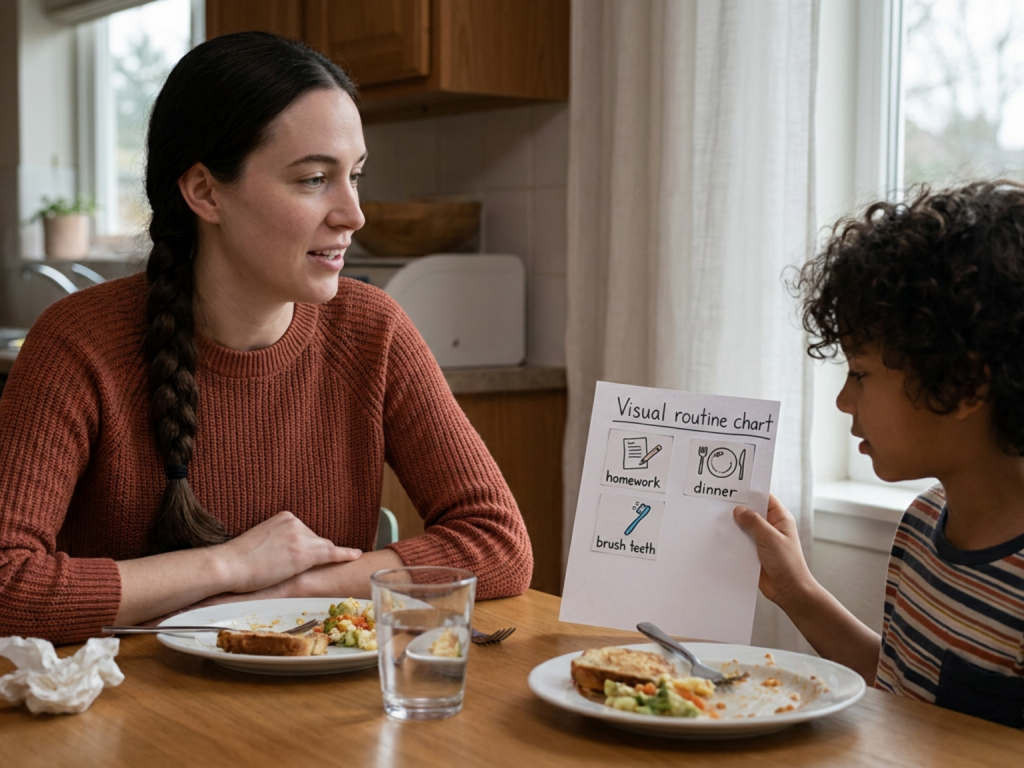
For younger children, visual routines can help: morning steps, bedtime steps, backpack checklist. For older children and teens, collaborative planning often works better: “Here are the non-negotiables. Where do you want flexibility?” Autonomy offered within boundaries can reduce oppositional behavior.
Scripts for common testing moments
Scripts are helpful because they reduce the parent’s cognitive load in the moment. They also make boundaries sound familiar, which can be regulating for children.
- When the child says, “You’re mean”: “You can be mad at the rule. The rule is still bedtime.”
- When the child refuses to move: “I will help your body get started if you cannot start on your own.”
- When the child negotiates repeatedly: “Asked and answered. I will talk when your voice is calm.”
- When a teen pushes curfew: “I hear that you want more freedom. Tonight’s curfew is 9:30. We can discuss future curfews tomorrow at 5.”
- When the parent is about to yell: “I am too upset to solve this well. I am taking two minutes, and then I will come back.”
These statements are not magic. They are anchors. The parent’s follow-through teaches the child that protest is allowed, disrespect is not, and the boundary will not disappear because the emotional volume increases.
Protecting the parent-child relationship
Firm limits are more effective when the relationship has regular deposits of warmth. This is especially important in single-parent households where the same adult may have to be both comforter and enforcer. Children tolerate limits better when they also receive predictable connection.
Connection does not need to be elaborate. Ten minutes of child-led attention, a bedtime check-in, a brief walk, cooking together, or a phone-free snack can reduce attention-seeking conflict. For adolescents, connection may look like driving without interrogating, sharing music, or asking for their opinion on something low-stakes.
After conflict, repair is a clinical strength, not a parental weakness. A repair might sound like: “I did not like how I yelled. I am sorry for yelling. The rule about hitting still stands. Next time I will take a pause, and you still need to use words or take space.” This models accountability without abandoning authority.
When behavior may need professional support
Some limit-testing is expected; some patterns deserve additional assessment. A pediatrician, licensed mental health clinician, school psychologist, or family therapist can help evaluate contributing factors such as sleep disorders, learning differences, anxiety, depression, trauma exposure, attention and executive-function difficulties, pain, medication effects, or family stress. Seeking help is not a sign that a parent has failed. It is often the most protective step.
Consider consultation if behavior is persistent, worsening, or impairing daily functioning across settings. Examples include frequent aggression, property destruction, school refusal, recurrent suspensions, severe withdrawal, self-harm statements, cruelty to animals, substance use, unsafe sexual behavior, or conflict that leaves the parent afraid in the home. Acute emotional dysregulation that includes threats of self-harm or harm to others should be treated as urgent.
Single parents should also monitor their own health. Chronic sleep deprivation, panic symptoms, depression, irritability, emotional numbing, or feeling trapped can reduce parenting capacity and deserve care. A healthcare professional can help identify appropriate supports without assuming a diagnosis from behavior alone.
Build support around the limit, not just the crisis
Children often behave better when the adults around them are coordinated. For a single parent, this may include teachers, school counselors, relatives, coaches, pediatric clinicians, faith communities, childcare providers, or trusted neighbors. The aim is not to expose family struggles unnecessarily, but to reduce isolation and create consistent expectations.
School collaboration for family stress can be especially useful. A teacher may notice patterns: conflict after poor sleep, homework avoidance when reading is difficult, behavior spikes after transitions, or social stress at lunch. If economic hardship is part of the strain, community-based family support programs, food assistance, transportation help, childcare subsidies, or parenting programs may reduce the background pressure that fuels conflict.
Support also means planning for predictable hard moments. If bedtime is the daily flashpoint, simplify the evening routine. If mornings are chaotic, prepare backpacks and clothing the night before. If grocery shopping leads to meltdowns, use pickup when possible or bring a snack and a clear list. Small environmental adjustments can reduce the number of limits that must be enforced by willpower alone.
When to seek urgent help
- If a child talks about suicide, self-harm, or wanting to die, contact emergency or crisis support promptly.
- If there is violence, weapons access, strangulation, serious threats, or the parent feels unsafe, prioritize immediate safety.
- If behavior changes abruptly with confusion, hallucinations, intoxication, head injury, fever, or severe sleep loss, seek medical evaluation.
- If the parent feels at risk of harming the child, place the child somewhere safe and contact emergency support or a trusted adult immediately.
- If school refusal, aggression, or emotional dysregulation is persistent across settings, consult pediatric and mental health professionals.
Tools & Assistance
- Create a one-page household limit plan with three non-negotiable safety rules and predictable consequences.
- Use a calm script card for repeated conflicts such as bedtime, screens, chores, and curfew.
- Ask the child’s school about counseling, learning evaluation, attendance support, or family resource referrals.
- Schedule a pediatric or behavioral health consultation when behavior is persistent, impairing, or escalating.
- Identify two backup adults or community resources before the next crisis, not during it.
FAQ
Is my child testing limits because I am a single parent?
Not necessarily. Children test limits in all family structures. Single parenting can make the behavior feel more intense because one adult is carrying more responsibility, but stress, routines, temperament, development, and support often matter more than family structure alone.
Should I be stricter if my child keeps pushing boundaries?
Stricter is not always better. Clearer, calmer, and more consistent is usually more effective. Choose a few important limits, state them briefly, and follow through with related consequences.
What if I lose my temper?
Repair as soon as everyone is calm. Apologize for your behavior without removing the boundary: “I am sorry I yelled. The rule still stands.” If losing control feels frequent or frightening, seek professional and practical support.
How do I handle different rules between households?
If co-parenting is possible, aim for shared safety and school expectations. If rules differ, tell the child, “Different homes can have different rules. In this home, this is the limit.” Avoid using the child as a messenger between adults.
When is limit-testing more than normal behavior?
Concern increases when behavior is severe, persistent, unsafe, or impairing at home, school, or with peers. Aggression, self-harm talk, major sleep disruption, substance use, or sudden personality changes warrant professional guidance.
Sources
- PubMed Central / National Center for Biotechnology Information — Single-Parent Households and Children's Educational Achievement
- Education Next — An International Look at the Single-Parent Family
- Annie E. Casey Foundation — Child Well-Being in Single-Parent Families
Disclaimer
This article is for informational purposes only and is not a medical or mental health diagnosis or treatment plan. Consult a qualified healthcare professional for concerns about a child’s behavior, safety, development, or caregiver wellbeing.

















Please log in to leave a comment.