
Intro
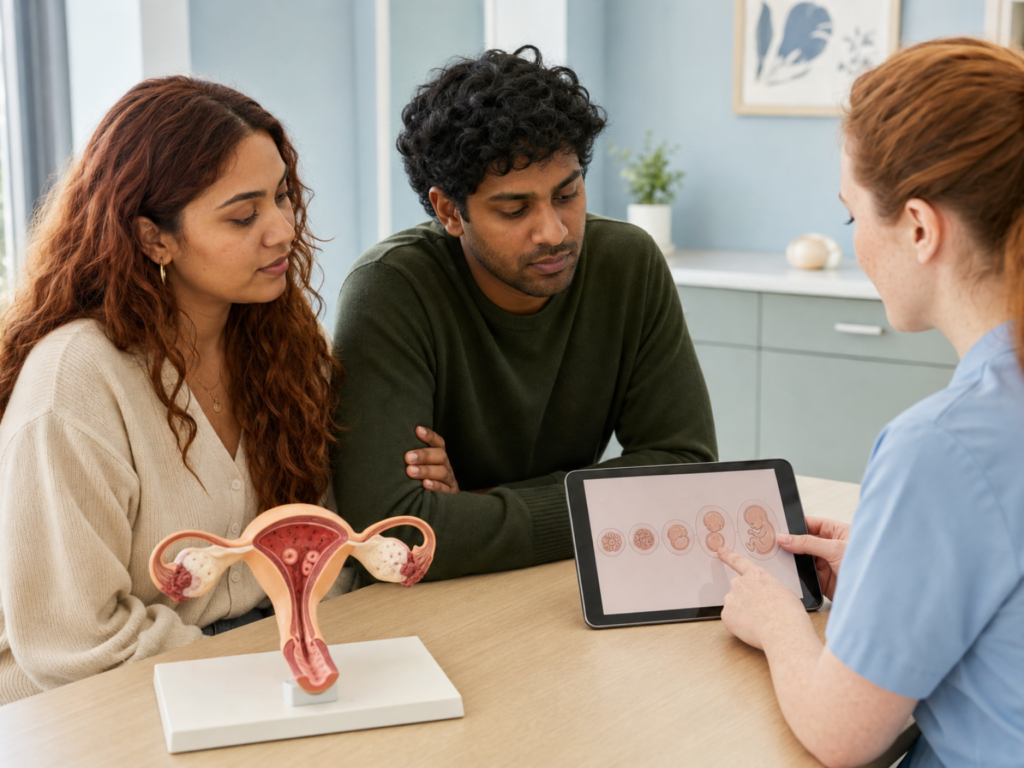
The days between fertilization and implantation can feel mysterious, especially when you are trying to conceive or waiting to test. Biologically, however, this interval follows a remarkably organized sequence: a sperm fertilizes an egg, the resulting zygote divides as it travels through the fallopian tube, becomes a blastocyst, and then begins to attach to the uterine lining.
Although the timeline is often described in neat day-by-day stages, real bodies vary. Ovulation timing may be uncertain, fertilization may occur within a short window after ovulation, and implantation can happen a little earlier or later than average. The overview below uses medically accepted timing ranges while keeping in mind that individual care should always be guided by a qualified healthcare professional.
Highlights
Fertilization usually occurs in the fallopian tube within about 12 to 24 hours after ovulation, if viable sperm are present.
The early embryo divides from one cell to many cells while moving toward the uterus; this transit takes several days.
By about day 5 to 6 after fertilization, the embryo typically reaches the blastocyst stage and becomes capable of implantation.
Implantation commonly begins around day 6 after fertilization, but timing can vary by a few days.
Home pregnancy tests usually become more reliable only after implantation has occurred and hCG has risen enough to detect.
Before day 0: ovulation and the fertile window
The fertilization-to-implantation timeline begins before fertilization itself. Ovulation is the release of a mature oocyte from the ovary. After release, the egg is picked up by the fimbriae at the end of the fallopian tube and remains fertilizable for a limited time, often described as roughly 12 to 24 hours.
Sperm, in contrast, can survive longer in the female reproductive tract under favorable cervical mucus conditions. This is why intercourse in the days before ovulation can still lead to fertilization. The practical fertile window is therefore not just the day of ovulation; it includes the several days leading up to it. For people tracking cycles, this distinction matters because the biological clock for embryo development starts at fertilization, not necessarily at intercourse.
Day 0: fertilization in the fallopian tube
Fertilization most commonly occurs in the ampulla of the fallopian tube. A sperm must pass through the protective layers surrounding the egg, including the corona radiata and zona pellucida. Once one sperm successfully fuses with the oocyte membrane, the egg activates mechanisms that help prevent additional sperm from entering.
The genetic material from the sperm and egg then organizes into pronuclei and combines, forming a single-cell embryo called a zygote. This is the point at which a new chromosomal complement is established. From a clinical timing perspective, this is considered day 0 after fertilization.
It is important to recognize that fertilization itself usually cannot be felt. Cramping, discharge, or mood changes around this time are more often related to ovulation, progesterone rise, or normal cycle variation rather than a detectable sensation of fertilization.
Days 1 to 3: cleavage divisions and tubal transport
After fertilization, the zygote begins cleavage, a series of mitotic cell divisions. The embryo divides from one cell to two cells, then four cells, then approximately eight cells. During this period, the embryo does not grow larger overall; instead, the original cellular material is divided into smaller cells called blastomeres within the zona pellucida.
At the same time, the embryo is transported along the fallopian tube toward the uterus. This movement depends on coordinated tubal muscle contractions and ciliary action. The timing is important: the embryo should arrive in the uterus when the endometrium is receptive, but not before it has developed sufficiently.
For many people, these days overlap with the early luteal phase of the menstrual cycle. Progesterone from the corpus luteum helps transform the uterine lining into a secretory, nutrient-rich environment. This hormonal preparation is essential, even though implantation has not yet begun.
Days 3 to 4: morula formation
By around day 3 to 4 after fertilization, the embryo often reaches the morula stage. A morula is a compact cluster of cells, classically compared in appearance to a mulberry. Compaction means the cells adhere more tightly to one another and begin to establish early differences in cellular position and function.
This stage is still pre-implantation. The embryo is usually approaching or entering the uterine cavity. It remains enclosed by the zona pellucida, which helps prevent premature attachment to the fallopian tube and supports orderly development during transit.
In natural conception, this stage is not directly observed. In in vitro fertilization, embryologists may evaluate embryos at comparable stages in the laboratory, but IVF timelines can differ depending on culture conditions, embryo transfer day, and individualized medical planning.
Days 5 to 6: blastocyst development and hatching
Around day 5 to 6 after fertilization, the embryo typically becomes a blastocyst. This is a more specialized structure with a fluid-filled cavity called the blastocoel, an inner cell mass that will contribute to the embryo, and an outer cell layer called the trophoblast that will help form the placenta.
For implantation to occur, the blastocyst must also hatch from the zona pellucida. Hatching allows the trophoblast to make direct contact with the endometrium. Without this step, attachment to the uterine lining cannot proceed normally.
This is the point in the timeline where the embryo becomes implantation-competent. Sources such as UCSF Health, Merck Manuals, and Cleveland Clinic describe implantation as occurring after the embryo reaches the blastocyst stage, often beginning about five to six days after fertilization.
Days 6 to 10: implantation begins and progresses
Implantation is not a single instant. It is a staged interaction between the blastocyst and the receptive endometrium. The process is commonly described in phases: apposition, adhesion, and invasion. In apposition, the blastocyst loosely aligns with the uterine lining. In adhesion, it attaches more firmly. In invasion, trophoblast cells begin to penetrate the endometrial surface and remodel maternal tissue.
Implantation often begins around day 6 after fertilization, though a range of several days is possible. During this interval, the trophoblast differentiates and starts early placental signaling. The endometrium responds through decidualization, a progesterone-driven transformation of stromal cells that supports early pregnancy.
Some people notice light spotting around the expected time of implantation, but many do not. Spotting is not a reliable way to confirm pregnancy, because it can also occur with normal luteal-phase hormonal changes, cervical irritation, infection, or the start of menstruation. Heavy bleeding, significant one-sided pelvic pain, shoulder pain, fainting, or severe dizziness should be treated as urgent symptoms, particularly if pregnancy is possible.
After implantation: hCG and pregnancy testing
After implantation begins, trophoblast cells start producing human chorionic gonadotropin, or hCG. This hormone supports the corpus luteum, helping it continue progesterone production until the developing placenta can take over more hormonal function later in the first trimester.
Because hCG rises only after implantation, testing too early can produce a negative result even when fertilization has occurred. Very sensitive tests may detect hCG near the expected period for some people, but results are generally more reliable after a missed period. Blood hCG testing through a healthcare setting can detect lower levels than most urine tests and may be used when clinically appropriate.
If cycles are irregular, ovulation occurred later than expected, or the date of intercourse is being used as a reference point, test timing can be confusing. In these cases, a clinician can help interpret results, decide whether repeat testing is useful, and evaluate symptoms that do not fit a straightforward early pregnancy pattern.
A concise day-by-day overview
- Ovulation: A mature egg is released and remains fertilizable for a short period.
- Day 0 after fertilization: Sperm and egg unite, forming a zygote.
- Days 1 to 3: Cleavage divisions produce a multicell embryo while it travels through the fallopian tube.
- Days 3 to 4: The embryo becomes a compact morula and approaches the uterus.
- Days 5 to 6: The blastocyst forms and hatches from the zona pellucida.
- Days 6 to 10: Implantation typically begins and progresses within the endometrium.
- After implantation: hCG production rises, eventually allowing pregnancy tests to become positive.
This timeline is a useful framework rather than a diagnostic tool. A difference of a day or two is common, especially when ovulation has not been precisely identified.
When to seek medical guidance
- Seek urgent care for severe pelvic pain, fainting, shoulder-tip pain, or heavy bleeding when pregnancy is possible.
- Contact a healthcare professional if you have persistent one-sided pain or bleeding after a positive pregnancy test.
- Do not rely on implantation spotting to confirm or exclude pregnancy.
- If pregnancy tests are confusing or cycles are irregular, ask a clinician about repeat urine testing or blood hCG testing.
- People using fertility treatment should follow the exact testing and medication schedule provided by their clinic.
Tools & Assistance
- Ovulation tracking with cycle history, cervical mucus observations, or ovulation predictor kits
- Home pregnancy testing after the expected period or as directed by a clinician
- Blood hCG testing through a healthcare provider when medically appropriate
- Early pregnancy consultation for pain, bleeding, recurrent loss history, or fertility treatment follow-up
FAQ
How many days after fertilization does implantation happen?
Implantation commonly begins around day 6 after fertilization, after the embryo has reached the blastocyst stage. A range of several days can occur.
Can I feel fertilization or implantation?
Fertilization is not usually felt. Some people report mild cramping or spotting around implantation timing, but these signs are nonspecific and cannot confirm pregnancy.
When will a pregnancy test turn positive?
A test can turn positive only after implantation and enough hCG production. Many urine tests are more reliable after a missed period, though blood tests can detect lower hCG levels.
Does late implantation mean something is wrong?
Not necessarily, but exact timing is difficult to know without assisted reproduction. If you have bleeding, pain, recurrent pregnancy loss, or fertility-treatment concerns, consult your healthcare provider.
Is the timeline different in IVF?
The biological stages are similar, but timing is tracked differently because fertilization and embryo culture are observed in the laboratory. Follow your fertility clinic’s instructions for transfer timing and pregnancy testing.
Sources
- UCSF Health — Conception: How It Works
- Merck Manuals Consumer Version — Stages of Fetal Development
- Cleveland Clinic — Conception: Fertilization, Process & When It Happens
Disclaimer
This article is for informational purposes only and does not replace medical advice, diagnosis, or treatment. Consult a qualified healthcare professional for personal guidance, especially with pain, bleeding, fertility treatment, or uncertain test results.

















Please log in to leave a comment.