
Intro
Choosing sports equipment for a child is about more than buying the smallest available size. Equipment should match the activity, the child’s developmental stage, body measurements, skill level, playing environment, and any advice received from a healthcare professional. The right equipment can improve comfort and reduce exposure to some preventable hazards, but it cannot eliminate the possibility of injury.
Families can feel pressure to purchase every available protective item, especially when a child is enthusiastic about a new sport. A calmer approach is to begin with the equipment required by the sport, prioritize correct fit and condition, and teach the child how and when to use each item. Protective equipment is one component of a broader plan that also includes supervision, rules, physical preparation, hydration, rest, and prompt attention to injuries.
Highlights
The best equipment is sport-specific, correctly fitted, age-appropriate, and maintained in good condition.
Helmets, mouthguards, shin guards, pads, and suitable footwear address different hazards; one item cannot substitute for another.
Protective equipment may reduce certain impacts or abrasions, but evidence for injury prevention is not equally strong for every product or sport.
Children should be able to move, see, hear instructions, and breathe comfortably while wearing their equipment.
Persistent pain, neurological symptoms, breathing difficulty, or a suspected concussion warrants stopping play and seeking appropriate medical advice.
Start with the sport, the child, and the setting
Sports equipment should be selected according to the specific activity rather than purchased as a general collection of protective items. A child playing field hockey, cycling, soccer, basketball, swimming, or contact sport faces different mechanical hazards. Equipment may need to address blunt impact, falls, friction, penetrating objects, unstable surfaces, excessive sun exposure, or contact with another participant.
Begin by asking the coach, league, school, or governing organization for its required equipment list. Requirements can differ by age group and playing position. Consider whether the activity takes place indoors or outdoors, on artificial turf or natural ground, in a pool, on ice, or on a road. Equipment that is appropriate in one environment may interfere with traction, balance, temperature regulation, or visibility in another.
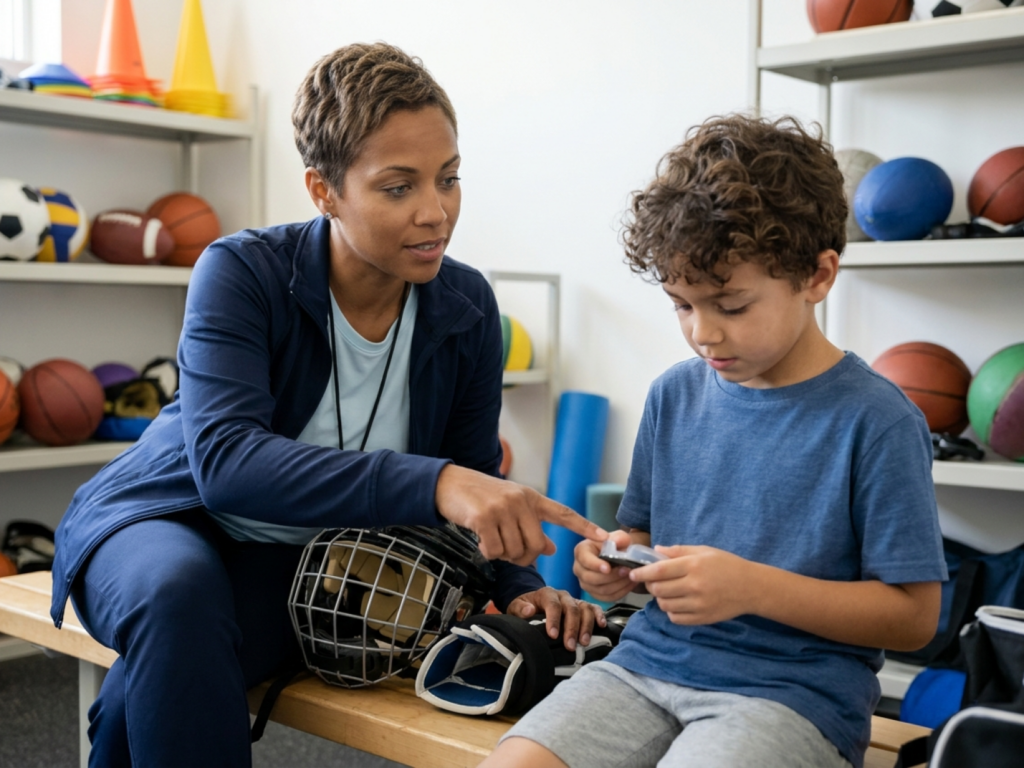
The child’s developmental abilities also matter. Younger children may need help recognizing when a strap has loosened, a helmet has shifted, or a piece of equipment has become uncomfortable. Children with visual, auditory, neuromuscular, orthopedic, or sensory differences may benefit from individualized adaptations. A pediatrician, sports medicine clinician, physical therapist, occupational therapist, or qualified equipment professional can help families think through these issues without assuming that a standard product will suit every child.
Helmets and head protection require precise fit
A helmet is designed for a particular activity and should not automatically be transferred from one sport to another. Cycling helmets, for example, are designed for cycling-related hazards, while helmets used for activities involving repeated contact or different impact patterns may have other design requirements. Follow the manufacturer’s instructions and the sport’s rules, and look for the safety certification or labeling recognized in the relevant jurisdiction.
A correctly fitted helmet should sit level and stable on the head, cover the intended area, and remain positioned when the child moves. Straps should form a secure configuration around the ears and under the chin without causing choking, pressure, or difficulty speaking. The child should be able to see normally and hear instructions. A helmet that rocks forward, backward, or from side to side is not providing the intended fit.
Inspect the shell, interior materials, fasteners, and straps before use. Replace a helmet after a significant impact, even if visible damage is not obvious, because internal protective materials may be compromised. Follow the product’s replacement guidance and avoid modifying the helmet with unapproved attachments, paint, padding, or stickers that could affect its performance. A helmet is not a license for riskier behavior, and no helmet guarantees prevention of concussion or other head injury.
Pads, mouthguards, shin guards, and footwear have different jobs
Protective pads should correspond to the body region and hazard they are intended to address. Elbow, knee, shoulder, hip, wrist, and chest protectors may reduce some abrasions or impact forces in particular sports, but they must not restrict circulation, joint motion, or the child’s ability to control equipment. Fasteners should remain closed during ordinary movement, and exposed hard edges should not create a new hazard for the wearer or other players.
Shin guards should cover the area required by the sport and remain centered during running and rapid changes of direction. They should not be so tight that they cause numbness, tingling, skin color changes, or persistent pressure marks. A mouthguard can help protect teeth and oral soft tissues during activities with a risk of contact. It should fit securely, permit comfortable breathing, and be cleaned and stored according to the manufacturer’s directions. Dental advice may be useful when a child has orthodontic appliances, dental trauma, or other oral health considerations.
Footwear affects traction, stability, and load distribution. Choose shoes or cleats designed for the playing surface and replace them when the sole is worn, the upper no longer supports the foot, or the child’s toes are compressed. Shoes should feel secure without requiring excessive tightening. Watch for recurring blisters, localized pain, limping, or altered movement. These findings do not establish a diagnosis, but they are reasons to stop and discuss the problem with a parent, coach, or healthcare professional.
Fit, comfort, and growth are safety issues
Children grow quickly, so equipment needs regular reassessment rather than a single fitting at the beginning of the season. Buying substantially oversized equipment for future growth can allow movement inside a helmet or pad, change balance, and reduce protection. Conversely, equipment that has become too small may cause pressure, restricted breathing, limited joint range, or skin injury. Adjustable components are useful only when they allow a secure fit within the manufacturer’s intended range.
Have the child try the complete set of equipment while performing sport-specific movements. Ask them to walk, run, bend, jump, turn, and hold the relevant ball, stick, racket, or bat. Check whether straps slide, padding shifts, vision is blocked, or the child feels overheated. A child who is distracted by pinching, itching, pain, or excessive weight may remove equipment during play or alter their technique to compensate.
Skin should be checked after initial use and during longer sessions, particularly where sweat and friction collect. Clean, dry clothing and equipment can reduce odor and irritation, but persistent rash, swelling, blistering, numbness, or pain should be discussed with a healthcare professional. Children should never be shamed for reporting discomfort. Early reporting helps adults adjust equipment before a small problem affects participation or becomes an injury.
Inspect, clean, and replace equipment routinely
Before each session, perform a brief visual and functional check. Look for cracks, dents, splits, loose stitching, stretched elastic, missing fasteners, damaged buckles, sharp edges, compressed padding, worn soles, and deterioration from heat or moisture. Test that closures hold and that moving parts operate as intended. Equipment should not be used if damage could affect protection, stability, or safe handling.
Follow the manufacturer’s cleaning instructions because some materials are damaged by bleach, high heat, solvents, or aggressive scrubbing. Allow damp items to dry fully in a ventilated area rather than storing them wet in a closed bag. Keep helmets and protective components away from unnecessary heat, direct sunlight, and chemicals. Do not share mouthguards, and use caution when sharing helmets or other items that contact the skin; cleaning and sport-specific infection-control guidance matter.
Record when equipment was purchased and when it was last checked. Replace items according to manufacturer guidance, after a serious impact, or when they no longer fit or function properly. Hand-me-down equipment may be safe if its history, age, condition, and fit are known, but an unknown impact history is a reason to be cautious, especially for helmets. Coaches and caregivers should also inspect shared equipment and remove defective items from use rather than leaving the decision to a child.
Protective gear works best within a wider safety plan
Equipment is not a substitute for developmentally appropriate coaching, rule enforcement, supervision, warm-up, conditioning, rest, and environmental planning. Children benefit when adults teach them to use equipment consistently and correctly rather than presenting it as an optional sign of fear or weakness. Coaches should model compliance, prohibit unsafe modifications, and create a culture in which a child can report pain, dizziness, breathing difficulty, or equipment failure without embarrassment.
Evidence is not equally conclusive for every protective product. Some equipment is strongly incorporated into sport-specific safety practice, while studies of other devices may show uncertain or limited injury-prevention effects. This uncertainty does not mean equipment is useless; it means families should avoid exaggerated claims and continue to use other prevention strategies. The aim is risk reduction, not a promise of zero injury.
Stop participation if equipment breaks, becomes displaced, causes significant discomfort, or cannot be fitted securely. Stop play and seek prompt medical assessment for concerning symptoms after an impact, including loss of consciousness, confusion, unusual behavior, worsening headache, repeated vomiting, seizure, weakness, difficulty walking, or changes in speech or vision. A suspected concussion requires removal from play and professional guidance about evaluation and return to activity. Do not use sports equipment to conceal symptoms or encourage a child to continue.
When to stop play and seek help
- Stop activity after a significant impact if the child has confusion, unusual behavior, loss of consciousness, worsening headache, repeated vomiting, seizure, weakness, or difficulty walking.
- Remove damaged, cracked, heavily worn, or impact-involved protective equipment from use until it has been properly assessed or replaced.
- Do not use oversized equipment that shifts, blocks vision, restricts movement, or compromises breathing.
- Persistent numbness, tingling, swelling, skin injury, limping, or pain during equipment use should be discussed with a healthcare professional.
- Follow emergency procedures for breathing difficulty, severe bleeding, suspected spinal injury, or any rapidly deteriorating condition.
Tools & Assistance
- Use a sport-specific equipment checklist from the child’s coach, school, league, or governing organization.
- Schedule a seasonal fit check and repeat it after growth spurts or changes in activity.
- Keep a small inspection and cleaning routine before every practice or competition.
- Ask a pediatrician, sports medicine clinician, physical therapist, dentist, or qualified equipment specialist about individual needs.
- Learn the team’s emergency action plan and how suspected concussion or other injuries are handled.
FAQ
Should children wear protective equipment for every sport?
Children should use the equipment required or recommended for their specific sport and setting. Additional gear is not automatically safer if it restricts movement, interferes with vision, or is not designed for the activity.
Can a child use the same helmet for different sports?
Usually, families should not assume that a helmet designed for one activity is appropriate for another. Helmet design and certification relate to specific hazards, so follow the manufacturer’s instructions and sport requirements.
How often should sports equipment be replaced?
Replace equipment when it no longer fits, has visible damage, fails a functional check, reaches the manufacturer’s recommended service period, or has been involved in a significant impact when replacement is advised.
What if my child refuses to wear a mouthguard or helmet?
Ask what feels uncomfortable and check the fit rather than forcing the child to tolerate pain. A coach, dentist, clinician, or qualified equipment professional may help identify a better-fitting or sport-appropriate option.
Sources
- NIH / PubMed Central — Strategies to prevent injury in adolescent sport
- Seattle Children's — Safety Gear for Sports and Play
- Nationwide Children's Hospital — Sports Safety for Kids
Disclaimer
This article provides general educational information and does not diagnose, treat, or replace advice from a qualified healthcare professional. Seek medical care for concerning symptoms, significant injuries, or questions about a child’s individual equipment needs.














Please log in to leave a comment.