
Intro
When a child resists transitions or struggles to adapt to new situations, daily life can feel unexpectedly intense. Leaving the playground, starting homework, entering a classroom, meeting unfamiliar relatives, or changing the bedtime sequence may trigger tears, refusal, bargaining, aggression, withdrawal, or a full meltdown.
These reactions are not simply “bad behavior.” Transitions require attention shifting, emotional regulation, prediction, language processing, sensory adjustment, and flexibility. Some children need more external structure while these developmental skills are still emerging. With calm support, predictable routines, and professional guidance when needed, many families can reduce conflict and help children feel safer during change.
Highlights
Transition resistance often reflects difficulty with regulation, predictability, sensory load, or executive function rather than intentional defiance.
Preparation, visual supports, advance warnings, and small choices can make new situations feel more manageable.
A child’s age, temperament, neurodevelopmental profile, sleep, stress level, and environment all influence adaptability.
Persistent, impairing, or escalating distress should be discussed with a pediatrician, psychologist, occupational therapist, or school support team.
Why transitions can feel so hard
A transition is not just a change in activity. For a child, it can mean stopping something enjoyable, shifting attention, tolerating uncertainty, following new instructions, managing sensory input, and accepting a different adult expectation. This combination places demands on executive functions: cognitive flexibility, inhibitory control, working memory, planning, and emotional regulation.
Young children naturally have immature executive function because the prefrontal cortex and related brain networks are still developing. They may know what is expected but be unable to shift quickly when tired, hungry, overstimulated, or emotionally invested. A child who refuses to leave a favorite game may not be choosing to be difficult; they may be overwhelmed by the abrupt loss of control and unable to organize the next step.
Transitions are also emotionally meaningful. Moving from parent to preschool may activate separation distress. Leaving a predictable home environment for a noisy birthday party may trigger anxiety or sensory overload. Switching from screen time to dinner may feel like a sudden reward removal. For some children, especially those with anxiety traits, attention-deficit/hyperactivity disorder, autism spectrum traits, developmental language differences, sensory processing differences, or a history of stressful experiences, changes may feel threatening even when adults see them as minor.
Common signs of transition and adaptation difficulty
Children show distress in different ways. Some externalize through crying, yelling, running away, throwing objects, or refusing to move. Others internalize by becoming quiet, clinging, freezing, complaining of stomachache, or repeatedly asking questions. A child may be relatively calm in familiar routines but become dysregulated when the order changes, a substitute teacher appears, a caregiver takes a new route, or a planned outing is canceled.
Families may notice patterns such as:
- Strong reactions when an enjoyable activity ends, especially screens, play, or outdoor time.
- Difficulty leaving the house, getting into the car, entering school, or moving between classrooms.
- Repeated questions about what will happen next, who will be there, and how long it will last.
- Meltdowns after holding it together in public, sometimes called an “after-school restraint collapse.”
- Resistance to unfamiliar foods, clothing, places, sounds, smells, or social expectations.
- Difficulty maintaining routine when sleep, illness, holidays, or family stress disrupts the usual rhythm.
It is useful to distinguish a tantrum from a meltdown, although they can overlap. A tantrum may be goal-directed and improve when the child gets what they want. A meltdown is more like a nervous system overload: the child may be unable to process language, reason, or calm quickly. In both cases, the immediate adult task is safety and regulation, not a long lecture.
What increases resistance to change
Transition difficulty is usually multifactorial. Sleep deprivation, hunger, pain, constipation, acute illness, medication effects, family conflict, school stress, bullying, and excessive sensory stimulation can lower a child’s threshold. A child who manages transitions well on a calm morning may struggle after a noisy assembly, a poor night of sleep, or a rushed breakfast.
Developmental stage matters. Toddlers and preschoolers are building autonomy and may resist because they want control. School-age children may resist when a transition interrupts concentration, feels unfair, or exposes academic or social difficulty. Adolescents may experience transitions as threats to independence, identity, or privacy. Across ages, a sudden change with little explanation is harder than a predictable, supported change.
Temperament also plays a role. Some children are naturally cautious, intense, or slow to warm up. They may need repeated exposure before a new situation feels safe. Others have strong novelty-seeking traits but struggle when asked to stop and shift. Children with language processing difficulties may miss verbal instructions; children with sensory sensitivities may experience a crowded hallway or fluorescent-lit store as physically uncomfortable. Understanding these drivers reduces blame and helps caregivers choose more effective supports.
Prevention: make the next step visible
Many transition problems improve when adults reduce uncertainty before the moment of change. A predictable but flexible routine gives the child a mental map: what is happening now, what comes next, and when preferred activities will return. The goal is not to make life rigid; it is to create enough predictability that the child can tolerate reasonable variation.
Helpful prevention strategies include:
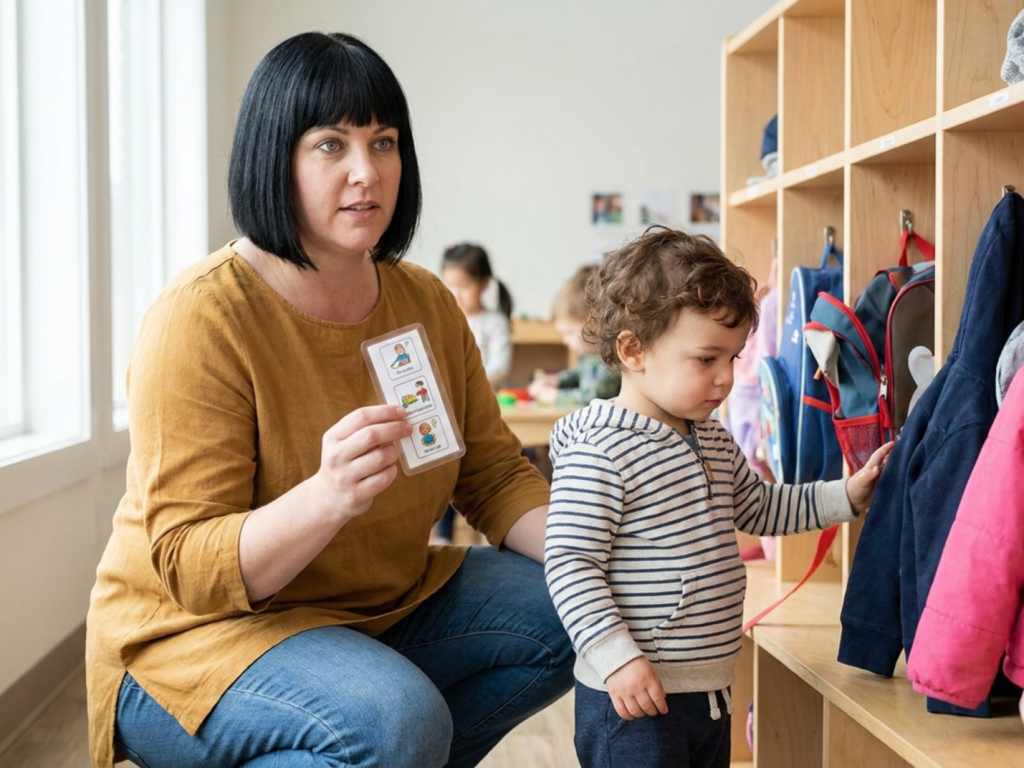
- Use a visual schedule for children who benefit from seeing the sequence of events. Pictures, drawings, written checklists, or objects can all work.
- Give advance warning in concrete terms: “Two more turns, then shoes,” or “When this song ends, we go to the car.”
- Use first-then language: “First pajamas, then story.” This reduces negotiation and clarifies the immediate reward.
- Offer limited choices: “Do you want to carry your backpack or your lunchbox?” Choices should be real but not so broad that they overwhelm.
- Practice new routines when no one is rushed. Rehearse entering the clinic, packing the school bag, or walking to the classroom door.
- Prepare for changes with simple social narratives: who will be there, what might happen, what the child can do if worried, and when the event ends.
Transition support strategies work best when they are consistent across caregivers and settings. If one adult gives repeated extensions while another enforces immediate stopping, the child may feel confused and escalate more. Consistency should still be compassionate: the adult can hold the boundary while acknowledging distress.
During the transition: co-regulate before you problem-solve
When a child is already distressed, reasoning skills decline. Long explanations, moral arguments, or repeated questions may intensify the reaction. Co-regulation means the adult uses their calm presence, voice, posture, and predictable actions to help the child’s nervous system settle. This is not “giving in”; it is creating the neurological conditions for cooperation.
Try to reduce verbal load. Use short, concrete phrases: “I see this is hard. Shoes now. I will help.” Move slowly, keep your face and tone neutral, and avoid adding shame. If the child is safe but overwhelmed, a brief pause may be more effective than rushing. Some children benefit from deep pressure, a quiet corner, headphones, a transition object, or carrying a job such as holding the door card. Others dislike touch when dysregulated, so consent and observation matter.
If the child becomes aggressive or unsafe, prioritize safety. Move breakable objects, protect siblings, and use the least restrictive intervention possible. After the child calms, review briefly: “Leaving was hard. Next time we will use the timer and you can choose the goodbye wave.” The teaching moment is after regulation returns, not during peak distress.
Helping children adapt to new situations gradually
New situations are easier when introduced in small, predictable steps. This is similar to graded exposure in behavioral health: the child approaches the unfamiliar experience gradually while supported, rather than being forced into full participation without preparation. For example, before starting a new preschool, a child might look at photos, walk past the building, visit the classroom when it is quiet, meet the teacher briefly, and then attend for a short period.
Caregivers can create a “preview and debrief” rhythm. Before the event, describe the plan simply and include one coping option: “The dentist will count your teeth. You can squeeze my hand.” Afterward, name success specifically: “You walked into a new room and sat in the chair for two minutes.” This builds self-efficacy, the child’s belief that they can manage difficult experiences.
Avoid over-reassurance, which can accidentally signal danger. Instead of repeatedly saying “Don’t worry,” use confident preparation: “It may feel strange at first, and I will be nearby. We know the plan.” If the child is very anxious, consult a qualified clinician about developmentally appropriate strategies. Forcing abrupt exposure to feared situations can backfire, while complete avoidance can also strengthen fear; professional guidance can help find the middle path.
Working with school and healthcare professionals
If transition resistance is frequent, intense, or interfering with learning, sleep, family functioning, peer relationships, or safety, it is reasonable to seek support. Start with the child’s pediatrician to review medical contributors such as sleep problems, pain, gastrointestinal issues, hearing or vision concerns, medication effects, or neurodevelopmental questions. A child psychologist, developmental-behavioral pediatrician, occupational therapist, speech-language pathologist, or school counselor may also be involved depending on the pattern.
Schools can help by using consistent routines, visual cues, transition warnings, calm spaces, and predictable adult language. Teachers may observe whether transitions are harder after recess, before writing tasks, during noisy hallway movement, or when instructions are only verbal. This information can guide supports without assuming the child is “manipulative” or “lazy.”
Families can share what works at home and ask what the school sees. Useful questions include: “Which transitions are hardest?” “What happens right before the escalation?” “Does the child understand the instruction?” “Are sensory factors present?” “What helps the child recover?” Written plans can be especially helpful when multiple adults interact with the child. If developmental, learning, anxiety, or sensory concerns are suspected, formal evaluation may clarify needs and accommodations.
Caregiver mindset: firm, warm, and realistic
Supporting a child who resists transitions can be exhausting. Parents may feel judged in public or worry that they are being too strict or too permissive. A helpful stance is warm authority: the adult validates the feeling while maintaining the necessary boundary. “You really wanted more time. It is still time to leave. I will help your body get to the car.”
Progress is often uneven. A strategy may work on Monday and fail on Thursday because the child is tired, the environment changed, or the expectation increased. Look for trends rather than perfection. If meltdowns become shorter, recovery improves, or the child uses one coping phrase before escalating, that is meaningful progress.
Caregivers also need support. If every transition feels like a battle, consider simplifying schedules, building in buffer time, reducing avoidable sensory load, and coordinating expectations among adults. Children borrow regulation from regulated adults, but adults can only offer that consistently when they are not chronically depleted. Seeking help is not a sign of failure; it is part of building a safer, more predictable environment for the child.
When to seek prompt support
- The child’s distress includes self-injury, aggression that causes injury, running into unsafe areas, or threats of harm.
- Transition problems cause major school refusal, persistent sleep disruption, or significant family impairment.
- There is sudden behavioral change, regression, new severe anxiety, loss of skills, or concern for trauma, bullying, pain, or illness.
- Caregivers feel unable to keep the child or siblings safe during meltdowns.
- A child has developmental delays, language concerns, sensory sensitivities, or attention difficulties that have not been assessed.
Tools & Assistance
- Create a simple visual schedule with pictures or written steps for high-stress transitions.
- Use a timer, countdown, or song to make the end of an activity predictable.
- Keep a brief log of triggers, time of day, sleep, hunger, sensory factors, and recovery time.
- Ask the school or childcare team for consistent transition cues and a shared support plan.
- Consult a pediatrician or qualified child mental health professional if distress is persistent or unsafe.
FAQ
Is transition resistance normal in young children?
Some resistance is developmentally common, especially in toddlers and preschoolers. It becomes more concerning when reactions are very intense, unsafe, persistent, or impairing across settings.
Should I avoid all changes if my child struggles?
Not usually. Children need gentle practice with change, but it should be predictable, gradual, and supported. Complete avoidance can make unfamiliar situations feel even more threatening.
Are visual schedules only for autistic children?
No. Visual supports can help many children because they reduce working memory demands and make expectations concrete.
What should I do during a meltdown?
Focus on safety and calm co-regulation. Use fewer words, reduce stimulation when possible, and wait until the child is regulated before teaching or problem-solving.
When should I ask for a professional evaluation?
Consider evaluation if transition distress disrupts school, sleep, relationships, safety, or daily functioning, or if you notice developmental, sensory, language, attention, or anxiety concerns.
Sources
- Child Mind Institute — Why Do Kids Have Trouble With Transitions?
- Sheffield Children's NHS Foundation Trust — Change and transitions top tips
- ZERO TO THREE — Coping with Change
Disclaimer
This article is for informational purposes only and does not replace medical, developmental, or mental health evaluation. Consult a qualified healthcare professional for concerns about your child’s behavior, safety, or development.

















Please log in to leave a comment.