
Intro
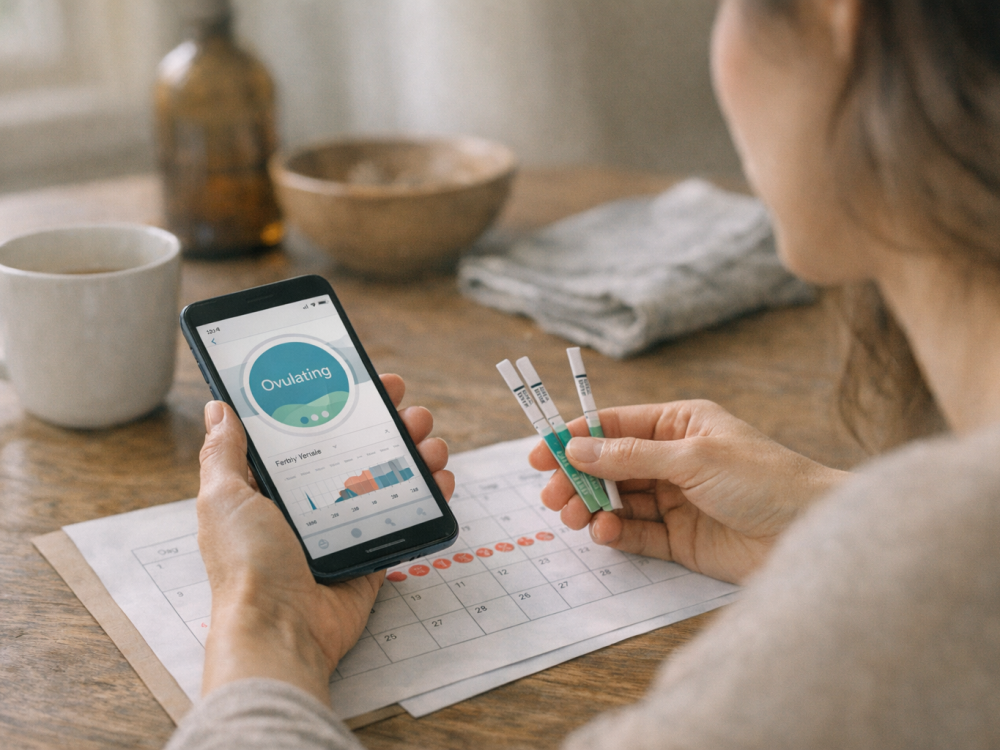
Fertility apps can make cycle tracking feel more organized, especially when you are trying to conceive, avoiding pregnancy, or simply trying to understand your body. They can store dates, symptoms, basal body temperature, ovulation test results, cervical mucus observations, bleeding patterns, and reminders in one place. For many people, that structure is genuinely helpful.
But a fertility app is not the same as a biological test of ovulation. Most apps estimate the fertile window using calendar-based assumptions, sometimes refined by user-entered data. That means the app may be useful as a planning tool, but it can also be misleading if its predicted ovulation day is treated as certain. Understanding how these apps work, where they fail, and how to use them safely can reduce stress and help you decide when to seek professional guidance.
Highlights
Most fertility apps estimate ovulation; they do not directly confirm that an egg was released.
Predictions are less reliable when cycles are irregular, recently changed, postpartum, perimenopausal, or affected by conditions such as PCOS.
Apps often disagree with one another even when given the same cycle dates, because their algorithms and assumptions differ.
Ovulation predictor kits, cervical mucus observations, and basal body temperature can add biological context, but each has limitations.
If timing intercourse has become stressful or you have been trying without success, a clinician can help evaluate ovulation, sperm factors, tubal factors, and other causes.
What fertility apps are designed to do
Fertility apps are digital tracking tools. At their simplest, they ask for the first day of menstrual bleeding and cycle length, then use those dates to estimate future periods, a , and an day. More advanced apps allow users to enter , basal body , , intercourse timing, spotting, pain, mood, medications, sleep, and pregnancy test results.
For a medically literate user, it helps to separate three concepts: predicting , detecting an ovulatory hormonal signal, and confirming that ovulation likely occurred. A calendar prediction estimates when ovulation might happen. An detects an LH surge, which usually precedes ovulation but does not guarantee it. Basal body ]] may support retrospective confirmation because after ovulation raises resting , but is vulnerable to illness, poor sleep, alcohol, and measurement inconsistency.
Apps are best understood as organizers and pattern-recognition aids. They may help you notice that your cycles are usually 26 to 29 days, that fertile-type cervical mucus appears several days before a , or that your luteal phase seems short. However, the app itself is usually not measuring hormones or evidence of follicle rupture. It is interpreting the information you provide.
How apps predict ovulation
Many apps use a version of the . A common assumption is that occurs about 14 days before the next period. If a person reports a 28-day cycle, the app may estimate around day 14. If the cycle is 32 days, it may shift the estimated day to around day 18. Some apps use averages from prior cycles; others apply fixed formulas or proprietary algorithms.
This approach is biologically plausible but incomplete. The luteal phase, the time from to the next period, is often more stable than the follicular phase, but it is not identical for everyone. may occur earlier or later than expected, and one cycle can differ from the next. Stress, illness, travel, weight change, intense exercise, thyroid dysfunction, hyperprolactinemia, polycystic ovary syndrome, perimenopause, postpartum hormonal changes, and recent discontinuation of hormonal contraception can all affect timing.
Some apps refine predictions using additional signs:
- LH test results: A positive urinary LH test suggests that may occur within the next 12 to 36 hours for many people, but false positives and prolonged surges can occur.
- : A can suggest that already occurred, but it is retrospective rather than predictive.
- Cervical mucus: Clear, stretchy, slippery mucus often reflects estrogenic changes before ovulation and may help identify fertile days.
- Cycle symptoms: Mittelschmerz, libido changes, breast tenderness, or mood shifts may be recorded, but symptoms alone are not reliable proof of ovulation.
The more biologically relevant data you enter consistently, the more useful the app may become as a record. Still, the quality of the prediction depends on both the algorithm and the accuracy of your entries.
The fertile window: why one date is not enough
A frequent source of confusion is the difference between the predicted ovulation day and the . Pregnancy is most likely from intercourse in the days before ovulation and on the day of ovulation, because sperm can survive in fertile cervical mucus for several days, while the egg is viable for a much shorter time after release.
If an app highlights one ovulation day, it can unintentionally make users focus too narrowly. For conception, having intercourse only on the predicted day may miss the most fertile days if ovulation occurs earlier than expected. For pregnancy prevention, relying on a narrow app-generated window can be risky because fertile days may shift.
A more realistic approach is to consider ovulation timing as a probability range, not a fixed appointment. For someone with regular cycles, an app may provide a useful starting estimate. For someone with variable cycles, the may be much wider than the app display suggests. This is why are less accurate than methods that incorporate current-cycle biological signs, such as LH testing and cervical mucus tracking.
How accurate are fertility apps?
Accuracy depends on what the app is being used for. An app may be reasonably accurate at reminding you when your next period is likely if your cycles are very regular. It may be less accurate at predicting the exact day of , and less reliable still if used as the sole method to avoid pregnancy.
Research evaluating period tracker applications has found that apps can provide conflicting fertile-window and ]] predictions even when the same information is entered. This matters because users may assume that app-generated dates are individualized and biologically confirmed, when in many cases they are formula-based estimates.
are particularly vulnerable in several situations:
- Cycles that vary by more than a few days from month to month.
- Very short or very long cycles.
- PCOS or suspected anovulatory cycles.
- Recent pregnancy, miscarriage, abortion, breastfeeding, or postpartum hormonal transition.
- Recent stopping, starting, or inconsistent use of hormonal contraception.
- Perimenopause, when may become less predictable.
For trying to conceive, apps can be helpful but are generally less reliable than predictor kits for identifying the LH surge. Even OPKs have limitations, especially in people with elevated baseline LH, multiple surges, or inconsistent testing times. For confirming whether occurred, clinicians may use history, cycle patterns, mid-luteal progesterone testing, ultrasound monitoring, or other evaluation depending on the situation.
Common mistake 1: assuming the app confirms ovulation
One of the most common mistakes is interpreting a predicted date as confirmation that happened. A calendar estimate cannot show follicle rupture, production, or egg release. It only estimates when may have occurred based on previous cycle patterns or default assumptions.
This distinction is especially important if periods are irregular, absent, unusually heavy, or associated with symptoms such as acne, hirsutism, galactorrhea, severe pelvic pain, or significant weight change. These features do not automatically mean there is a serious problem, but they may justify medical assessment rather than continued reliance on an app.
If you are trying to conceive and want more confidence, consider combining app tracking with LH testing, observations, and possibly . If patterns remain confusing, a healthcare professional can help determine whether is occurring and whether additional evaluation is appropriate.
Common mistake 2: entering incomplete or inconsistent data
Apps depend heavily on user-entered data. If period start dates are estimated from memory, spotting is counted inconsistently as day 1, or LH tests are entered only occasionally, predictions can drift. The first day of the cycle is usually counted as the first day of full menstrual flow, not light premenstrual spotting.
Basal requires particularly consistent technique: measuring after a block of , getting out of bed, and at roughly the same time. Illness, fever, alcohol, disrupted sleep, shift work, and different thermometers can obscure the shift. Cervical mucus tracking can also be affected by semen, lubricants, vaginal infections, antihistamines, and individual variation.
It may help to treat the app as a clinical-style log: enter dates as accurately as possible, note unusual events, and avoid overinterpreting a single abnormal reading. Patterns over several are usually more informative than one day of data.
Common mistake 3: using a fertility app as if it were medically validated contraception
Some people use fertility apps to avoid pregnancy by abstaining or using barrier methods on predicted fertile days. This can be appropriate only if the method is understood, used consistently, and the user accepts the pregnancy risk. Many apps are not regulated as contraceptive medical devices and may not be clinically validated for pregnancy prevention.
There is also a difference between fertility awareness-based methods taught with strict rules and a general period-tracking app that displays a fertile window. The former may require daily observations, specific criteria for fertile and infertile days, and training. The latter may simply project future dates from past cycles.
If avoiding pregnancy is important, discuss contraception options with a qualified healthcare professional. If using fertility awareness, consider instruction from a trained clinician or educator and understand how illness, postpartum status, breastfeeding, irregular cycles, and medication changes may affect reliability.
How to use fertility apps more safely and effectively
A practical, balanced strategy is to use the app for organization while grounding decisions in current-cycle signs. For , this often means having intercourse every 1 to 2 days during the several days before expected and around a positive LH test, rather than waiting for one app-predicted date. This reduces the pressure to identify a perfect day.
Consider the following approach:
- Track the first day of full menstrual flow each cycle.
- Record cycle length, bleeding duration, and any unusual bleeding.
- If using OPKs, test according to the kit instructions and enter both positive and negative results.
- Observe cervical mucus if you are comfortable doing so, especially slippery or egg-white-type mucus.
- If using BBT, focus on sustained shifts rather than isolated temperatures.
- Review several cycles rather than reacting to one prediction.
Seek medical advice sooner if you are 35 or older and have been trying for 6 months, under 35 and trying for 12 months, or at any age if cycles are very irregular, periods are absent, there is known endometriosis or pelvic inflammatory disease, there have been recurrent pregnancy losses, or a male partner has known semen concerns. These timeframes are general guidance, not a diagnosis; individual circumstances matter.
When not to rely on an app alone
- Do not treat an app-predicted ovulation date as proof that ovulation occurred.
- Do not use a date-only app as your sole contraception if pregnancy prevention is essential.
- Seek clinical advice for absent periods, very irregular cycles, severe pelvic pain, or bleeding between periods.
- Consider earlier fertility evaluation if you are over 35, have known reproductive conditions, or have been trying without success.
- Use caution interpreting app predictions after stopping hormonal contraception, postpartum, while breastfeeding, or during perimenopause.
Tools & Assistance
- Use a fertility app as a structured log for cycle dates, symptoms, LH tests, and temperature data.
- Consider ovulation predictor kits if you are trying to better identify the LH surge.
- Bring app cycle summaries to an obstetrician-gynecologist, reproductive endocrinologist, midwife, or primary care clinician.
- Ask a healthcare professional about evaluation if cycles are persistently irregular or conception is taking longer than expected.
- Choose apps with transparent methods, privacy protections, and clear statements about whether they are medically validated.
FAQ
Can a fertility app tell me exactly when I ovulate?
Usually no. Most apps estimate ovulation from cycle dates and sometimes user-entered signs. They do not directly observe follicle rupture or confirm egg release.
Are apps useful if my cycles are irregular?
They can still be useful for recording patterns, but their predictions are less reliable. Current-cycle signs such as LH tests and cervical mucus may be more informative, and persistent irregularity should be discussed with a clinician.
Is an ovulation predictor kit better than an app?
For identifying the LH surge, an OPK is generally more biologically specific than a calendar prediction. However, a positive OPK does not guarantee ovulation, and results can be harder to interpret in some hormonal conditions.
Should I have intercourse only on the app’s ovulation day?
If trying to conceive, focusing only on one predicted day can miss the fertile window. Intercourse during the several days before ovulation and around the LH surge is usually a more forgiving strategy.
Can fertility apps be used to avoid pregnancy?
Some people use fertility awareness methods, but a general date-based app is not the same as a validated contraceptive method. If avoiding pregnancy is important, discuss reliable options with a healthcare professional.
Sources
- PubMed Central — Period tracker applications: What menstrual cycle information are women entering, what menstrual cycle information are they given, and what is the evidence?
- Cedars-Sinai — Do Fertility and Ovulation Apps Work?
- Tommy's — Apps and tools for conception
Disclaimer
This article is for informational purposes only and is not a substitute for personalized medical advice, diagnosis, or treatment. Consult a qualified healthcare professional about fertility concerns, irregular cycles, contraception, or pregnancy planning.














Please log in to leave a comment.