
Intro
Many children are naturally curious about dogs, and many dogs are friendly. However, even a familiar-looking or usually gentle dog can react unpredictably when frightened, injured, startled, or protecting food, toys, territory, or puppies. Teaching children clear, repeatable behaviors helps them stay safer without making them fearful of animals.
The goal is not to expect a child to interpret every canine signal perfectly. Adults remain responsible for supervision and intervention. Children need simple rules for asking permission, giving dogs space, moving calmly, and seeking help when a situation feels unsafe.
Highlights
A child should ask the dog’s owner before approaching or petting, then allow the dog to sniff while remaining calm.
Children should never disturb a dog that is eating, sleeping, caring for puppies, confined, injured, or trying to move away.
If an unfamiliar dog approaches, standing still and avoiding direct eye contact is safer than running, screaming, or reaching toward the animal.
Constant, close supervision is essential; young children should never be left alone with a dog, including a family pet.
Why unfamiliar dogs require careful boundaries
Children often judge a dog by its size, appearance, wagging tail, or the owner’s reassurance. These observations are not enough to establish safety. Dogs communicate through posture, movement, facial expression, vocalization, and changes in arousal, and those signals can be subtle. A wagging tail does not always mean a dog wants to be touched; the dog may be excited, anxious, or conflicted.
An unfamiliar dog is any dog the child does not know well, including a neighbor’s pet, a dog at a park, or a relative’s animal seen only occasionally. A child should not assume that a dog is safe because it is small, wearing a leash, behind a fence, or accompanied by an adult. The owner may know the dog’s temperament, but the child still needs permission and an adult should remain close.
This approach is part of broader stranger safety for children: children learn practical rules for uncertain situations rather than being told that every unfamiliar person, animal, or environment is dangerous. Use calm language such as, “We give animals a choice to come closer,” instead of “Dogs are scary.”
The safe approach: ask, pause, and let the dog choose
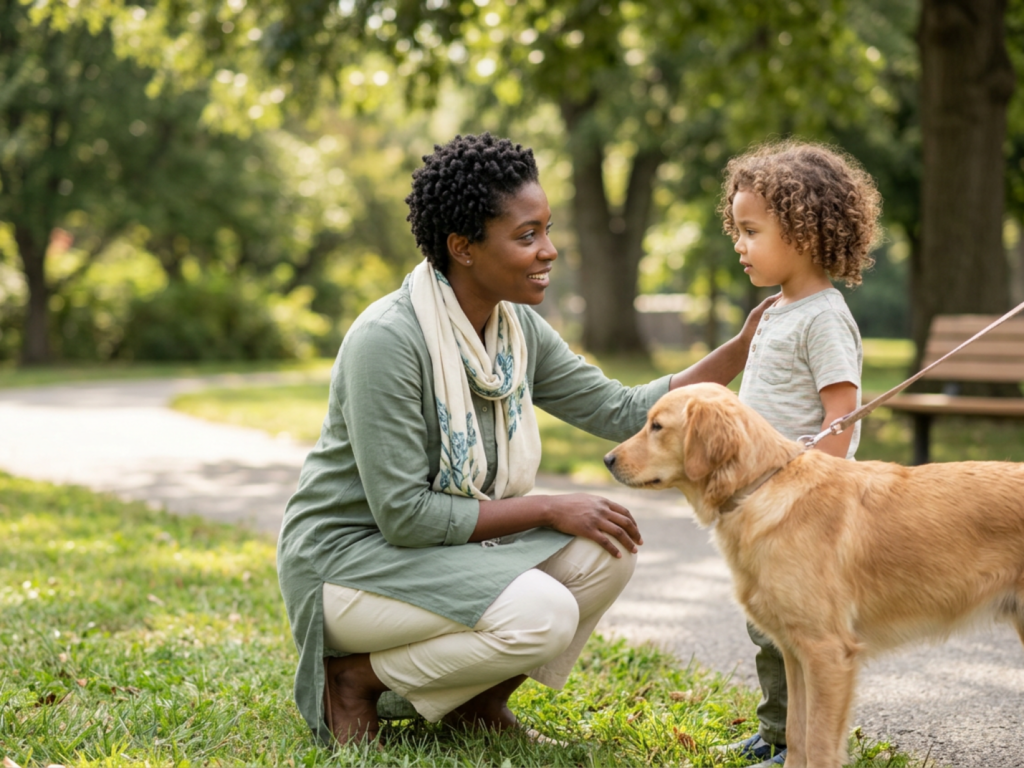
Teach a short sequence that children can remember: stop, ask, wait, and observe. Before approaching, the child should stop several steps away, ask the owner whether petting is appropriate, and wait for a clear answer. If the owner is absent, distracted, or says no, the child should not approach. A leashed dog may still be uncomfortable with contact, and an owner’s permission is not a substitute for supervision.
If permission is given, the child should approach slowly from the side rather than running directly toward the dog. The child can stand quietly, keep hands low and relaxed, and allow the dog to sniff without forcing contact. The child should not put a hand over the dog’s head, hug the dog, climb on it, pull its ears or tail, kiss its face, or place a face close to the dog’s muzzle. Gentle strokes on the shoulder or upper back are generally less intrusive than touching the head or face, but the child should stop if the dog moves away.
Teach children that consent applies to animals too: a dog may say no by turning away, hiding, stiffening, lowering its body, moving behind its owner, or repeatedly trying to leave. The correct response is to give space, not to follow, corner, or persuade the dog. If a child is too young to follow this sequence reliably, the child should observe from a safe distance rather than pet.
Recognizing when a dog needs space
Children do not need to become animal-behavior experts, but they should learn to notice broad warning patterns. A dog that is growling, snarling, barking intensely, showing its teeth, lunging, snapping, or staring rigidly should not be approached. Other concerning signs can include a stiff or frozen posture, raised hair along the back, tucked or tightly held tail, ears pinned back, repeated lip licking, yawning when not tired, or turning the head away while remaining tense.
Some situations are unsafe even when the dog is quiet. Children should never touch a dog that is eating, chewing a bone, sleeping, caring for puppies, injured, ill, trapped, inside a car, behind a fence, or resting in a crate or other confined space. They should not take toys or food from a dog, tease it, chase it, ride on it, or interfere with dogs that are fighting. Children should also avoid reaching through fences or opening gates.
Explain that these rules are about respecting an animal’s space, not blaming the dog. A dog that is frightened or in pain may react defensively. A child who notices warning behavior should move away calmly and tell a trusted adult. Practicing these observations supports observational learning in early childhood: children see adults notice boundaries, respond without panic, and protect both the child and the animal.
What to do when a loose or unfamiliar dog approaches
Running can trigger a dog’s chase response, and screaming or waving the arms may increase arousal. Teach a child to stop moving, stand quietly, keep arms close or folded, and look toward the ground rather than making direct eye contact. The child should avoid sudden movements and should not attempt to touch, feed, or verbally challenge the dog. A calm, low voice may be used if speaking helps the child stay composed.
If there is a nearby safe barrier, such as a gate, car, building entrance, or adult, the child can move toward it slowly without turning and running. The child should not approach an unfamiliar dog to read its identification tag or try to catch it. Instead, the child should alert a trusted adult, animal-control service, or another appropriate local service from a safe location.
If a dog follows, remind the child to continue standing or walking slowly away without staring at the animal. Rehearse the difference between walking calmly to safety and running away. Adults should model this behavior rather than shouting instructions from a distance. Clear, calm coaching is especially useful for children who become overwhelmed during sudden events; child personal safety skills are more likely to be available when they have been practiced in brief, positive sessions.
If the dog acts threateningly or knocks a child down
If a dog approaches aggressively, the child should remain as still and quiet as possible. The child should not hit, kick, scream at, or attempt to wrestle with the dog. If knocked down, the child should curl into a protective position, tuck the head, cover the face and neck with the arms, and keep still until the dog moves away. Once there is a safe opportunity, the child should move toward an adult or secure location and call for help.
These instructions should be taught without graphic demonstrations or frightening role-play. An adult can use a stuffed animal, a cushion, or simple movement practice: freeze like a tree, lower safely to the ground, cover the head and neck, and call for a trusted adult. Stop the exercise if the child becomes distressed. A child who freezes, cries, or runs during a real incident is not at fault; adults should focus on protection and reassurance rather than blame.
After an incident, report it to the responsible adult and relevant local authorities as appropriate, particularly if the dog is loose or cannot be identified. Do not encourage a child to approach the animal again to investigate what happened. A healthcare professional can advise on evaluation and follow-up after any bite, scratch, or other injury.
Supervision is an adult responsibility
Young children should never be left alone with a dog, even when the dog is known to the family and has behaved gently for years. Supervision means an attentive adult is close enough to intervene immediately, not merely in the same house or looking away briefly. The Health Service Executive emphasizes constant supervision and teaching children to approach slowly, ask permission, and respect a dog’s space.
Adults should manage the environment as well as the child’s behavior. Use gates, closed doors, separate rooms, or a secure leash when visitors arrive, during meals, around sleeping areas, and when a dog appears stressed. Ask the owner to secure a dog before children enter a home. Never assume that a child can reliably recognize risk based on age alone; developmental level, impulsivity, communication ability, and prior experience all matter.
Adults should also avoid forcing interactions for photographs or social expectations. A child may say, “No, I do not want to pet the dog,” and that decision should be respected. Modeling calm boundaries is a powerful part of positive reinforcement for children: praise the child for waiting, asking, noticing a dog’s discomfort, and moving away appropriately.
How to teach and rehearse the rules
Teach one or two rules at a time, use simple language, and repeat the same sequence across settings. For example: “Ask first. Let the dog sniff. Touch gently. Stop when the dog moves away.” Pair words with demonstrations using a toy dog or picture cards. Avoid asking a child to practice with an unfamiliar live dog; practice should take place under controlled conditions with a calm, knowledgeable adult and a dog that is comfortable around children.
Role-play common situations briefly: seeing a dog behind a fence, meeting a leashed dog, noticing a dog eating, encountering a loose dog, and falling near a dog. Ask the child what they would do, then praise safe decisions and correct only the specific behavior that needs changing. For preschool children, visual cues and repetition may be more effective than lengthy explanations. School-age children can discuss why a dog might need space and how to identify a safe adult or location.
Children who have developmental, sensory, language, or motor differences may need individualized teaching methods, additional distance, or a concrete visual plan. Caregivers can coordinate with a pediatrician, occupational therapist, teacher, or behavioral professional when standard practice is not effective. The broader framework of child emergency response can also help families rehearse how to freeze, seek a safe adult, and report an injury.
What to do after a bite or scratch
Any bite or scratch that breaks the skin deserves prompt attention from a responsible adult. Move the child away from the animal and provide basic first aid according to professional guidance. Seek medical advice promptly, particularly for a deep or extensive wound, significant bleeding, injury to the face, hand, foot, or genital area, severe pain, or a child who appears unwell. A clinician can assess the wound and determine whether additional care or follow-up is needed.
Do not minimize an injury because the dog is familiar, vaccinated, small, or normally friendly. Tell the healthcare professional what happened, when it occurred, where the injury is located, and whether the dog and its vaccination information can be identified. Local public health or animal-control authorities may need to advise about the animal and exposure circumstances.
Monitor the child emotionally as well as physically. Fear, nightmares, avoidance, or repeated distress can occur after a frightening event. Offer reassurance, listen without pressing for details, and consult the child’s healthcare professional if emotional symptoms persist, interfere with sleep or daily activities, or cause substantial anxiety. The child is never responsible for an adult’s failure to supervise an animal safely.
Safety warnings
- Never leave a baby or child alone with a dog, regardless of the dog’s breed, size, or history.
- Do not approach dogs that are eating, sleeping, injured, confined, caring for puppies, or trying to move away.
- Never run from, scream at, tease, hit, hug, or climb on an unfamiliar dog.
- If a bite or scratch breaks the skin, move away safely and seek prompt medical advice.
- Adults should intervene early rather than expecting a child to manage a tense dog-child interaction alone.
Tools & Assistance
- A short family script: ask first, wait, let the dog sniff, touch gently, stop when the dog moves away
- A stuffed animal or picture cards for calm role-play
- A list of trusted adults and safe places a child can seek during an unexpected encounter
- Contact information for the child’s healthcare professional, local emergency services, and local animal-control or public health services
FAQ
Should a child pet every dog whose owner says yes?
No. The child should still pause, allow the dog to approach voluntarily, and stop if the dog appears uncomfortable or moves away. Children who cannot follow these steps should observe from a distance.
Is a wagging tail a sign that a dog is safe to touch?
Not necessarily. Tail movement can reflect excitement, anxiety, or uncertainty. Children should consider the dog’s overall posture and follow the owner-permission and calm-approach rules.
What should a child do if a loose dog runs toward them?
Teach the child to stop, stay quiet, avoid direct eye contact, keep arms close, and move slowly toward a safe adult or barrier when possible. Running and screaming may increase the risk of chasing.
Should a child try to identify or catch a dog after an incident?
No. The child should move to safety and tell an adult. Adults can contact appropriate local services and seek medical guidance if there was a bite, scratch, or other injury.
How can parents teach these rules without making children afraid of dogs?
Use neutral language, emphasize respectful boundaries, practice briefly with toys or pictures, and praise calm decision-making. The message is that children can enjoy animals safely when adults supervise and everyone’s space is respected.
Sources
- American Academy of Pediatrics — Dog Bite Prevention Tips
- Nemours KidsHealth — Preventing Dog Bites
- Health Service Executive — Dogs - teaching your child to be safe
Disclaimer
This article provides general educational information and does not replace advice, diagnosis, or treatment from a qualified healthcare professional. Seek prompt medical care after a bite, scratch, or other concerning injury.
















Please log in to leave a comment.