
Intro
Public restrooms can feel rushed, crowded, and unfamiliar, especially for a child who is learning toileting skills or becoming more independent. A calm plan helps caregivers reduce preventable injuries while preserving the child’s dignity and confidence.
The main concerns include slips and falls, contact with contaminated surfaces, scalds from hot water, entrapment, unsafe toilet use, and accidental exposure to cleaning products. Supervision should match the child’s developmental abilities, not only their age or previous bathroom experience.
Highlights
Stay close enough to provide immediate help whenever a young child is using a public restroom.
Treat wet floors, unstable stools, heavy doors, and toilet-related falls as predictable safety hazards rather than minor inconveniences.
Teach hand hygiene without expecting a child to touch hot water, harsh soap, or unfamiliar equipment independently.
If an injury, poisoning, burn, or possible drowning event occurs, seek prompt medical advice even when the child initially appears well.
Why public restrooms require active safety planning
Children have different proportions, balance, strength, and risk perception than adults. A toilet that seems stable to an adult may be difficult for a small child to approach, sit on, or stand from safely. A sink may be too high, a hand dryer may startle a child, and a door may close quickly or trap fingers. In a busy facility, the caregiver may also be managing luggage, a stroller, another child, or limited privacy.
Research on bathroom injuries in children has identified falls and impacts as common mechanisms, with many injuries occurring during bathing or showering. Although public restrooms are not identical to home bathrooms, the same principles apply: supervision and environmental modification reduce opportunities for injury. Research on toilet-related emergency-department visits also shows that toilets account for most reported toilet-related injuries in young children. This supports using developmentally appropriate equipment, such as a potty chair or properly fitted training seat when available, rather than expecting a small child to balance on an adult toilet.
Safety planning is not a sign that a child is incapable or that a caregiver has done something wrong. It is a practical response to an unfamiliar environment. Children can gradually learn independence while an adult remains close enough to intervene.
Inspect the restroom before your child enters
When possible, take a brief look around before placing a child on a toilet or changing table. Choose a stall or family restroom that provides enough space for the caregiver to stand beside the child. A family restroom may be especially useful for children who need physical assistance, children with disabilities, or children who cannot safely use a gender-separated restroom independently.
- Check the floor for standing water, soap, paper, or other slipping hazards.
- Look for loose mats, damaged tiles, unstable toilet seats, or a changing table that does not appear securely attached.
- Notice whether the door, stall latch, toilet lid, or trash container could pinch fingers or allow a child to become trapped.
- Keep the child away from exposed pipes, sharp edges, dispensers, and electrical equipment.
- Do not allow a child to climb on sinks, toilets, bins, or dispensers to reach a faucet or hand dryer.
- If the restroom is visibly unsafe, ask staff for another facility or report the hazard before using it.
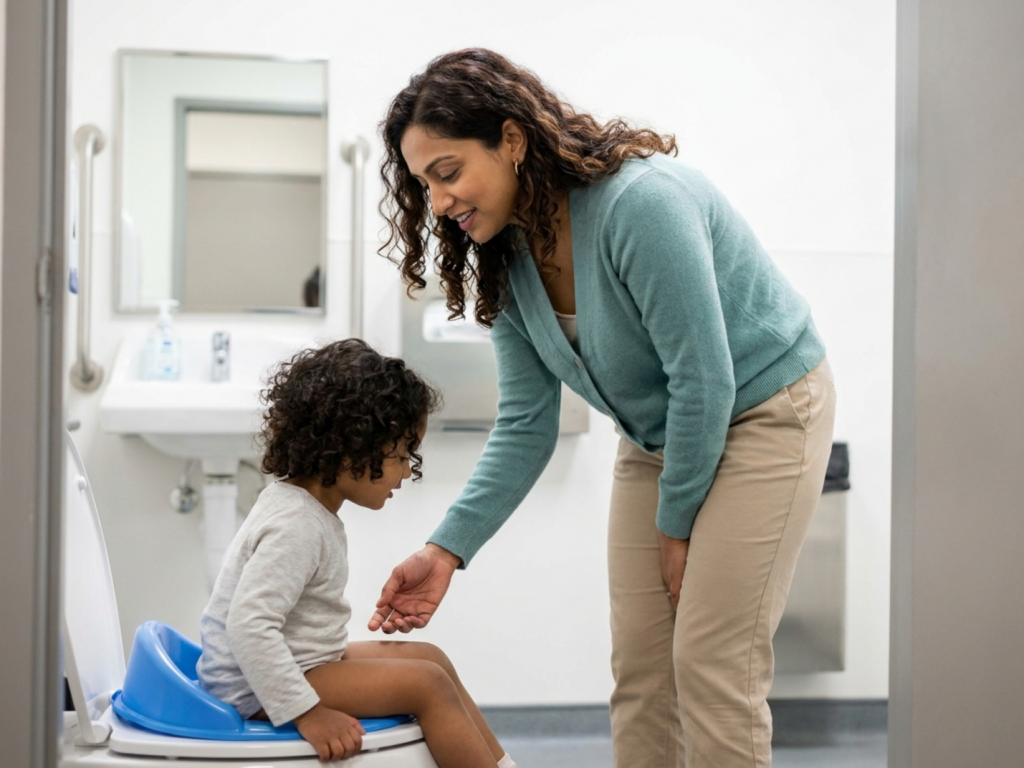
Some public toilets flush automatically or use strong suction. Explain the function calmly and keep the child seated until they are finished. A child who is frightened by a sudden flush may stand abruptly, slip, or attempt to climb away. If the child is very small, hold or steady them according to their developmental needs rather than relying on the toilet seat alone.
Match supervision to the child’s developmental stage
Supervision should be continuous and within immediate reach for infants, toddlers, and children who are unsteady, impulsive, medically complex, or still learning toileting. A child should not be left alone on a changing table, near an open toilet, or in a restroom containing water or cleaning equipment. Even a small amount of water can create a drowning risk for a young child who cannot lift their head or climb out independently, so drowning prevention in bathrooms depends on active, close supervision.
For a toddler or preschooler, the caregiver may need to provide hands-on help with clothing, sitting, wiping, flushing, and handwashing. Use simple, repeated instructions such as, “Feet on the floor,” “Hold my hand,” and “Wait until I say it is safe to stand.” Physical assistance should be respectful and explained in advance whenever possible.
School-age children may be able to use a restroom with less hands-on help, but independence is not the same as unsupervised safety. Consider the child’s judgment, coordination, communication skills, and the setting. A child who normally uses a restroom alone may need an adult nearby in a crowded venue, unfamiliar building, or restroom with a slippery floor. Agree on a check-in plan and teach the child where to wait if separated.
Children with mobility limitations, developmental differences, sensory sensitivities, or continence concerns may need additional preparation. An occupational therapist, pediatrician, or other healthcare professional can help families plan equipment, transfers, and accommodations suited to the child’s needs.
Prevent slips, falls, and toilet-related injuries
Falls are among the most important public restroom hazards. Ask the child to walk rather than run, and remove shoes or clothing only when the child is positioned securely. Keep one hand available to steady the child instead of carrying multiple items at once. If the child uses a stroller, wheelchair, or mobility aid, place it where it will not block the exit or roll toward wet areas.
Do not allow a child to stand on an adult toilet seat, squat on the rim, or climb onto a sink. These behaviors can lead to a fall, head injury, or contact with contaminated surfaces. A portable potty chair may be safer for some young children, but it should be placed on a level surface and kept under direct supervision. A training seat should fit the toilet securely and should not be treated as a substitute for adult assistance.
For transfers, explain each step before moving the child. Lock wheelchair brakes, position footrests safely, and use equipment only as intended. Caregivers should avoid lifting beyond their own safe capacity; asking facility staff or another trusted adult for assistance may prevent both child and caregiver injuries.
After a fall, observe the child for concerning changes such as loss of consciousness, repeated vomiting, seizure-like activity, worsening headache, unusual sleepiness, confusion, weakness, difficulty walking, or behavior that is clearly different from usual. These can be pediatric emergency warning signs and require urgent medical assessment. When in doubt, contact emergency services or a healthcare professional rather than relying solely on online advice.
Reduce burns, scalds, poisoning, and contamination
Public sinks may dispense water that is hotter than a child expects. Test the water yourself first and keep the child’s hands away from the faucet until the temperature is comfortable. Never leave a young child alone while the water is running. A brief exposure to very hot water can cause a scald, particularly on thin pediatric skin.
Hand hygiene is important, but children should not be expected to use harsh products without supervision. Use a small amount of available soap, prevent the child from putting it in their mouth or eyes, and rinse thoroughly. Alcohol-based hand sanitizer may be useful when soap and water are unavailable, but it should be applied by or under the close supervision of an adult because ingestion can cause serious toxicity. Keep sanitizer away from the child’s face and do not use it on visibly soiled hands when washing is possible.
Cleaning agents, disinfectant containers, drain chemicals, and other hazardous substances may be stored in staff-only areas, but a child could encounter them if a cabinet is open or a container is left unattended. Do not let children touch unlabeled liquids, tablets, powders, or equipment. Household chemical poisoning risk is not limited to the home; any unidentified product should be treated as potentially hazardous. If exposure occurs, move the child away from the source, avoid inducing vomiting, and contact local poison-control services or emergency services for product-specific guidance.
Encourage children to keep hands away from their mouth, eyes, and face until handwashing is complete. Avoid placing personal items on restroom floors or counters that appear visibly soiled. These steps reduce exposure to microorganisms, although no public restroom can be made completely sterile.
Teach privacy, body boundaries, and asking for help
Public restroom safety includes emotional and personal safety. Teach children that a trusted caregiver can help with toileting, wiping, clothing, or transfers, but that they can ask questions and say when something feels uncomfortable. Use anatomically correct terms and explain that private body parts deserve privacy and respectful care.
Before entering a public restroom, tell the child what will happen: where they will stand, who will help, whether the door will remain open or partly closed, and how they can call for you. A simple phrase such as “I need help” can be practiced in advance. Children should know not to leave with an unfamiliar person, open a locked stall for someone they do not know, or follow a stranger into another area. If an unfamiliar adult makes a child uncomfortable, the child should move toward the caregiver, restroom attendant, security desk, or another clearly identified trusted adult.
Respecting privacy does not mean leaving a child unsafe. A caregiver can provide appropriate assistance while using neutral language, limiting exposure, and explaining necessary contact. For older children, discuss how to handle a restroom that feels unsafe: leave, find the caregiver, and report the concern to staff. Rehearsing these steps calmly is more effective than using frightening stories.
Prepare for outings and respond calmly to incidents
A small preparation kit can make public restroom visits safer and less stressful. Depending on the child’s needs, it may include spare underwear and clothing, wipes, disposable changing supplies, a portable potty seat, gloves for the caregiver, hand sanitizer for supervised use, and a sealable bag for soiled items. Keep medications and medical devices in their original labeled containers and follow the child’s existing healthcare plan.
Before an outing, identify whether the destination has family restrooms, accessible stalls, changing tables, or a quiet space. If the child has a medical condition, continence difficulty, seizure disorder, mobility limitation, or sensory sensitivity, discuss an individualized plan with the child’s healthcare team. The plan may include transfer assistance, communication strategies, or signs that require immediate evaluation.
If a minor incident occurs, stay calm and move the child away from the hazard. For a small bump or brief slip, check the child carefully and continue observing. For bleeding, cover the wound with clean material and seek medical advice about the need for evaluation. For a suspected burn, chemical exposure, head injury, loss of consciousness, breathing difficulty, or submersion event, seek urgent professional help. Do not delay emergency care because the child appears calm or stops crying.
Afterward, report unsafe conditions to facility staff and document what happened while details are fresh. A near miss can reveal a loose fixture, wet floor, or equipment problem that should be corrected before another child is injured.
Build gradual, confident bathroom independence
Independence develops through repeated practice, not sudden withdrawal of supervision. Begin by teaching one step at a time: locating the restroom, walking safely, managing clothing, sitting securely, wiping, flushing, washing hands, and returning to the caregiver. Give the child enough time to process instructions, especially in a noisy or crowded environment.
Use specific praise for safe behaviors rather than praising speed. For example, acknowledge that the child waited for help, kept feet on the floor, or washed hands thoroughly. If the child has an accident, respond matter-of-factly and avoid shame. Stress that accidents and fears can be discussed with a trusted adult and, when persistent or medically concerning, with a pediatric clinician.
Review the plan periodically as the child’s height, strength, communication, and judgment change. The goal is not to eliminate every risk or make a child fearful of public spaces. It is to create predictable routines, maintain appropriate supervision, and give the child practical skills for safer participation in everyday life.
Seek urgent help for these warning signs
- Trouble breathing, blue or gray lips, collapse, or loss of consciousness
- A submersion event, even if the child initially seems recovered
- Severe or worsening pain, repeated vomiting, seizure-like activity, or confusion after a fall
- A significant burn, chemical exposure, or suspected ingestion of an unknown product
- Heavy bleeding, inability to use a limb normally, or a possible spinal injury
- Any concern that a child has been harmed, touched inappropriately, or cannot safely return with the caregiver
Tools & Assistance
- A destination-specific restroom and accessibility check before outings
- A compact toileting and clothing-change kit
- A simple child phrase for requesting help, such as “I need you now”
- Local emergency services and poison-control contact information
- Advice from a pediatrician, occupational therapist, or continence specialist when additional support is needed
FAQ
Can my child use a public restroom alone?
It depends on developmental maturity, judgment, communication, mobility, and the environment. A child who is usually independent may still need an adult nearby in an unfamiliar or crowded restroom. Follow local facility policies and prioritize immediate access to help.
Is it safe for a child to sit directly on a public toilet?
The main concerns are balance, falls, contact with contaminated surfaces, and automatic flushing. Help the child sit securely, use a properly fitted training seat when appropriate, and never allow climbing or standing on the toilet.
What should I do if my child touches a public restroom surface?
Stay calm. Help the child avoid touching their mouth, eyes, or face and wash hands with soap and running water. Seek medical advice if there was contact with an unknown chemical, visible blood, or another concerning substance.
When should a fall in a restroom be medically evaluated?
Seek urgent care for loss of consciousness, repeated vomiting, worsening headache, confusion, unusual sleepiness, seizure-like activity, weakness, trouble walking, breathing problems, severe pain, or any concern about a serious injury. Contact a healthcare professional if you are uncertain.
How can I support a child who is afraid of public restrooms?
Visit during quieter times, explain the routine beforehand, use calm language, and offer a trusted comfort strategy that does not compromise safety. Persistent anxiety, toileting regression, pain, or other concerning changes should be discussed with a pediatric healthcare professional.
Sources
- MedlinePlus, U.S. National Library of Medicine — Bathroom safety - children
- PubMed — Bathroom injuries in children less than 15 years old
- PubMed — Toilet Injuries Presenting to Emergency Departments, 2000–2019
Disclaimer
This article provides general educational information and does not diagnose, treat, or replace advice from a qualified healthcare professional. Seek urgent medical care for emergencies or contact a pediatric clinician when you are concerned about a child.
















Please log in to leave a comment.