
Intro
Knowing how to get help is an essential safety skill for children, not a reason to frighten them. A child does not need to understand every medical emergency or make a diagnosis; they need to recognize when an adult may need urgent help, know which number to use, and explain where they are and what has happened.
Emergency numbers differ by country. Families should teach the numbers used locally, write them clearly where children can read them, and practise calling in a calm, age-appropriate way. Children should also know their own full name, home address, a parent or caregiver’s phone number, and how to contact another trusted adult if their usual caregiver cannot answer.
Highlights
Teach children the local emergency number, such as 999 or 112 in the UK, and explain that it is for immediate danger or serious illness.
Make sure children know the difference between emergency services, urgent medical advice, and emotional or mental health support.
A child who calls for help should stay on the line, answer questions clearly, and follow the call handler’s instructions.
Keep a visible family emergency contact card and update it when phone numbers, addresses, or caregivers change.
Why children should learn emergency numbers
In an emergency, adults may be injured, confused, unconscious, absent, or unable to use a phone. A child who knows how to summon help can reduce delay during time-critical situations such as cardiac arrest, severe breathing difficulty in children, major bleeding, a serious allergic reaction, fire, or an immediate threat of violence. The child’s role is not to provide treatment or decide exactly what condition is present. Their role is to get a responsible adult or emergency dispatcher involved quickly.
Learning emergency numbers also supports independence. Children may be at home with a sibling, travelling with a school group, visiting relatives, or separated from caregivers in a public place. Explain that calling for help is appropriate when someone is in immediate danger, is very difficult to wake, is not breathing normally, has severe difficulty breathing, or has a serious injury. If a child is unsure, they should seek a nearby trusted adult and describe what they see rather than keeping the situation secret.
Use reassuring language: calling emergency services is a safety action, not something a child will be punished for when they genuinely believe help is needed. Teach children never to make prank or pretend emergency calls, because they can delay help for another person.
The main emergency numbers children may need
In the United Kingdom, 999 and 112 connect callers to emergency services, including ambulance, fire, and police assistance. A child should use one of these numbers when there is an immediate threat to life, serious injury, a fire, or another situation requiring rapid emergency response. The operator can help identify the appropriate service.
For urgent but non-life-threatening medical concerns in England, NHS 111 can provide advice and direct the caller to an appropriate service. Availability and arrangements differ across the UK, so families should check the system used in their nation and local area. A child should not delay an emergency call while trying to decide whether a problem is serious enough; when there may be immediate danger, use the emergency number.
Numbers vary internationally. For example, 911 is used in the United States and Canada, while 112 is an emergency number available across much of Europe and in some other locations. Before travel, caregivers should check the destination’s emergency number and save it in a child’s phone. The display should also include the child’s address, a caregiver’s number, and an alternative trusted contact.
Children should learn that emergency numbers are not interchangeable with ordinary contact numbers. A parent, school office, neighbour, or family doctor may be the right first contact for a minor concern, but an immediate safety threat requires emergency services.
Mental health and emotional crisis numbers
Children and adolescents can experience acute emotional distress, suicidal thoughts, self-harm urges, panic, abuse, or fear of harming someone else. These situations deserve the same seriousness as physical emergencies. Use clear, non-judgmental language and explain that a young person should tell a trusted adult promptly rather than managing a crisis alone.
In the UK, 999 or 112 is appropriate when there is immediate danger, a serious injury, an overdose, an attempt to end life, or an urgent risk that someone may act on suicidal thoughts. NHS 111 may help with urgent health concerns when there is no immediate danger, according to local service arrangements. For emotional support, services such as Childline and Samaritans may be available, and young people can also use text-based crisis support where offered. Current eligibility, opening hours, and contact methods should be checked with a caregiver or the service provider.
Teach children to say plainly: I am worried someone may hurt themselves; they have taken something; they are missing; or I do not feel safe. They do not need to use clinical terminology. If a child discloses suicidal thoughts or abuse, listen calmly, stay with them when safe, and involve an appropriate adult or emergency service. Do not promise secrecy when safety is at risk. Additional guidance about mental health emergencies in adolescents can help caregivers plan these conversations.
What to say when calling emergency services
Children often fear that they will not know what to say. A simple script can make calling more manageable. Teach them to state the emergency first, give the location, answer questions, and remain on the line until told to disconnect. Call handlers are trained to ask structured questions and may provide dispatcher-assisted instructions while help is being sent.
- Give the emergency number and say what happened: someone is unconscious, not breathing normally, severely injured, or in immediate danger.
- Give the exact location, including the house or flat number, street, town, floor, room, or a nearby landmark. If calling from a mobile phone, explain that the location may not be precise.
- Describe who needs help, including their approximate age if known, whether they are conscious, and whether they are breathing normally.
- Answer questions honestly. If the child does not know an answer, saying I do not know is better than guessing.
- Follow instructions, unlock the door if safe, and send another person to meet responders when possible. Do not hang up until the call handler says it is safe.
Children should never put themselves in danger to reach a person, retrieve medication, enter a fire, or confront a violent individual. They should move to a safer place and tell the dispatcher where they are. If a phone has no credit or the child is unsure of the address, they should still attempt to call the local emergency number and explain the problem.
How to teach emergency numbers by age
Teaching works best when it is repeated briefly during ordinary moments rather than introduced only during a frightening event. Preschool children may learn to identify a phone, unlock it with supervision, call a trusted adult, and give their name and address. They should understand that emergency calls are only for real danger and should not practise by contacting live services.
Primary-school children can learn the local emergency number, how to describe a location, and how to identify whether a person is awake and breathing normally without touching an unsafe scene. They can practise calling a caregiver from a locked or unfamiliar room using a family phone card. An adult can role-play a safe scenario and use a pretend or disconnected device so no real emergency line is contacted.
Older children and teenagers can learn how to report a road collision, fire, suspected poisoning, severe allergic reaction, or serious injury, while maintaining their own safety. They should also know how to access urgent medical and emotional support. Include children with communication, developmental, sensory, or language differences in planning; visual cards, simplified scripts, translation support, text relay options, or an emergency contact feature may help.
Practise calling emergency services using role-play, but make the exercise predictable and supportive. Afterward, ask what felt confusing and revise the plan. A child should know that they can call again if disconnected and that their safety comes first.
Create a family emergency contact plan
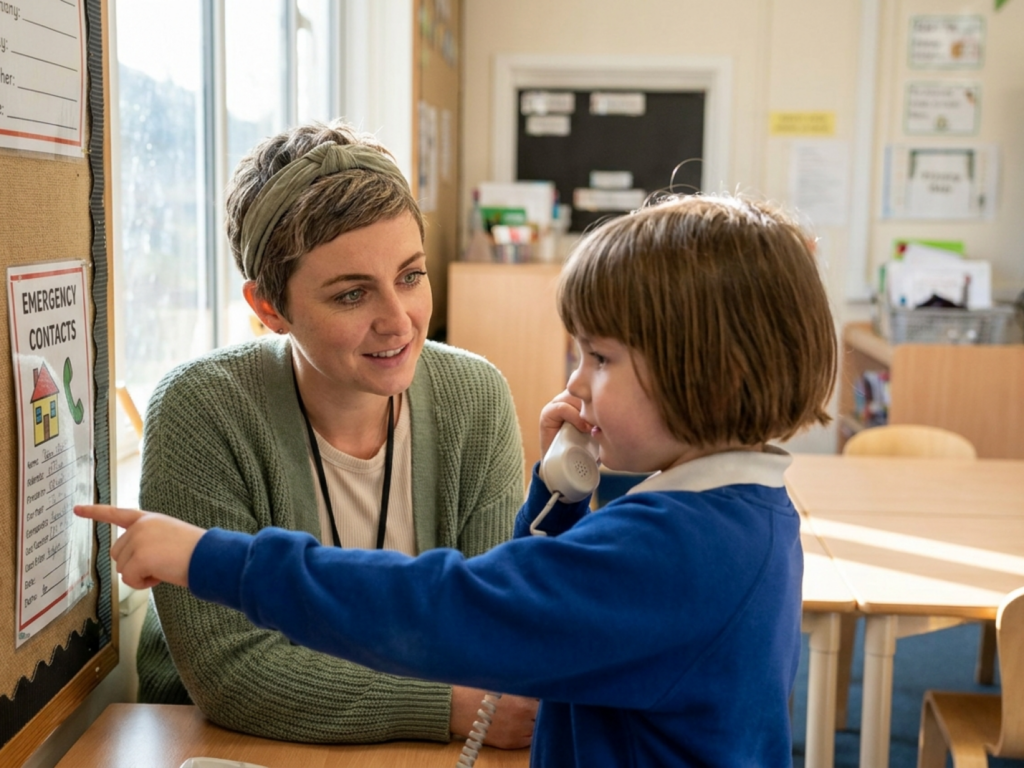
Write a family emergency contact card in large, readable print and place copies near home phones, in school bags, with a caregiver, and in a trusted relative’s home. Children should know how to find it without searching through private messages or relying on memory. Children’s Minnesota recommends displaying emergency and contact numbers clearly and teaching children their own phone number, both of which are practical safety measures.
The card may include:
- The local emergency number and the local urgent medical advice number
- The child’s full name, home address, postcode or ZIP code, and important access details
- Phone numbers for parents, caregivers, another trusted adult, and the child’s school
- Relevant information about communication needs, allergies, prescribed medicines, or complex medical conditions, handled with appropriate privacy
- The location of the nearest safe meeting point and instructions for contacting emergency services during a power or mobile-network interruption
Review the card after a move, change of school, new caregiver, or change in phone number. Discuss what to do if a caregiver does not answer: call the second contact, ask a trusted adult such as a teacher or neighbour, or use emergency services if there is immediate danger. Do not place responsibility for supervising younger children entirely on an older child; an emergency plan supports children but does not replace adult supervision.
Choosing the right kind of help
Children can use a three-level framework: immediate danger, urgent concern, or routine support. Immediate danger includes a person who is not breathing normally, severe breathing difficulty, uncontrolled bleeding, a fire, a serious accident, or an active threat. The child should move away from danger if possible and call the local emergency number.
An urgent concern may involve a child who is becoming significantly unwell but is awake, breathing normally, and not in immediate danger. In the UK, NHS 111 or the relevant local urgent-care pathway may provide direction. A caregiver should generally make this call, but an older child may need to do so if no adult is available. For routine concerns, contact a parent, school nurse, primary-care clinician, pharmacist, or another appropriate professional.
Children should not be expected to distinguish every emergency from a non-emergency. If they are frightened, uncertain, or told by a trusted adult to call, it is reasonable to seek help. Emergency call handlers and clinicians can assess the situation. Families can review pediatric emergency warning signs together, but online information should never delay urgent professional assessment.
Reassure children that emergency responders are there to help. After any real event, give the child time to ask questions and consider support from a healthcare professional if they remain distressed, have sleep disruption, or show persistent changes in behavior.
When a child should call immediately
- Someone is unconscious, difficult to wake, or not breathing normally.
- There is severe breathing difficulty, major bleeding, a serious injury, or a rapidly worsening condition.
- There is a fire, dangerous gas or chemical exposure, violence, or another immediate threat.
- Someone may have taken an overdose or may imminently harm themselves or another person.
- The child is alone and cannot reach a trusted adult while a serious danger is unfolding.
Tools & Assistance
- A laminated family emergency contact card in large print
- A supervised phone practice script using a disconnected or pretend device
- An emergency-contact entry saved in the child’s phone and checked regularly
- A list of local emergency, urgent medical, and emotional-support services
- A planned safe meeting point and backup caregiver
FAQ
Should a child call 999 or 112 if they are unsure?
If there may be immediate danger or a life-threatening medical problem, the child should call the local emergency number. They should explain what they see and follow the dispatcher’s questions rather than trying to diagnose the situation.
What if a child does not know the exact address?
They should give as much location information as possible, such as a nearby shop, school, road, landmark, or building name. They should say clearly that they do not know the exact address and answer the dispatcher’s questions.
Can children call emergency services for mental health concerns?
Yes. A child should call emergency services when someone is in immediate danger, has attempted self-harm, has taken an overdose, or may act on an immediate threat. For urgent but non-immediate distress, a trusted adult or appropriate crisis and healthcare service may help.
How often should families practise?
Review the plan periodically and whenever contact details or living arrangements change. Use brief, calm role-play rather than repeated frightening drills, and never place a live test call to emergency services.
Sources
- Children's Minnesota — Getting Help: Know the Numbers
- Avon and Wiltshire Mental Health Partnership NHS Trust — I need help now
- Mind — Useful contacts for support - for 11-18 year olds
Disclaimer
This article provides general safety information and does not replace emergency services or advice from a qualified healthcare professional. If a child may be in immediate danger or seriously unwell, contact the local emergency number without delay.
















Please log in to leave a comment.