
Intro
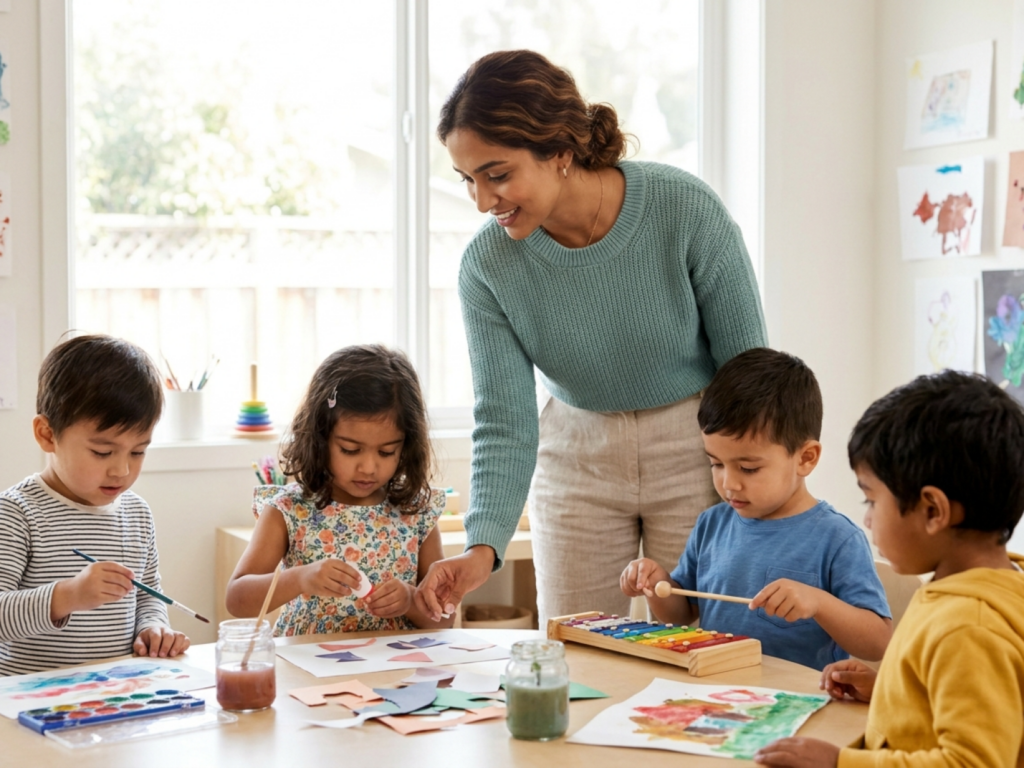
Arts, crafts, and music give children a structured way to explore ideas, feelings, and social connection. A child may not have the words to explain frustration, curiosity, grief, or excitement, but a drumbeat, a paintbrush, or a glue stick can become a safe language for expression.
For families and caregivers, the goal is not to produce perfect artwork or polished performances. It is to create regular opportunities for experimentation, repetition, and enjoyment. Research suggests that creative experiences can support aspects of cognition, executive control, and social-emotional growth, although benefits vary by age, setting, and the quality of the activity.
Highlights
Creative activities can support language, motor coordination, attention, and self-regulation. The value often comes from the process, not the finished product.
Music instruction has been associated with changes in executive control and behavior, but the effects depend on intensity, duration, and the broader learning environment.
Structured art experiences may support cognition in young children, especially when adults provide consistent materials, encouragement, and room for exploration.
Arts participation can also help children practice empathy, turn-taking, frustration tolerance, and emotional expression in a low-pressure setting.
Why creative expression matters in childhood
Children learn through action, repetition, and meaningful play. Arts, crafts, and music provide all three. When a child tears paper, shapes clay, shakes a rattle, or chooses colors for a drawing, they are practicing decision-making, cause-and-effect reasoning, and flexible thinking. These experiences also invite curiosity, which is an important driver of learning.
Creative expression can feel especially helpful because it is often less demanding than direct conversation. A child who struggles to name feelings may still show them through color choice, volume, rhythm, or movement. That does not mean an artwork or song should be interpreted like a diagnostic test. It simply means creative activities can offer another route for communication.
Not every child responds in the same way. Some prefer painting and collage. Others feel more comfortable with singing, drumming, building, or movement-based games. A supportive environment respects temperament and sensory preferences rather than pushing one ideal form of expression.
What children are practicing when they paint, build, and sing
Behind the apparent simplicity of creative play is a great deal of neurological and cognitive work. In music training, researchers have reported associations with executive control, which includes skills such as planning, inhibition, working memory, and attentional shifting. These skills help children wait their turn, follow multi-step directions, and keep track of a goal while the activity changes.
Visual art can also be cognitively enriching. In a structured art intervention, children are asked to observe, select, compare, and adapt, all of which recruit attention and problem-solving. The point is not to claim that a single art lesson permanently changes the brain, but that repeated, well-supported creative experiences may contribute to development over time.
In everyday life, creative play in children may look wonderfully messy. A child might switch roles in pretend play, sing the same line again and again, or cover a page with circles before adding detail. Those repeated choices are part of learning how to sustain attention, plan actions, and adjust to feedback.
For many children, this is also where self-efficacy begins: the internal sense that, with effort, they can make something happen.
Matching the activity to the child's age and temperament
The best creative activity is one that a child can actually use. Toddlers usually benefit from large, safe materials: thick crayons, washable paint, simple stamps, chunky blocks, and shaker instruments. Preschoolers often enjoy paper collage, rhythm games, singing with gestures, and dramatic play. Older children may want more control over detail, sequence, and performance.
Temperament matters as much as age. A highly active child may enjoy drumming, dancing, or construction. A quieter child may prefer drawing, beadwork, or listening closely to a song before trying it. Children with sensory sensitivities may need softer sounds, simpler textures, or shorter sessions. In some cases, a smaller group or calmer room can make the difference between engagement and overload.
Materials do not need to be expensive. Recycled paper, cardboard, spoons, cardboard tubes, fabric scraps, and homemade shakers can be enough. The important part is not the cost but the invitation to explore. When adults make room for choice, children are more likely to stay engaged long enough to develop confidence and skill.
Social and emotional benefits beyond the finished product
Research reviews from early childhood arts participation consistently highlight social and emotional gains. Shared music, drawing, theater, and craft activities can help children practice turn-taking, cooperation, empathy, and reading social cues. These are not abstract benefits. They show up when children wait for a cue, listen to another child’s idea, or repair a small conflict over materials.
Creative activities also support emotional regulation, the capacity to notice a feeling and modulate the response. A child who is upset may calm more easily while squeezing dough, tapping a steady beat, or coloring in long strokes. Another child may use music to energize after a quiet transition. The activity is not magic; it is a structured outlet that can make regulation easier.
Adults sometimes focus too much on product: a neat drawing, a finished craft, or a perfect song. In childhood, process is usually more valuable. If a child experiments, makes choices, tolerates a little frustration, and tries again, the activity has already done meaningful developmental work.
That process is one reason Creative development through play is such a useful idea for families and teachers. Artistic expression is not separate from learning; it is one of the ways learning becomes embodied, social, and memorable.
Building creative routines at home and school
Creative routines work best when they are simple and repeatable. Many families do well with a small basket of materials that stays available, such as paper, crayons, stickers, child-safe scissors, tape, and a few musical instruments. Schools and childcare settings may schedule short, predictable creative blocks so children know when to expect them.
It helps to reduce pressure. Instead of asking, What did you make? try What was that like? or Which part did you enjoy? This keeps attention on exploration rather than evaluation. If a child wants to sing the same song ten times, that repetition may reflect learning, mastery, or comfort, not boredom.
If you are looking for creative hobbies for children, choose options that fit your daily life rather than your ideals. A five-minute rhythm game before dinner, a paper collage after school, or a weekend family song can be enough to sustain interest. Small, regular moments often matter more than occasional elaborate projects.
Caregivers can also model participation without taking over. Sitting nearby, keeping materials ready, and joining briefly when invited communicates that creativity is valued. This kind of gentle support often works better than correction or constant instruction.
When to ask for extra support
Most children vary in interest from day to day, and occasional resistance is normal. Still, it is reasonable to seek professional guidance if a child consistently avoids all creative activities, becomes extremely distressed by ordinary sounds or textures, or loses previously enjoyed skills. Concerns about hearing, fine motor coordination, attention, language, or social interaction also deserve attention if they are persistent.
Sometimes the issue is not motivation but access. A child with motor difficulty may need adapted tools. A child with sensory sensitivities may need quieter instruments or a smaller group. A child with developmental differences may benefit from a more structured plan. A pediatrician, occupational therapist, speech-language pathologist, child psychologist, or other qualified clinician can help clarify what is needed.
The main message is reassuring: creative expression should feel safe enough for exploration. If it does not, that is a signal to adjust the environment and, when appropriate, ask for help.
When to seek professional guidance
- A child suddenly stops using skills they previously had, such as drawing, singing, or following simple rhythm patterns.
- Creative activities trigger intense distress, pain, or strong sensory discomfort that does not improve with small adjustments.
- There are ongoing concerns about speech, hearing, fine motor control, attention, or social interaction.
- A child shows frequent frustration, withdrawal, or loss of interest across many activities, not only art or music.
Tools & Assistance
- Pediatrician or developmental specialist
- Occupational therapist for sensory or fine motor concerns
- Speech-language pathologist for communication concerns
- Community art class, library program, or early childhood music group
- Child psychologist or counselor when emotional regulation is a concern
FAQ
Is music better than art for child development?
Not necessarily. Music, drawing, crafts, and movement can all support different skills. The best choice is often the activity the child will join willingly and repeat over time.
Can creative activities improve attention or self-control?
They may support those skills, especially when the activity is structured and repeated. Research on music training suggests possible benefits for executive control, but results vary and are not guaranteed.
What if my child makes a mess or loses interest quickly?
That is common, especially in younger children. Try shorter sessions, fewer materials, and a low-pressure approach that values exploration more than a perfect result.
Should I worry if my child does not like singing or painting?
No. Children have different preferences. If the child enjoys blocks, movement, rhythm, storytelling, or building, those are also valid creative expressions.
Sources
- PubMed — Music training and child development: a review of recent findings from a music-neuroscience perspective
- PubMed Central — Cognitive enrichment through art: a randomized controlled trial with children from a disadvantaged population
- National Endowment for the Arts — The Arts in Early Childhood: Social and Emotional Benefits of Arts Participation: A Literature Review and Gap-Analysis (2000-2015)
Disclaimer
This article is for educational purposes only and does not replace individualized medical, developmental, or mental health advice. If you have concerns about a child's hearing, behavior, sensory responses, or development, consult a qualified healthcare professional.















Please log in to leave a comment.