
Intro
Children and adolescents increasingly use digital spaces to talk, play, and maintain friendships. For many families, online connection is now part of ordinary social life rather than a separate activity, especially when school, gaming, and messaging platforms overlap.
This can be supportive when it helps a child feel included, practice communication, or stay connected across distance. It can also become stressful if online contact crowds out sleep, school, or face-to-face relationships. The key question is not simply how much time a child spends online, but what the interaction is doing for their emotional and social wellbeing.
Highlights
Online social interaction can support belonging, especially when children use it to maintain friendships, collaborate, or recover from isolation.
Recent WHO evidence shows that many adolescents stay in continuous online contact with friends, and patterns vary by age, gender, and country.
Some children use online communication more when they feel lonely or socially anxious, which may reflect an attempt to reduce discomfort rather than avoid people entirely.
Problems are more likely when online contact disrupts sleep, schoolwork, offline play, or emotional regulation.
Supportive adult guidance works best when it is calm, curious, and focused on function rather than blame.
What online social interaction means for children
Online social interaction includes texting, group chats, video calls, shared gaming, class platforms, and social apps where children exchange messages or reactions. It is not identical to face-to-face play, but it can still involve turn-taking, humor, conflict, repair, and friendship maintenance.
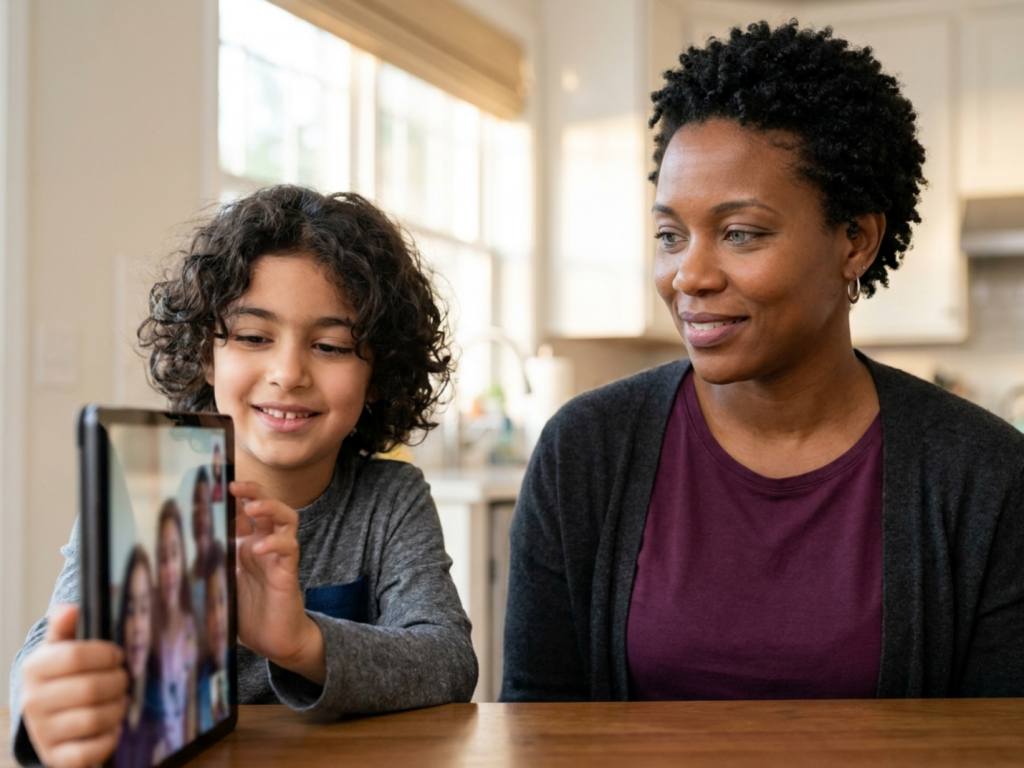
WHO reports show that continuous online contact with friends is common in adolescence, and the pattern is shaped by age, gender, and country. That matters because digital contact is not a single behavior; it can range from brief, supportive check-ins to hours of highly stimulating, hard-to-stop engagement. A younger child may use a tablet to talk with cousins, while an older child may rely on group chats to coordinate belonging in a peer group.
From a developmental perspective, the question is whether online contact supports social development or replaces opportunities that are still important, such as in-person play, sleep, movement, and family conversation. In practice, many children need both. Healthy online use usually feels flexible, shared, and recoverable. Difficult use tends to feel urgent, secretive, or hard to interrupt.
How digital contact can support social growth
For many children, online spaces offer a low-pressure place to practice communication. A child can rehearse jokes, learn group norms, ask for clarification, and repair small misunderstandings without the full intensity of a face-to-face audience. This is one reason digital platforms may feel safer for some children than a noisy classroom or crowded playground.
Online interaction can also sustain friendship during illness, relocation, family separation, or school transitions. Children who miss peer interaction after school may use messages or games to stay emotionally connected. In that sense, digital contact can be a bridge rather than a substitute. It may help a child preserve friendship skills in elementary school and beyond, especially when adult support keeps the interaction positive and age-appropriate.
For some children, digital games and social communication overlap. Cooperative play, shared goals, and light competition can offer structured practice in negotiation and perspective-taking. The key is that the activity remains developmentally balanced: it should leave room for school, offline play, and rest, not crowd them out.
Why some children lean on online communication more heavily
Not every child uses online contact for the same reason. The PubMed study on loneliness and social anxiety found that children and adolescents who felt lonelier or more socially anxious were more likely to use online communication frequently. This does not mean online contact is harmful by itself. It may mean the child is trying to meet a real social need in a setting that feels more manageable than direct conversation.
Typed or asynchronous communication can feel easier because it gives a child more time to think before responding. That can be especially helpful for children who worry about being judged, who struggle to enter groups, or who feel overwhelmed by nonverbal cues. In some cases, online interaction temporarily compensates for weaker offline social confidence.
At the same time, heavy reliance on online contact can become a signal that something else needs attention: loneliness, bullying, family stress, low mood, or social anxiety. The online behavior is not the diagnosis. It is a clue. A calm conversation about when, where, and with whom the child feels most comfortable can be more informative than counting minutes alone.
Benefits and risks that deserve equal attention
The benefits of online social interaction are real. Children may feel less isolated, maintain contact with friends during holidays or illness, and find communities that share interests, hobbies, or school projects. For some, online groups may offer a sense of belonging that is hard to find elsewhere. That feeling can be protective for mood and self-esteem.
But there are also risks. Rapid messaging, public reactions, and constant notifications can make social life feel intense and difficult to step away from. Poor sleep is common when devices stay in bedrooms or when a child feels compelled to reply late at night. Exposure to comparison, exclusion, or pressure to perform can worsen irritability and lower self-worth. Questions about cyberbullying and child wellbeing are especially important when a child becomes withdrawn, fearful, or unusually secretive about their device use.
Some children also experience conflict between online and offline identity. They may feel they must stay available to avoid missing out, which can contribute to stress and compulsive checking. In those situations, the problem is often not the technology itself but the pattern of reinforcement, emotional dependence, and reduced recovery time between interactions.
How caregivers can support healthy online relationships
Support starts with curiosity. Ask who the child talks to, what they do together, and how they feel afterward. A child who returns from a chat feeling energized, calm, and connected is in a different situation from a child who becomes tense, tearful, or unable to log off. Those emotional patterns are often more useful than screen time alone.
Families can reduce friction by creating predictable routines: device-free meals, a regular bedtime, and shared rules about where screens are used. It also helps to review privacy settings for child accounts, friend lists, and notification controls together rather than treating them as one-time technical fixes. When adults model balanced use, children usually notice more than they admit.
Encourage offline anchors as well: sports, art, reading, family conversation, and unstructured play. This is not about punishing online life. It is about keeping a child’s social world wide enough that one platform does not carry all the emotional weight. If a child uses online contact because face-to-face social situations feel difficult, a gentle step toward support may be more helpful than sudden restrictions.
When to seek professional guidance
Consider talking with a pediatrician, school counselor, or child mental health professional if online social interaction is linked to persistent sadness, irritability, panic, sleep loss, school refusal, or withdrawal from friends and family. If a child seems unable to tolerate being offline, hides interactions, or becomes distressed whenever access is limited, that pattern deserves attention.
Professional input is especially important when there is repeated harassment, sexual pressure, threats, or signs of self-harm. In those situations, the goal is safety first, then a broader look at emotional and developmental needs. A clinician can help distinguish a temporary adjustment problem from a wider concern such as anxiety, depression, or significant social stress.
It can be helpful to mention developmental surveillance for social concerns if a child has long-standing difficulty with peer relationships, communication, or emotional regulation. That does not mean a child has a disorder. It simply means their social functioning may benefit from closer, structured review over time.
Warning signs that need attention
- A child stops sleeping well because they feel they must stay online to keep friendships.
- Online contact is followed by tears, panic, anger, or a persistent drop in mood.
- The child hides messages, fears logging off, or seems trapped in constant checking.
- There is repeated cyberbullying, threats, sexual coercion, or pressure to share images.
- The child talks about self-harm, hopelessness, or wanting to disappear.
Tools & Assistance
- A family media plan agreed on with the child
- Pediatrician or school counselor for a social and emotional check-in
- Built-in privacy, friend, and notification settings on the child’s device
- A bedtime routine that keeps screens out of the sleep environment
- Local crisis or emergency mental health services if safety concerns arise
FAQ
Is online social interaction bad for children?
Not necessarily. It can support friendships and belonging when it is balanced, supervised as needed, and not crowding out sleep or offline life.
Why does my child prefer chatting online instead of face-to-face time?
Some children find online interaction less intimidating, especially if they are shy, lonely, or socially anxious. It is worth exploring what feels easier and whether they are getting enough support.
Can online communication help with social skills?
Yes, sometimes. Messaging, gaming, and video calls can provide practice with turn-taking, cooperation, and repairing misunderstandings, especially when adults help keep the experience positive.
When should I ask for professional help?
Seek help if online contact is linked to sleep loss, school problems, withdrawal, marked distress, bullying, or any self-harm concern.
Sources
- World Health Organization (WHO) — Teens, screens and mental health
- World Health Organization Regional Office for Europe — A focus on adolescent social media use and gaming in Europe, central Asia and Canada
- PubMed — The relationship of loneliness and social anxiety with children's and adolescents' online communication patterns
Disclaimer
This article is for general information only and is not a diagnosis or a substitute for medical or mental health advice. If you are worried about a child’s mood, behavior, safety, or online experiences, please speak with a qualified healthcare professional.


















Please log in to leave a comment.