
Intro
Disagreements are a normal part of childhood. Children do not just argue to be difficult; they are practicing how to protect their own needs, understand another person's point of view, and find a workable solution. In early childhood, these skills are still developing, so conflict may look messy, loud, or repetitive before it looks cooperative.
A supportive adult can help children move from impulsive reactions toward more flexible problem-solving. That does not mean every disagreement should be stopped immediately. It means adults can notice what the child is trying to communicate, keep everyone safe, and teach skills that build over time, including emotional regulation, perspective-taking, and children's conflict resolution skills.
Highlights
Many childhood disagreements are developmentally typical and reflect growing autonomy, not bad character.
Toddlers often clash over objects and possession, while preschoolers begin to use explanation and negotiation more often.
Children may insist, disengage, ask for adult help, or try to compromise depending on language and social skills.
Adults help most when they stay calm, set limits, and model constructive repair instead of escalating the conflict.
Why disagreements are part of normal development
Children are learning how to be separate people while still staying connected to others. That developmental task creates friction. A child may want the same toy, the same seat, the same turn, or the same attention as someone else, and the resulting disagreement is often a first lesson in fairness, patience, and shared space.
In younger children, these moments are closely tied to brain maturation. Skills such as inhibitory control, cognitive flexibility, and emotional regulation are still emerging, so a child may know what they want long before they can explain it calmly. Adults sometimes mistake this for deliberate defiance, but it is often better understood as immature self-management.
When children are allowed to experience small, safe disagreements with guidance, they practice negotiation, compromise, and repair. These experiences help build social competence over time. The goal is not to remove every conflict. The goal is to make sure the child learns that conflict can be handled without humiliation, force, or fear.
How toddlers and preschoolers usually respond
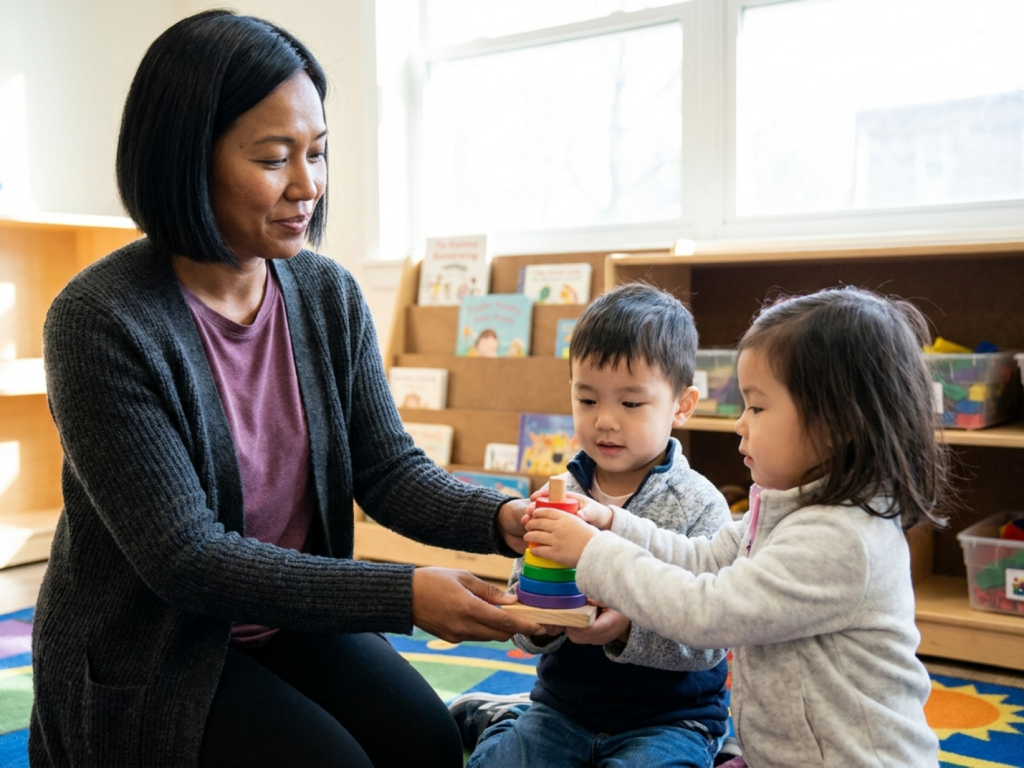
Research on early childhood conflict shows a developmental pattern. Toddler disagreements often center on object possession: who has the block, the cup, the car, or the seat. At this stage, children may grab, resist, cry, insist, or simply walk away because their language and planning skills are still limited. Their behavior can look abrupt, but it often reflects a very concrete problem.
As children move into the preschool years, they usually gain more words and more social understanding. That shift changes how they handle disagreement. They are more likely to explain their view, propose a swap, ask for a turn, or use prosocial actions such as offering an alternative toy. They may still become upset, but they have more tools to work with.
Common strategies include:
- Insisting on their own idea or possession.
- Negotiating for a turn or trade.
- Disengaging when the situation feels overwhelming.
- Seeking help from adults when the conflict feels too hard to solve alone.
None of these strategies is automatically good or bad. The important question is whether the child can eventually move toward a safer, more flexible solution.
Why context matters so much
The same child may handle one disagreement well and another poorly. That is because context matters. A child who is rested, fed, and playing with a familiar friend may negotiate more easily than the same child who is tired, overstimulated, or competing for a highly desired item. Setting, time pressure, and adult expectations all shape the outcome.
Family relationships matter too. In parent-child conflict, constructive comments from both adults and children are associated with a greater chance of compromise rather than deadlock. In practical terms, this means that the tone of the interaction can matter as much as the topic itself. A child who feels heard is more likely to stay engaged long enough to solve the problem.
Children also watch how adults handle disagreement with each other. If they see calm explanation, turn-taking, and repair, they are more likely to copy those patterns. If they see shouting, insults, or threats, they may learn to expect conflict to become unsafe. This is why disagreement should be viewed as a relational event, not only a child behavior problem.
What adults can do in the moment
When a disagreement begins, the adult’s first job is regulation, not lecture. A calm voice, clear boundaries, and a steady pace help lower the emotional temperature. This is the idea behind co-regulation before self-regulation: children often need an adult nervous system to help them settle before they can use their own coping skills.
Helpful responses include active listening with children, naming the problem in simple words, and giving two acceptable options. For example: ‘You both want the red truck. One child can use it for two minutes, then we switch,’ or ‘I hear that you are upset because you wanted the last turn.’ These statements do not reward aggression; they show the child that their perspective was understood.
Adults can also coach repair after a parent-child argument or peer disagreement. Repair may include an apology, a redo, or a practical fix such as returning an item or inviting the other child back into play. The message is that conflict can be addressed without shame. Over time, that approach strengthens and makes compromise feel possible instead of threatening.
Try to avoid lengthy explanations during peak emotion. Children usually need short phrases, simple limits, and time to recover before they can think clearly.
When disagreement is no longer just ordinary conflict
Most childhood disagreements are brief and manageable. Still, some patterns deserve closer attention. Seek professional assessment for persistent conflict if disagreements are frequent, very intense, or lead to injury, if a child seems unable to recover after arguments, or if family life becomes organized around avoiding the next explosion. These patterns may signal broader difficulties with emotional regulation, communication, anxiety, or neurodevelopmental functioning.
It is also worth asking whether the child has language delays, hearing problems, learning differences, sensory sensitivities, or sleep problems, because these can make conflict harder to manage. A child who cannot express needs clearly may rely more on grabbing, crying, or shutting down. That does not mean the child is choosing poor behavior on purpose; it means the child may need support beyond ordinary discipline.
Red flags include repeated hitting or biting, threats, intense fear of peers, constant deadlock with no repair, or a child who becomes isolated because conflict is pushing others away. In these cases, a pediatrician, child psychologist, or school-based professional can help assess what is driving the pattern and what supports are appropriate.
How adults can model better conflict habits
Children learn a great deal from the way adults handle small disagreements. When caregivers model respect, they teach the child that disagreement does not have to become rejection. That includes saying what is needed without ridicule, listening long enough to understand the other side, and returning to the conversation after everyone is calmer.
Use clear, concrete language. Replace vague criticism with a description of the behavior and a next step: ‘I cannot let you grab. You may ask for a turn.’ That approach keeps the limit firm while still giving the child a path forward. For older children, naming feelings and goals can help them think more flexibly: ‘You are frustrated because you want fairness. Let’s figure out a fair order.’
Repair matters after the argument ends. A simple check-in, apology, or shared plan for next time helps children learn that relationships can survive conflict. That is often what they remember most. If disagreements stay frequent despite consistent support, talk with your child’s healthcare professional, school staff, or a child mental health specialist about next steps.
Watch for these warning signs
- Disagreements regularly become physical, unsafe, or threatening.
- A child cannot calm down or return to normal activities after conflict.
- The same conflict repeats many times a day with little improvement.
- Family life or school participation is being disrupted by ongoing deadlock.
- Language, sleep, or sensory concerns may be making conflict harder to manage.
Tools & Assistance
- Pediatrician for developmental and behavioral screening
- Child psychologist or licensed therapist
- School counselor or classroom teacher
- Speech-language pathologist if communication skills are delayed
- Family therapist for repeated conflict patterns
FAQ
Are disagreements normal in young children?
Yes. They are common and often reflect growing independence, limited language, and still-developing self-control.
Why do toddlers fight over toys so much?
Toddlers usually focus on object possession and turn-taking, so the conflict is often about who has what right now.
What is the best thing an adult can do first?
Stay calm, set a clear limit, and help the child settle before trying to solve the problem.
When should I ask for professional help?
If conflict is frequent, intense, unsafe, or causing major problems at home or school, speak with a healthcare professional.
Sources
- Taylor & Francis — Conflict strategies in early childhood: a phenomenographic study of children’s conflict resolution
- SAGE Journals — Approaches to conflict and conflict resolution in toddler relationships
- PubMed — Characteristics of mother-child conflict and child sex predicting resolution
Disclaimer
This article is for general information only and is not a diagnosis or treatment plan. If a child has severe, frequent, or unsafe conflict, please consult a qualified healthcare professional.















Please log in to leave a comment.