
Intro
Learning works best when attention and memory cooperate. Attention helps a child select what matters in the moment, while memory holds on to that information long enough to use it again. When a child seems to forget quickly, it does not automatically mean there is a serious problem; often the task was too noisy, too fast, too long, or too demanding for the child’s current attentional capacity.
This article explains how attention shapes what gets encoded into memory, why some study habits help more than others, and when families should ask a clinician or school team for support. The goal is not to push children harder, but to make learning more realistic, kinder, and more effective.
Highlights
Attention acts like a filter: the brain cannot encode everything equally well, so focused attention improves what enters memory.
Memory is not one single skill. Working memory, episodic memory, and long-term memory each support learning in different ways.
Children learn better when tasks are short, clear, and free of unnecessary distraction.
Spaced review, self-testing, and strategic breaks are backed by learning science and are often more helpful than last-minute cramming.
Ongoing attention or memory concerns deserve a professional conversation, especially if they affect daily life or show up in more than one setting.
How attention opens the door to memory
Attention is the brain’s way of saying, this information is worth processing now. In learning, that matters because memory does not record every detail from the environment. Instead, it selects. Research on attention and episodic memory shows that goal-directed attention helps determine what gets encoded, especially when a child is trying to understand, remember, or solve a problem. In simple terms, the brain is not a camera; it is a decision-maker.
This is why two children can hear the same lesson and remember it differently. One child may be looking at the teacher, listening to the key words, and connecting the new idea to something familiar. Another child may be distracted by noise, worry, fatigue, or a screen in the room. The second child is not necessarily less capable; the brain may simply have had fewer clean moments to process the new information.
From a neuroscience perspective, attention and memory involve networks that include the prefrontal cortex, which helps with goal setting and control, and the hippocampus, which is important for forming new episodic memories. When attention is scattered, the memory trace is often weaker. When attention is stable, the memory trace is more likely to be detailed and usable later.
What memory does during learning
Memory supports learning in stages. First, information must be encoded, meaning the brain has to take it in and give it some structure. Next comes consolidation, when the brain stabilizes the new information over time. Finally, retrieval allows the child to bring the information back when needed, such as during class discussion, homework, or a test.
Working memory is especially important in childhood learning. It is the short-term mental workspace that lets a child hold a few pieces of information at once, such as remembering a math instruction while writing the answer. Because working memory is limited, children can become overloaded quickly if instructions are long or if several tasks are introduced at once. That is one reason brief, well-organized lessons often work better than long, crowded ones.
Long-term memory is where knowledge becomes more durable. In Memory development in children, a new idea may first be remembered as a single event, then repeated, linked to other ideas, and eventually stored as knowledge that can be used in new situations. Sleep also matters, because consolidation is helped by rest. This does not mean every child needs more sleep as the only solution, but it does mean learning and rest are closely connected.
Why children lose focus
Children lose focus for many ordinary reasons. Hunger, tiredness, anxiety, boredom, overstimulation, and difficult material can all reduce attention. In addition, children are still developing executive functions, the mental skills that help with planning, inhibition, shifting between tasks, and monitoring mistakes. That is why a child may do well one day and struggle the next, especially if the setting changes.
How brain development affects learning is especially clear in childhood, because attention systems are still maturing. A younger child may be able to focus intensely for a short period but struggle with long, self-directed work. An older child may manage more sustained attention, yet still need clear structure when a task is unfamiliar or emotionally loaded.
It can help to think of focus as a limited resource rather than a fixed trait. When the environment is noisy or the goal is unclear, the child spends more mental energy on filtering distractions and less on learning itself. When the environment is calm and the task is broken into manageable steps, more attention can be used for understanding.
- Common attention drains include fatigue, hunger, stress, and too much visual or sound stimulation.
- Unclear instructions can make working memory overload worse.
- Tasks that feel too easy or too hard can both reduce engagement.
Study strategies that fit how the brain learns
Several evidence-based habits help children remember more without needing to study longer. One of the strongest is spaced review: revisiting material in short sessions over days or weeks instead of trying to learn everything at once. Spacing gives memory more than one chance to strengthen, and it reduces the illusion that a child has learned something just because it felt familiar in the moment.
Self-testing is another powerful strategy. Asking a child to recall an answer, explain an idea, or use a fact in a new sentence is more effective than simply rereading. Retrieval practice tells the brain which information is actually accessible. It also reveals what still needs attention, which is useful for parents and teachers because it makes learning visible.
Harvard’s learning guidance also emphasizes reducing distractions and taking strategic breaks. A short break can reset attention before mental fatigue builds up. For many children, a routine such as a focused work period, a brief movement break, and then another work period is easier to sustain than one long session.
- Keep study materials simple and uncluttered.
- Use one clear goal at a time.
- Mix review of old material with new learning.
- Return to difficult material after a pause, not only in the same sitting.
These strategies are not about pressure. They are about matching learning to how memory and attention actually work.
A supportive home and school environment
Children usually learn best when adults lower the cognitive load around them. Cognitive load is the amount of mental effort required by a task. If the instructions are too complex, the room is too busy, or the child is expected to do several things at once, the brain may spend more resources on managing the situation than on learning the material itself.
Simple supports can make a large difference. A quiet place to work, a predictable routine, a visual checklist, and one instruction at a time can all help children stay oriented. In a classroom, it can also help when teachers preview the goal, repeat key points, and check understanding before moving on. At home, adults can ask a child to explain the task back in their own words, which supports both attention and retrieval.
For some children, movement helps focus. A brief walk, stretch, or water break can reduce restlessness and improve the next study interval. For others, it may be enough to close a tablet, turn off background noise, or sit near a calm adult. The best approach depends on the child and the task, so it is reasonable to experiment gently rather than assuming one method fits every learner.
If you want another practical overview, How to improve child focus and concentration skills discusses child-friendly ways to shape attention without making learning feel punitive.
When to ask for professional advice
Some variability in attention and memory is normal. Children have off days, and even strong learners can struggle when tired, anxious, or unwell. Still, persistent concerns deserve attention, especially if they affect school performance, daily routines, social interaction, or confidence.
It is a good idea to speak with a pediatrician or another qualified clinician if a child shows a clear change from their usual abilities, has trouble following age-appropriate instructions in more than one setting, seems unable to retain basic information despite repeated teaching, or appears to lose skills that were previously established. Hearing or vision problems, sleep disorders, anxiety, language difficulties, and other developmental issues can also interfere with learning and should be considered by professionals.
Parents and teachers do not need to decide on a diagnosis. Their role is to notice patterns, collect examples, and ask for evaluation when needed. That may lead to school-based support, a developmental assessment, or referral to another specialist. Early clarification can be reassuring and can prevent children from being blamed for problems that may have a treatable or supportable cause.
Most importantly, concern should be met with curiosity rather than shame. A child who struggles to pay attention or remember school material is usually sending a signal that the learning environment, the task demand, or the child’s developmental needs deserve a closer look.
When to seek help promptly
- A sudden or marked loss of memory, language, or attention needs medical review.
- Repeated trouble in more than one setting may deserve a developmental or school-based evaluation.
- Hearing, vision, sleep, anxiety, or headache problems can affect learning and should not be ignored.
- Do not assume a child is lazy or unmotivated when difficulties are persistent.
- If a child is unsafe, unusually confused, or rapidly changing, seek urgent medical advice.
Tools & Assistance
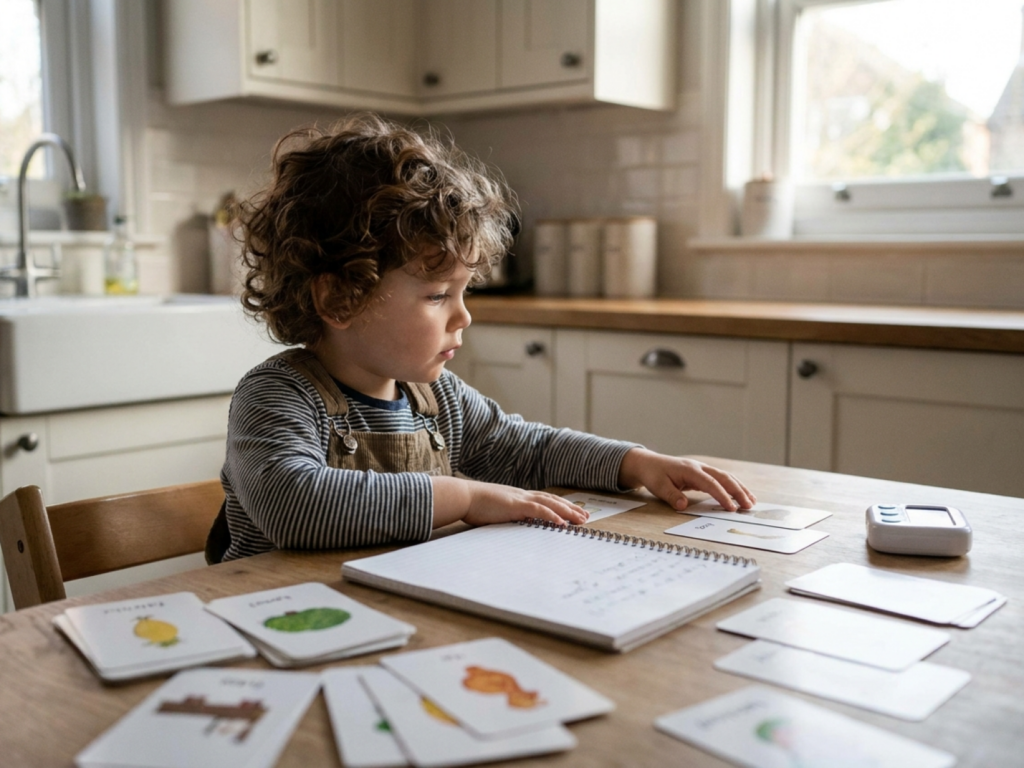
- A quiet, low-distraction study space
- A simple timer for short work and break intervals
- Flashcards or practice questions for self-testing
- A pediatrician, school psychologist, or developmental specialist if concerns persist
FAQ
Is attention the same as memory?
No. Attention helps the brain choose what to process, while memory stores and later retrieves that information.
Why does my child remember some things but not others?
Information that gets focused on, repeated, and connected to meaning is more likely to be remembered.
Are long study sessions best for children?
Usually not. Short, spaced sessions often work better than long cramming sessions.
When should I ask for help?
If attention or memory problems are persistent, affect daily life, or appear across settings, speak with a healthcare or school professional.
Sources
- PubMed Central (NIH) — Attending to Remember: Recent Advances in Methods and Theory on the Interaction of Attention and Episodic Memory
- Annual Reviews — The Relation Between Attention and Memory
- Harvard University Academic Resource Center — Memory and Attention
Disclaimer
This article is for general educational purposes and is not a substitute for medical advice, diagnosis, or treatment. If you have concerns about a child’s memory, attention, or learning, please speak with a qualified healthcare professional.

















Please log in to leave a comment.