
Intro
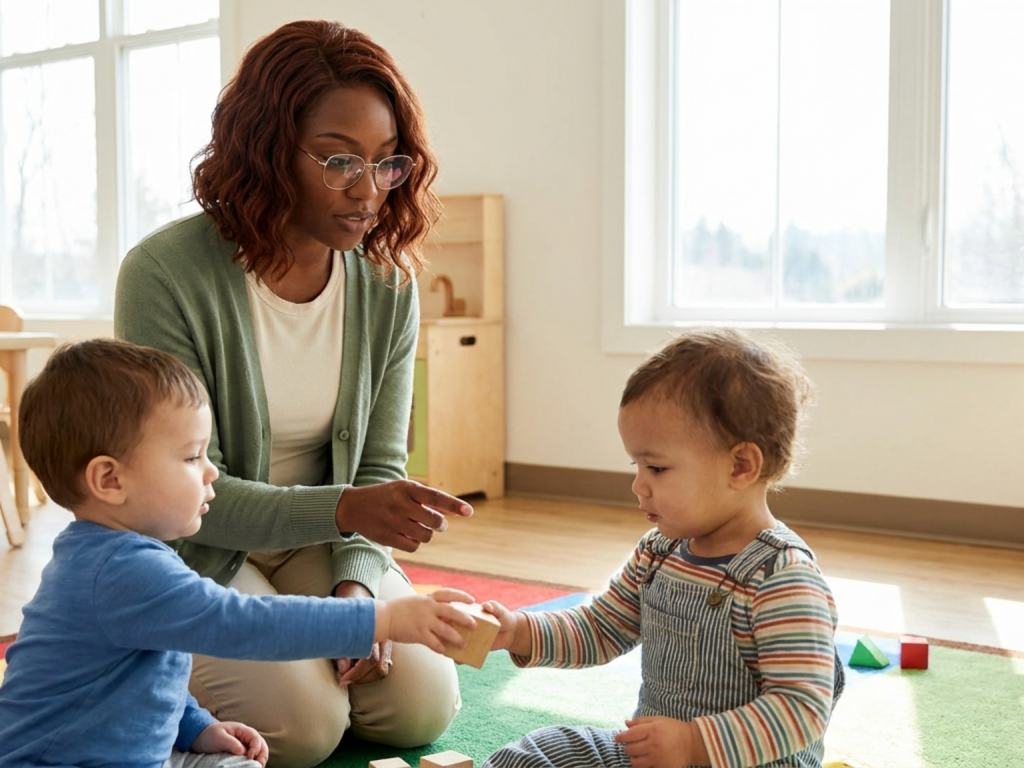
Sharing is one of the most visible social challenges of toddlerhood. A child may offer a cracker sweetly one moment and fiercely guard a toy the next. This variability is not a moral failure; it reflects rapid maturation of attention, language, impulse control, perspective-taking, and social learning.
For medically literate caregivers and professionals, it helps to view sharing as an emerging neurodevelopmental skill shaped by temperament, context, adult modeling, and repeated social experiences. Toddlers learn not only from direct instruction but also from observing who seems competent, confident, kind, and consistent.
Highlights
Toddlers are still developing the executive functions needed to wait, inhibit grabbing, and consider another child’s perspective.
Social learning shifts during toddlerhood: younger infants respond strongly to direct cues such as eye contact, while older toddlers increasingly learn from competence, confidence, and consensus.
Forced sharing can backfire; guided turn-taking, modeling, and predictable routines usually support cooperation more effectively.
Persistent aggression, loss of skills, or major communication concerns should be discussed with a pediatric clinician or developmental specialist.
Why sharing is hard in toddlerhood
Sharing requires several developing systems to work together. A toddler must notice another person’s desire, hold a rule in mind, inhibit the impulse to keep or grab the object, tolerate frustration, and often use language to negotiate. These capacities depend on immature but rapidly developing executive functions, including inhibitory control, working memory, and cognitive flexibility.
From a developmental perspective, possession is also meaningful. Toddlers are learning that objects can be “mine,” “yours,” or “ours,” and this early ownership understanding often appears before reliable generosity. A child who clutches a truck may not be selfish in an adult sense; they may be protecting a valued object while still learning that another child can use it briefly and return it.
Emotional regulation is a major limiting factor. When arousal rises, the toddler’s ability to process language and social rules drops. A calm child may manage a short turn-taking game, while the same child who is hungry, tired, overstimulated, or transitioning between activities may hit, scream, or flee. This is why predictable routines and realistic expectations matter as much as verbal teaching.
It is also normal for toddlers to share more easily with adults than with peers. Adults scaffold the interaction, wait patiently, narrate emotions, and return objects reliably. Peers are less predictable, have similar impulse-control limitations, and may not yet understand reciprocity. Peer sharing therefore often requires close adult support.
Social learning: how toddlers decide whom to copy
Toddlers are not passive imitators. Research on selective social learning shows that young children evaluate the people around them. They are more likely to seek information from individuals who appear competent, knowledgeable, confident, or supported by group consensus. By around 12 months, infants can prefer information from someone who has demonstrated expertise, and by 24 months, children show sensitivity to consensus when deciding what to believe or imitate.
This matters for sharing behavior because toddlers learn social norms by watching what trusted people actually do. If an adult says “we share” but snatches objects, interrupts, or uses threats, the child receives mixed data. If an older sibling calmly asks for a turn and thanks the toddler afterward, that peer may become a powerful model. Confidence also matters: children tend to imitate demonstrators who act sure of themselves more than those who seem uncertain.
Developmental timing is important. Infants under about 18 months are especially sensitive to ostensive cues, such as eye contact, infant-directed speech, and clear communicative gestures. These cues signal “this is for you to learn.” As children approach and pass 20 months, the facilitation from such pedagogical cues may lessen, while selective learning from knowledgeable or experienced people remains useful. In practical terms, toddlers still benefit from warm attention, but they also increasingly ask, implicitly or explicitly, “Who knows how this works?”
Caregivers can use this transition respectfully. Instead of relying only on commands, demonstrate the desired behavior with visible competence: “I’m giving you one block and keeping one block. Now we both can build.” Repeat the pattern, show the positive outcome, and allow the toddler to observe other children cooperating when possible.
The role of empathy, perspective-taking, and language
Empathy in toddlerhood is real but uneven. Many toddlers notice distress and may pat, bring a blanket, or look worried when someone cries. However, perspective-taking is still emerging. A toddler may understand that another child is upset but not yet grasp that giving a toy back could help, especially if the toy is highly desirable.
Adults can support this by translating social events into simple, concrete language. For example: “Maya is sad because she was using the cup. You wanted it too. Let’s give it back, then you can have a turn when the timer rings.” This kind of narration links emotion, cause, action, and repair. It also helps build receptive and expressive language skills, which are closely tied to social problem-solving.
Language reduces conflict because it gives toddlers alternatives to grabbing or screaming. Useful phrases include “my turn,” “your turn,” “help please,” “stop,” “all done,” and “trade?” Gestures or picture cues can be equally valuable for children with limited speech. The goal is not to make a toddler verbally sophisticated, but to provide a small, reliable communication toolkit.
Caregivers can also model mental-state language: “You thought the bear was free, but Leo was still playing.” “You really wanted the red crayon.” “She is waiting.” These phrases gently introduce the idea that different people have different wants, knowledge, and feelings. Over time, this supports empathy and cooperative play.
What helps: modeling, scaffolding, and play-based practice
Sharing improves most reliably when adults reduce the cognitive load and make cooperation rewarding. Long lectures rarely help during conflict. Short scripts, repetition, and environmental design work better. This is consistent with How toddlers learn through play: children build skills through hands-on practice, imitation, and emotionally safe repetition.
Practical scaffolds include:
- Use turn-taking before true sharing. “First Sam, then you” is easier than asking a toddler to permanently give up a treasured object.
- Offer duplicates for high-conflict materials. Two paintbrushes or two scoops can prevent unnecessary competition while children learn parallel play.
- Use brief, visible timers. A sand timer or simple countdown can make waiting more concrete, though some toddlers still need adult co-regulation.
- Practice with low-value objects first. A child may share blocks more readily than a comfort toy or favorite vehicle.
- Notice prosocial behavior immediately. “You gave her a turn. She looks happy, and now she is giving it back.”
Art, water play, music, and building activities can be structured to minimize conflict. For instance, each child can have their own brush while sharing a large paper, or each can have a shaker while participating in the same song. This teaches “we are doing something together” before expecting mature resource-sharing.
Natural consequences can also teach cooperation without shame. If a toddler repeatedly throws blocks at peers, the blocks can be put away briefly: “Blocks are for building. Throwing hurts. We’ll try again after snack.” This is not punishment as humiliation; it is a safety boundary paired with another opportunity to practice.
Responding to grabbing, refusal, and aggression
When a toddler grabs or refuses to share, the first adult task is regulation, not moral instruction. Move close, use a calm voice, and block unsafe behavior. A concise script might be: “I won’t let you hit. You wanted the truck. It is Nora’s turn. You can wait with me or choose the bus.” This validates the desire while maintaining the boundary.
Forced apologies or forced sharing often do not teach the intended lesson. A toddler may learn that adults can take possessions abruptly, or that saying “sorry” ends the problem without repair. More helpful repair includes returning the object, checking on the other child, helping rebuild, or practicing the phrase needed next time.
For repeated conflicts, examine the pattern clinically and practically. Does aggression happen near meals, naps, transitions, crowded spaces, or language-heavy demands? Is the child overwhelmed by noise or touch? Are expectations mismatched to developmental age? Toddler behavior management is most effective when it addresses antecedents as well as consequences.
It is appropriate to protect special possessions. Adults do not share everything on demand, and toddlers should not have to share comfort objects or treasured gifts in every setting. Before playdates, help the child put away items that are not for sharing, then provide communal toys that are easier to use cooperatively. This respects autonomy while still teaching generosity.
Individual differences and when to seek guidance
Sharing behavior varies widely. Temperament, sensory processing, sleep, hunger, language level, sibling dynamics, cultural expectations, childcare experience, and adult stress all influence a toddler’s social behavior. A cautious, slow-to-warm child may guard objects in unfamiliar settings. A highly active child may grab before thinking. A child with delayed expressive language may use physical behavior to communicate frustration.
Caregivers should avoid diagnosing a toddler based only on sharing difficulties. Many typically developing toddlers struggle with turn-taking, especially between 18 and 36 months. However, professional input is wise when concerns are persistent, intense, or accompanied by other developmental signs. Pediatricians, developmental-behavioral clinicians, speech-language pathologists, occupational therapists, and early intervention programs can help clarify whether support is needed.
Consider seeking guidance if a child rarely responds to social bids, has limited eye contact in meaningful interaction, loses previously acquired language or social skills, shows frequent severe aggression that does not improve with consistent support, or seems unable to understand simple communication. Hearing difficulties, sleep disorders, neurodevelopmental differences, anxiety, trauma exposure, and medical discomfort can all affect behavior and should be considered by qualified professionals.
For most families, the path forward is steady and compassionate: model the behavior, narrate emotions, structure the environment, protect safety, and give toddlers many chances to try again. Sharing is not learned in a single lesson. It develops through hundreds of small, supported interactions in which children experience that relationships are safe, turns return, and other people’s feelings matter.
When to be extra cautious
- Seek professional advice if a toddler loses language, play, or social skills they previously had.
- Discuss frequent severe aggression, biting, or unsafe behavior with a pediatric clinician.
- Consider hearing, speech-language, sleep, pain, or sensory contributors when behavior suddenly worsens.
- Do not use physical punishment or shaming; these can increase fear and dysregulation.
- If caregivers feel overwhelmed or unsafe, ask for support from healthcare, early childhood, or mental health professionals.
Tools & Assistance
- Pediatric well-child visit and developmental surveillance
- Early intervention evaluation for communication, motor, sensory, or social concerns
- Speech-language pathologist evaluation when communication limits peer interaction
- Childcare teacher observation notes about triggers, timing, and peer context
- Simple home plan with turn-taking scripts, duplicate toys, and calm repair routines
FAQ
At what age should toddlers be expected to share?
Some toddlers show brief spontaneous sharing before age 2, but reliable sharing and turn-taking usually develop gradually through the third year and beyond. Adult support is still expected.
Should I make my toddler give a toy to another child?
Usually it is better to guide turn-taking than to force immediate sharing. Protect special items, use timers or “first-then” language, and help the child repair harm if grabbing occurs.
Is refusing to share a sign of poor empathy?
Not necessarily. Toddlers may care about others but still lack the impulse control, language, or perspective-taking needed to share in the moment.
How can I teach sharing without constant conflict?
Use low-pressure practice: duplicate materials, parallel play, cooperative art, short turns, and immediate praise for small prosocial actions.
When should I worry about social learning?
Ask a clinician if sharing problems occur with limited social engagement, loss of skills, major language delay, frequent severe aggression, or concerns about hearing, sleep, pain, or sensory distress.
Sources
- Frontiers in Psychology — The development of social learning: from pedagogical cues to selective learning
- National Center for Biotechnology Information (PMC) — The Developmental Origins of Selective Social Learning
- ZERO TO THREE — 24-36 Months: Social-Emotional Development
Disclaimer
This article is for informational purposes only and does not replace medical, developmental, or mental health advice. Consult a qualified healthcare professional for concerns about your child’s behavior or development.


















Please log in to leave a comment.