
Intro
Math learning in children is not just about memorizing facts or moving quickly through worksheets. It is a developing neurocognitive skill that depends on number sense, language, attention, memory, and confidence. Some children grasp counting early and still need help with symbols; others understand ideas well but need more time to retrieve facts smoothly. Both patterns can be part of normal development.
A supportive approach looks at how a child understands quantity, uses strategies, and handles frustration. With the right mix of play, practice, and encouragement, many children become more fluent and more secure in math over time.
Highlights
Math learning begins with understanding quantity and symbols, not with speed alone.
Playful practice, family routines, and positive feedback can strengthen number skills early.
Brief timed practice can help fluency when it follows conceptual understanding.
Persistent math distress, avoidance, or confusion deserves a professional conversation, not blame.
What math learning actually involves
Math learning is broader than memorizing addition facts. It includes understanding quantity, recognizing patterns, comparing amounts, estimating, and linking a written numeral to a real set of objects. At the base is math number sense in children, the intuitive ability to notice how many, how much, and how one amount relates to another. This foundation supports later arithmetic, fractions, measurement, and problem solving.
A child may know how to count aloud without fully understanding that the last number said represents the total amount. Another child may solve a puzzle by reasoning well but still need practice with fact retrieval. That unevenness is common. It does not automatically mean something is wrong. It usually means the brain is still building connections between concepts, language, and procedure.
Math also places demands on working memory and cognitive load. A child often has to hold several steps in mind, inhibit distractions, and choose a strategy at the same time. When those demands are high, performance can look weaker than true understanding. That is one reason children may do well in one setting and struggle in another.
How math develops from early childhood through school age
Early number understanding begins long before formal school. Even early number sense in toddlers can grow through simple experiences such as handing out crackers, comparing toy piles, or noticing which group is bigger. In preschool years, children often learn best through early numeracy through play: stacking blocks, matching shapes, playing board games, counting steps, and sorting objects by size or color. These activities build subitizing, one-to-one correspondence, and the idea that numbers can represent real quantities.
Many adults worry when a child does not learn math in a straight line, but development is rarely linear. Some children need repeated exposure before a pattern becomes stable. Others understand a concept one day and use a different strategy the next. Sleep, language exposure, attention, and emotion can all affect how well a child shows what they know. That is why a child who seems hesitant is not necessarily incapable; they may simply need more repetition, clearer language, or a calmer learning context.
Variety matters too. Counting the same worksheet problems is not the same as seeing the same idea in different forms. Children build stronger understanding when they experience numbers in multiple ways: objects, drawings, words, and movement.
Why the home environment matters so much
Research on early home learning shows that supportive parent-child interaction and a math-rich home environment predict stronger later mathematical skills. This does not mean families need advanced lessons or constant drilling. It means everyday experiences can become powerful teachers when adults are responsive and encouraging.
Practical examples include measuring ingredients while cooking, comparing quantities during shopping, talking about time on a clock, sorting laundry by type or size, or noticing patterns on a walk. Even short conversations can help if they invite the child to explain thinking. Questions like Which pile has more? How did you decide? or What comes next? turn ordinary moments into reasoning practice.
The emotional tone matters as much as the activity. Children learn more readily when mistakes feel safe. If adults react with anxiety, criticism, or impatience, the child may focus on threat instead of thinking. A calm, predictable routine helps the brain stay available for learning. Families that already feel stressed about math can still help by keeping activities short, playful, and connected to real life rather than turning every interaction into a test.
Why practice and reflection both matter
A recent synthesis summarized by the Association for Psychological Science describes a useful cycle for math instruction: conceptual understanding, brief timed practice, and reflection. This is an important point for parents and teachers alike. Fluency is not the enemy of understanding. When a child can retrieve facts or steps more automatically, there is more mental space for harder problems later.
Timed practice still matters, but timing should be brief, developmentally appropriate, and linked to meaning. If a child already understands addition as combining groups, a short practice set can help retrieval become smoother and less effortful. The goal is not speed for its own sake. The goal is to make useful knowledge easier to access.
Reflection is the step that often gets skipped. After practice, children can be asked why a strategy worked, whether another method would be clearer, or how they knew an answer was reasonable. That process strengthens metacognition, the ability to think about one’s own thinking. It also helps children recover from errors without shame. If timed work causes distress, the response should be to reduce pressure, simplify the task, and rebuild confidence rather than to force more repetition.
When a child may need extra support
Some variation in math progress is normal, but persistent difficulty deserves attention. Concerns may include trouble recognizing small quantities, losing track while counting, confusing simple symbols, needing much more repetition than peers, or avoiding math because of intense frustration. Some learning difficulties in children can affect math specifically, while other problems may reflect language differences, attention challenges, visual or hearing issues, anxiety, or broader neurodevelopmental variation.
It is important not to diagnose on your own. Only a qualified professional can sort out whether a child needs screening, a psychoeducational evaluation, classroom accommodations, or another kind of support. A pediatrician, teacher, school psychologist, or developmental specialist can help determine next steps. If a child’s performance drops suddenly, if homework becomes a source of tears or panic, or if the child seems physically tense before math tasks, it is reasonable to ask for help sooner rather than later.
Early evaluation is not about labeling a child negatively. It is about understanding what is getting in the way. Once the cause is clearer, support can be tailored more precisely and the child can often feel less isolated and more capable.
How to make math feel safer and more meaningful
Children usually learn best when math feels understandable, manageable, and emotionally safe. That starts with small, concrete experiences and language that makes thinking visible. Adults can model phrases such as first, next, more, fewer, equal, and I counted again to check. They can also show their own reasoning out loud, which helps children see that math is a process, not a mysterious talent.
Useful family habits include:
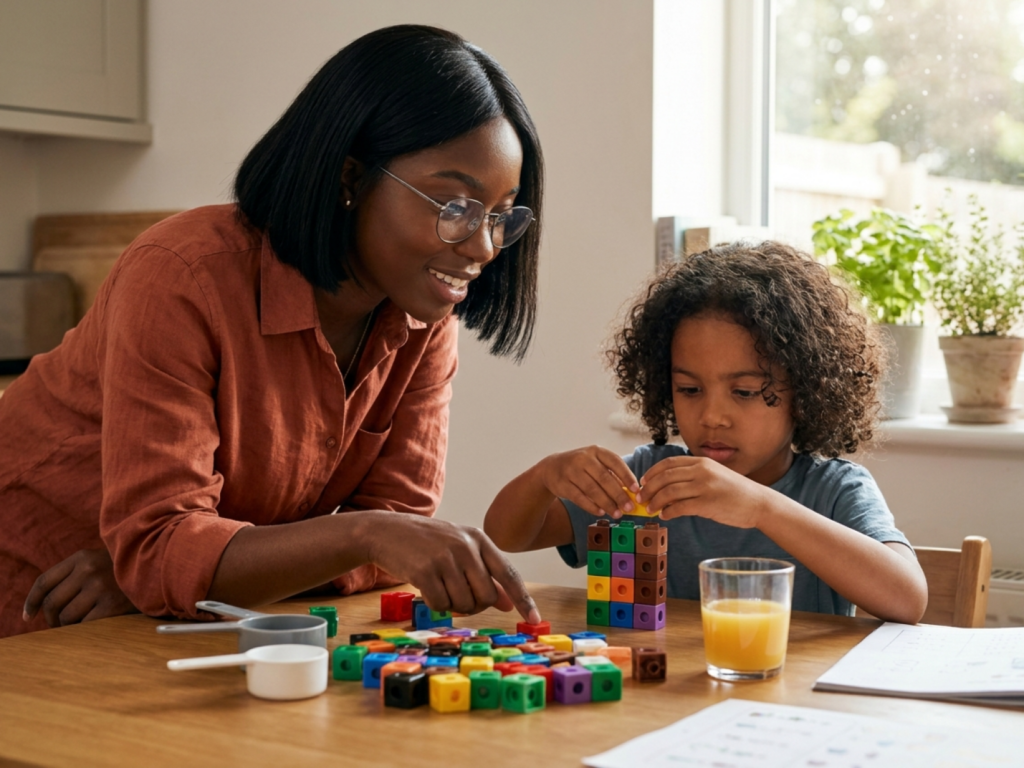
- Using blocks, coins, buttons, or snacks to compare and combine groups.
- Keeping practice short enough that the child can stay engaged without becoming overloaded.
- Praising strategy, persistence, and careful thinking instead of speed alone.
- Connecting math to interests such as sports scores, recipes, games, or building projects.
- Accepting fingers, drawings, and counting aloud as normal tools for learning.
If a family wants structured but friendly support, the National Science Foundation offers classroom- and home-friendly materials with activities, games, and visual explanations. Over time, small positive experiences can change how a child feels about math. Confidence grows when children repeatedly discover that numbers can be explored, questioned, and understood.
When to seek professional guidance
- Persistent panic, tears, or avoidance around math should not be ignored.
- A sudden change in performance may reflect sleep problems, stress, vision issues, hearing issues, or other concerns that deserve review.
- Do not assume a child is lazy, careless, or unintelligent because math is hard.
- If difficulties continue despite supportive practice, ask a teacher, pediatrician, or school psychologist about evaluation.
Tools & Assistance
- Pediatrician or family doctor for a first discussion about broader developmental concerns
- Teacher or school counselor for classroom observations and school-based support
- School psychologist or developmental specialist for formal learning evaluation if needed
- Home math games, blocks, measuring cups, and board games for low-pressure practice
- National Science Foundation mathematics resources for family-friendly activities and visual explanations
FAQ
Is it normal if my child understands math one day and forgets the next?
Yes. Math skills develop unevenly, and recall can change with sleep, stress, attention, and how familiar the task is.
Do timed tests help children learn math?
Brief timed practice can help fluency after a child understands the idea, but it should not create overwhelming anxiety.
Should I worry if my child uses fingers to count?
Usually not. Finger use is a normal bridge between quantity and symbols and often supports learning.
When should I ask for an evaluation?
Consider it when difficulties are persistent, significant, and affecting school or home life despite support.
What is the most helpful way to support math at home?
Use short, concrete activities in daily life, praise strategy, and keep the emotional tone calm and encouraging.
Sources
- Association for Psychological Science — Science Explains How Children Best Learn Math—And Yes, Timed Practice Still Matters
- Child Development — Early home learning support and home mathematics environment as predictors of children's mathematical skills
- National Science Foundation — Educational Resources: Mathematics
Disclaimer
This article is for educational purposes only and does not replace individualized medical, developmental, or educational advice. If you have concerns about a child’s learning, please speak with a pediatrician, teacher, or qualified specialist.


















Please log in to leave a comment.