
Intro
Snack time can be reassuring, confusing, and sometimes exhausting for caregivers. Children are growing, their appetite varies from day to day, and convenience often competes with nutrition. A healthy snack does not need to be elaborate; in many families, the best snack is simply a small, nutrient-dense food that fits the child’s age and routine.
This article explains what makes a snack supportive of growth, how to choose better everyday options, and when to ask a health professional for help. The aim is practical, not perfection: snacks should reduce hunger, provide useful nutrients, and support a healthy diet for children without turning every eating moment into a negotiation.
Highlights
Healthy snacks are best when they add nutrients such as fiber, protein, vitamins, and minerals rather than only adding calories.
Fruit and vegetables are consistently the strongest everyday choices, especially when paired with water and simple, low-sugar foods.
Packaged snacks are not forbidden, but frequent use can crowd out more nutrient-dense options and increase added sugar and sodium intake.
Snack timing matters as much as snack content; predictable routines often work better than constant grazing.
Caregiver stress is common, and many families benefit from simple systems rather than strict rules.
Why snacks matter in a child’s day
Children have smaller stomach capacity than adults and may need food between meals to maintain energy, concentration, and satiety. In that sense, snacks are not extra indulgences; they are part of the overall eating pattern. A snack works best when it supports growth rather than simply filling time.
In a healthy diet for children, snacks should usually complement meals, not replace them. That means the snack should be substantial enough to prevent rapid hunger, but modest enough that it does not suppress appetite for lunch or dinner. This balance is especially useful for toddlers and preschoolers, whose eating can be variable and who may be distracted by play. The NHS and Mayo Clinic both emphasize nutrient-dense foods such as fruit, vegetables, whole grains, and other minimally processed choices.
Parents and caregivers often describe snack quality in practical terms: Will the child eat it, can it be packed easily, and does it keep them satisfied? Those concerns are reasonable. The goal is to find a workable middle ground between nutrition science and real life.
What makes a snack truly healthy
A healthy snack is usually one that offers at least one meaningful nutrient benefit: fiber for gastrointestinal health and satiety, protein for tissue growth and longer-lasting fullness, or vitamins and minerals from whole foods. Snacks with a lower energy density, such as fruit or vegetables, can be especially helpful when a child is already eating enough at meals but still asks for food between them.
Fruit and vegetables are often the best choices because they are naturally rich in micronutrients and typically lower in added sugar and sodium than packaged snack foods. That does not mean every snack must be plain produce. Pairing produce with yogurt, cheese, hummus, or a whole-grain option can improve palatability and help a child feel satisfied.
When you read labels, a practical rule is to look for shorter ingredient lists and lower amounts of added sugar and sodium. Many snacks marketed to children are highly palatable but relatively low in nutritional value. The Mayo Clinic guidance is useful here: aim for foods that are filling, minimally processed, and based on everyday staples rather than ultra-sweet or heavily salted products.
- Good snack features: fiber, protein, healthy fats, and moderate portion size.
- Less ideal features: high added sugar, high sodium, and low satiety.
- Best pattern: combine foods so the snack is both nourishing and acceptable to the child.
Age-appropriate snack ideas that are easy to use
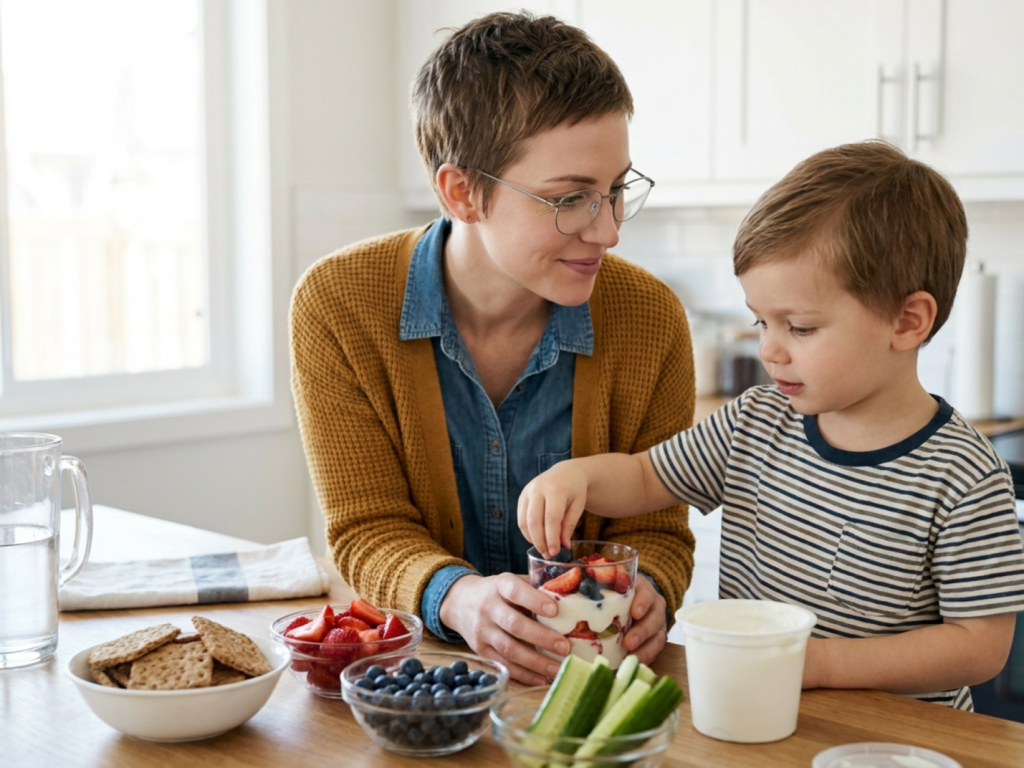
For toddlers, snack ideas should be soft, simple, and developmentally appropriate. Good examples include banana slices, soft pear, unsweetened yogurt, cheese pieces, oatmeal, avocado on toast, or cooked vegetables cooled to a safe temperature. For preschoolers, planned preschool snacks can include apple slices with a spread, whole-grain crackers with cheese, cucumber sticks with hummus, or a small sandwich made with whole-grain bread.
School-age children often do well with slightly more independence. They may help assemble a snack box with fruit, vegetables, a protein source, and a whole-grain item. A snack does not need to be large to be useful. A small combination of carbohydrate plus protein is often enough to reduce hunger until the next meal.
Texture and size matter. Children who are still learning to chew safely need softer items and smaller pieces; older children can manage a wider range of foods. If a snack is too large, too dry, or too hard, the child may lose interest or eat too quickly. The idea is to make the nutritious choice the convenient one.
In many homes, a few repeat options are helpful. Predictable snacks lower decision fatigue for caregivers and reduce conflict for children who prefer routine. Variety can still exist within a short list of trusted foods.
What to limit and how to make realistic swaps
Packaged snacks are often designed for convenience and taste, not for nutrient density. Biscuits, crisps, sweets, and many child-marketed snack bars may be high in added sugar, refined starch, or sodium, while contributing little fiber or protein. That does not mean they can never appear, but they are usually better as occasional foods than as the default choice.
A more sustainable strategy is substitution rather than prohibition. For example, replace sugary snacks with fruit and yogurt, swap salty crisps for whole-grain crackers with cheese, and offer water or milk instead of sweetened drinks. Many caregivers also underestimate the effect of juice and sweet drinks on appetite; these can provide quick sugar without the same satiety as whole fruit.
When families think in terms of frequency and context, rather than perfect and forbidden foods, snack planning becomes easier. A child does not need an ideal menu every day. They need a pattern that consistently favors nutrient-dense foods most of the time. That approach is both more realistic and more aligned with long-term healthy eating habits.
If your child strongly prefers one packaged snack, you can sometimes pair it with a more nourishing item. For example, serve a small portion of the preferred snack alongside fruit, vegetables, or a protein food. This lowers the nutritional cost without making the child feel deprived.
How to build a calm snack routine
Routine is one of the most powerful tools in pediatric feeding. Children tend to do better when meals and snacks follow a predictable rhythm, because predictable timing reduces grazing and helps appetite recover between eating occasions. The phrase structured meal and snack times captures this idea well: offer food at regular intervals, then allow the child to become hungry enough to eat at the next meal.
This is especially relevant in preschool eating habits, where appetite can appear inconsistent even when growth is normal. A child who nibbles all day may seem fussy at dinner simply because they are not truly hungry. By contrast, a child who has a clear snack window is often more willing to eat a balanced meal later.
Practical structure can be simple. Offer one planned snack, keep portions modest, and include water. Let the child help choose between two acceptable options instead of opening the pantry repeatedly. In many families, this reduces tension and helps the child feel some autonomy without turning snack time into a constant negotiation.
If your child is in the preschool years, this same approach can support preschool picky eating by making eating feel predictable rather than pressuring. Calm, repeated exposure usually works better than force or reward-based feeding.
When snack concerns deserve professional advice
Most snack questions can be handled with practical guidance, but some patterns deserve closer review. If a child has persistent poor weight gain, frequent choking or gagging, recurring vomiting, suspected food allergy, severe constipation, or an extremely restricted diet, speak with a pediatric clinician. These concerns do not automatically mean disease, but they do justify assessment.
Professional input is also valuable when mealtimes have become highly stressful, when a child refuses nearly all foods outside a very narrow range, or when caregiver anxiety is making feeding decisions harder. A pediatrician, pediatric dietitian, or feeding specialist can help distinguish normal variability from a problem that needs support.
Try to bring specific information to the visit: what the child eats in a typical day, how often snacks are offered, what drinks are used, and whether there are texture, chewing, or sensory concerns. That detail makes it easier to tailor advice to the child’s actual routine. The most useful plan is usually the one a family can follow consistently.
Healthy snack planning is not about getting every choice perfect. It is about building a reliable pattern that supports growth, learning, and family peace.
When to seek medical advice
- Seek help if your child has poor growth, weight loss, or fatigue that does not improve with routine changes.
- Get urgent advice for repeated choking, swallowing problems, or significant breathing trouble during eating.
- Ask about allergies if snacks trigger hives, swelling, vomiting, or recurrent rash after foods.
- Do not rely on snack changes alone if the child eats only a very narrow range of foods for a long time.
- Contact a professional if feeding stress is high enough that meals are becoming a daily conflict.
Tools & Assistance
- Use a weekly snack list based on fruit, vegetables, whole grains, dairy, and other simple staples.
- Ask a pediatrician or registered dietitian for age-specific feeding advice if you are unsure about portions or food variety.
- Keep water available between meals and snacks to support hydration without adding sugar.
- Use the NHS healthier snack guidance as a practical shopping checklist.
- Track which snacks actually satisfy your child for one to two hours, then build from those options.
FAQ
How many snacks should a child have each day?
It depends on age, appetite, and meal timing, but many children do well with one or two planned snacks between meals.
Are packaged snacks always bad?
No, but they are best used less often than fruit, vegetables, whole grains, and other minimally processed foods.
Is fruit juice a good snack?
Whole fruit is usually a better choice because it provides fiber and more satiety than juice.
What if my child wants the same snack every day?
That is common. Keep a few reliable options, then gently rotate in similar foods rather than forcing big changes.
Sources
- NHS — Healthier snacks - Food facts
- Mayo Clinic — Nutrition for kids: Guidelines for a healthy diet
- PubMed — Healthy Snacks and Drinks for Toddlers: A Qualitative Study of the Perceptions of Parents and Caregivers
Disclaimer
This article is for general educational purposes only and does not replace individualized medical advice. If you have concerns about allergies, growth, swallowing, or feeding behavior, consult a qualified healthcare professional.














Please log in to leave a comment.