
Intro
Resilience is the developing capacity to adapt to stress, recover after difficulty, and continue participating in relationships, learning, and everyday life. Emotional strength does not mean that a child is always calm, optimistic, independent, or unaffected by painful experiences. Rather, it reflects the ability to experience difficult emotions while gradually building skills, support, and confidence to manage them.
Children develop resilience through the interaction of temperament, brain maturation, caregiving relationships, health, social conditions, and opportunities to practice coping. Families cannot prevent every adversity, but they can strengthen protective factors and seek timely professional support when distress is persistent, severe, or impairing.
Highlights
Resilience is a developmental process, not a fixed personality trait or a test of toughness.
Consistent, responsive relationships are among the most important foundations of emotional strength.
Predictable routines, realistic positive appraisal, and opportunities to practice problem-solving can support adaptation.
A resilient child may still need help; asking for professional support is a sign of appropriate care, not failure.
What resilience means in childhood
Resilience in childhood is best understood as adaptive functioning in the context of challenge. It may involve recovering after disappointment, adjusting to a school transition, seeking help during conflict, or maintaining connection and curiosity after a stressful event. A child can be resilient in one setting and overwhelmed in another because resilience depends on the demands placed on the child and the resources available at that time.
Developmental neuroscience is central to this concept. Executive function, including working memory, cognitive flexibility, attention regulation, and inhibitory control, develops gradually through childhood and adolescence. These capacities help children pause before acting, consider alternatives, remember coping strategies, and shift attention away from an escalating stress response. Younger children therefore depend more heavily on adults for co-regulation, while older children can increasingly use internal strategies, language, and social problem-solving.
Resilience should not be confused with emotional suppression, compliance, or high achievement. A child who appears easygoing may still be experiencing substantial internal distress. Conversely, expressing fear, anger, sadness, or confusion can be part of healthy adaptation when the child has safe relationships and gradually returns to ordinary activities. Research reviews have found a consistent association between higher resilience and better mental health outcomes, but resilience does not make children immune to anxiety, depression, trauma-related symptoms, or other conditions requiring care.
Relationships are the foundation of emotional strength
Children build emotional security through repeated experiences of being noticed, protected, understood, and guided. Responsive caregiving does not require adults to respond perfectly. It involves making a reasonable effort to recognize a child’s signals, name what may be happening, set appropriate limits, and repair connection when an interaction becomes tense. These experiences help children develop expectations that distress can be communicated and that support is available.
Co-regulation is especially important in early childhood. When a child is physiologically activated, reasoning and verbal instruction may be less effective. A calm adult voice, physical proximity when welcomed, simple language, and reduced stimulation can help the child’s nervous system settle. Once calm has returned, the adult can discuss what happened and practice a future response. This sequence is usually more effective than lengthy explanations during a tantrum or crisis.
Caregivers can support resilience by validating emotion without endorsing unsafe behavior. For example, “You are very angry that the game ended. I will not let you hit. We can take space and then decide what to do next” acknowledges the feeling, maintains a boundary, and offers a path forward. Predictable limits create safety; they are not incompatible with warmth. Repair after conflict is also protective. A brief apology, clarification, or affectionate reconnection can teach that relationships can withstand mistakes.
Caregiver wellbeing matters as well. Depression, anxiety, trauma, chronic sleep deprivation, financial strain, and social isolation can reduce an adult’s capacity to provide consistent co-regulation. This is not a moral failing. It is a reason to involve healthcare professionals, community services, trusted relatives, or school supports. Supporting maternal mental health and the mental health of all primary caregivers can indirectly strengthen a child’s emotional environment.
Build coping skills through ordinary routines
Resilience is strengthened through repeated, manageable practice rather than a single conversation. Consistent household routines around sleep, meals, school preparation, medication when prescribed, recreation, and bedtime reduce avoidable uncertainty. Routines should be flexible enough to accommodate illness, disability, cultural practices, and family circumstances, but a child benefits from knowing what generally happens next.
Sleep deserves particular attention because insufficient or irregular sleep can worsen emotional reactivity, concentration, and impulse control. Families can use a predictable wind-down period, consistent wake times when feasible, and a calming sleep environment. Persistent sleep problems, nightmares, or major changes in sleep should be discussed with a pediatric clinician rather than attributed automatically to poor motivation or behavior.
Children also need opportunities to experience manageable challenge. Adults can break a difficult task into smaller steps, offer limited choices, and allow time for effort before intervening. This approach develops self-efficacy, the belief that one can influence an outcome through action. Praise is most useful when it is specific and honest: “You kept trying different pieces until the puzzle worked” communicates a strategy that can be repeated. Overprotection, by contrast, can unintentionally suggest that ordinary frustration is dangerous or unmanageable.
Helpful coping methods vary by age. Young children may use movement, sensory calming, drawing, play, or a familiar comfort object. School-age children can learn slow breathing, brief muscle relaxation, emotion labeling, structured problem-solving, and help-seeking. Adolescents may benefit from journaling, physical activity, peer connection, mindfulness practices, and examining unhelpful interpretations. These tools should be taught when the child is calm and practiced routinely, not introduced for the first time during acute distress.
Positive appraisal without dismissing reality
One modifiable resilience factor identified in pediatric research is a positive appraisal style: the ability to interpret a challenge in a realistic, flexible, and hopeful way. This is different from forced optimism. Children should not be told that a frightening, unfair, or painful experience is “not a big deal.” Instead, adults can acknowledge the difficulty while helping the child identify what is known, what remains uncertain, what support exists, and what small action is possible.
For example, after a disappointing test, a child may say, “I am terrible at everything.” An adult might respond, “That result feels upsetting, and one test does not measure everything you can do. Let us look at which questions were difficult and decide whether to ask your teacher for help.” This gently challenges an overgeneralized conclusion and redirects attention toward evidence and action. With adolescents, adults can explore automatic thoughts and cognitive distortions such as catastrophizing, all-or-nothing thinking, and excessive self-blame without turning every conversation into a debate.
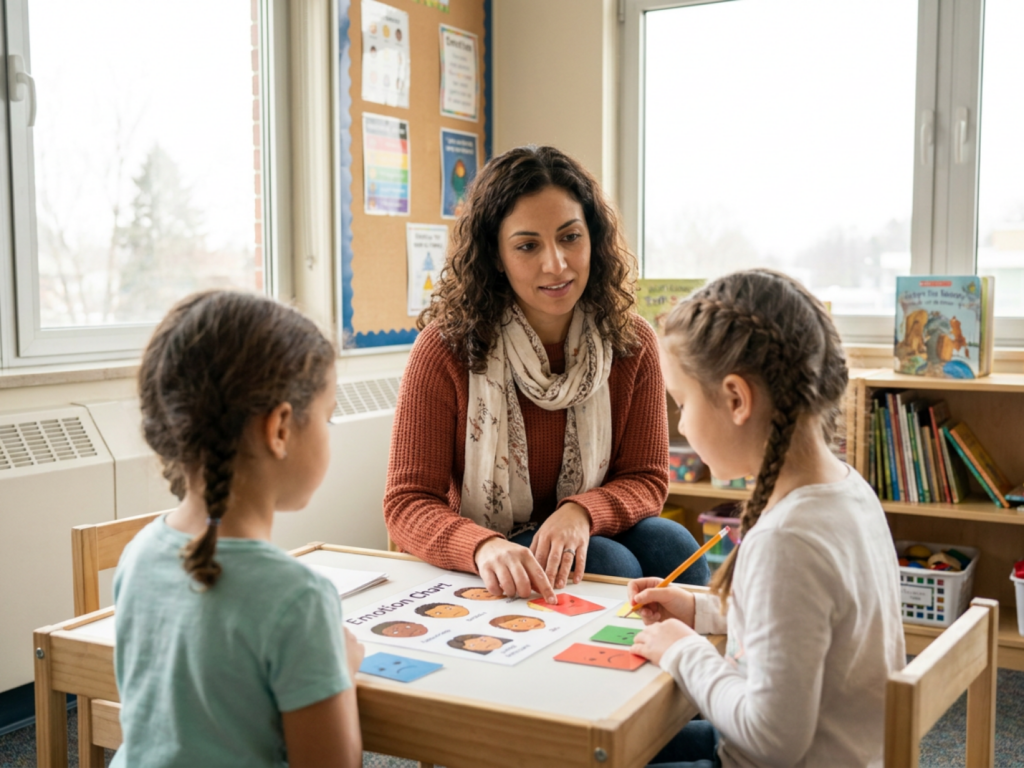
Emotional literacy supports appraisal. Naming emotions with appropriate nuance helps children distinguish fear from embarrassment, sadness from disappointment, and anger from feeling powerless. Adults can use books, play, daily events, or body cues as opportunities to discuss emotional states. It is important to avoid assigning a fixed identity, such as “the anxious child” or “the difficult child.” Behavior is information about a child’s current needs and skills, not a complete description of character.
When adversity involves abuse, bullying, discrimination, bereavement, violence, or serious illness, positive appraisal must never replace protection and systemic action. The child may need changes in the environment, trauma-informed therapy, school intervention, social services, or medical evaluation. Emotional strength grows when children learn that they deserve safety and can seek meaningful help.
Executive function, autonomy, and problem-solving
Executive function helps children organize responses to stress. Adults can support it by reducing unnecessary cognitive load and externalizing steps. Visual schedules, checklists, timers, labeled storage, and advance notice of transitions are practical aids, particularly for children with attention, learning, developmental, or sensory differences. These supports are not evidence of weakness; they provide structure while self-management skills continue to mature.
Problem-solving can be taught as a sequence: define the problem, identify feelings and goals, generate several options, consider likely consequences, choose a first step, and review what happened. A parent might ask, “What part of the morning is hardest?” rather than assuming the entire routine is a refusal. The child may then identify a specific obstacle, such as finding clothes or managing noise. Collaborative planning makes autonomy possible while preserving adult responsibility for safety.
Age-appropriate responsibility can also build confidence. Children may choose between two acceptable tasks, prepare part of a school bag, help plan a meal, or decide how to approach a friendship repair. Adults should distinguish a child’s responsibility from an adult’s responsibility. Children should not be expected to manage unsafe environments, parental conflict, serious financial problems, or a caregiver’s mental health without support.
Setbacks provide useful information when interpreted without shame. A failed strategy can be reviewed: Was the goal too large? Was the child tired, hungry, overstimulated, or missing information? Was the consequence proportionate? This reflective approach teaches flexibility and reduces the risk that mistakes become evidence of personal inadequacy.
The role of school, peers, and professional support
School is a major developmental setting where children practice persistence, cooperation, communication, and recovery from social and academic setbacks. Teachers and school counselors can provide predictable expectations, check-ins, learning accommodations, safe adults, and opportunities for belonging. When stress affects attendance, concentration, behavior, or academic performance, communication among caregivers, school staff, and healthcare professionals can clarify whether the child needs temporary support, formal assessment, or a broader safety plan.
Healthy friendships offer practice in empathy, perspective-taking, negotiation, and conflict repair. Adults can model that relationships include boundaries and accountability. A child should not be pressured to remain in a friendship that involves threats, coercion, repeated humiliation, or physical harm. Bullying and cyberbullying require adult intervention; telling a child simply to be tougher places responsibility in the wrong place.
Professional assessment is appropriate when emotional or behavioral changes persist, intensify, or interfere with daily functioning. Relevant signs may include sustained withdrawal, loss of interest, frequent physical complaints without an adequate medical explanation, marked irritability, panic-like episodes, persistent sleep disruption, regression, school refusal, self-injury, disordered eating behaviors, or statements about death or hopelessness. Assessment may involve a pediatrician, child and adolescent mental health professional, psychologist, psychiatrist, school clinician, or other qualified provider. Evaluation should consider medical conditions, neurodevelopment, trauma exposure, family context, substance use in adolescents, and environmental stressors.
Urgent help is needed when a child may be at immediate risk of suicide, serious self-harm, abuse, violence, or inability to remain safe. Contact local emergency services or an urgent crisis service, remain with the child when possible, reduce access to immediate means of harm, and seek professional guidance. The exact response depends on local services and the child’s circumstances.
When to seek prompt help
- Persistent distress that disrupts sleep, eating, school attendance, relationships, or ordinary activities
- Statements about wanting to die, disappear, or hurt oneself, or behavior suggesting imminent danger
- Self-injury, severe agitation, psychotic symptoms, intoxication, or inability to maintain basic safety
- Suspected abuse, neglect, exploitation, domestic violence, or serious bullying
- Sudden major behavioral regression or physical symptoms that require medical assessment
Tools & Assistance
- A predictable daily and bedtime routine
- Emotion-labeling and calm-time coping practice
- A brief collaborative problem-solving worksheet
- Regular communication with teachers, school counselors, or pediatric clinicians
- Local crisis, safeguarding, and emergency services when immediate safety is at risk
FAQ
Can resilience be taught?
Resilience can be supported through secure relationships, predictable routines, emotional coaching, manageable challenges, problem-solving practice, and access to appropriate care. It develops over time and is influenced by the child’s environment as well as individual characteristics.
Should parents avoid protecting children from all stress?
Children benefit from protection from danger and from exposure to developmentally appropriate challenges. Adults can provide support while allowing safe opportunities to try, make mistakes, repair problems, and experience ordinary frustration.
What if my child does not want to talk about feelings?
Conversation is only one route to emotional communication. Play, drawing, shared activities, movement, and brief observations may feel less demanding. Avoid forcing disclosure, but continue offering calm availability and seek professional advice if concerns persist.
Does emotional strength mean a child should recover quickly?
No. Recovery varies with age, temperament, adversity, health, and available support. A child may continue to feel grief, fear, or anger while gradually regaining functioning. Persistent or worsening impairment deserves assessment.
Who can assess a child’s emotional difficulties?
A pediatrician or primary healthcare professional can begin an evaluation and coordinate referrals. Depending on the concern, assessment may involve a child psychologist, child and adolescent psychiatrist, therapist, school clinician, or safeguarding professional.
Sources
- American Academy of Pediatrics — Modifiable Resilience Factors to Childhood Adversity for Clinical Pediatric Practice
- PubMed Central — Resilience and mental health in children and adolescents
- PubMed — Resilience in Children: Developmental Perspectives
Disclaimer
This article provides general educational information and does not diagnose, treat, or replace advice from a qualified healthcare professional. Seek prompt medical or emergency support when a child may be unsafe or seriously unwell.


















Please log in to leave a comment.