
Intro
Children encounter disappointment, conflict, uncertainty, academic pressure, family changes, illness, and other stressors while the brain networks supporting impulse control and emotional regulation are still developing. Emotional coping strategies are learned methods that help a child notice feelings, tolerate distress, communicate needs, and respond to problems safely.
Effective support is not about eliminating difficult emotions or expecting children to remain calm at all times. It involves responsive adults, developmentally appropriate practice, predictable environments, and opportunities to use both problem-focused and emotion-focused coping. The goal is gradual skill building, with professional guidance when distress is persistent, severe, or unsafe.
Highlights
Coping skills develop through repetition, relationships, and maturation; they are not simply traits a child either has or lacks.
Emotion labeling, co-regulation, movement, problem solving, and supportive routines can help children manage everyday stress.
Avoidance and emotional suppression may provide short-term relief but can become unhelpful when they prevent communication or participation.
Persistent physical complaints, major functional changes, or safety concerns warrant assessment by a qualified healthcare professional.
Understanding emotional coping in childhood
Emotional coping refers to the thoughts, behaviors, and relational supports a child uses to manage internal distress or respond to an external stressor. Emotion regulation is closely related: it includes identifying an emotion, modulating its intensity, delaying an impulsive response, and returning to an organized state. These abilities depend on executive functions such as inhibitory control, working memory, and cognitive flexibility, which continue developing throughout childhood and adolescence.
A child’s coping response is influenced by age, temperament, language, sensory processing, prior experiences, family relationships, and the level of control the child has over the situation. A preschool child may need an adult to provide most of the calming structure, whereas an adolescent may benefit from private reflection, social support, or a planned change in perspective. Neither should be judged by adult standards.
Research distinguishes between several broad coping patterns. Problem solving and constructive engagement can be useful when a child has some control over the stressor. Acceptance, emotional expression, distraction, and seeking support can help when an event cannot be changed immediately. Avoidance, withdrawal, or suppression may reduce distress briefly, but repeated reliance can be associated with poorer adjustment when these strategies block learning, communication, or needed action.
Start with connection and co-regulation
Children often regulate more effectively in the presence of a calm, responsive adult. Co-regulation means that an adult helps organize the child’s emotional and physiological state through proximity, a steady voice, empathic attention, and clear limits. This is not the same as giving in to unsafe behavior. An adult can acknowledge the feeling while maintaining a boundary: “You are furious that playtime ended. I will not let you hit. I am staying nearby while we help your body become calmer.”
During intense distress, lengthy explanations and demands for insight may exceed the child’s available cognitive capacity. First reduce stimulation and address immediate safety. Use brief language, slow breathing, a neutral posture, and a predictable choice such as sitting quietly or moving to a calm space. Physical contact should be guided by the child’s comfort and safety; restraint should not be improvised and requires appropriate professional or institutional protocols.
After the child has recovered, revisit the event without shame. Ask what happened before the emotion rose, what the body felt like, what helped, and what could be tried next time. This reflective conversation builds emotional literacy and creates a practical sequence the child can recognize in future situations. Repair also matters: adults can acknowledge when they raised their voice, model an apology, and reaffirm the relationship.
Teach children to identify and express emotions
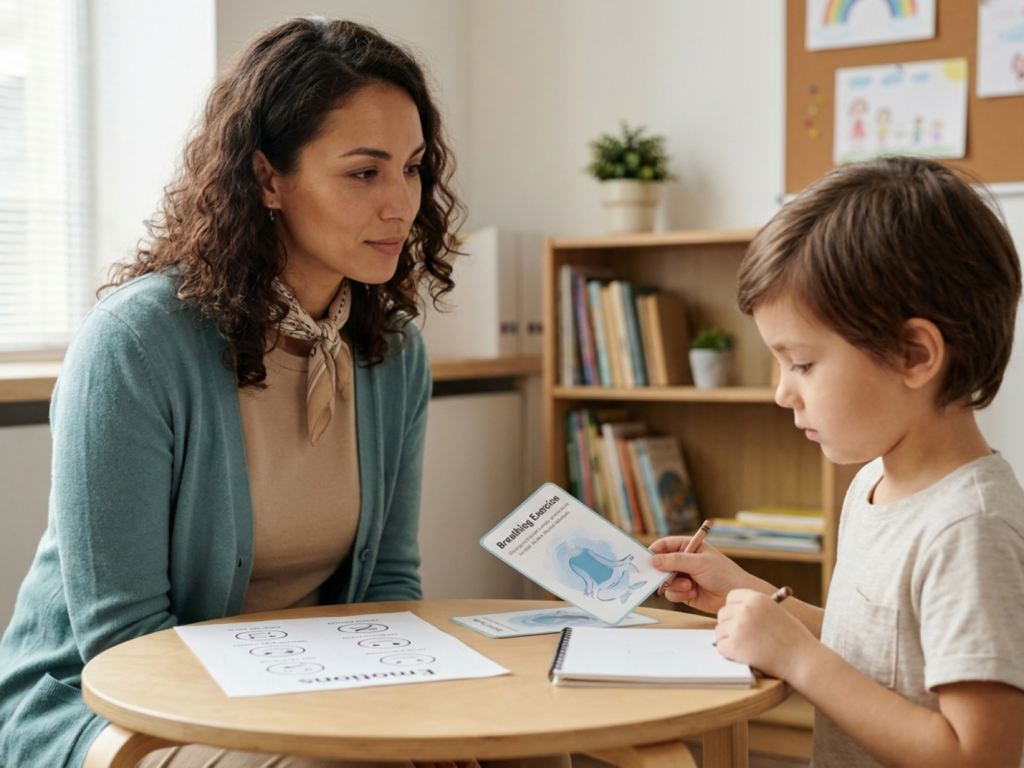
Emotion labeling gives children language for experiences that might otherwise emerge as irritability, aggression, crying, refusal, or physical complaints. Adults can use simple, specific observations: “Your hands are tight and your voice is louder. It looks like frustration.” A feelings chart, drawing, storytelling, play, or a body map can make abstract states more concrete. The purpose is not to force a child to disclose, but to offer multiple communication routes.
Validate the emotion without confirming every interpretation. “It makes sense to feel worried before a new class” validates the experience; “Everyone will reject you” would reinforce an untested prediction. Help the child distinguish feelings, thoughts, and actions: feelings are acceptable, thoughts can be examined, and actions still need safe limits.
Encourage expression that matches the child’s developmental level and preferences. Younger children may use pretend play, movement, or pictures. School-age children may write, talk while walking, or use a short check-in scale. Adolescents may prefer conversation in the car, messaging a trusted adult, music, journaling, or time alone followed by reconnection. Adults should avoid using emotional disclosure as a punishment or sharing private disclosures unnecessarily.
Useful prompts include:
- “What was the hardest part?”
- “Where do you notice that feeling in your body?”
- “Do you want listening, help solving it, or a short break?”
- “What would make the next ten minutes safer or easier?”
Build a practical calming toolkit
Calming skills work best when practiced during neutral periods rather than introduced for the first time during a crisis. A child may experiment with paced breathing, progressive muscle relaxation, sensory grounding, stretching, rhythmic movement, quiet reading, drawing, or listening to music. For some children, vigorous physical activity helps discharge arousal; for others, reduced noise and predictable sensory input are more effective. The response should be individualized rather than treated as a universal formula.
Paced breathing can be introduced without demanding perfect technique. For example, the child might gently inhale and make the exhale slightly longer, repeating for several cycles. Grounding can involve naming several things seen, heard, and felt, or pressing the feet into the floor while describing the room. These approaches may reduce physiological arousal, but they do not remove the cause of distress or replace assessment when symptoms persist.
Distraction is another legitimate short-term strategy when a child is overwhelmed or facing a stressor that cannot be changed immediately. A brief game, walk, practical task, or neutral conversation can create recovery time. The adult should later return to the underlying issue when the child is ready. Distraction becomes less helpful when it is the only response to grief, bullying, trauma, or a recurring problem.
Predictable routines support regulation by reducing unnecessary uncertainty. Regular sleep and meal patterns, transition warnings, movement opportunities, and a designated quiet area can lower the overall stress load. Routines should remain flexible enough for illness, family needs, and the child’s developmental stage.
Teach problem solving and cognitive flexibility
When a stressor is modifiable, structured problem solving can convert an overwhelming experience into manageable steps. Adults can help the child define the problem in one sentence, separate facts from predictions, generate several options, consider likely consequences, choose a small first action, and review what happened. This approach should remain collaborative. Adults who immediately solve every problem may unintentionally limit the child’s sense of competence, while adults who expect independent solutions too early may increase shame.
Problem-focused coping is appropriate for issues such as organizing schoolwork, preparing for a difficult conversation, planning a transition, or identifying a safe response to peer conflict. The plan may include requesting clarification from a teacher, breaking an assignment into timed segments, practicing an opening sentence, or identifying a trusted adult. A child should never be expected to confront an abusive or dangerous person alone.
Cognitive restructuring is a more advanced skill in which a child learns to examine an unhelpful thought and develop a balanced alternative. With younger children, this may sound like, “Is that a fact, a worry, or a guess?” With older children, adults can explore evidence, alternative explanations, and what advice the child would give a friend. The aim is not forced positive thinking. Balanced thinking can acknowledge difficulty while preserving agency: “This is embarrassing, and I can ask for help and try again.”
Acceptance is also important. Some experiences, including loss, uncertainty, or another person’s decision, cannot be controlled. Acceptance does not mean approval; it means making room for the feeling while choosing safe, values-consistent action.
Strengthen coping across home and school
Children benefit when the adults around them use compatible language and expectations. Families can ask teachers, school counselors, or pediatric clinicians which situations are most difficult and which supports have helped. Schools may teach problem-focused skills, emotional regulation, relaxation, social problem solving, and cognitive reframing through classroom lessons or targeted interventions. These efforts are particularly valuable when stressors occur in settings the child cannot easily control.
Adults should look for patterns rather than isolated incidents. A brief record can note the context, trigger, behavior, duration, recovery, sleep, appetite, physical symptoms, and response to support. This information may reveal predictable transitions, sensory demands, peer stress, academic mismatch, or family pressures. It should be used to guide support, not to label the child.
Building self-worth is a coping intervention in its own right. Notice effort, persistence, kindness, creativity, and incremental progress rather than praising only outcomes. Offer age-appropriate choices, such as selecting the order of tasks or choosing between two calming activities. Connection with trusted adults, peers, extracurricular activities, and culturally meaningful communities can provide social support and opportunities for mastery.
Digital media, sleep disruption, chronic conflict, and excessive performance pressure can affect emotional bandwidth. Reasonable boundaries should be explained consistently and paired with alternatives for rest, movement, relationships, and enjoyment. A child’s coping plan should be realistic enough to use on a school morning, during a family disagreement, or before bedtime.
When professional support is needed
Some stress reactions are transient and improve with support. Professional assessment is appropriate when distress is intense, persistent, worsening, or interfering with school attendance, learning, sleep, eating, friendships, family life, or ordinary activities. Concerning changes may include prolonged withdrawal, frequent unexplained physical complaints, marked irritability, recurrent panic-like episodes, severe sleep disturbance, regression, compulsive behaviors, or a sustained loss of interest.
Parents and caregivers should consult a pediatrician, family physician, child psychologist, psychiatrist, school mental-health professional, or other appropriately qualified clinician. Assessment may consider medical contributors, developmental factors, anxiety or mood symptoms, trauma exposure, neurodevelopmental needs, medication effects, sleep, and environmental stress. A clinician can recommend evidence-based supports without assuming that every difficult behavior represents a psychiatric disorder.
Ask directly and calmly about safety if a child mentions wanting to disappear, die, self-harm, or harm someone else, or if behavior becomes dangerous. Do not leave the child alone when there is an immediate risk. Contact local emergency services or a crisis service appropriate to the child’s country, and seek urgent professional evaluation. Caregivers should also receive support; a regulated, supported adult is better positioned to provide consistent co-regulation.
Warning signs requiring attention
- Immediate danger, self-harm thoughts, suicidal statements, or threats toward another person
- Persistent distress that disrupts sleep, eating, school attendance, learning, or relationships
- New or recurrent physical complaints without an adequate explanation
- Marked withdrawal, regression, panic-like episodes, or a substantial change in behavior
- Disclosure or suspicion of abuse, bullying, trauma, or another unsafe environment
- A caregiver’s concern that coping strategies are no longer sufficient
Tools & Assistance
- A brief feelings-and-triggers log shared with the child’s clinician or school team
- A personalized calm-down menu with two or three practiced activities
- Predictable routines for sleep, meals, transitions, homework, and movement
- A list of trusted adults and local pediatric or child mental-health services
- Collaborative problem-solving conversations after the child has returned to baseline
FAQ
Should adults tell children to stop crying?
Crying is a form of emotional expression and is not inherently harmful. Adults can acknowledge the feeling, maintain safety limits, and help the child regain control without shaming or demanding immediate silence.
Are breathing exercises suitable for every child?
Many children can use gentle paced breathing, but some find attention to breathing uncomfortable or activating. Offer alternatives such as movement, grounding, drawing, or quiet space, and stop an exercise that increases distress.
How can I tell whether avoidance is becoming a problem?
Avoidance deserves attention when it repeatedly prevents school attendance, relationships, age-appropriate activities, or needed conversations. A clinician can help distinguish a brief recovery break from a pattern that maintains anxiety or impairment.
What should schools do when a child is overwhelmed?
Schools can prioritize safety, reduce unnecessary stimulation, provide a predictable adult response, allow a brief regulated break, and follow up with collaborative problem solving. Ongoing impairment should be discussed with caregivers and appropriate professionals.
When should a child see a mental-health professional?
Seek consultation when distress persists, worsens, causes significant functional impairment, follows trauma, produces concerning physical or behavioral changes, or raises safety concerns. Urgent danger requires immediate local emergency or crisis support.
Sources
- PubMed Central — Coping, Emotion Regulation and Psychopathology in Childhood and Adolescence: A Meta-Analysis
- MedlinePlus — Stress in childhood: MedlinePlus Medical Encyclopedia
- PubMed — Improving children's coping with everyday stress: transporting treatment interventions to the school setting
Disclaimer
This article is for general educational purposes and does not diagnose, treat, or replace advice from a qualified healthcare professional. Seek urgent local emergency or crisis support for immediate safety concerns.


















Please log in to leave a comment.