
Intro
Children learn about relationships, emotions, communication, and problem-solving by observing the people around them. Modeling behavior means demonstrating the actions and attitudes you hope a child will gradually understand and use, such as apologizing after a mistake, managing frustration, listening respectfully, or asking for help.
Modeling is not about being a perfect parent, teacher, or caregiver. Children benefit from seeing realistic adults notice their own emotions, repair ruptures, and practice healthier responses. The most effective approach combines warmth, clear expectations, repetition, and developmentally appropriate support.
Highlights
Children often imitate behavior that is visible, repeated, emotionally meaningful, and demonstrated by a trusted or relatable person.
A calm response to stress can teach emotional regulation more effectively than a lecture delivered during a crisis.
Modeling should be paired with explicit teaching, predictable limits, and opportunities for the child to practice.
Adults can model repair by acknowledging mistakes, apologizing sincerely, and showing how to try again.
Persistent or impairing behavior may require assessment by a pediatrician or qualified child mental health professional.
How children learn through observation
Observational learning occurs when a child watches another person perform an action and then incorporates some part of that behavior into their own repertoire. The child may imitate a specific action, adopt a communication style, or learn an expectation about how people respond to conflict. Modeling can occur intentionally, such as demonstrating how to greet a new classmate, or incidentally, such as a child observing how adults respond when plans change.
Early childhood is a particularly important period because language, inhibitory control, perspective-taking, and emotional regulation are still developing. Children may understand more than they can consistently express or control. They often rely on external regulation from adults before they can independently organize their attention, impulses, and emotions. Watching a caregiver pause, label an emotion, and choose a response gives the child a concrete sequence to remember.
Modeling does not mean that every observed behavior will be copied. Children interpret what they see in the context of attachment, temperament, developmental stage, consequences, and the relationship with the model. A child may imitate an adult’s harsh tone in one setting but use a different response at school. Consistent, repeated demonstrations across settings make the desired behavior easier to recognize and practice.
Why some role models have greater influence
Research on peer modeling suggests that perceived similarity can affect behavioral change. Children may pay closer attention to a model who seems similar in age, ability, interests, background, or social position. A peer who successfully completes a task can therefore be especially persuasive, particularly when the observing child believes that the task is achievable for them too.
Similarity is only one factor. Children also evaluate a model’s competence, credibility, warmth, and social status. A trusted teacher may influence classroom conduct because the teacher is both familiar and visibly capable. A sibling or friend may shape language, play, or social behavior because the relationship is emotionally salient. Adults should avoid assuming that children will automatically copy a behavior simply because it is explained or demonstrated once.
Evidence from educational settings illustrates the value of visible, positive adult behavior. In research on children’s pro-environmental behaviors, teacher modeling was associated with measurable positive effects, whereas peer modeling and negative demonstrations did not produce the same benefit. The practical implication is that adults should demonstrate the behavior they are requesting: use materials responsibly, speak respectfully about differences, follow agreed routines, and acknowledge why the behavior matters.
Children also notice discrepancies. When an adult demands respectful communication but routinely uses insults, or emphasizes honesty while hiding mistakes, the inconsistency can weaken the lesson. No caregiver can behave perfectly, but authenticity and repair help restore trust.
Modeling emotional regulation and conflict repair
Emotional regulation is learned through repeated co-regulation before it becomes a reliable independent skill. During ordinary moments, adults can make their internal process observable without placing responsibility on the child. For example, a caregiver might say, “I am frustrated because we are late. I am going to take two slow breaths and focus on the next step.” This communicates that emotions are tolerable, behavior remains a choice, and practical action is possible.
When conflict occurs, model a brief sequence:
- Pause and reduce the intensity of your voice and movements.
- Name the relevant emotion or problem without blaming the child.
- State the boundary clearly, especially if safety is involved.
- Offer or demonstrate a realistic replacement behavior.
- Return later for repair and practice when everyone is calmer.
For example, an adult can say, “It is okay to be angry. It is not okay to hit. I am moving back to keep us safe. You can stomp on the floor or tell me you need space.” This does not reward aggression; it separates the emotion from the unsafe action and teaches an alternative. With younger children, the replacement may need to be physical and simple. Older children can participate in problem-solving and evaluate which strategy might work next time.
Repair is also a powerful model. If an adult shouts, the adult can later say, “I raised my voice. That was not the way I want to handle frustration. I am sorry. Next time I will pause before I answer.” An apology should not erase a necessary limit, but it demonstrates accountability and makes it safer for children to acknowledge their own mistakes.
Modeling communication, empathy, and boundaries
Children learn interpersonal behavior from the way adults speak to them and to other people. Model active listening by putting aside distractions when possible, reflecting the child’s message, and checking your understanding. A short response such as, “You wanted more time to finish, and stopping suddenly felt unfair,” validates the experience without necessarily agreeing with every demand.
Empathy can be modeled through attention to another person’s perspective. Adults might notice a sibling’s disappointment, ask how a classmate could be feeling, or describe the effect of an action: “When the blocks were knocked down, your brother looked upset. Let us check whether he is ready to rebuild together.” These observations should remain concrete rather than forcing a child to display an emotion they do not feel.
Boundaries are most effective when adults demonstrate them consistently. Model asking permission before touching another person’s belongings, accepting “no,” using private rather than humiliating correction, and leaving a conversation briefly when it becomes unsafe. Respectful boundaries teach children that kindness does not require passive acceptance of harmful behavior.
Positive reinforcement for children works best when it identifies the behavior specifically. Instead of relying only on general praise, say, “You waited while she finished speaking,” or “You returned the marker after using it.” This helps the child connect the feedback with an observable action. A balanced approach also includes natural consequences and clear limits, because modeling is strongest when expectations are predictable rather than dependent on adult mood.
Adapting modeling to developmental stages
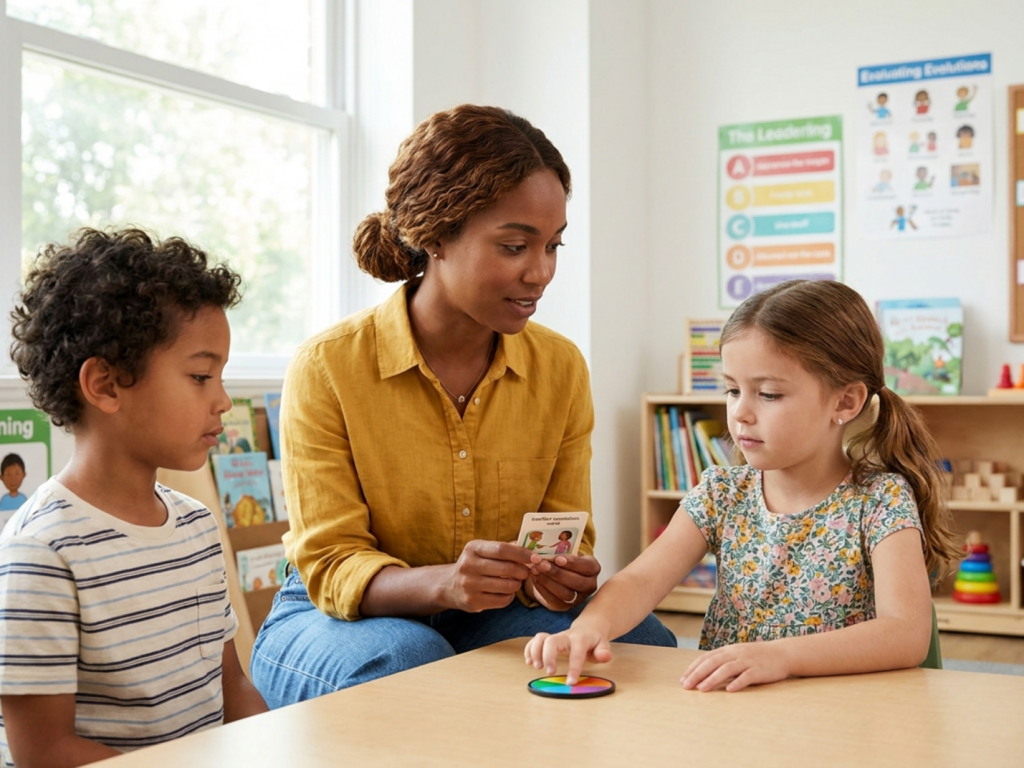
Toddlers and preschoolers learn through short demonstrations, repetition, imitation, and play. Use one-step directions, simple emotional language, and physical guidance that respects the child’s body and safety. A caregiver can model putting toys away, taking turns, washing hands, or asking for help. Stories, puppets, and pretend play allow children to rehearse behavior before a difficult real-life situation occurs. Emotion coaching for preschoolers can be as brief as naming the feeling, acknowledging the wish, and showing one acceptable action.
School-age children can understand more complex explanations and participate in collaborative planning. Model organizing school materials, coping with disappointment, and responding to mistakes without global self-criticism. Families and teachers can coordinate a small number of shared expectations so that the child receives consistent signals across settings. Positive teacher-student relationships may increase the child’s willingness to attend to guidance, especially when correction is respectful and paired with genuine recognition of effort.
Adolescents are sensitive to autonomy, fairness, and hypocrisy. Modeling should become more collaborative and less performative. Discuss how adults make decisions, weigh risks, evaluate online information, and manage disagreements. Invite the adolescent to explain their reasoning rather than expecting compliance based solely on authority. Adults can still set non-negotiable safety limits while acknowledging that independence develops through graduated responsibility.
Across ages, model self-management rather than demanding emotional perfection. A child who sees an adult use a calendar, request a pause, seek advice, or change course learns that competence includes using supports.
Common obstacles and more effective responses
One obstacle is expecting immediate imitation. Children may understand a modeled behavior but fail to use it when tired, hungry, overstimulated, anxious, or socially pressured. Treat this as information about the child’s current capacity, not automatically as defiance. Reduce the number of instructions, address basic needs, and practice the skill during calm periods.
Another obstacle is modeling only after a problem begins. Teaching a child to breathe, negotiate, or ask for space in the middle of a major outburst is difficult. Build brief practice into daily routines. Role-play losing a game, receiving a correction, or waiting for a turn, then reinforce small improvements.
Adults may also unintentionally model avoidance, sarcasm, excessive screen use, or aggressive conflict. Shame rarely improves this pattern. Identify one behavior to change, make the replacement visible, and enlist another supportive adult when needed. A behavior log can help document triggers, responses, and outcomes for a pediatric appointment without labeling the child as bad.
Finally, modeling cannot resolve every cause of behavior. Sleep problems, language differences, learning difficulties, neurodevelopmental conditions, trauma exposure, medication effects, family stress, and medical conditions can influence behavior. If difficulties are persistent, severe, occur across settings, or cause functional impairment, consultation with a pediatrician, developmental-behavioral pediatrician, school psychologist, or child mental health professional is appropriate.
Building a practical modeling plan
Choose one observable target rather than a broad goal such as “behave better.” A useful target might be greeting a teacher, using words instead of hitting, starting homework within ten minutes, or repairing a hurtful comment. Describe what the child will see and hear. Then decide which adult will model it, when practice will occur, and how progress will be noticed.
Use a predictable sequence: demonstrate, explain briefly, invite the child to try, provide specific feedback, and repeat in another context. Keep the language neutral and avoid turning every practice opportunity into a test. A child may need many repetitions before the behavior becomes reliable.
Review the plan every few weeks. Ask whether the expectation matches the child’s developmental abilities, whether the environment is contributing to difficulty, and whether adults are responding consistently. School-age behavior management is often more successful when caregivers and educators share observations and reinforce the same replacement skill.
Seek professional guidance when behavior creates safety risks, markedly disrupts learning or relationships, or is accompanied by regression, severe distress, persistent sleep disruption, self-injury, or threats toward others. A clinician can assess the broader context and recommend an individualized plan without reducing the child to a behavior label.
When to seek professional help
- Seek urgent help for immediate danger, serious injury, suicidal statements, or threats of significant harm.
- Consult a healthcare professional when behavior is persistent, escalating, or causing impairment at home, school, or with peers.
- Do not use physical punishment, humiliation, threats, or unsafe restraint as behavior-modeling strategies.
- Consider evaluation when behavior changes abruptly or occurs alongside developmental regression, severe sleep problems, or marked distress.
- Caregivers who feel unable to remain safe or regulated should step away when possible and contact a trusted support or professional service.
Tools & Assistance
- A brief behavior log noting the setting, trigger, adult response, and outcome
- A family practice routine for one replacement behavior
- Role-play, picture books, puppets, or visual schedules matched to the child’s developmental level
- A shared home-school communication plan with one or two observable goals
- A pediatrician, developmental-behavioral specialist, school psychologist, or licensed child mental health professional
FAQ
Does modeling require adults to behave perfectly?
No. Children benefit from seeing adults make mistakes, take responsibility, apologize, and try a different response. Consistent repair is more realistic and instructive than pretending never to struggle.
Why does my child copy undesirable behavior so quickly?
Behavior may be especially noticeable, emotionally intense, socially rewarding, or repeatedly observed. Calmly identify the problem, set a limit, model the replacement behavior, and reinforce appropriate attempts.
Can peers be effective role models?
Yes. Children may respond strongly to peers they perceive as similar and competent. Peer influence varies by context, relationship, and the behavior being modeled, so adult guidance and positive supervision remain important.
How long does it take for modeled behavior to become consistent?
There is no universal timeline. Age, temperament, stress, developmental abilities, and the complexity of the behavior all matter. Repeated practice in calm settings usually supports gradual improvement.
When should modeling be supplemented by an evaluation?
Consider professional assessment when behavior is severe, persistent, unsafe, occurs across settings, or causes meaningful impairment. A clinician can evaluate developmental, emotional, medical, family, and educational contributors.
Sources
- University of North Carolina at Greensboro — Peer Models and Children's Behavioral Change
- PubMed Central — The Influence of Various Role Models on Children’s Pro-environmental Behaviours
- Michigan State University Extension — Monkey see, monkey do: Model behavior in early childhood
Disclaimer
This article provides general educational information and does not diagnose, treat, or replace advice from a qualified healthcare professional. Seek individualized guidance for persistent, severe, or unsafe behavior.















Please log in to leave a comment.