
Intro
Self-care skills are the everyday abilities children use to look after their own bodies: feeding, dressing, toileting, washing, grooming, sleep routines, and participating safely in daily family life. These abilities do not appear all at once. They emerge through maturation of gross motor control, fine motor coordination, sensory processing, language development, attention, imitation, emotional regulation, and repeated practice with supportive adults.
Highlights
Self-care development follows a broad sequence, but the exact timing varies from child to child.
Feeding, dressing, hygiene, and toileting all require motor, sensory, cognitive, and emotional readiness.
Adult support works best when it is warm, predictable, and gradually reduced as the child gains competence.
Persistent loss of skills, marked asymmetry, severe feeding difficulty, or major delays deserve professional assessment.
What self-care really means
Self-care, sometimes called self-help or activities of daily living, includes the routine tasks a child uses to participate in home, childcare, school, and community life. In pediatrics, these skills are often grouped into feeding, dressing, toileting, bathing, grooming, oral hygiene, sleep participation, and safety awareness. Although these tasks may look simple from the outside, they are neurologically complex.
For example, eating with a spoon requires postural stability, shoulder and wrist control, hand-eye coordination, oral-motor control, sensory tolerance, attention, and the motivation to imitate adults. Toileting requires awareness of internal body signals, motor planning, communication, sequencing, and emotional readiness. Dressing requires bilateral coordination, balance, body awareness, problem-solving, and frustration tolerance.
Because self-care is built from many developmental systems, age ranges should be interpreted as guideposts rather than strict deadlines. Prematurity, neurodevelopmental differences, chronic illness, musculoskeletal conditions, visual or hearing impairment, family routines, cultural expectations, and opportunities to practice can all affect the timing. A supportive approach asks, “What is the next achievable step for this child?” rather than, “Why is this child not doing everything independently yet?”
Infancy: birth to 12 months
In the first year, self-care is mostly participation rather than independence. Newborns depend completely on caregivers for feeding, hygiene, positioning, sleep routines, and comfort. Still, important foundations are developing. Infants gradually improve head control, trunk stability, visual tracking, hand-to-mouth exploration, and regulation of sleep-wake states. These early abilities later support eating, dressing, and grooming.
During feeding, infants move from reflexive sucking toward more coordinated oral-motor patterns. As development progresses, many babies bring hands to the bottle or breast, mouth toys, tolerate spoon-feeding when developmentally ready, and begin to explore soft foods and finger foods under appropriate supervision. By later infancy, many can sit with support or independently, reach for food, hold a bottle briefly, and begin messy self-feeding.
Caregivers can support self-care by allowing safe exploration: letting the infant touch a spoon, hold a washcloth, bring hands to midline during dressing, or participate in wiping after meals. These small acts are not about performance. They teach body awareness, sequencing, and trust. If an infant has persistent feeding distress, poor weight gain, recurrent choking, unusual stiffness or floppiness, or difficulty coordinating sucking, swallowing, and breathing, medical evaluation is important.
Toddler years: 12 to 36 months
Toddlerhood is a period of rapid growth in independence, but also strong preferences and inconsistent cooperation. A toddler may insist on doing something alone one day and refuse the same task the next. This is developmentally typical because motor skills, autonomy, language, and emotional control are maturing at different rates. Toddler boundary testing and cooperation often show up most clearly during dressing, meals, toothbrushing, bathing, and bedtime.
Between 12 and 24 months, many children begin using fingers well for self-feeding, drink from a cup with help, hold a spoon with spills, remove socks or shoes, push arms through sleeves, and help with simple washing or wiping. They may point to wet or soiled diapers and show interest in the bathroom. Between 24 and 36 months, many can use a spoon more effectively, begin using a fork, pull down elastic-waist pants, remove more clothing, wash and dry hands with assistance, and participate in early toileting routines.
Toileting readiness is not only about age. It depends on bladder and bowel maturation, awareness of body signals, the ability to sit safely, communication, and willingness to participate. Pressuring a toddler can increase resistance. A calmer strategy is to use predictable routines, simple language, easy clothing, foot support at the toilet or potty, and praise for participation rather than outcomes.
Practical support at this age includes offering limited choices, such as two shirts or two cups, and breaking tasks into one-step instructions. Adults can start a zipper and let the child pull it, place toothpaste on the brush and let the child try brushing, or guide the child to wipe hands before providing help. These partial successes build confidence.
Preschool years: 3 to 5 years
Preschoolers usually make noticeable gains in dressing, toileting, feeding, and hygiene. Many 3-year-olds can feed themselves with a spoon and fork, drink from an open cup with fewer spills, remove simple clothing, put on some garments with orientation help, wash hands with reminders, and use the toilet with assistance for wiping or clothing. By 4 to 5 years, many children can dress with less help, manage large buttons or snaps, brush teeth with adult follow-up, use the toilet more independently, and help with bathing steps while still needing supervision.
This stage depends heavily on sequencing and executive functions: remembering what comes first, staying with the task, shifting attention, and correcting mistakes. A child may know how to put on shoes but still put them on the wrong feet. They may brush only the front teeth, forget soap, or become upset when sleeves twist. Emotional regulation in preschoolers is therefore part of self-care, not separate from it.
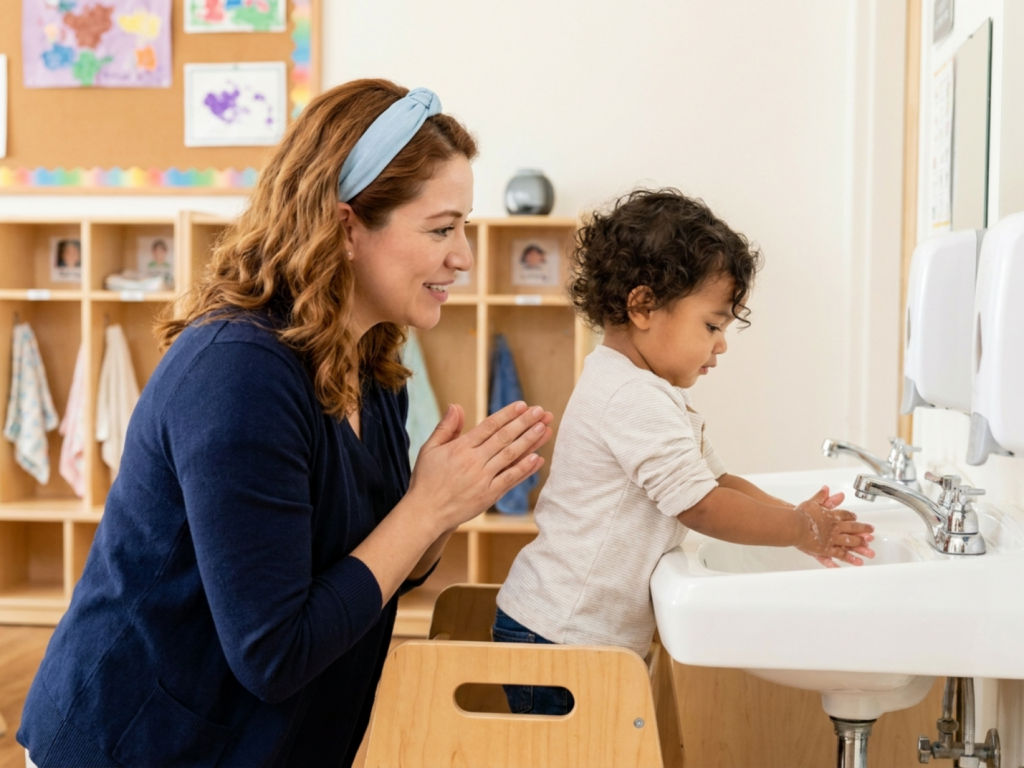
Caregivers can make routines more successful by using consistent order, visual cues, and child-sized tools. A low hook for a towel, a stable stool at the sink, easy-open lunch containers, elastic waistbands, and toothbrushes that fit the child’s hand reduce unnecessary barriers. Practice is most effective when the child is not rushed. Morning routines may need more adult support than evening practice because time pressure makes learning harder.
Preschool is also a social environment. Children notice peers putting on coats, washing hands, opening snack containers, and cleaning up. Turn-taking and cooperative play can indirectly support self-care because children practice waiting, following group routines, asking for help, and tolerating small frustrations. If self-care struggles are accompanied by marked sensory distress, motor clumsiness, limited communication, or frequent meltdowns, a pediatric occupational therapy evaluation may help clarify what support is needed.
Early school age: 6 to 8 years
By early school age, many children can complete most basic self-care tasks, although reminders are still common. They may dress for the weather with some guidance, manage buttons, zippers, and fasteners, brush teeth more thoroughly, bathe with supervision, comb or brush hair with variable quality, wipe after toileting, pack simple belongings, and open most food containers. The goal is not perfect independence but reliable participation.
At this age, expectations expand because school demands more self-management. Children may need to handle lunch packaging, manage bathroom routines outside the home, change for sports or swimming, keep track of a coat, and notice when hands or face need cleaning. Language development supports these tasks because children can understand multi-step directions, describe discomfort, ask for help, and learn safety rules.
Families can support independence by shifting from doing tasks for the child to coaching the process. Instead of tying every shoelace automatically, an adult might demonstrate, let the child complete one loop, and then help finish. Instead of repeatedly saying “get ready,” a caregiver can use a short checklist: bathroom, teeth, clothes, socks, shoes, bag. Written or picture-based routines are useful even for children who read, because they reduce working memory load.
Some children still need adapted tools, extra time, or therapy support. This is especially true when there are difficulties with fine motor coordination, praxis or motor planning, attention, visual-motor integration, sensory processing, or anxiety around bodily routines. These needs are not character flaws. They are signals that the task may need to be taught in smaller steps or supported differently.
Later childhood: 9 to 12 years
Later childhood brings more responsibility for personal hygiene, privacy, health habits, and preparation for puberty. Many children can shower independently, use deodorant when appropriate, care for hair with reminders, select clothing for activities and weather, manage toileting and menstrual hygiene education when relevant, prepare simple snacks, organize school materials, and follow household safety rules. They may still need adult oversight for consistency, product use, and hygiene quality.
Puberty-related self-care should be introduced before changes begin, using accurate, calm language. Children benefit from knowing what body odor, breast development, testicular growth, pubic hair, acne, erections, vaginal discharge, and menstruation can mean in normal development. The purpose is not to rush maturity, but to reduce shame and help the child recognize when to ask questions or seek help.
Self-care at this age also includes sleep hygiene, screen boundaries, medication safety, sports hygiene, and awareness of privacy. Children can learn to report pain, dizziness, constipation, urinary symptoms, skin irritation, or feeding concerns, but adults should not expect them to manage health problems alone. A child who appears independent still needs accessible adults and regular preventive care.
Caregivers can support later childhood by using collaborative routines. Ask the child what part of the morning is hardest, then solve that step together. Use checklists, timers, organized storage, and predictable laundry or bathing schedules. Independence grows best when the adult remains available without taking over every task.
How adults can encourage independence safely
The most effective teaching is respectful, repetitive, and matched to the child’s developmental level. A useful pattern is to demonstrate the task, do it together, let the child do one part, then gradually step back. This method preserves dignity because the child experiences success while still receiving enough support.
Small environmental changes can make a large difference. Use stable seating for meals, a footrest at the toilet, step stools at sinks, clothing with manageable fasteners, soap pumps the child can press, towels within reach, and cups or utensils sized for the child’s hand. For children with sensory sensitivities, consider texture, temperature, smell, sound, and timing. A child who resists toothbrushing may be reacting to oral sensory input, gagging, taste, or loss of control rather than simple defiance.
Skill-building should avoid shame. Statements such as “You are too old for this” rarely help and may increase avoidance. More useful language is specific and neutral: “You pulled your pants up by yourself,” “The back teeth still need brushing,” or “Let’s try the first button together.” When a child is tired, ill, hungry, or dysregulated, temporary help is reasonable. Support can be reduced again when the child is ready.
Seek professional guidance when delays are persistent, widening compared with peers, or interfering with nutrition, hygiene, school participation, sleep, toileting, or family functioning. A pediatrician can screen for medical contributors and refer to occupational therapy, physical therapy, speech-language pathology, feeding therapy, psychology, gastroenterology, dentistry, or other specialists when appropriate.
When to seek medical guidance
- Loss of previously acquired self-care skills should be discussed promptly with a healthcare professional.
- Choking, recurrent coughing with meals, poor weight gain, or severe food restriction needs medical assessment.
- Ongoing constipation, painful urination, stool withholding, or toileting distress should not be managed with pressure alone.
- Marked asymmetry, unusual muscle tone, persistent clumsiness, or difficulty using one side of the body warrants evaluation.
- Extreme distress with hygiene, dressing, or feeding may reflect sensory, developmental, anxiety-related, or medical contributors.
Tools & Assistance
- Pediatric well-child visits and developmental surveillance
- Pediatric occupational therapy assessment for self-care and sensory-motor skills
- Speech-language or feeding therapy evaluation when eating or swallowing concerns are present
- Visual routines, child-sized tools, adaptive utensils, step stools, and clothing with manageable fasteners
- Teacher or childcare-provider observations about bathroom, lunch, dressing, and handwashing routines
FAQ
What age should a child dress independently?
Many children can manage parts of dressing by age 3 to 4 and become more independent between 5 and 6, but fasteners, clothing orientation, time pressure, and motor coordination can affect readiness.
Is late toilet training always a medical problem?
No. Readiness varies, and stress can slow progress. However, constipation, pain, urinary symptoms, stool withholding, developmental concerns, or major distress should be discussed with a clinician.
Should parents keep helping if a child can do a task but refuses?
Sometimes. Refusal may reflect fatigue, sensory discomfort, anxiety, attention difficulty, or a need for autonomy. Offer limited choices, reduce the task size, and seek guidance if routines remain highly stressful.
Can occupational therapy help with self-care skills?
Yes. Pediatric occupational therapists commonly assess feeding participation, dressing, hygiene, toileting routines, fine motor skills, motor planning, sensory processing, and environmental supports.
Sources
- Ann & Robert H. Lurie Children's Hospital of Chicago — Self-help & ADL Skills by Age
- Children's Specialized Hospital — Self-Care Skills in Child Development | Pediatric OT
- Education Bureau, Hong Kong SAR Government — The art of promoting young children's self-care skills
Disclaimer
This article is for general educational purposes and does not replace medical evaluation, diagnosis, or treatment. Consult a qualified healthcare professional for concerns about your child’s development, feeding, toileting, or daily functioning.















Please log in to leave a comment.