
Intro
Independence in childhood is not a single achievement. It develops gradually as a child builds motor control, language, attention, self-regulation, and social understanding. Small actions such as reaching for a spoon, tolerating brief separation, or following a two-step request are meaningful signs that a child is moving toward more autonomous daily functioning.
The pace is highly individual. Age ranges are useful as a framework, but they are not a verdict on readiness or ability. A supportive, medically informed view looks at the whole child, tracks progress over time, and pays attention to regression, persistent difficulty, or any pattern that limits participation at home, in childcare, or at school.
Highlights
Independence grows across several domains at once: motor, language, cognitive, and social-emotional.
Early self-help skills, such as self-feeding and toileting readiness, often emerge alongside broader developmental milestones.
Progress is usually uneven and age ranges are approximate, not strict deadlines.
Adult support matters: children learn independence best when guidance is scaffolded rather than removed abruptly.
Loss of previously mastered skills or a clear plateau deserves timely clinical attention.
Independence begins as coordinated development
Independence is best understood as a developmental trajectory, not a single event. A child first depends on adults for nearly everything, then gradually contributes more to daily care through improved postural control, grasp, communication, memory, and emotional regulation. The earliest version of independence may be brief self-soothing, turning toward a voice, or bringing hands to the mouth. Later it becomes feeding, dressing, toileting, problem-solving, and managing routines with less prompting.
Developmental surveillance and screening provide the clinical structure for noticing whether this progression is unfolding in a typical way. They help place a child’s skills in context rather than treating one isolated behavior as decisive. In practice, clinicians and caregivers look at how milestones cluster across domains. A child who is still unsteady in movement, for example, may also be limited in self-feeding or play that requires two hands, while language and social understanding can influence how much help the child asks for and accepts.
Global references such as the WHO motor milestone windows are useful because they remind families that some variation is expected. The goal is not to force every child into the same calendar, but to notice whether abilities are emerging steadily and whether new skills are being used across settings.
Infancy and toddlerhood: the first self-help milestones
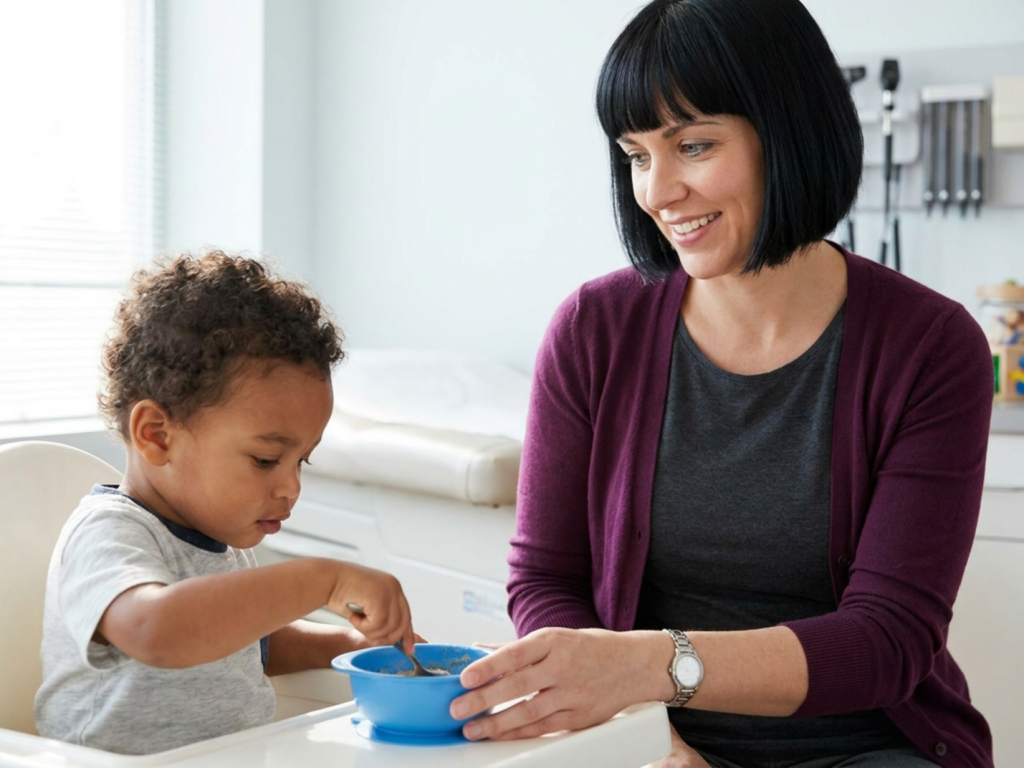
In the first years of life, independence is often visible in very practical moments. An infant who can hold up the head, sit with growing stability, transfer objects between hands, and bring food or a toy to the mouth is building the motor platform for later self-care. As hand control improves, children start to grasp a spoon, drink from a cup with help, and show more interest in feeding themselves, even if the result is messy.
During toddlerhood, everyday routines become the main stage for independence. Toddlers often want to feed themselves, pull clothing on and off with assistance, wash hands with supervision, and participate in simple clean-up. Toilet training readiness varies widely, but the underlying skills are similar: body awareness, communication, enough bladder and bowel control, and the ability to follow short instructions.
These milestones are not just about convenience. They reflect a child’s developing ability to plan, coordinate, and tolerate some frustration. A toddler who insists on using a spoon, even imperfectly, is practicing autonomy. A child who can wait briefly for help is also practicing self-regulation.
Preschool and school-age independence becomes more complex
As children enter preschool and school age, self-care becomes less about single tasks and more about sequences. A child may need to get dressed, manage shoes, wash hands, gather belongings, sit for a meal, and transition to the next activity. The work here is not only physical. It depends on memory, inhibition, task initiation, and the ability to recover after mistakes. That is why fine motor skill progression matters so much: buttoning, zipping, manipulating utensils, opening containers, and handling crayons or scissors all support practical autonomy.
School-age independence also expands into routines around learning. Children begin to carry folders, follow classroom procedures, and increasingly manage their own materials. This is where independent learning skills in children become visible in ordinary ways, such as remembering homework, checking a schedule, or asking for clarification instead of stopping entirely when confused. These skills are not innate personality traits; they are teachable habits built on attention control, planning, and repeated practice.
- Self-care becomes faster and more accurate with repetition.
- Children tolerate more delay before adult help arrives.
- Small responsibilities become part of identity, not just compliance.
Emotional and social independence develop alongside self-care
Independence is often mistaken for doing things alone, but emotionally healthy autonomy depends on relationship security. Children need to know that help is available before they can safely step away from constant adult support. In infancy, this is shaped by caregiver co-regulation in infancy: adults lend calm, structure, and predictability until the child can begin to use those supports internally.
As children grow, social development becomes central to independence. A preschooler who can join play, tolerate turn-taking, or recover after conflict is building the social flexibility needed for classrooms, family life, and later peer relationships. Children also become more independent when they can label needs, negotiate simple choices, and seek help appropriately rather than reacting only through distress or avoidance.
Separation tolerance, pretend play, cooperation, and empathy all contribute. A child who can play near others, then with others, and later solve minor disagreements with adult coaching, is gaining the social bandwidth required for autonomous participation. In that sense, independence is not a withdrawal from connection. It is the ability to use connection well and then act with increasing self-direction.
How adults support independence without overhelping
Support works best when it is structured, calm, and gradually reduced. Children benefit from predictable routines, simple language, and enough time to attempt a task before an adult steps in. Instead of taking over, caregivers can break a task into parts, demonstrate once, and then let the child complete the next step. This approach respects the child’s developmental stage and helps the nervous system learn from repetition.
Practical support also means choosing the right level of challenge. If a task is too hard, children become frustrated or disengaged. If it is too easy, they do not practice. The goal is a narrow band of effort where the child can succeed with some support. That is true for daily care, play, and school routines. It is also true for emotional skills, where children benefit from naming feelings, planning for transitions, and hearing expectations in advance.
Useful principles include:
- Offer limited choices rather than open-ended demands.
- Let the child try first, even if the attempt is slow.
- Praise effort, persistence, and completion, not only speed.
- Keep expectations stable so the child can form habits.
When adults overfunction for a child, independence can stall even when the underlying capacity is present. Support should increase competence, not replace it.
When slower progress needs a professional review
Variation is common, but some patterns deserve evaluation. A child who is not adding new skills over time, who loses previously acquired abilities, or who shows major difficulty across several domains should be assessed by a pediatric clinician. Independence problems may reflect motor delay, vision or hearing concerns, language delay, coordination difficulty, neurodevelopmental differences, or medical issues that interfere with energy, attention, or movement.
Warning signs can include persistent feeding difficulty, very limited interest in self-care, inability to follow age-expected routines, marked distress around ordinary transitions, or regression in toileting, language, or motor skills. These concerns do not point to one diagnosis on their own, but they justify timely review because early support can improve participation and reduce family strain.
For children with specific needs, referral may involve developmental surveillance and screening, occupational therapy, physical therapy, speech-language evaluation, or early intervention services. The key point is to look for a pattern, not a single late skill. A child can be strong in one area and still need support in another, and that is medically normal enough to deserve careful, individualized assessment.
Seek timely assessment if you notice
- Loss of previously acquired skills at any age.
- Persistent feeding, swallowing, or toileting difficulty.
- Very limited progress across multiple developmental domains.
- Marked frustration or avoidance that blocks routine self-care.
- Concerns from caregivers, teachers, or clinicians that a child is plateauing.
Tools & Assistance
- Well-child visits with developmental surveillance and screening
- Pediatric occupational therapy for self-care and fine motor skills
- Pediatric speech-language pathology for communication and routine participation
- Early intervention services for infants and toddlers
- School-based evaluation for functional independence concerns
FAQ
Is independence expected at the same age for every child?
No. Milestones have approximate age ranges, but children vary widely. Clinicians look for steady forward progress rather than identical timing.
Does independence only mean doing things without help?
No. Healthy independence includes knowing when to ask for help, using routines, and tolerating guided support while skills are still forming.
What is a common early sign of growing independence?
Self-feeding, brief separation tolerance, helping with dressing, and following simple routines are common early signs.
When should parents ask about delayed independence?
Ask if a child is regressing, has very limited progress, or cannot manage several age-expected self-care tasks despite repeated practice.
Sources
- PubMed Central — Evidence-based milestone ages as a framework for developmental surveillance
- MedlinePlus — Toddler Development
- World Health Organization — The WHO Child Growth Standards
Disclaimer
This article is for education only and is not a diagnosis or treatment plan. For concerns about a child's development, safety, or regression, speak with a pediatrician or other qualified clinician.
















Please log in to leave a comment.