
Intro
Empathy is one of the most meaningful parts of human development, but it does not arrive fully formed. A toddler who pats a crying sibling, a preschooler who says “you feel sad,” a school-age child who apologizes after hurting a friend, and a teenager who worries about injustice are all showing different layers of the same growing capacity.
Empathy develops through brain maturation, language, attachment relationships, culture, temperament, peer experience, and executive function. Children vary widely, and variation is not automatically a problem. The goal is not to force children to “perform kindness,” but to understand how emotional resonance, perspective-taking, self-regulation, and prosocial behavior gradually become more integrated.
Highlights
Empathy begins early as emotional contagion and simple comforting behavior, then becomes more intentional as children gain language and self-awareness.
Cognitive empathy, including perspective-taking and theory of mind, expands across preschool and school age as children understand that other minds can differ from their own.
Adolescence brings more abstract empathy, including concern for groups, moral issues, identity, fairness, and people outside the teen’s immediate social circle.
Warm caregiving, caregiver co-regulation, safe peer practice, and reflective conversations support empathy without shaming the child.
Low or uneven empathy can reflect many factors, including stress, neurodevelopmental differences, trauma, anxiety, depression, or delayed self-regulation, so persistent concerns deserve professional guidance.
Empathy is not one single skill
Empathy is often described as “feeling what another person feels,” but medically and developmentally it is more useful to separate several related processes. Affective empathy is emotional resonance: the child’s nervous system reacts to another person’s distress or joy. Cognitive empathy is perspective-taking: the child understands that another person has thoughts, beliefs, desires, or pain that may differ from the child’s own. Empathic concern is the caring motivation that can follow from understanding another person’s state. Prosocial behavior is the outward action, such as comforting, helping, sharing, apologizing, or seeking an adult’s support.
These processes do not mature at the same pace. A young child may feel intense distress when another child cries but be unable to offer useful help. Another child may understand that a peer is upset yet freeze because the situation is socially confusing. Development depends on limbic reactivity, prefrontal executive function, language, attention, memory, temperament, attachment security, culture, and repeated social learning. This is why empathy can look inconsistent even in a loving, typically developing child.
Toddlerhood: emotional resonance comes before perspective
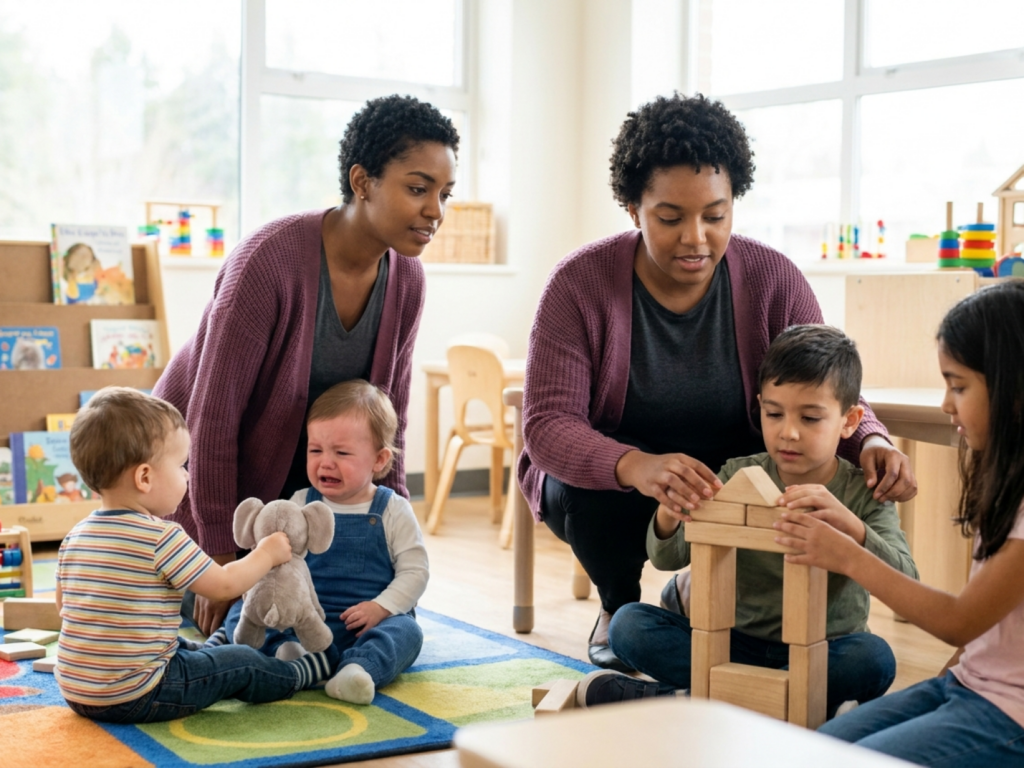
During toddlerhood, empathy is usually concrete, sensory, and immediate. Toddlers often show emotional contagion: they may cry when another child cries or look alarmed when a caregiver appears hurt. This does not mean they fully understand the other person’s experience. Their self-other distinction is still developing, so another person’s distress can feel like something happening inside their own body.
Early comforting behaviors may appear as patting, hugging, bringing a blanket, offering a toy, or copying what adults do when someone is upset. These behaviors can be touching, but they are also fragile. A toddler may comfort a parent one moment and grab a toy from a crying peer the next. That inconsistency reflects immature inhibitory control and limited working memory, not necessarily lack of caring.
toddler emotional development is strongly shaped by co-regulation. When adults name feelings, stay calm, and model repair, toddlers begin linking bodily arousal with social meaning. For example, “You saw Sam fall. His knee hurts. Let’s get help,” connects observation, emotion, and action. At this stage, empathy grows best through simple language, predictable responses, safe routines, and adult modeling rather than lectures about morality.
Preschool years: language and theory of mind expand empathy
Between about 3 and 5 years, many children become better able to label emotions, recognize facial expressions, and use symbolic play to explore social roles. Pretend play lets children practice being the doctor, baby, teacher, monster, rescuer, or friend. This kind of role shifting supports mentalizing, also called theory of mind, which is the ability to infer that another person has a mind with beliefs and feelings separate from one’s own.
Preschool empathy is still limited by egocentrism and emotional intensity. A child may understand that a friend is sad but still struggle to stop laughing, wait a turn, or offer comfort when excited. emotional regulation in preschoolers is therefore closely connected to empathic behavior. A dysregulated child has less cognitive bandwidth for another person’s distress because their own autonomic arousal is dominating attention.
Helpful adult responses are concrete and brief. Instead of asking, “Why would you do that?” adults can scaffold the sequence: “Maya is crying because the block hit her. We need to stop, check her body, and help fix it.” Preschoolers also benefit from storybooks, emotion words, puppets, and calm repair after conflict. The repair matters: apology is more meaningful when paired with noticing impact and making amends.
School age: empathy becomes more social and rule-based
In middle childhood, children usually become more skilled at comparing perspectives, understanding intentions, and using social rules. They can begin to distinguish accidents from deliberate harm, embarrassment from anger, and private feelings from public behavior. Their peer world also becomes more complex, with friendship loyalty, exclusion, teasing, fairness, competition, and group belonging all influencing empathic choices.
social problem-solving in school-age children depends on executive function as much as kindness. A child needs attention to social cues, impulse control, cognitive flexibility, and working memory to notice a problem, pause, infer another person’s view, and choose a helpful response. This is why fatigue, hunger, anxiety, bullying, learning stress, or sensory overload can temporarily reduce empathic behavior.
At this age, children can discuss motives and consequences more directly. Questions such as “What do you think he thought was happening?” or “What could help her feel included next time?” support cognitive empathy without forcing shame. Group settings can also build empathy when they include cooperative learning, restorative conversations, peer mentoring, and adult-supervised practice. School-based empathy interventions often work best when they match developmental capacity rather than asking children to reason like adults.
Adolescence: empathy becomes more abstract and identity-linked
Adolescence brings major changes in social cognition, identity formation, reward sensitivity, and prefrontal-limbic integration. Teenagers can often think about suffering that is distant in time, geography, or personal experience. Their empathy may extend to social justice, climate anxiety, discrimination, community violence, global crises, or moral hypocrisy. teen abstract reasoning allows young people to imagine systems, not only individual interactions.
At the same time, adolescent empathy can be uneven. Peer evaluation is highly salient, and social belonging can compete with compassionate action. A teen may privately feel concern but stay silent to avoid rejection. Mood, sleep deprivation, stress, substance exposure, trauma, depression, or anxiety may also alter emotional availability. This does not make the teen uncaring; it means empathy is filtered through a nervous system undergoing rapid remodeling.
Adolescents benefit from being treated as moral thinkers, not simply corrected as children. Conversations can include nuance: empathy does not require agreeing with someone, absorbing everyone’s pain, or abandoning boundaries. Mature empathy includes perspective-taking, compassion, accountability, and self-protection. Adults can ask teens how they understood a situation, what values were involved, and what kind of repair or advocacy would be realistic.
What supports empathy across development
Empathy is strengthened by relationships in which children feel safe enough to notice both their own feelings and other people’s feelings. Secure attachment does not mean perfect parenting. It means the child repeatedly experiences that distress can be recognized, named, soothed, and repaired. caregiver co-regulation is especially important because children borrow adult nervous system organization before they can regulate independently.
Several practices are useful across ages, with the wording adjusted to the child’s developmental level. Adults can name emotions without overinterpreting: “You look disappointed,” or “She may have felt left out.” They can model repair after their own mistakes: “I spoke sharply. I’m sorry. I’ll try again.” They can praise specific prosocial behavior: “You noticed he was overwhelmed and gave him space.” They can also protect boundaries: “You can care about your friend and still say no.”
Family culture, community values, and lived experiences influence how empathy is expressed. Some children show care through words; others through practical help, quiet presence, humor, or problem-solving. Children with language delay, autism, attention differences, sensory processing differences, or trauma histories may express concern in ways adults miss. child emotional development by age is a helpful framework, but it should not become a rigid checklist that ignores temperament, neurodiversity, or context.
When empathy development looks different
Empathy does not follow a perfectly linear path. Temporary self-focus, blunt comments, possessiveness, jealousy, and peer conflict are common at many ages. Concerns become more important when patterns are persistent, intense, escalating, or impairing relationships, safety, school functioning, or family life. A child who rarely responds to others’ distress may be overwhelmed, avoidant, depressed, anxious, traumatized, socially confused, impulsive, or struggling to interpret cues.
It is also important not to diagnose a child from one behavior. For example, not crying at sad events does not automatically mean absence of empathy; some children inhibit emotion, process slowly, or show care through action rather than facial expression. Conversely, intense empathic distress can be painful and impairing if the child becomes flooded by others’ emotions.
If caregivers are worried, the safest next step is developmental surveillance and consultation. A pediatrician, child psychologist, developmental-behavioral specialist, school counselor, or speech-language pathologist can help clarify whether the issue relates to communication, attention, mood, trauma exposure, social cognition, sensory processing, family stress, or another factor. Support should be individualized, respectful, and focused on skills, safety, and connection.
When to seek guidance
- Persistent cruelty, aggression, or enjoyment of others’ pain should be discussed promptly with a qualified child mental health professional.
- Marked loss of previously present social interest, warmth, language, or play skills warrants medical or developmental evaluation.
- Empathic behavior that changes suddenly after trauma, bullying, grief, illness, or major stress deserves supportive assessment.
- Severe anxiety, depression, self-harm talk, or substance exposure can affect empathy and requires professional care.
- Do not label a child as uncaring based on one incident; look for patterns across settings and seek professional input when concerned.
Tools & Assistance
- Use emotion labeling during everyday moments, including play, conflict, books, and family routines.
- Model repair after mistakes by naming the impact, apologizing briefly, and showing how to make amends.
- Ask schools about restorative practices, social-emotional learning, counseling support, or peer inclusion programs.
- Track repeated concerns across home, school, sleep, mood, stress, and peer settings before appointments.
- Consult a pediatrician, child psychologist, or developmental specialist if empathy concerns are persistent or impairing.
FAQ
At what age do children first show empathy?
Early signs can appear in toddlerhood as emotional contagion, concern, or simple comforting, but these behaviors are inconsistent because self-regulation and perspective-taking are still immature.
Is it normal for a preschooler to seem selfish sometimes?
Yes. Preschoolers may care about others but still struggle with impulse control, frustration, and egocentric thinking. Repeated modeling and calm repair are more useful than shame.
Why can teenagers seem empathetic about world issues but harsh at home?
Adolescents can reason abstractly, but family conflict, fatigue, peer pressure, autonomy needs, and emotional reactivity can make everyday empathy uneven.
Can empathy be taught?
Empathy can be supported through warm relationships, emotion coaching, perspective-taking practice, cooperative activities, restorative repair, and developmentally appropriate school programs.
When should parents worry about low empathy?
Seek guidance if low concern for others is persistent, escalating, linked with aggression or cruelty, associated with major mood or behavior changes, or causing significant impairment.
Sources
- PubMed Central / NIH — Rethinking empathy development in childhood and adolescence
- PubMed / Journal of Clinical Child & Adolescent Psychology — School-Based Interventions to Promote Empathy-Related Responding in Children and Adolescents: A Developmental Analysis
- PubMed Central / NIH — The typical and atypical development of empathy
Disclaimer
This article is for informational purposes only and does not replace medical, developmental, or mental health evaluation. If you have concerns about a child’s behavior, mood, safety, or development, consult a qualified healthcare professional.


















Please log in to leave a comment.