
Intro
Creativity in childhood is not a rare talent that appears only in a few children. It is a developing set of cognitive, emotional, social, and motor capacities that helps a child imagine alternatives, combine ideas, test possibilities, and express meaning. Original thinking grows through ordinary experiences: play, conversation, problem solving, art, movement, storytelling, mistakes, boredom, and supportive relationships.
For medically literate readers, creativity can be understood as a neurodevelopmental process shaped by executive function, language, affect regulation, sensory processing, motivation, and environmental opportunity. It is also highly individual. A cautious, supportive approach avoids labeling a child as “creative” or “not creative” and instead asks what conditions help this child explore, persist, and communicate ideas safely.
Highlights
Children develop creativity through interaction between cognition, emotion, relationships, education, and the physical environment.
Original thinking often begins in play, where children can separate an object from its usual function and test symbolic possibilities.
Supportive adults help creativity by asking open questions, allowing manageable risk, and valuing process as well as outcome.
Too much pressure for a polished product can make ideas more practical but sometimes less original.
A child who avoids creative activities may need curiosity and support, not judgment; persistent concerns about development or distress should be discussed with a healthcare professional.
Creativity is a developmental capacity, not a fixed trait
Creativity in children is usually defined as the ability to produce ideas, actions, questions, stories, drawings, movements, or solutions that are both novel and meaningful in context. For a preschool child, a “new” idea may be new only to that child: a spoon becomes a microphone, blocks become a hospital, or a bedtime story gets a different ending. In older children, originality may appear as unusual hypotheses, humor, invention, music, design, writing, social problem solving, or flexible approaches to schoolwork.
Research reviews emphasize that children’s creativity is not one single skill. It reflects multiple interacting influences: cognitive development, domain knowledge, motivation, temperament, education, culture, family responses, and opportunities for exploration. This matters clinically and educationally because a child may be very inventive in one setting and inhibited in another. A child who seems uncreative on a timed worksheet may show rich creative play and creativity during construction play, drawing, role play, or conversation.
Original thinking also changes with age. Young children often generate ideas with high imaginative freedom but limited feasibility. As children mature, they gradually learn constraints: materials break, stories need sequence, other people have perspectives, and solutions must work in the real world. Healthy creative development does not mean preserving fantasy at the expense of reality. It means helping children move flexibly between imagination and evaluation.
Brain systems that support original thinking
Creativity is not located in a single “creative center” of the brain. It depends on coordinated neural networks involved in spontaneous association, attention, inhibition, memory, sensory integration, and goal-directed planning. In practical terms, a child needs both idea generation and idea selection. Divergent thinking helps the child imagine several possibilities; convergent thinking helps the child refine, organize, and test them.
Executive function is especially relevant. Working memory allows a child to hold an idea in mind while modifying it. Cognitive flexibility allows a shift from one rule or interpretation to another. Inhibitory control helps the child pause an automatic response and try something less obvious. These capacities mature gradually across childhood and adolescence, with substantial individual variation.
Language development also supports creativity. Vocabulary gives children more categories to combine, while narrative ability helps them organize events, motives, and consequences. A child who can explain “what if,” “because,” and “maybe” can mentally simulate alternatives. For children with language delay, neurodevelopmental differences, hearing impairment, or motor speech challenges, creative thought may still be present but expressed through drawing, movement, construction, music, assistive communication, or sensory play.
Emotion regulation is another core ingredient. Creativity requires tolerating uncertainty: the picture may not look right, the tower may fall, the joke may not land, and the first idea may fail. Children who feel chronically shamed, rushed, dysregulated, or unsafe may avoid this uncertainty. Supportive adults reduce the threat level so the child can explore without feeling that every attempt is an exam.
Play is the early laboratory for imagination
Imaginative play in child development gives children a protected way to test ideas before they must be realistic. In symbolic play, one object can stand for another, and one child can temporarily become a doctor, builder, teacher, animal, inventor, or patient. This symbolic shift is cognitively sophisticated: the child holds the real identity of the object and the pretend identity at the same time.
Pretend play also strengthens social cognition. When children negotiate roles, rules, and storylines, they practice perspective taking: “You be the patient, I will be the nurse,” or “The spaceship needs a repair station.” This is not only entertainment. It involves planning, turn-taking, emotional expression, and flexible problem solving. Peer play can challenge a child to adapt an idea when another child changes the plot.
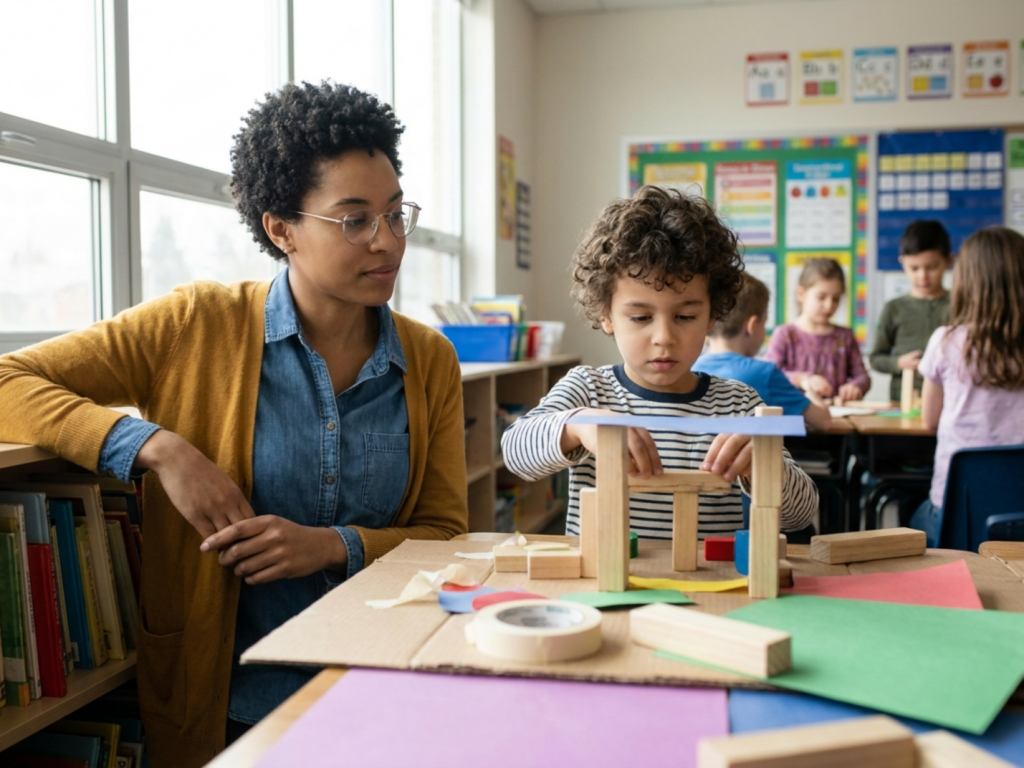
Open-ended materials for children are especially useful because they do not prescribe one correct use. Blocks, fabric, cardboard, clay, recycled containers, safe household objects, music, natural materials, and drawing tools invite transformation. A toy with one button and one sound may be enjoyable, but it often leaves less room for invention than materials that can become many things.
Adults can support play without taking it over. Useful prompts include “What else could this be?”, “How might the character solve that?”, or “What do you need for the next part?” The adult’s role is to provide safety, language, materials, and emotional containment, then allow the child’s idea to lead when possible.
Originality grows through constraints as well as freedom
Children need freedom to generate unusual ideas, but they also need constraints to develop feasibility. A completely open task can be exciting for some children and overwhelming for others. A constrained task, such as “build a bridge using only paper and tape,” can stimulate creativity by giving the child a clear problem space. The balance depends on the child’s age, temperament, skills, and current stress level.
Evidence suggests that task framing affects originality. When children are asked only to imagine ideas, they may generate more unusual possibilities. When they are told they will need to construct a product, their ideas may become more feasible but less original. This is not a failure; it reveals an important developmental tradeoff. Implementation encourages planning, motor sequencing, and practical reasoning. Pure ideation encourages wider exploration.
A helpful rhythm is to separate phases: first, generate many ideas without judging them; second, choose one or two to build, draw, test, or explain; third, revise. This protects originality from being shut down too early while still teaching children that ideas can be improved. For example, a child designing a cardboard clinic might first imagine impossible rooms, then decide which ones can be built, then modify the design when the walls collapse.
Adults can model this rhythm out loud: “Let’s think of lots of possibilities first. Later we can decide which one might work.” This reduces perfectionism and teaches metacognition, the ability to think about one’s own thinking.
Relationships shape whether children risk new ideas
Creativity is socially sensitive. Children watch how adults respond to mistakes, mess, unusual questions, and nonconforming ideas. A child who hears “That is wrong” every time an idea is unexpected may learn to hide original thought. A child who hears “Tell me how you thought of that” receives a different message: unusual thinking is worth examining.
Support does not mean praising everything indiscriminately. Specific feedback is more useful than global praise. Instead of “You are a genius,” an adult might say, “You tried three ways to make the wheel stay on,” or “You changed the ending so the character solved the problem differently.” This emphasizes strategy, persistence, and flexible thinking rather than fixed identity.
Secure relationships also help children manage the emotional load of creation. Making something personal can feel vulnerable. Some children abandon projects quickly because frustration rises faster than problem-solving capacity. Others become rigid because they fear losing control. Calm co-regulation, predictable routines, and permission to pause can keep the creative process accessible.
Culture and family values matter too. Some families emphasize storytelling, music, craft, repair, cooking, spiritual practice, entrepreneurship, humor, or community problem solving. Creativity should not be narrowly equated with art supplies or performance. A child may show original thinking by finding a fair rule for a sibling conflict, inventing a recipe variation, organizing a collection, or asking an unexpected scientific question.
Practical ways to support creativity at home and school
Practical support starts with time. Children need periods that are not fully scripted by screens, adult instruction, or performance goals. Boredom can be uncomfortable, but it often precedes self-generated activity. The goal is not to remove all structure; it is to leave enough mental space for initiative.
- Offer open-ended materials, including paper, blocks, clay, fabric, safe tools, recycled boxes, musical objects, and outdoor materials.
- Ask open questions: “What else could happen?”, “How many ways can we solve it?”, “What would make it stronger?”, or “What would another character think?”
- Use process-focused feedback that notices experimentation, persistence, revision, and flexible strategy.
- Protect some activities from grading, comparison, or public display unless the child wants to share.
- Encourage cross-domain combinations, such as drawing a science idea, building a story setting, composing a rhythm for a poem, or acting out a math problem.
For school-age children, creative hobbies for children can provide sustained domain knowledge. Originality improves when a child has enough skill to manipulate a medium intentionally. A child who learns music, coding, woodworking, dance, gardening, cooking, drama, or robotics gains a vocabulary of possibilities. However, overscheduling can reduce spontaneous exploration, especially if every hobby becomes achievement-focused.
Digital tools can be useful when they allow creation rather than passive consumption. Animation, music composition, coding, digital drawing, photography, and supervised maker platforms can expand expression. Adults should still consider sleep, physical activity, social interaction, visual strain, and age-appropriate online safety.
When to seek guidance
Variation in creativity is normal. Some children are bold performers; others are private inventors. Some prefer realistic building to fantasy play. Some need sensory adaptations, visual schedules, or shorter creative tasks. Neurodivergent children may show deep originality through intense interests, pattern detection, construction, humor, systems thinking, or unconventional associations, even if their social play looks different from peers.
Medical caution is appropriate when changes are persistent, impairing, or associated with broader developmental or emotional concerns. A child who suddenly stops playing, loses previously acquired skills, becomes markedly withdrawn, shows severe anxiety around mistakes, has intense sensory distress, or cannot engage in age-expected symbolic or social activities may benefit from professional assessment. These signs do not automatically indicate a disorder, but they deserve careful context.
Parents and caregivers can start with a pediatrician, family physician, developmental-behavioral pediatrician, child psychologist, occupational therapist, speech-language pathologist, or school-based support team depending on the concern. The purpose is not to pathologize creativity or prescribe a personality style. It is to understand barriers such as language delay, anxiety, sleep problems, trauma exposure, hearing or vision difficulties, motor planning challenges, attention difficulties, or sensory processing differences.
A supportive clinical approach asks what helps the child participate, communicate, and enjoy exploration. Creativity develops best when adults combine realistic attention to developmental needs with respect for the child’s own pace and interests.
When extra support may be needed
- Seek professional guidance if a child loses previously acquired play, language, social, or motor skills.
- Discuss persistent withdrawal, severe anxiety about mistakes, or distress that prevents normal activities with a healthcare professional.
- Consider developmental evaluation if symbolic play, communication, or peer interaction is markedly delayed compared with age expectations.
- Check hearing, vision, sleep, pain, medication effects, and stressors when creativity or engagement changes suddenly.
- Avoid using creativity differences alone to label or diagnose a child.
Tools & Assistance
- Pediatric or family medicine visit for developmental concerns
- Developmental-behavioral pediatric assessment when delays or functional impairment are present
- Speech-language pathology evaluation for communication barriers
- Occupational therapy consultation for sensory, motor, or participation challenges
- Teacher or school support team meeting to adapt creative tasks and classroom expectations
FAQ
Can creativity be taught?
Creativity can be supported and practiced. Children benefit from open-ended tasks, rich language, safe experimentation, flexible problem solving, and chances to revise ideas.
Is pretend play necessary for every child?
Pretend play is a common path for symbolic thinking, but children express creativity in many ways. Building, music, movement, systems, nature exploration, and problem solving can also show original thinking.
Should adults correct unrealistic ideas?
Not immediately in every context. It is often helpful to let children generate ideas first, then later discuss feasibility, safety, or how an idea could be adapted.
Can screens reduce creativity?
Passive, excessive screen time can crowd out sleep, movement, social interaction, and self-generated play. Creative digital tools may be useful when they involve making, designing, composing, or coding.
When is lack of creative play concerning?
Concern rises when reduced play is persistent, sudden, distressing, or accompanied by language delay, social withdrawal, loss of skills, severe rigidity, sensory distress, or functional impairment.
Sources
- Review of Educational Research — Children's Creativity: A Theoretical Framework and Systematic Review
- Journal of Creative Behavior — Creativity Landscapes: Systematic Review Spanning 70 Years of Creativity Interventions for Children
- PubMed Central / NIH — Instructing children to construct ideas into products alters originality and feasibility of ideas
Disclaimer
This article is for informational purposes only and does not diagnose, treat, or replace medical care. Consult a qualified healthcare professional for concerns about a child’s development, behavior, or emotional health.

















Please log in to leave a comment.