
Intro
Traveling with several children and a baby is less about creating a perfect schedule and more about building enough margin for real family life: feeds that run long, restroom stops, spilled snacks, and children who need reassurance. Thoughtful preparation can reduce stress while preserving flexibility.
For medically literate caregivers, travel planning also includes assessing the baby’s developmental stage, birth history, feeding needs, infection exposure, sleep environment, and access to care at the destination. A pediatric clinician can help individualize plans when a baby has medical complexity or was born prematurely.
Highlights
A successful family trip is built around essential needs first: safe transport, feeding, hydration, sleep, medication access, and supervision.
Older children can be active participants in travel routines, which reduces the caregiver workload and gives them predictable responsibilities.
Healthy, full-term infants can often travel safely, but very young infants, premature infants, and babies with chronic conditions may need individualized medical advice.
A smaller, well-organized set of immediately accessible supplies is more useful than packing every possible item.
Start with travel readiness, not the itinerary
When traveling with multiple children and a baby, begin by deciding whether the baby is ready for the specific trip rather than assuming every destination and mode of transport carries the same risk. For a healthy, full-term infant, air travel is generally possible, but families should consider age, immune exposure, feeding reliability, trip duration, and the availability of medical care. Very young babies have limited physiologic reserve, and crowded transit settings can increase exposure to respiratory pathogens.
Ask for individualized advice before departure if the baby was born prematurely, has cardiopulmonary disease, has needed oxygen, has feeding difficulties, is immunocompromised, or has had a recent acute illness. Prematurity can affect travel readiness because respiratory vulnerability and complications related to immature organ systems may persist beyond the newborn period. A clinician who knows the baby can advise on timing and destination-specific risks.
Review immunizations for every child early enough to address gaps. Keep a concise medical summary on your phone and on paper: diagnoses, medications with doses, allergies, pharmacy details, clinician contact information, insurance information, and emergency contacts. This is especially useful when one caregiver is managing the baby while another is seeking help for an older child.
Build a family travel system that shares the load
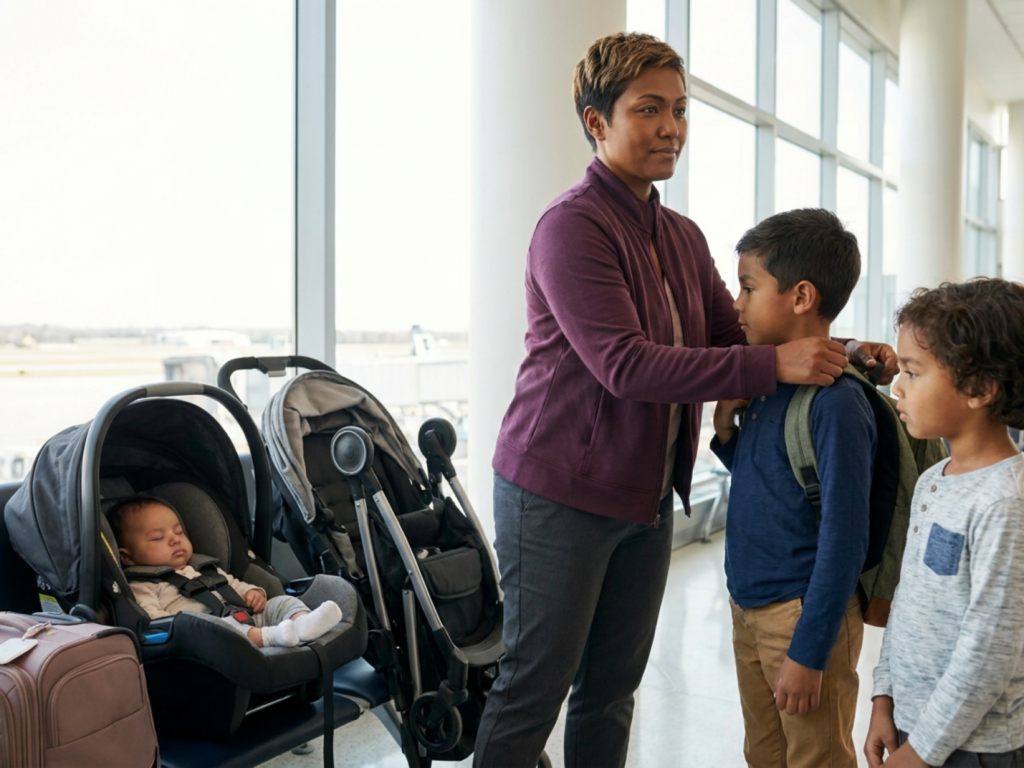
Multiple children create competing needs, so reduce decisions during the journey. Give each older child a small, age-appropriate travel bag containing water, shelf-stable snacks, an extra layer, a quiet activity, and any comfort item. Keep the baby’s supplies separate and immediately reachable. The goal is not independence in every moment; it is preventing routine requests from interrupting a feed, diaper change, or safety transition.
Create two layers of supplies. A day bag stays with the responsible adult and holds diapers, wipes, changing mat, spare baby clothes, burp cloths, feeding items, hand hygiene supplies, medication, and a compact first-aid kit. Reserve luggage holds replenishment supplies. Pack more than expected for delays, diversions, luggage separation, or an unexpectedly long wait, especially when formula feeding or traveling with children who have dietary restrictions.
- Assign one adult, when possible, to ticketing, navigation, and older-child supervision during transitions.
- Use a simple meeting rule for older children: stay within sight, stop if separated, and identify uniformed or official staff for help.
- Photograph current identification details and clothing before entering a busy terminal or venue.
- Plan rest stops, meals, and movement breaks around the youngest child’s needs without expecting an exact timetable.
When only one adult is traveling, simplify further. Minimize loose equipment, use luggage that can be moved one-handed, and accept help from staff when it is safe and appropriate. Practical planning protects caregiver bandwidth, which is a genuine safety resource.
Protect feeding, hydration, and medication routines
Feeding is often the anchor of a travel day. Breastfeeding families may find it helpful to wear clothing that supports comfortable feeding and to identify quieter locations in advance, while remembering that feeds may become more frequent in unfamiliar or overstimulating environments. Formula preparation during travel requires reliable access to clean water, clean bottles, and a way to follow the product’s preparation instructions. Avoid improvising dilution ratios or changing formula simply for convenience unless the child’s clinician has advised it.
Carry enough feeding supplies for the travel period plus a meaningful delay buffer. If expressing milk, plan for safe storage, cleaning equipment, and transport requirements before leaving. For older children, bring familiar foods that reliably provide energy, especially if long lines or limited destination options could delay meals. New foods and major routine changes are best introduced when the family is not dependent on them during transit.
Medication should stay in hand luggage in original labeled containers. Bring extra doses when feasible and use alarms for time-sensitive medicines, accounting for time-zone changes with advice from a pharmacist or prescribing clinician. Do not share medications between siblings, even when symptoms seem similar. Vomiting, diarrhea, hot weather, and prolonged travel can increase dehydration risk. Babies may have fewer wet diapers, dry mouth, reduced tears, unusual sleepiness, or poor feeding; these signs need prompt clinical assessment rather than home diagnosis.
Make transport transitions safer and calmer
Transport safety becomes more complex when adults are outnumbered by children. Before traveling by car, verify that each child has an appropriate restraint system and that caregivers know how it will be installed in a rental vehicle or transferred between cars. A properly installed rear-facing car seat remains the expected restraint for babies until they meet the manufacturer’s limits for a different configuration. Avoid adding unapproved inserts, bulky outerwear under harness straps, or products that interfere with the restraint system.
For flights, confirm the airline’s current policies for seating, baggage, stroller handling, and child restraints before booking. An airline-approved child restraint system can provide a dedicated secured seat for a baby when used according to the airline and manufacturer requirements. Holding a baby may feel simpler during a short flight, but it does not provide the same protection in unexpected turbulence.
During takeoff and landing, feeding or sucking may help some infants with ear pressure discomfort during takeoff, but it is not a substitute for evaluating persistent pain, fever, or signs of illness. Let older children know in advance that these phases require calm voices and staying seated. Prepare a compact “transition kit” with diapers, wipes, snacks, and one activity so you are not searching through bags at boarding, security, or a roadside stop.
Plan sleep and accommodation with safety in mind
Trips disrupt sleep even for children who normally sleep well. Aim for a realistic bedtime routine rather than reproducing home exactly. A short sequence such as feeding, diapering, sleep clothing, a familiar song, and placing the baby in the sleep space can signal continuity amid a new environment. Schedule expectations should remain flexible, particularly on arrival days and after time-zone changes.
Inspect the sleep arrangement before the baby is tired. A safe sleep surface should be firm, flat, and intended for infant sleep, with a fitted sheet and no loose bedding, pillows, soft toys, or improvised positioners. Do not assume a hotel crib, sofa, adult bed, or borrowed sleep product is appropriate without checking its condition and instructions. If using a portable crib for travel, practice setting it up at home and verify that all parts lock as intended.
Room-sharing can make overnight care more manageable, but it also requires attention to cords, blind pulls, unstable furniture, medications, hot drinks, balconies, and accessible cleaning products. Place older children’s bags and activities away from the baby’s sleep area. If a child becomes overtired and dysregulated, one caregiver can take that child for a brief quiet reset while the other preserves the baby’s routine. This division is often more effective than asking everyone to settle simultaneously.
Prepare for illness without turning the trip into a clinic
Families do not need to anticipate every illness, but they should know how to access care. Before departure, identify local emergency services, the nearest pediatric-capable urgent care or hospital, and your insurer’s assistance process. For international travel, confirm whether your coverage includes the destination and whether there are requirements for preauthorization. Keep medical documents available even if they are also stored electronically, since low battery or unreliable connectivity can occur at inconvenient times.
Use routine infection-prevention measures: handwashing when available, alcohol-based hand sanitizer when hands are not visibly soiled, cleaning frequently touched personal items, and avoiding close contact with clearly ill people when practical. These measures matter particularly for young infants, who may be more vulnerable to serious infection. However, travel cannot be made sterile, and families should avoid creating unmanageable rules that make the trip impossible.
Seek urgent medical assessment for a baby with difficulty breathing, bluish or gray coloration, marked lethargy, a seizure, signs of significant dehydration, a serious injury, or fever in a young infant. The threshold for prompt evaluation should be low for babies who are very young or medically complex. For any child, concerning symptoms that worsen quickly, impair alertness, or prevent adequate drinking warrant professional advice. Trust your observation that a child is not acting like themselves, and communicate that change clearly to clinicians.
Finally, plan recovery time after return. A day without major commitments allows sleep, laundry, medication restocking, and decompression. Traveling with multiple kids and a baby can be demanding, but a calm structure, realistic expectations, and timely medical guidance make it far more manageable.
When to get urgent help
- Seek urgent care for breathing difficulty, blue or gray color, seizure, unresponsiveness, or serious injury.
- A fever in a young infant requires prompt medical evaluation; ask a clinician what age-specific threshold applies to your baby.
- Get professional advice for poor feeding, markedly fewer wet diapers, persistent vomiting, or unusual sleepiness.
- Contact a clinician before travel for premature infants or babies with significant heart, lung, immune, or feeding conditions.
- Do not use improvised sleep surfaces or unapproved modifications to car seats or child restraint systems.
Tools & Assistance
- Schedule a pre-travel pediatric visit for complex medical needs or destination concerns
- Confirm airline policies for infant seating, strollers, and approved child restraints
- Locate pediatric urgent care and emergency services near your accommodation
- Ask a pharmacist about medication timing across time zones
- Use a written packing and medication checklist
FAQ
Can a baby fly with older siblings?
Many healthy, full-term infants can fly, but timing should be individualized for very young, premature, or medically complex babies. Discuss concerns with the baby’s clinician before booking.
How many diapers should I carry during transit?
Carry enough for the expected journey plus a substantial delay buffer. Keep them in the day bag rather than relying on checked luggage.
Should the baby sleep in an adult bed while traveling?
No. Plan an infant-specific, firm, flat sleep surface that follows current safe-sleep guidance and the product instructions.
What is the best way to manage several children at an airport?
Use simple roles, keep essential baby supplies accessible, establish a family meeting rule, and allow extra time for security, toileting, feeding, and boarding.
Sources
- MedlinePlus — Traveling with children: MedlinePlus Medical Encyclopedia
- Mayo Clinic — Air travel with infant: Is it safe?
- Derbyshire Family Health Service NHS — Travelling and going on holiday with a baby
Disclaimer
This article is for general information and does not replace medical advice, diagnosis, or treatment. Consult a qualified healthcare professional for advice tailored to your child and travel plans.
















Please log in to leave a comment.