
Intro
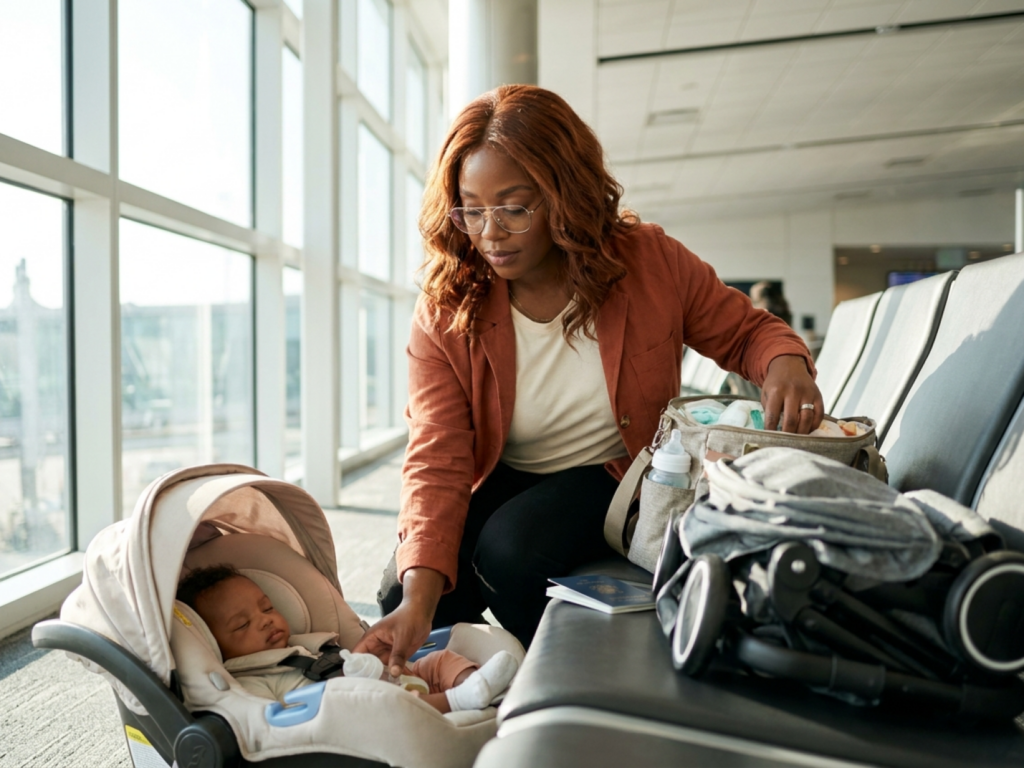
Traveling alone with a baby can feel like coordinating several clinical priorities at once: feeding, sleep, hygiene, safe transport, emotional regulation, and your own basic needs. The aim is not to keep the day perfectly on schedule. It is to create a plan that remains workable when a feed runs late, a diaper leaks, or transit is unexpectedly delayed.
Preparation reduces cognitive load, but flexibility protects both you and your baby. A short, realistic trip plan and a few clear safety thresholds can make solo travel more manageable.
Highlights
Solo baby travel is easier when essential supplies are accessible without unpacking every bag.
Use age-appropriate restraint and supervised sleep arrangements as non-negotiable safety priorities.
Build extra time into every stage of the journey, including feeding, changes, security, transfers, and delays.
Seek professional advice before travel when your baby has complex medical needs, recent illness, or medication requirements.
Plan the journey around the least flexible needs
When you are traveling without another adult, the most useful plan is a simple sequence of decisions rather than an ambitious itinerary. Start with the fixed parts: departure time, journey duration, transfers, border or security procedures, and access to toilets or private feeding areas. Then estimate where your baby is likely to need a feed, diaper change, nap, or quiet reset. Add more time than you think you need. A delay that is inconvenient alone can become much harder when you are holding a tired infant and trying to locate supplies.
Choose the most direct route that is practical, even if it costs slightly more. Fewer changes reduce the number of times you must move a baby, stroller, car seat, bags, and documents simultaneously. If possible, travel at a time that broadly aligns with your baby’s usual calmer period, but do not depend on a routine being reproduced exactly. Infants commonly sleep, feed, or become unsettled at different times in unfamiliar environments.
Before leaving, make a baby travel care plan in a note on your phone or on paper. Include your destination address, transportation details, your baby’s feeding pattern, medications and doses if prescribed, allergies, primary clinician contact information, insurance details, and local urgent-care options. Keep a separate backup of critical information in case your phone battery fails. For international travel, review destination-specific health advice well ahead of departure with a qualified clinician or travel-health service.
Pack for immediate access, not just total quantity
Solo travel packing works best when supplies are divided by when you will need them. Your primary personal item should stay with you at all times and contain enough essentials for the planned journey plus a meaningful delay. Store it so that one hand can retrieve wipes, a diaper, a muslin cloth, a clean baby outfit, and your phone without searching through everything else. A small zip pouch for each diaper change can prevent loose items from falling onto a train floor, airport seat, or pavement.
Bring more diapers, wipes, and feeding supplies than the journey should require. The right buffer depends on the trip length and your baby’s age, feeding method, and bowel pattern. Include spare clothes for your baby and at least one clean top for yourself, because a caregiver who is wet, soiled, or cold may have difficulty safely managing the next stage of travel. A lightweight changing mat and disposable bags are useful for managing surfaces and waste where facilities are limited.
For formula-fed babies, follow current safe formula preparation guidance. Bring the usual formula, clean bottles and teats, and a way to prepare feeds safely for the circumstances. Water safety varies by location. Ready-to-feed formula can reduce preparation steps when it is available and suitable for your baby, but it may be bulky. Breastfeeding parents may benefit from clothing and seating that allow comfortable feeding, but there is no requirement to feed in a particular location. Prioritize a secure, supported position for both of you.
- Keep travel documents, phone, payment method, and keys in one secure, reachable place.
- Carry any prescribed medication in original labeled packaging, with enough supply for delays.
- Use a compact wet bag or sealed pouch for soiled clothing.
- Bring a familiar comfort item only if it can be used safely and supervised appropriately.
Protect feeding, hydration, and comfort during transit
Feeding is often the most reliable way to settle an infant in a changing environment, but it need not become a rigid target. Offer feeds responsively, watching your baby’s usual hunger cues such as rooting, hand-to-mouth movements, or escalating fussiness. Travel can increase feeding frequency for some babies because of stimulation, warmth, or the need for reassurance. If your baby has a specific feeding plan, poor weight gain, swallowing difficulty, metabolic condition, or fluid restriction, ask the clinician managing their care for individualized travel guidance.
During air travel, feeding during takeoff and landing may help some babies tolerate pressure changes through swallowing. It is not a guarantee against ear discomfort, and you should not force-feed a distressed baby. For a breastfed infant, nursing can be convenient; for bottle-fed infants, use a method that keeps feeding safe and allows you to hold the bottle rather than propping it. Avoid relying on unadvised medicines or decongestants for travel-related ear concerns; discuss symptoms or treatment questions with a pediatric clinician.
Monitor practical comfort factors: heat, cold, sun exposure, and overstimulation. Babies regulate temperature less effectively than adults, especially young infants. Use removable layers and check the chest or back rather than hands and feet alone when assessing warmth. In crowded or warm transit areas, remove excess layers promptly. Regularly observe alertness, color, breathing effort, feeding ability, and wet diapers. These observations are more informative than trying to make every aspect of the routine look normal.
Keep restraint and sleep safety central
When you are alone, it can be tempting to accept any convenient place where your baby falls asleep. Convenience should not override safe sleep principles. For routine sleep, use a firm, flat sleep surface designed for infants, with the baby placed on their back unless a clinician has given you individualized advice. Avoid leaving a sleeping baby unattended in a stroller, car seat, sling, adult bed, or improvised surface. Car seats are essential for travel in a vehicle but are not intended as a routine sleep space once you have reached your destination.
Safe transport for infants also means using the appropriate restraint for the mode of travel. In a car, use a properly installed rear-facing car seat that fits your baby’s size and follows the manufacturer instructions and local law. Do not hold a baby on your lap in a moving vehicle. For flights, check the airline’s current policies before booking, including whether you can use an airline-approved child restraint system, baggage rules for strollers and car seats, boarding support, and seating restrictions.
A baby carrier can free your hands in stations and airports, but use it according to its instructions. Keep your baby’s face visible, chin off the chest, airway clear, and body adequately supported. Avoid tasks that compromise your balance while carrying your baby, such as managing a heavy suitcase on stairs. Ask staff for assistance when needed. Requesting a hand with a door, stroller fold, or bag is a reasonable safety measure, not a failure of preparation.
Manage changes, mess, and distress with a repeatable routine
A predictable micro-routine helps when you are tired or under pressure: secure the baby, assess the immediate need, gather supplies, complete one task, clean your hands, and repack before moving on. Never place your baby on an elevated changing surface without one hand available for supervision. If a changing table feels unstable, dirty, or too small, look for a safer alternative or ask staff about family facilities. Use your portable changing pad and clean the surface only as far as practical; thorough hand hygiene after diaper changes remains especially valuable.
Have a low-stimulation reset strategy for crying. This might be feeding, a diaper change, a brief walk with the stroller, holding your baby close while seated safely, or moving to a quieter area. A crying baby does not mean you are doing the journey incorrectly. Infants may react to noise, unfamiliar faces, disrupted sleep, gas, hunger, or simply the cumulative demands of travel. Focus on basic checks first rather than trying multiple new techniques at once.
For diarrhea-related diaper changes, prioritize frequent changes, gentle cleaning, and keeping the skin dry where possible. Persistent diarrhea, markedly reduced urine output, repeated vomiting, poor feeding, fever in a young infant, or unusual lethargy warrant prompt medical assessment. Know the signs of dehydration relevant to your baby’s age, such as significantly fewer wet diapers than usual, dry mouth, absent tears when crying in an older infant, or reduced alertness. These signs should be interpreted by a healthcare professional in the context of the whole clinical picture.
Prepare for delays, illness, and your own capacity
Before departure, identify what you will do if your transport is cancelled, your phone loses charge, or your baby becomes unwell. Save the local emergency number while traveling, locate medical facilities near the destination, and tell a trusted person your route and expected arrival. Keep your baby’s medical summary accessible, particularly if they have prematurity-related needs, congenital conditions, respiratory disease, seizures, allergies, or regular medications. A concise summary can help an unfamiliar clinician understand relevant history quickly.
Seek urgent medical help for breathing difficulty, blue or gray color, unresponsiveness, a seizure, signs of severe dehydration, or any acute concern that feels immediately serious. Fever in a young baby can require prompt assessment; contact a healthcare professional for age-specific guidance rather than assuming it is a routine travel illness. Do not delay needed care because you are alone or concerned about changing travel plans. Transport providers, hotel staff, and public venues can often help contact emergency services or direct you to local care.
Your capacity matters too. Eat, drink, use the toilet when you have a safe opportunity, and keep your phone charged. Choose a seat or stopping point where you can safely place the stroller, keep belongings close, and settle the baby. If you are overwhelmed, pause in a staffed, well-lit area and ask for practical help. Solo travel with a baby is demanding because it requires sustained attention. Reducing preventable strain is part of protecting your baby’s safety.
When to seek urgent help
- Seek emergency help for breathing difficulty, blue or gray color, unresponsiveness, or a seizure.
- Get prompt medical advice for a young infant with fever, repeated vomiting, poor feeding, or unusual sleepiness.
- Do not leave a baby unattended in a car seat, stroller, carrier, adult bed, or improvised sleep space.
- Do not hold a baby on your lap in a moving car; use an appropriate child restraint.
- Contact a clinician before travel if your baby has complex medical needs or needs individualized feeding or medication guidance.
Tools & Assistance
- Ask your pediatric clinician or family doctor for destination- and baby-specific travel advice.
- Check airline, rail, or coach rules for infant restraints, strollers, baggage, and boarding assistance.
- Save local emergency contacts, destination address, and nearby urgent-care locations before departure.
- Use a written feeding and medication log if your baby has a complex care routine.
FAQ
How early should I arrive when traveling alone with a baby?
Allow extra time for feeding, diaper changes, security procedures, stroller handling, and unexpected queues. The appropriate margin depends on the transport provider and airport or station.
Can my baby sleep in a car seat during a journey?
A correctly used car seat is necessary in a moving vehicle, but it is not a routine sleep surface once travel stops. Move your baby to a firm, flat infant sleep space when feasible.
Should I bring medicine just in case?
Bring medications already prescribed or specifically recommended for your baby, in labeled packaging. Ask a healthcare professional before giving a baby any new medicine for travel symptoms.
What should I do if my baby cries throughout the trip?
Check basic needs such as feeding, diaper, temperature, positioning, and fatigue. Move to a quieter space when possible and seek medical advice if crying is unusual, persistent, or accompanied by illness signs.
Sources
- MedlinePlus — Traveling with children: MedlinePlus Medical Encyclopedia
- Johns Hopkins Medicine — Traveling With Children
- NHS — Traveling with Children
Disclaimer
This article provides general educational information and is not a substitute for individualized medical advice. Consult a qualified healthcare professional for concerns about your baby's health or travel readiness.













Please log in to leave a comment.