
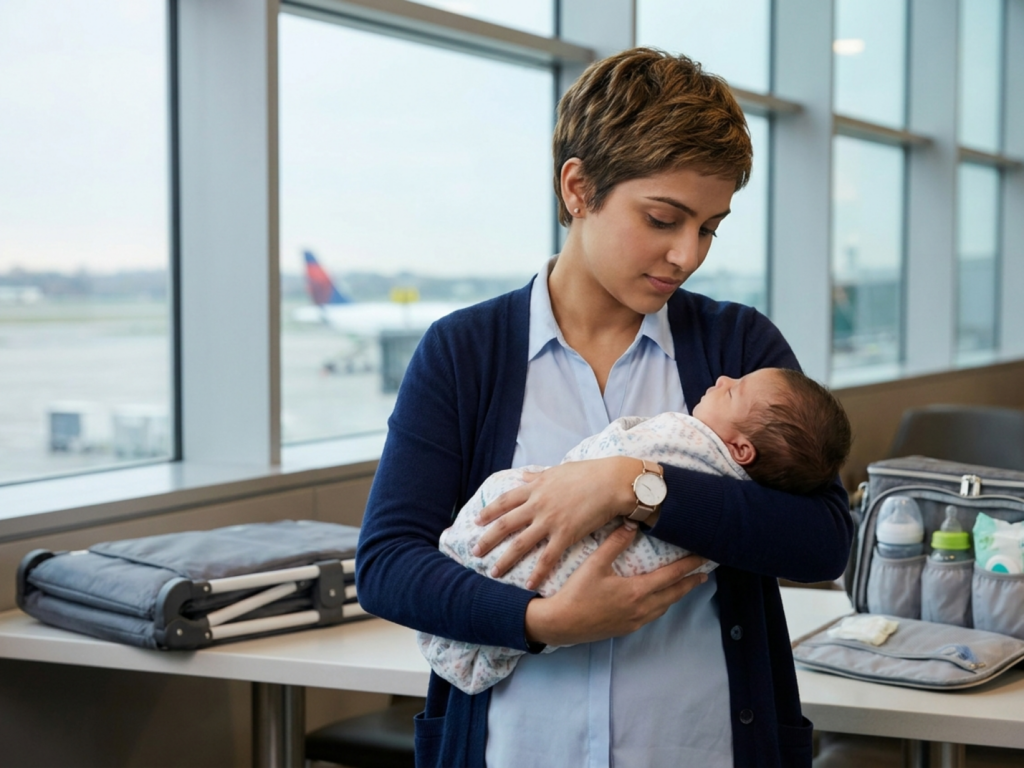
Intro
Jet lag in babies can be unsettling for the whole family. Crossing time zones may disrupt an infant’s developing circadian rhythm, the internal timing system that helps coordinate sleep, feeding, alertness, and hormone release. A baby may wake when caregivers expect sleep, become unusually sleepy during the day, feed at unfamiliar times, or take longer to settle.
These changes are usually temporary, but babies have less flexibility than adults because sleep, feeding, and comfort are closely linked. Thoughtful preparation, gradual adjustment, safe sleep practices, and attention to the baby’s cues can make the transition easier. This article explains what jet lag may look like, how travel affects infant rhythms, and when professional advice is appropriate.
Highlights
Crossing time zones can temporarily disturb a baby’s sleep-wake pattern, feeding rhythm, and mood.
Light exposure, local-time routines, and familiar care cues may help the body clock adjust.
Infants should continue to sleep on a firm, flat, separate sleep surface that meets local safety guidance.
Jet lag should not be assumed when a baby is difficult to wake, feeding poorly, dehydrated, or medically unwell.
What jet lag means in babies
Jet lag is a temporary mismatch between the body’s internal clock and the local time. When a family travels rapidly across several time zones, environmental cues such as daylight, darkness, meals, activity, and social interaction occur at different times than the infant’s circadian system expects. The NHS describes jet lag as a disruption that can affect sleep, alertness, concentration, appetite, and general wellbeing. In babies, the visible effects often appear through sleep and feeding rather than through a verbal report of tiredness.
An infant’s circadian rhythm is still maturing, particularly in the first months of life. Newborns naturally sleep and wake in relatively short cycles and may not yet have a stable distinction between day and night. Older infants may have a more recognizable pattern, but that pattern can still be easily disrupted by travel, unfamiliar surroundings, illness, missed naps, or changes in feeding times. The greater the time-zone difference and the faster the journey, the more noticeable the adjustment may be.
Jet lag does not mean that a baby has developed a disease, and it is not a parenting failure. It is a physiological response to a rapid environmental change. The adjustment may take several days, and some babies may need longer, especially when travel is combined with overstimulation, disrupted naps, or a new sleep environment.
How jet lag may appear
Possible signs include waking repeatedly during the local night, waking very early, taking unusually long daytime naps, resisting naps, or becoming unsettled at bedtime. A baby may appear more irritable, harder to soothe, or less interested in usual play. Some infants temporarily feed at times that reflect their home schedule rather than the local schedule. Others may seek additional comfort because tiredness and unfamiliar surroundings increase their need for predictable caregiving.
These signs are nonspecific. Sleep disruption can also result from teething, respiratory infection, gastrointestinal illness, pain, hunger, a developmental change, or the stress of travel itself. A baby’s age and usual pattern matter. A newborn who wakes frequently overnight may be behaving within a normal range, while a previously settled older infant with an abrupt change may merit closer observation.
Look at the whole clinical picture rather than sleep alone. Continue monitoring wet diapers, feeding effectiveness, alertness when awake, breathing, temperature, and the baby’s ability to be comforted. A temporarily irregular sleep schedule is generally less concerning than poor hydration, marked lethargy, breathing difficulty, persistent vomiting, or a baby who is difficult to wake.
Before travelling across time zones
Preparation is most useful when it is realistic. If the baby has a fairly predictable schedule and the journey crosses multiple time zones, caregivers may gradually shift bedtime, wake time, naps, and meals toward the destination schedule over several days. The change should be modest and responsive rather than forced. A baby who becomes overtired may sleep more poorly, so preserving adequate total sleep is more important than achieving a precise timetable before departure.
Discuss travel plans with the baby’s clinician if the infant was born prematurely, has a chronic medical condition, uses regular medication, has feeding or growth concerns, or has recently been ill. Ask about destination-specific health issues, travel vaccines where relevant, required medication storage, and how to manage feeding during transit. The CDC Yellow Book emphasizes that travel with infants requires attention to both developmental needs and general travel safety.
Pack supplies that support familiar care: usual feeding equipment, enough food or formula for delays, nappies, spare clothing, comfort objects used safely, and a plan for changing or expressing milk. MedlinePlus recommends practical preparation for feeding, hygiene, and comfort when travelling with babies. Do not rely on sedating medicines, antihistamines, melatonin, or supplements to make an infant sleep unless a qualified healthcare professional has specifically advised their use. Medication can have unpredictable effects in young children.
Managing the journey and arrival
During the journey, respond to hunger and comfort cues while using the destination’s time as a gradual reference point. Feeding may be irregular during a flight or long road trip, so flexibility is expected. Breastfed babies may need additional opportunities to feed for comfort and hydration. Formula should be prepared, stored, and discarded according to local safety guidance and the product instructions. For infants who have started complementary foods, familiar options may be easier to tolerate than introducing several new foods while travelling.
Once at the destination, use daylight and darkness as strong environmental signals. Morning daylight can help anchor the start of the local day, while dimmer, quieter conditions in the evening support the transition toward sleep. The NHS notes that exposure to daylight and adapting activities to local time can help with jet lag. With babies, avoid prolonged direct sun exposure and follow infant sun-protection advice; bright outdoor light does not require placing an infant in harsh sun.
Try to establish a simple local-time sequence: wake, feed, light activity, naps, evening feeding, quiet routine, and sleep. Keep the sequence recognizable even if clock times are imperfect. Low-stimulation bedtime cues such as a wash, feed, song, or brief story may be more helpful than insisting on a rigid schedule. During the first nights, a gradual shift toward the local bedtime is reasonable. The goal is a secure rhythm, not immediate perfection.
Protecting sleep safety while travelling
Jet lag can increase the temptation to let a baby sleep wherever the baby finally settles. Safety still applies during exhausting travel. The safest arrangement is a separate, firm, flat sleep surface designed for infants, with the baby placed on their back and the sleep area kept free of pillows, loose blankets, toys, and other soft items. Follow current local safe-sleep recommendations and check that any travel cot or hotel crib is intact, correctly assembled, and appropriate for the baby’s size and developmental stage.
Room-sharing without bed-sharing can allow a caregiver to respond quickly while preserving a separate sleep surface. Do not treat a car seat, stroller, sling, sofa, adult bed, or airplane seat as a routine sleep space. If a baby falls asleep during transport, move the baby to an appropriate sleep surface when practical and safe to do so. Ask accommodation providers about hotel crib availability before arrival, and inspect the equipment rather than assuming it meets current standards.
Keep the sleep environment as predictable as possible. Familiar sleepwear, a consistent short routine, and controlled background noise may help, provided that any device or fabric is used safely and does not create overheating or entrapment risks. A darkened room may support nighttime sleep, but caregivers should still be able to check the baby easily. Avoid unsafe improvisation when fatigue is severe; arrange shifts between adults where possible.
Returning to a normal rhythm
Most babies gradually realign with local time through repeated exposure to the new schedule. Continue offering naps based on age-appropriate needs and the baby’s signals, while gently keeping nighttime conditions calm and boring. If the baby wakes overnight, use low light and minimal stimulation, then return to the usual settling approach. Daytime feeding and activity can be gradually aligned with local time as the infant’s appetite and alertness permit.
Consistency matters, but responsiveness matters more. A baby who is overtired may need an earlier nap or bedtime, and a baby who is hungry should be fed rather than kept awake to meet a schedule. Expect some variation for several days. The adjustment may be slower after westward or eastward travel depending on the individual infant, the number of time zones crossed, and the baby’s developmental stage. It is also common for sleep to remain unsettled because of the journey, not solely because of the time difference.
Caregivers should protect their own sleep and safety. Share overnight responsibilities, accept practical help, and avoid driving when severely sleep deprived. If sleep disruption persists well beyond the expected adjustment period, repeatedly affects feeding or daytime functioning, or is accompanied by concerning physical signs, contact the baby’s clinician. For a broader discussion of time-zone adjustment for infants, families may also benefit from a dedicated travel-sleep plan.
When jet lag may be something else
Jet lag is a reasonable explanation only when the timing and symptoms fit recent travel. It should not be used to explain away signs of acute illness. Seek urgent medical care if a baby has trouble breathing, blue or grey coloration, a seizure, severe dehydration, repeated vomiting, a rapidly worsening condition, or is unusually difficult to wake. For young infants, fever thresholds and other warning signs vary by age, so obtain prompt clinical advice rather than relying on general travel guidance.
Contact a healthcare professional if the baby is feeding substantially less than usual, has noticeably fewer wet diapers, has persistent diarrhea, appears unusually floppy or lethargic, develops a significant fever, or cannot be consoled. Also seek advice after a head injury, possible ingestion, or an unsafe sleep incident. Travel can expose babies to infections and changes in food, water, climate, and altitude, so the explanation may be broader than a disrupted body clock.
When speaking with a clinician, provide the departure and arrival times, number of time zones crossed, the baby’s age, usual sleep and feeding pattern, symptoms, wet-diaper count, temperature if measured, and any medications or exposures. This information helps distinguish expected adjustment from a problem requiring assessment.
Seek medical advice promptly when
- The baby is difficult to wake, unusually floppy, or markedly less responsive.
- Breathing is difficult, noisy, or associated with blue or grey coloration.
- The baby is feeding poorly, vomiting repeatedly, or has substantially fewer wet diapers.
- A young infant develops a fever or any rapidly worsening symptom.
- Sleep disruption continues with concerning changes in alertness, hydration, or general behavior.
Tools & Assistance
- A written record of feeds, wet diapers, naps, and symptoms
- A destination-time sleep and feeding plan with flexible adjustment points
- A clinician or travel-medicine consultation before international travel
- A safe, age-appropriate portable sleep surface
- Emergency and routine healthcare contact details for the destination
FAQ
How long does jet lag last in babies?
Many babies begin adjusting over several days, but the duration varies with age, temperament, the number of time zones crossed, and whether travel also caused missed naps or illness. A persistent or worsening problem should be discussed with a healthcare professional.
Should I wake my baby to follow the destination schedule?
There is no universal rule. Protect adequate sleep and feeding, and shift toward local time gradually. A clinician can provide individualized advice for newborns, premature infants, or babies with feeding and growth concerns.
Can babies take melatonin for jet lag?
Do not give melatonin or another sleep product to a baby unless a qualified healthcare professional has specifically recommended it. Infant dosing, product quality, interactions, and developmental effects require clinical consideration.
Does daylight help a baby adjust after travel?
Daylight is an important circadian cue and can help define daytime, but infants need appropriate protection from direct sun and overheating. Use ordinary, safe daytime light rather than deliberate prolonged sun exposure.
What if my baby sleeps in a car seat after the flight?
Transport devices are not intended to replace a routine infant sleep surface. When practical and safe, move the baby to a firm, flat, separate sleep surface and continue following current safe-sleep guidance.
Sources
- CDC Yellow Book / National Center for Biotechnology Information — Traveling Safely with Infants and Children
- NHS — Jet lag
- MedlinePlus — Traveling with children: MedlinePlus Medical Encyclopedia
Disclaimer
This article is for general educational purposes and does not diagnose, treat, or replace advice from a qualified healthcare professional. Seek medical care promptly for urgent or worsening symptoms.















Please log in to leave a comment.