
Intro
Exploration is how babies gather information about their bodies, people, and surroundings. It can look very simple: watching a face, turning toward a sound, kicking on a mat, reaching for a cloth, or mouthing a safe toy. These repeated experiences support perceptual, motor, cognitive, and social learning without requiring a busy schedule or specialized equipment.
A calm, responsive adult and a safe place to move are the essential ingredients. Babies vary substantially in their pace, preferences, alertness, and physical abilities, so activities should follow the individual baby’s cues rather than a rigid milestone timetable.
Highlights
Exploratory play gives babies opportunities to connect sensory input with movement, attention, and cause-and-effect learning.
Short, repeated periods of supervised play are generally more useful than attempting to keep a baby continuously stimulated.
The safest exploration occurs on a clear floor space with an attentive adult nearby, age-appropriate objects, and careful attention to choking and fall hazards.
A baby’s signals of interest, fatigue, or overstimulation should guide when an activity continues, changes, or stops.
Why exploration matters in infancy
Babies are active learners from the beginning. Exploration helps them link perception and action: a sound prompts a head turn, a visually interesting object holds attention, or a hand contacts a toy and produces movement or noise. Over time, these experiences contribute to sensorimotor learning, the foundation on which later problem-solving and intentional action are built.
Research on infant exploratory play has found an association between more efficient exploration and later cognitive outcomes. This does not mean that a particular toy, activity, or amount of play predicts an individual child’s intelligence. It does reinforce that everyday play is meaningful learning, especially when babies can repeat actions, notice results, and receive responsive support from an adult.
Exploration also supports postural control and upper-extremity skill. Reaching, grasping, bringing objects to the midline, transferring an object between hands, and manipulating it are not isolated milestones. They depend on vision, attention, shoulder stability, trunk control, tactile feedback, and opportunities to practice. For a baby, touching and mouthing a safe object can be serious scientific work.
The goal is not to accelerate development. A supportive approach creates time, safety, and emotional security so the baby can initiate exploration. Pausing to observe what captures their attention often tells you more than adding another activity.
Follow cues and choose a manageable pace
Begin when your baby is awake, reasonably settled, and has basic needs met. A few minutes may be plenty for a young infant. Brief sessions across the day are often easier to tolerate than one long session, particularly because newborns and young babies can become fatigued or overstimulated quickly.
Signs that a baby is available for interaction can include quiet alertness, looking toward a face or object, smooth body movements, relaxed hands, vocalizing, or returning attention after a brief pause. Signs to slow down may include turning away repeatedly, yawning, fussing, hiccups, finger splaying, arching, crying, or increasingly disorganized movement. These are communication signals, not misbehavior or failure to engage.
Try one sensory input at a time. For example, slowly move a high-contrast object within comfortable viewing distance, then pause. Speak softly while changing a diaper, then allow silence. Offer one toy during supervised floor play rather than surrounding the baby with many objects. This simpler setup makes it easier for the baby to attend, act, and show preferences.
Responsive caregiving during exploration means noticing the baby’s response and adjusting. Describe what you see in ordinary language: “You found the crinkly sound” or “You are looking at the light.” The exact words matter less than the warm turn-taking, predictable voice, and pause for the baby’s response.
Sensory exploration in the early months
In the first months, sensory activities for newborns can be quiet and relationship-centered. Babies may study a familiar face, orient to a caregiver’s voice, track a slowly moving high-contrast pattern, or respond to gentle touch. Their visual system is still maturing, so hold objects at a comfortable close distance and move them slowly rather than expecting sustained tracking across a room.
Offer varied but gentle tactile input. During an awake period, let a baby’s hands or feet touch a clean cotton cloth, a smooth board book, or a soft rattle with no loose components. Narrate bathing, lotion application, dressing, or diaper changes as sensory moments. Skin-to-skin contact may also be calming and can support co-regulation when it is appropriate for the baby and caregiver.
Sound exploration can be as simple as speaking, singing softly, or briefly shaking a rattle to one side while your baby is alert. Avoid placing loud sound sources close to the ears. A baby does not need constant background music; intermittent sound followed by quiet allows time to notice and respond.
Mouthing is a common route for object exploration once babies can bring items to the mouth. Provide only clean, intact, age-appropriate objects that are too large to be swallowed and have no detachable pieces, damaged seams, button batteries, magnets, or toxic coatings. Stay close throughout play, since supervision remains necessary even with products marketed for infants.
Movement, reaching, and hands-on discovery
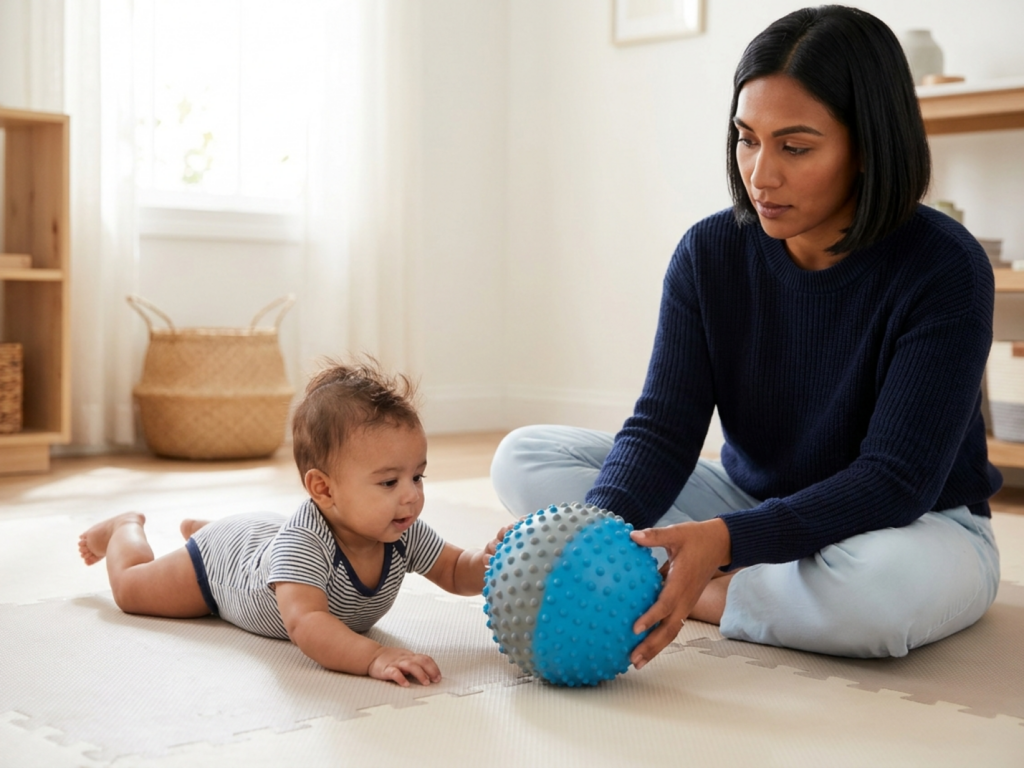
Supervised tummy time while awake gives babies an opportunity to work against gravity, strengthen neck and trunk muscles, and explore from a different visual perspective. Begin with very short intervals when the baby is comfortable. A caregiver’s face, a mirror designed for infant use, or a simple object placed within view can make the position more engaging. Stop if the baby becomes distressed, then try again later rather than forcing endurance.
Floor time on a firm, clear surface gives room for spontaneous kicking, turning, rolling, pivoting, and eventually crawling. Place one interesting object just within reach, allowing the baby to attempt the movement before moving it closer. The effort to orient, reach, and make contact is valuable even when the object is not grasped immediately.
As hand use emerges, offer lightweight objects with different safe properties: a graspable rattle, a soft fabric square, or a large textured teether. You can place an object near the midline and wait. Later, place it slightly to either side to encourage visual attention and reaching. Avoid repeatedly positioning a baby’s arm or forcing a grasp; voluntary movement provides more useful information to the nervous system.
Upper-extremity exploration is clinically relevant because persistent asymmetry, very limited spontaneous movement, or difficulty using one side may occasionally warrant assessment. One-sided preferences can be transient, especially early on, but a persistent pattern deserves a non-urgent conversation with the child’s clinician, physiotherapist, or occupational therapist rather than a home-based attempt to correct it.
Simple cause-and-effect and object activities
Cause-and-effect play helps babies notice that their actions can change something around them. A baby may kick and make a hanging toy sway, squeeze a soft noisy toy, or hit a surface with an open hand. Set up these experiences so the effect is immediate and modest. Too many lights, sounds, and moving parts can obscure the connection between the baby’s action and the result.
Object permanence develops gradually, so games involving partially hidden objects can be adapted to the baby’s stage. For a younger infant, slowly cover part of a familiar object with a cloth and reveal it again. For an older baby who is reaching or searching, leave a portion visible and pause to let them attempt retrieval. This is play, not a test; offer help before frustration escalates.
Books are also useful exploration tools. Choose sturdy board books with simple images, varied but secure textures, and pages that tolerate handling. Pointing, naming pictures, allowing the baby to pat a page, and waiting for their gaze are all meaningful. Reading does not need to be completed from cover to cover. Repetition of a favorite page is a valid form of attention and learning.
- Place a safe toy on a mat and wait for your baby to look, reach, or kick.
- Roll a soft ball slowly across a clear floor once your baby can visually follow it.
- Use a cloth to hide part of a toy, then reveal it after a short pause.
- Let an older baby safely bang two large, lightweight objects together while you supervise.
Social exploration and language-rich routines
Babies learn about people through repeated, reciprocal exchanges. Face-to-face interaction with babies can include copying a coo, waiting after a sound, smiling when the baby looks back, or responding to a change in facial expression. These small back-and-forth patterns support early communication and teach babies that their behavior has social meaning.
Routine care offers many natural opportunities. During feeding, bathing, dressing, and walks, name what is happening and leave pauses. A baby may respond with a gaze shift, limb movement, expression, vocalization, or stillness. Treating these behaviors as communicative helps keep the interaction child-led, even before spoken language is possible.
As babies grow, shared attention becomes increasingly noticeable. They may look at an object and then toward you, or seek your response to something unfamiliar. Calmly labeling the object and acknowledging the feeling can support this social learning. You do not need to perform continuously. A quiet, available adult who follows the baby’s focus is often more supportive than elaborate entertainment.
When possible, include exploration in ordinary environments: feeling a safe leaf while held outdoors, listening to water during a bath, or looking at light and shadow on a wall. Stay attentive to temperature, sun exposure, allergens, falls, and objects that could be placed in the mouth. Everyday moments can be rich without becoming overwhelming.
Safety and when to seek professional guidance
A safer play space is usually simple: a firm floor mat, a small number of intact age-appropriate objects, and continuous adult supervision. Follow safe sleep guidance by keeping tummy time and all active play awake and supervised; move a sleeping baby to their usual safe sleep surface. Avoid elevated surfaces, loose cords, plastic bags, small parts, water play without hands-on supervision, and toys with accessible batteries or magnets.
It is also reasonable to ask questions when exploration feels noticeably different from what you observe over time. Discuss concerns with a pediatric clinician or other qualified healthcare professional if your baby consistently does not respond to sound, rarely tracks faces or objects when alert, shows very little spontaneous movement, has a marked or persistent use of one side only, loses a previously acquired ability, or has feeding, tone, vision, or hearing concerns. These observations do not establish a diagnosis, but early assessment can clarify what is typical for that child and whether support is useful.
For babies born preterm, developmental expectations are often considered using corrected age in the early years. Medical history, vision or hearing differences, reflux, musculoskeletal conditions, and neurodevelopmental variation can all affect how a baby participates. Adaptation is appropriate: change position, reduce sensory load, shorten the activity, or use advice from the child’s care team.
Exploration should feel safe enough for curiosity. The most helpful activity is often the one your baby returns to with interest, supported by your attentive presence.
Safety reminders
- Keep all active play, including tummy time, awake and directly supervised.
- Check toys frequently for loose parts, damaged seams, magnets, button batteries, and choking hazards.
- Never leave a baby unattended on a sofa, bed, changing surface, in water, or near stairs.
- Stop an activity when your baby shows distress, fatigue, breathing difficulty, or persistent discomfort.
- Seek prompt medical care for sudden weakness, unusual unresponsiveness, breathing concerns, or loss of previously acquired skills.
Tools & Assistance
- A clear floor mat for supervised play
- A pediatric clinician for developmental questions
- An occupational or physical therapist when recommended
- Age-appropriate board books and intact graspable toys
- A written list of observations to bring to well-child visits
FAQ
How long should exploration activities last?
Follow your baby’s cues. For young babies, even a few calm minutes can be enough; repeat short sessions when they are alert and receptive.
Do babies need many toys to explore?
No. A small number of safe, simple objects and a responsive adult usually provide plenty of opportunities for attention, reaching, touch, and repetition.
Is mouthing toys normal?
Mouthing is a common way babies explore. Offer only clean, intact, age-appropriate items that cannot be swallowed or broken apart, and supervise closely.
Should I worry if my baby dislikes tummy time?
Many babies need gradual practice. Try very brief awake periods with support and stop when distressed. Speak with a healthcare professional if intolerance is persistent or you have motor concerns.
Sources
- PubMed Central — The Efficiency of Infants' Exploratory Play Is Related to Longer-Term Cognitive Outcomes
- PubMed — Characterization and intervention for upper extremity exploration & reaching behaviors in infancy
- ZERO TO THREE — Stages of Play From Birth to 6 Months: A Full-Body Experience!
Disclaimer
This article is for general educational purposes and is not a substitute for individualized medical advice, diagnosis, or treatment. Consult a qualified healthcare professional about concerns regarding your baby.














Please log in to leave a comment.