
Intro
Baby activities do not need to be elaborate, expensive, or constantly educational to be valuable. Infants learn through ordinary, repeated experiences: being spoken to, moving on a safe floor, looking at faces, handling simple objects, and having their signals noticed. It is understandable to feel pressure to provide the “right” stimulation, particularly when developmental advice is plentiful and sometimes contradictory.
Most activity-related mistakes come from good intentions, fatigue, or uncertainty about what a baby can safely do at a given stage. A calmer, responsive approach can support motor, sensory, communication, and social-emotional development while making daily life more manageable.
Highlights
The most supportive baby activities are responsive, simple, and matched to the infant’s current abilities rather than a fixed developmental timetable.
Unrestricted movement on a safe floor is often more developmentally useful than prolonged time in containers or highly directed play.
Safety and engagement must work together: toys, positions, and play areas should be reassessed as a baby gains new mobility.
Stopping an activity when a baby shows fatigue, distress, or overstimulation is responsive caregiving, not a missed learning opportunity.
Treating play as a performance or developmental test
One common mistake is approaching every activity as a chance to make a baby achieve a milestone sooner. Infants do not need a continuous program of enrichment, and developmental progress is not a competition. Motor, language, social, and sensory skills emerge through maturation combined with repeated, responsive everyday experiences. A baby who spends time watching a caregiver’s face during feeding, hearing conversation during a diaper change, or reaching for a nearby object is learning.
Highly structured activities can become counterproductive when adults repeatedly position a baby, demonstrate an action, or persist after the baby loses interest. Young infants have limited capacity for sustained attention. Repetition is useful, but it should be guided by the baby’s engagement rather than an adult agenda. Pause, observe, and let the baby look away, kick, vocalize, reach, or rest. These behaviors provide information about readiness and regulation.
A more useful goal is to offer a manageable opportunity and respond to what happens. Place a visually interesting object within reach during supervised floor play, narrate the baby’s attempts, and allow time to explore. Avoid comparing the baby’s response to online examples or another child’s behavior. If you have concerns about a persistent loss of previously acquired skills, unusually limited movement, feeding difficulty, or lack of response to sound or visual interaction, discuss the pattern with the child’s clinician rather than trying to intensify activities at home.
Too much time in seats, swings, and other containers
Infant seats, swings, bouncers, and similar equipment can be practical for brief, awake, supervised periods. The problem arises when they replace opportunities for free movement. Babies need time on a stable surface to turn their head, kick, reach, roll, push through their arms, shift weight, and eventually practice mobility. These self-initiated movements contribute to postural control and motor learning.
Long stretches in a semi-reclined device can limit movement and may keep pressure on the same area of the head. It also reduces chances for the baby to explore the environment from different positions. This is especially relevant when a baby is awake for much of the day but routinely moved from car seat to stroller to seat. Car seats are designed for travel, not routine play or sleep outside the vehicle.
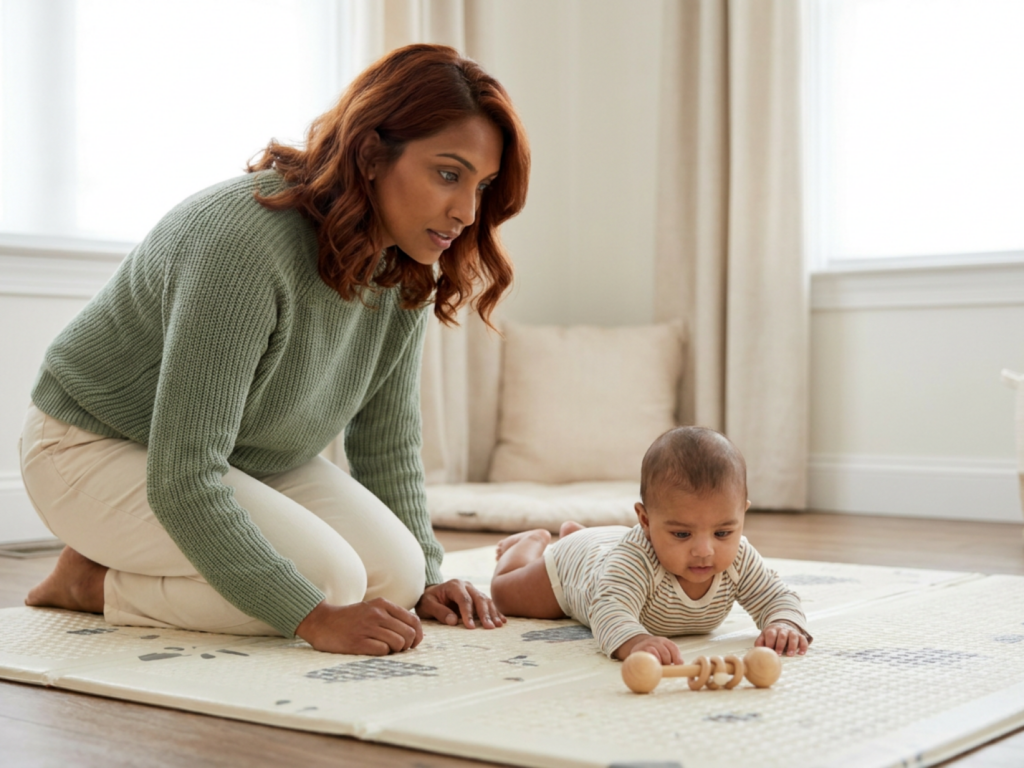
Build brief floor-based activity into ordinary transitions. A clean, firm mat or blanket in a hazard-free area can be enough. Start with short periods, especially for a young infant who dislikes prone positioning, and increase gradually as tolerated. The caregiver can lie nearby, use a calm voice, or place a simple high-contrast object within view. Never leave a baby unattended on an elevated surface, in a container, or near cords, pets, stairs, hot drinks, or small objects. Review infant sleep and play spaces as mobility changes, because a baby who has just begun rolling can reach hazards that were previously out of range.
Avoiding tummy time or forcing it too long
Tummy time while awake and closely supervised gives babies an opportunity to strengthen the muscles used for head control, rolling, and later mobility. Some babies initially protest because the position is unfamiliar or demanding. Skipping it entirely can reduce opportunities for prone movement, but forcing a distressed baby to remain in the position for long intervals can make the experience harder for everyone.
Think in frequent, brief exposures rather than a single endurance session. Tummy time can happen on a caregiver’s chest, across a lap, or on a firm floor mat while the adult is at eye level. A rolled towel may be helpful for some babies when advised by a healthcare professional, but it should not substitute for direct supervision. Use an engaging face, a mirror designed for infant use, or one simple toy to make the position more tolerable. End the activity when the baby becomes increasingly upset, exhausted, or unable to maintain a comfortable position, then try again later.
It is also a mistake to confuse supervised awake tummy time with sleep positioning. For sleep, infants should be placed on their backs on a firm, flat, separate sleep surface according to local safe-sleep guidance. Do not use tummy time equipment, pillows, loungers, or positioning products for unsupervised sleep. Seek individualized advice from a pediatric clinician or physiotherapist if your baby consistently favors one side, has marked head flattening, seems uncomfortable in prone play, or has a medical condition affecting tone, breathing, or movement.
Missing signs of overstimulation or fatigue
Babies benefit from sensory variety, but more stimulation is not always better. Bright lights, loud toys, several people speaking at once, frequent activity changes, or extended outings can overwhelm an infant’s still-developing ability to regulate arousal. An overstimulated baby may turn away, avert their gaze, stiffen, fuss, hiccup, yawn, rub the face, become unusually quiet, or escalate into crying. These signs are communication, not misbehavior.
A frequent mistake is adding more noise, movement, or toys when a baby becomes unsettled. Instead, reduce input. Move to a quieter area, lower the volume, hold the baby calmly if they accept it, or offer a familiar routine such as feeding, rocking, or a rest period. One object, one voice, or one brief game can be plenty. A baby who looks away during interaction may be regulating and may re-engage after a pause.
Pay attention to the timing of activity as well as the activity itself. Hunger, tiredness, illness, and a disrupted nap pattern can lower a baby’s tolerance for play. A flexible baby routine can provide predictable windows for feeding, sleep, and calm interaction without requiring every day to look identical. In particular, avoid assuming that a tired baby needs more stimulation to “wear out.” Infants commonly need help settling, and overtiredness can make soothing more difficult.
Choosing toys that are too advanced, busy, or unsafe
Commercial toys can imply that every developmental stage requires a specialized product. In reality, babies often gain more from simple, safe objects and an engaged caregiver than from a crowded play area full of lights, sounds, and moving parts. Toys that are too complex may be frustrating, while electronic features can draw adult attention away from the baby’s own signals. Consider whether the item allows the baby to look, listen, grasp, mouth safely, shake, or explore cause and effect at their current stage.
Safety requires ongoing reassessment. Inspect toys for loose parts, damaged seams, peeling paint, exposed batteries, sharp edges, long cords, and pieces small enough to create a choking hazard. Button batteries and high-powered magnets require particular vigilance because ingestion can cause severe internal injury. Keep them completely inaccessible and seek urgent medical help if ingestion is suspected. Avoid giving a baby household items unless they have been checked for breakage, choking, strangulation, burn, and toxic exposure risks.
Choose a small rotation of washable, age-appropriate items and leave enough open space for the baby to move. Books with sturdy pages, safe rattles, textured cloths, and simple objects that cannot break into small pieces can support exploration. Supervision remains essential even with products marketed for infants. The safest toy can become unsafe when used during sleep, in a car seat, near water, or when an older sibling introduces smaller pieces.
Talking at babies without truly interacting
Language-rich play is helpful, but it is not the same as delivering a constant stream of words. Babies learn communication through reciprocal exchanges: a caregiver notices a sound, facial expression, or gesture and responds. This back-and-forth supports early social communication and helps the baby connect sounds, expressions, and actions with other people.
It is easy to miss this when multitasking or following a scripted activity. Rather than testing a baby with repeated prompts, describe what is happening, wait briefly, and respond to any attempt to participate. For example, during a reach for a toy, you might say that the baby is reaching, then pause for their vocalization or movement. Singing familiar songs, copying coos, reading short books, and naming daily routines can all be useful when the pace remains comfortable.
Screen media is another common substitute for interaction. A screen may appear engaging, but it does not reliably provide the contingent, face-to-face exchange babies need from caregivers. Protect time for direct connection, including ordinary care routines. When caregivers are depleted, short, warm interactions still count; perfection is unnecessary. If you notice persistent concerns about hearing, eye contact, communication, motor skills, or social responsiveness, bring specific observations and examples to a healthcare professional. Early discussion can clarify whether variation is expected or whether further assessment is appropriate.
Activity safety reminders
- Never leave a baby unattended during floor time, water play, tummy time, or use of infant equipment.
- Do not use swings, loungers, seats, or tummy time products as unsupervised sleep spaces.
- Keep button batteries, high-powered magnets, cords, small objects, and hot liquids out of every play area.
- Stop an activity if a baby shows escalating distress, breathing difficulty, unusual lethargy, or pain, and seek medical advice when needed.
- Reassess the environment whenever the baby gains a new skill such as rolling, scooting, crawling, or pulling to stand.
Tools & Assistance
- Ask a pediatric healthcare professional for individualized guidance on movement, tone, head shape, feeding, or developmental concerns.
- Create a daily supervised floor-play area that is clean, firm, and free from choking and strangulation hazards.
- Use a simple toy rotation and inspect toys regularly for loose parts, damaged batteries, and age-inappropriate components.
- Keep notes or short videos of recurring concerns to help describe patterns accurately at a clinical appointment.
FAQ
How much tummy time does a baby need?
The amount varies by age and tolerance. Offer brief, frequent, awake, supervised opportunities and build gradually. A pediatric clinician can advise when a baby has medical or movement concerns.
Are activity mats and baby gyms necessary?
No. They can be useful if used safely, but a clear floor area, a caregiver’s interaction, and a few simple age-appropriate objects are sufficient for meaningful play.
Should I stop play as soon as my baby looks away?
Usually, pause first. Looking away can be a normal way to regulate stimulation. Reduce input and see whether the baby re-engages when ready.
Can a baby learn from educational videos?
Direct interaction with caregivers and real-world exploration are more appropriate for infant learning. Screens should not replace conversation, responsive play, movement, or sleep.
Sources
- Health Service Executive (HSE) — How to play with your child
- Nationwide Children's Hospital — Infant Play
- ZERO TO THREE — Learning Through Play: Birth to 12 Months
Disclaimer
This article provides general educational information and is not a substitute for individualized medical advice, diagnosis, or treatment. Consult a qualified healthcare professional about concerns regarding your baby.














Please log in to leave a comment.