
Intro
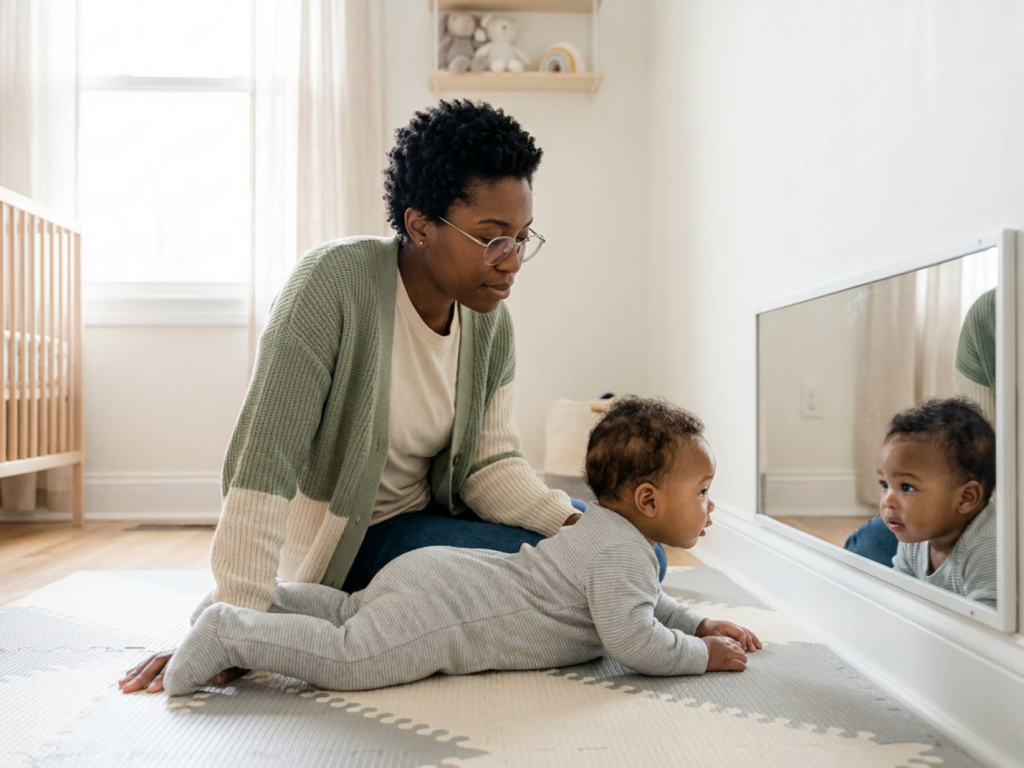
A floor mirror can turn a simple stretch of supervised play into a rich social and sensory experience for a baby. The changing face, moving limbs, and familiar caregiver nearby give your baby something meaningful to look at, track, and respond to without requiring a complicated setup.
Mirror play is not a test of intelligence or a milestone to rush. Babies gradually learn to process faces, movement, touch, and their own body over time. A calm, responsive adult and a safe setup matter far more than whether a baby appears to understand that the reflection is their own.
Highlights
A securely positioned, shatter-resistant floor mirror can make supervised floor play more visually engaging and support shared interaction.
Babies often respond to a mirror long before explicit mirror self-recognition develops; early interest may include watching faces, movement, and changing expressions.
Mirror play can fit naturally into awake supervised prone play, back play, side-lying play, and caregiver conversation.
Follow your baby's cues. Brief, relaxed sessions are more useful than prolonged stimulation when a baby is tired, distressed, or looking away.
Why a Floor Mirror Can Be So Engaging
For young babies, a mirror offers high-contrast facial features, motion that changes immediately, and an opportunity to see a caregiver’s expression beside their own reflected image. These are naturally compelling inputs for the developing visual and social-attention systems. When your baby kicks, turns their head, opens their mouth, or waves an arm, the image moves at the same time. This close visual-motor contingency can invite sustained looking and repeated movement.
Mirror play also creates a convenient setting for responsive caregiver interaction. You might sit beside your baby, describe what you see, pause for a coo or gaze shift, and answer it. That reciprocal pattern is more valuable than performing a lesson. Simple language such as “I see your feet moving” or “You found my face” connects words with a shared experience while leaving space for your baby to respond.
For babies who are spending short periods on the floor, the mirror can provide a stable visual target at their level. It may make awake supervised prone play feel more tolerable for some infants, although it will not suit every baby every time. A baby who turns away, fusses, stiffens, or becomes increasingly unsettled is communicating a need for a break.
Mirror Interest Comes Before Self-Recognition
It is common to wonder when a baby will recognize themselves. Explicit mirror self-recognition is a later developmental achievement, rather than the main purpose of early mirror play. Research on the mirror-mark task has found that tactile localization training was associated with later mirror self-recognition in many infants, with a mean first recognition age of 16.3 months in one study. Individual timing varies substantially, and a child should not be judged by a single mirror behavior.
Before that point, babies may look intently at a reflected face, smile, vocalize, reach toward the image, or appear interested in the movement. These actions do not necessarily mean that the baby knows the reflection is “me.” They may be processing visual features, social signals, and the relationship between what they feel themselves doing and what they see. Experimental work suggests that visual features of the infant’s own face can be particularly relevant as explicit self-recognition approaches.
This perspective can relieve pressure. Your baby does not need to touch a mark on their own face or show a particular reaction in order for mirror play to be worthwhile. Treat the mirror as a shared play object that supports curiosity. Over weeks and months, your baby may show changing ways of attending, but there is no need to interpret each new response as a diagnostic sign.
Setting Up a Safe Mirror Play Space
Choose a mirror specifically designed for infant use, ideally shatter-resistant and made from a material intended for this purpose. It should be large enough to show a clear image but light enough that it cannot cause injury if displaced. Avoid freestanding household mirrors, glass mirrors placed on the floor, mirrors with loose frames, and products with small detachable components. Check the mirror regularly for cracks, sharp edges, peeling material, or loosened fastenings.
Place the mirror directly on a firm, level floor or secure it according to the manufacturer’s instructions. Position it where it cannot slide, tip, trap fingers, or be reached from an unsafe elevated surface. Keep the play area clear of cords, unstable furniture, soft loose bedding, and other hazards. Floor mirror play belongs in an awake, closely supervised setting; a mirror is not appropriate for a crib, bassinet, or sleep area.
- Stay within arm’s reach, particularly when your baby is very young or beginning to roll.
- Use a clean mat or blanket only for awake play, on a stable floor surface.
- Set the mirror at a shallow, secure angle so your baby can see it without needing to strain the neck.
- Stop the activity before fatigue escalates, especially during prone positioning.
If your baby has a medical condition affecting positioning, muscle tone, vision, or movement, ask their pediatric clinician or therapist how to adapt floor play safely.
Gentle Activities by Early Developmental Stage
In the newborn period, keep mirror play brief and quiet. Place your baby on their back for a moment of awake, supervised looking, or hold the mirror safely at an appropriate distance while you speak softly. Newborn vision is still maturing, so a calm face and slow movement may be more accessible than an elaborate activity. Watch for cue-based newborn sensory play: periods of alert attention can be followed quickly by looking away, hiccups, yawning, color change, or fussing.
As head control develops, place the mirror low in front of your baby during short periods of awake supervised prone play. Get down to the same level and alternate between watching your baby and appearing in the reflection. You can slowly move your head from side to side, name body parts, or pause to let your baby study the image. Keep expectations modest; lifting and turning the head is physically demanding work.
For babies who roll, pivot, sit with support, or reach, offer the mirror as part of open-ended exploration. Let them notice the reflection while they move rather than directing every action. A soft song, a familiar expression, or a gentle question can support early language reciprocity. Avoid attaching toys to the mirror in a way that could create an entanglement, falling, or choking hazard.
Reading Your Baby's Cues During Play
Engagement is usually quiet and individualized. Your baby may gaze at the mirror, shift their eyes between you and the reflection, smile, vocalize, kick, reach, or return to the mirror after briefly looking away. These behaviors can suggest that the activity is well matched to their current state, but there is no required response. Some babies prefer a quick look; others repeatedly revisit the mirror during varied floor movement for infants.
Equally useful are cues that the activity has become too much. Repeated head turning away, crying that builds rather than settles, arching, frantic limb movements, grimacing, hiccups, yawning, or difficulty organizing movement can indicate fatigue or overstimulation. Reduce visual and verbal input, change position, offer a quiet cuddle if wanted, or end the session. A pause is responsive care, not a missed developmental opportunity.
Try to distinguish a temporary dislike of a position from a persistent pattern. A baby may protest prone play when hungry, tired, uncomfortable, or unfamiliar with the position. However, persistent infant movement asymmetry, a strong ongoing preference to look only one direction, repeated distress with ordinary positioning, or concerns about vision merit discussion with a pediatric healthcare professional. Early assessment can clarify whether any individualized support is appropriate.
Keeping Mirror Play Supportive Rather Than Performative
Floor mirror play works best when it is woven into ordinary caregiving rather than treated as a developmental assignment. A few minutes after a diaper change, before a feed when your baby is alert, or during a short floor session may be enough. Regular but flexible opportunities allow your baby to become familiar with the experience without becoming overwhelmed.
Use simple narration and allow silence. For example, you might say, “Your hand is up,” then wait. If your baby coos, look toward them and respond. If they gaze at the reflection, let them look without interrupting. This back-and-forth interaction helps make the mirror a social experience rather than a screen-like source of stimulation. Your own face and voice remain the central relationship.
For babies born preterm, consider corrected age for preterm infants when thinking about broad developmental expectations, while recognizing that development is not fully captured by age alone. Discuss individualized guidance with the clinician who knows your baby’s medical history, especially after a prolonged hospital stay or when therapy services are involved. Mirror play is a modest enrichment activity, not treatment for delayed milestones, feeding problems, torticollis, or visual concerns.
Above all, let your baby lead the pace. A secure mirror, a safe floor, and your attentive presence are enough. The meaningful part is the shared noticing: your baby moves, you notice, and you respond.
Safety and When to Ask
- Use only a secure, shatter-resistant mirror intended for baby use; do not place ordinary glass mirrors on the floor.
- Provide continuous awake supervision and keep mirrors out of cribs, bassinets, and other sleep spaces.
- Stop prone mirror play if your baby shows escalating distress, breathing difficulty, or marked fatigue.
- Seek prompt medical advice for sudden changes in movement, alertness, vision behavior, or breathing.
- Discuss persistent head-turning preference, asymmetrical movement, or ongoing difficulty tolerating positions with a pediatric healthcare professional.
Tools & Assistance
- A shatter-resistant baby floor mirror checked for damage before use
- A firm, uncluttered floor area for supervised play
- A clean awake-play mat
- A pediatric clinician, physiotherapist, or occupational therapist for individualized positioning concerns
FAQ
At what age can babies use a floor mirror?
Babies can have brief, awake, supervised mirror experiences from early infancy when the mirror is secure and positioned safely. Adjust duration and position to your baby's alertness and motor abilities.
Does smiling at a mirror mean my baby recognizes themselves?
Usually not. Smiling may reflect interest in a face, movement, or social interaction. Explicit mirror self-recognition generally develops later and varies between children.
Can a mirror make tummy time easier?
Some babies find a mirror interesting during short prone sessions, while others do not. Use it as an optional visual focus and stop if your baby becomes distressed.
What type of mirror is safest for a baby?
Choose a stable, shatter-resistant mirror manufactured for infant use, follow its installation instructions, and inspect it regularly for damage or loose parts.
Sources
- Cell Press — Tactile localization promotes infant self-recognition in the mirror-mark test
- PubMed — Just Before I Recognize Myself: The Role of Featural and Multisensory Cues Leading up to Explicit Mirror Self-Recognition
- First Things First — Reflecting on babies and mirror play
Disclaimer
This article is for general educational purposes and does not replace medical advice. Consult a qualified healthcare professional for concerns about your baby's safety, vision, movement, or development.















Please log in to leave a comment.