
Intro
Singing is a simple, flexible way to communicate with a baby before spoken language develops. A familiar voice, repeated melody, facial expression, rhythm, and pause can all help an infant notice social signals and participate in an early exchange. These moments do not require musical training or a quiet, perfectly organized home; they can happen during feeding, bathing, dressing, walking, or settling for sleep.
For babies, the goal is responsive connection rather than performance. Following the baby's cues, allowing time for a response, and adjusting the volume or pace can make singing calming and enjoyable. Singing can complement talking, play, shared book reading, and other forms of responsive caregiving, but it should not be used to diagnose or treat a developmental or medical condition without professional guidance.
Highlights
Singing gives babies repeated opportunities to hear rhythm, pitch, pauses, and the sound patterns of language.
Infant-directed singing can support bonding, emotional regulation, and preverbal social communication.
The most useful activity is usually responsive: the caregiver observes the baby's cues, pauses, and answers the baby's sounds or movements.
Short, comfortable interactions are sufficient; babies do not need constant stimulation or elaborate musical activities.
Concerns about hearing, vocal quality, responsiveness, or communication should be discussed with a pediatric healthcare professional.
Why singing communicates before words
Communication begins before a baby uses recognizable words. Infants exchange information through gaze, facial expression, body movement, crying, cooing, babbling, and changes in arousal. Singing naturally organizes many of these signals into a predictable social event. The caregiver’s voice carries prosody, meaning the rhythm, pitch, stress, and intonation that help listeners interpret emotion and conversational structure.
Infant-directed singing often includes a slower tempo, wider pitch range, clear repetition, and expressive pauses. These features can make the voice easier for a young listener to attend to, although babies differ in what they find comfortable. A pause after a line creates space for a baby to look, smile, move, vocalize, or simply remain attentive. When the caregiver notices and responds to that behavior, the baby experiences an early form of turn-taking.
Research on early social communication through music describes infant-directed singing as a context for bonding, emotional regulation, and preverbal interaction. Singing does not replace ordinary speech, and it does not guarantee a particular language outcome. Its value is relational: it gives the baby repeated, emotionally meaningful opportunities to listen, anticipate, respond, and share attention with another person.
Responsive singing in the early weeks
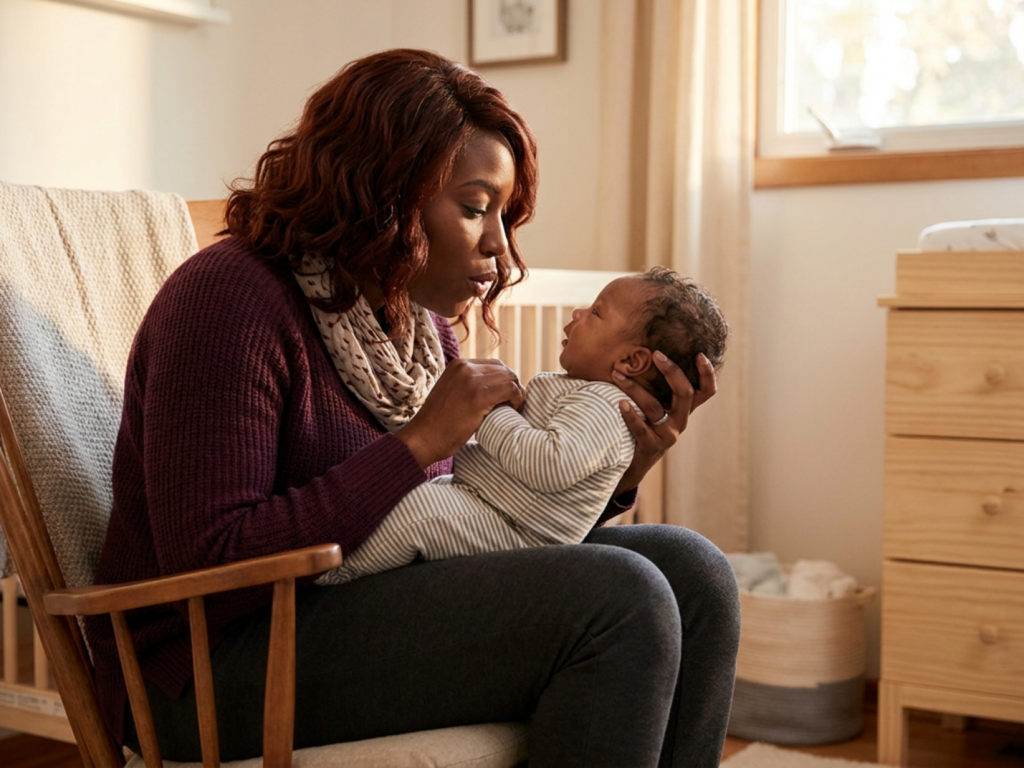
In the newborn period, singing can be brief and quiet. Hold the baby securely or sing while the baby is in a safe, supervised position. Choose a simple phrase, hum, or lullaby and repeat it for a few cycles. Keep your face within a comfortable distance when the baby is alert, then pause. Watch for changes such as a shift in gaze, relaxed hands, a small movement, a startle, a yawn, or a vocal sound. These are information about the baby’s state, not a test that the baby must pass.
Try matching the baby’s level of alertness. A gentle hum may suit a tired or unsettled baby, whereas a brighter song may suit a calm period after feeding. If the baby turns away, becomes tense, cries, hiccups, or shows signs of overload, reduce stimulation or stop. Responsive caregiving means treating the baby’s behavior as communication and adjusting accordingly.
Everyday routines provide natural opportunities for repetition. A short changing song can mark the beginning of care; a bathing song can use the same melody with different words; a bedtime lullaby can provide a consistent cue for winding down. Predictable routines may help a baby anticipate what comes next, but they should remain flexible. Feeding, sleep, and physical comfort take priority over completing an activity.
Caregivers do not need a strong singing voice. Humming, chanting, speaking rhythmically, or using a familiar recorded song at a low volume can be adapted to family preference. The live human response is often more important than musical accuracy because it allows the caregiver to pause, observe, and answer the baby’s cues.
Activities for turn-taking and shared attention
As a baby becomes more alert and socially engaged, singing can become a structured back-and-forth exchange. Begin with a short musical phrase, then wait several seconds. If the baby vocalizes, kicks, smiles, or moves, imitate one aspect of the response, such as its rhythm or length. Then sing another phrase. This is a form of vocal turn-taking and can be especially useful for showing that communication is reciprocal rather than one-sided.
Use songs with repeated lines and predictable endings. Stop just before the final word or sound, wait, and then complete the phrase. A baby may not supply the missing word, but anticipation may be shown through a smile, movement, gaze, or vocalization. These behaviors are meaningful participation. Avoid insisting on a response or repeating the pause so often that the interaction becomes demanding.
Movement can add another communication channel. Gently sway, tap the baby’s feet only when appropriate and comfortable, or move your hands in a simple pattern while singing. Pair a repeated sound with the same movement. For example, a caregiver might open and close the hands during a song about hands, or gently wave during a greeting song. Keep movements slow and predictable, and avoid forceful bouncing or actions that could strain the baby’s neck.
Shared attention can be supported by singing about what the baby is looking at. If the baby watches a light, toy, or caregiver’s hand, sing a simple phrase that refers to it and then pause. This links the baby’s focus, the caregiver’s voice, and a shared event. Talking to the baby before or after the song adds ordinary vocabulary and helps connect musical patterns with everyday language.
Singing across the first year
Newborns may respond most readily to familiar voices, gentle rhythm, and changes in vocal prosody. During the first months, use short songs with pauses and observe whether the baby settles or becomes more alert. Face-to-face singing may support social attention when the baby is awake and comfortable, while humming during routine care may provide continuity without demanding eye contact.
Between approximately three and six months, many babies show increasing interest in social sounds, vocal exchanges, and expressive facial movements. Caregivers can vary one feature at a time: sing the same melody with a different vowel, elongate a final sound, or alternate between humming and words. Leave time for the baby to respond. Imitating the baby’s cooing or squealing can communicate that their sounds have been heard, provided the imitation is gentle and not mocking or excessively loud.
Later in the first year, babies may anticipate familiar songs, bounce to rhythm, imitate sounds, or participate with babbling and gestures. Add simple actions such as waving, clapping, or pointing, while recognizing that motor skills develop at different rates. Songs that name body parts, people, or routine events can support joint attention and receptive language, which means understanding language before speaking it.
Families using more than one language can sing in each language. A multilingual environment does not need to be restricted to one language for communication to be meaningful. Familiar caregivers can use the languages they naturally speak, keeping the interaction warm and responsive. The quality of engagement, opportunities for turn-taking, and consistent exposure are more useful goals than trying to make every song identical across languages.
Using singing for regulation and connection
Singing can influence arousal, the baby’s level of alertness and physiological activation. Slow, predictable singing may help some babies settle, while a lively song may help others engage during play. There is substantial individual variation, so caregivers should use the baby’s behavior to guide the activity rather than assuming that one tempo is universally calming.
For a baby who is becoming fussy, begin by lowering your volume and simplifying the melody. A steady hum may be less stimulating than a song with dramatic changes in pitch. Combine singing with familiar, safe caregiving actions such as holding the baby appropriately, reducing bright light, or moving to a quieter space. Singing should not be used to mask persistent crying, breathing difficulty, pain, feeding problems, or other signs of illness.
Singing can also support caregiver wellbeing and attachment. Repeating a song may create a small ritual during exhausting routines and can help a caregiver remain emotionally present. There is no requirement to feel joyful every time. A tired caregiver may hum quietly or invite another trusted adult to sing. If bonding feels persistently difficult, or if sadness, anxiety, intrusive thoughts, or hopelessness are present, seek help from a healthcare professional. Support for the caregiver is part of support for the baby.
Keep sound exposure comfortable. Sing at a normal conversational level and avoid placing a phone, speaker, or headphones directly beside the baby’s ears. Do not sing loudly near a sleeping baby or use amplified music as a substitute for supervision. A baby who repeatedly startles, turns away, or becomes distressed may be signaling that the sound is too intense or the timing is not suitable.
What the evidence can and cannot show
Evidence about music and communication comes from different populations and should be interpreted carefully. A randomized crossover trial of a multicomponent singing intervention in adults with chronic aphasia reported improvements in everyday communication, responsive speech, and social participation, along with reduced caregiver burden and benefits that persisted over time. Aphasia is an acquired language disorder, so findings from that study cannot be transferred directly to infants. It does, however, illustrate how structured singing may support communication in some clinical contexts.
A systematic review of choral singing for communication impairments after acquired brain injury found emerging evidence for speech and voice improvements in Parkinson’s disease, while evidence for broader communication gains remained limited. This distinction matters: singing may be a useful supportive activity, but it is not a universal treatment and should not replace individualized speech-language therapy or medical assessment when those services are indicated.
For babies, the strongest rationale is developmental and relational rather than a claim that singing prevents delay or accelerates language in every child. Singing creates repeated opportunities for shared attention, auditory exposure, emotional co-regulation, and contingent responses. Outcomes depend on the baby’s age, hearing, health, temperament, environment, and the quality and frequency of interaction. Developmental variation is common, and one activity cannot determine whether communication is progressing typically.
When to seek professional guidance
Discuss concerns with a pediatrician, family doctor, public health nurse, audiologist, or speech-language pathologist when a baby’s responses to sound or social interaction seem consistently different from expected patterns, or when a caregiver is worried. A professional can consider the whole developmental history, examine hearing and health factors, and recommend observation, screening, or assessment when appropriate.
Seek prompt medical advice for signs such as difficulty breathing, a sudden change in responsiveness, persistent inconsolable crying, poor feeding with lethargy, or a concerning acute change in behavior. These are not problems to manage with singing alone. For less urgent concerns, keep a brief record of what the baby does, in which situations, and whether responses are consistent across caregivers and environments. Short videos may be useful to discuss with a clinician, subject to privacy and local guidance.
Do not compare a baby’s vocalizations or social responses rigidly with those of another child. A baby may be more responsive to humming than lyrics, may engage through movement rather than eye contact, or may need frequent breaks. The most supportive approach is patient observation, accessible interaction, and timely professional advice when concerns persist.
Safety and medical caution
- Stop or reduce the activity if the baby turns away repeatedly, becomes tense, cries, startles persistently, or appears overstimulated.
- Keep singing and speakers at a comfortable volume; never place amplified sound or headphones directly beside a baby's ears.
- Never use singing to delay care for breathing difficulty, feeding problems, severe distress, fever, injury, or a sudden change in responsiveness.
- Singing is not a diagnostic tool and does not replace hearing assessment, developmental screening, speech-language therapy, or medical care.
- Ask a healthcare professional about persistent concerns involving hearing, vocal quality, responsiveness, feeding, or communication.
Tools & Assistance
- A short list of familiar songs for routines such as waking, dressing, bathing, and bedtime
- A quiet space where the caregiver can observe the baby's responses without competing noise
- A simple note or video record of sounds, gestures, and situations to discuss with a clinician if concerns arise
- The baby's pediatric healthcare team, audiology services, or a speech-language pathologist
- Support from another trusted caregiver when singing or daily interaction feels emotionally or physically difficult
FAQ
Do I need to sing in tune for the activity to help?
No. A familiar, responsive voice is more important than musical accuracy. Humming, rhythmic speech, and simple repeated phrases can also support interaction.
How long should a singing activity last?
There is no required duration. A few responsive exchanges may be enough. Stop when the baby shows fatigue, hunger, distress, or overstimulation.
Can I sing in more than one language?
Yes. Families can sing and talk in the languages they naturally use. Warm, repeated interaction and shared attention are more important than limiting the baby to one language.
Can singing improve a communication delay?
Singing may provide supportive communication practice, but it cannot diagnose, prevent, or treat every delay. Concerns should be discussed with a pediatric healthcare professional and, when indicated, an audiologist or speech-language pathologist.
What if my baby does not look at me while I sing?
Babies may participate through listening, movement, changes in expression, or vocalization rather than sustained eye contact. If limited responsiveness to sound or social interaction is persistent or concerning, seek professional guidance.
Sources
- PubMed Central — Efficacy of a multicomponent singing intervention on communication and psychosocial functioning in chronic aphasia: a randomized controlled crossover trial
- Wiley — The effects of choral singing on communication impairments in acquired brain injury: A systematic review
- PubMed Central — Early social communication through music: State of the art and future directions
Disclaimer
This article is for general educational purposes and does not diagnose, treat, or replace advice from a qualified healthcare professional. Seek medical advice for concerns about a baby's hearing, development, behavior, feeding, or health.
















Please log in to leave a comment.