
Intro
Visual stimulation activities can help a baby notice, track, and explore the people and objects around them. In early infancy, vision is still developing, and babies often respond best to simple, high-contrast targets, human faces, slow movement, and brief periods of shared attention.
These activities are not lessons or a substitute for routine healthcare. They are gentle opportunities for responsive interaction during calm, awake periods. Follow your baby's cues, adapt activities to their developmental stage, and discuss concerns about vision, eye movements, or development with a pediatrician, family doctor, optometrist, or other qualified healthcare professional.
Highlights
A caregiver's face, voice, and responsive attention are among the most useful forms of early visual stimulation.
High-contrast patterns and slow, predictable movement are often easier for young infants to detect than complex or rapidly moving images.
Short, repeated activities are generally more appropriate than prolonged or intense stimulation.
Stopping when a baby turns away, becomes distressed, or appears fatigued helps protect the interaction from becoming overwhelming.
How Infant Vision Develops
Newborn vision is functional but immature. A very young baby may see best at close range, particularly during feeding, holding, and face-to-face contact. Visual acuity, contrast sensitivity, ocular alignment, and the ability to sustain fixation continue to mature over time. Babies gradually become better at locating a target, maintaining gaze, following a slowly moving object, and coordinating vision with head and body movement.
Early visual attention is influenced by salience. A target with strong contrast, a clear outline, or a face may be easier to notice than a low-contrast object placed against a busy background. Research involving young human infants has linked stronger visual stimulation with increased neural activity in visual cortical regions and greater visual attention. This does not mean that more stimulation is always better. The useful goal is a clear, manageable target that allows the baby to attend without pressure.
Visual stimulation also occurs within relationships. When a caregiver pauses for the baby’s gaze, responds to a change in expression, or moves a toy in response to the baby’s attention, the infant experiences shared attention and contingent interaction. These exchanges connect visual perception with social communication, emotional regulation, and early learning.
Face-to-Face Interaction
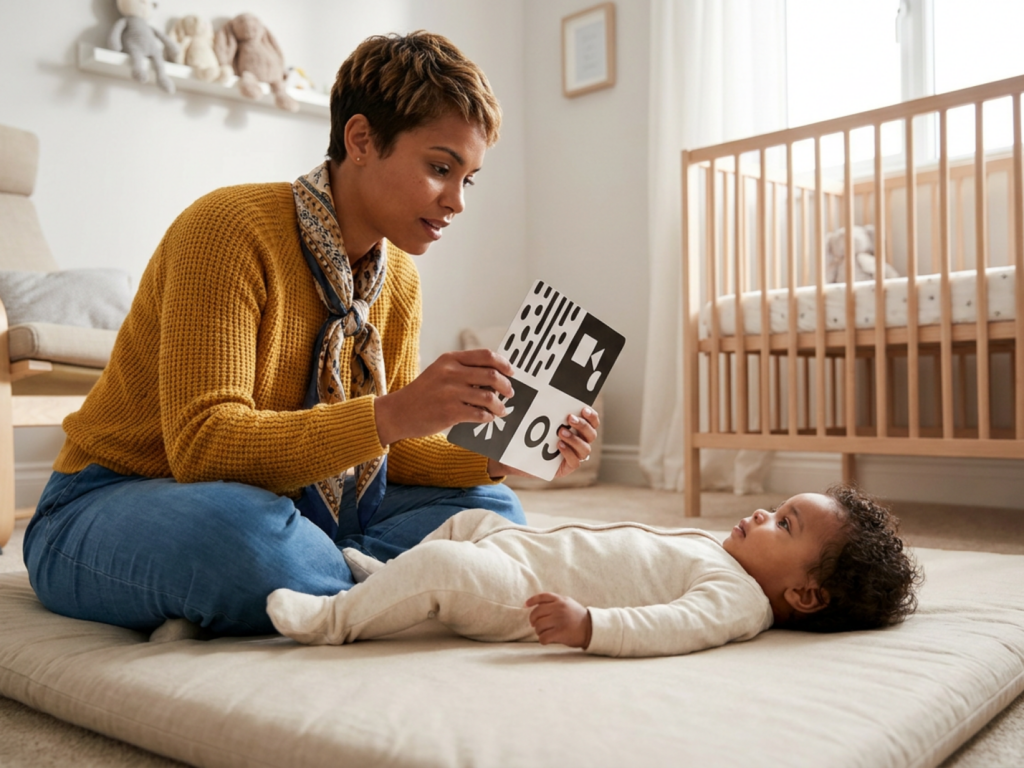
Begin with your face. Hold your baby securely and position yourself at a comfortable close distance when the baby is awake and settled. Use a relaxed expression, speak softly, and pause often. The purpose is not to maintain constant eye contact; it is to offer an interesting, emotionally meaningful target while allowing the baby to look, look away, and return.
Try changing your facial expression gradually, such as opening your eyes slightly wider or smiling, while keeping your movements slow. You can also move your face a small distance to one side and wait to see whether the baby shifts their gaze. Respond to any attempt to look toward you rather than repeatedly repositioning the baby’s head or insisting that they follow.
Face-to-face play works well during ordinary routines, including after a diaper change, while holding the baby upright, or during a quiet cuddle. A baby may be more visually attentive when well rested and fed, but not immediately hungry. The caregiver’s voice can help orient the baby, although the activity remains primarily a shared visual and social experience.
For families exploring broader sensory play, sensory activities for newborns can be incorporated into the same calm, cue-based routine. Keep the environment safe, uncluttered, and free from bright light directed into the baby’s eyes.
High-Contrast Objects and Patterns
High-contrast materials can provide a simple target for visual attention. Examples include a black-and-white card, a bold geometric pattern, or a plainly outlined household object. Place one target where the baby can see it comfortably, rather than surrounding the baby with many cards or toys. A simple background helps the object remain visually distinct.
Show the object during a calm period and hold it still first. Give the baby time to notice it. If the baby looks toward the target, keep it in place briefly before moving it slowly from one side to the other. Movement should be smooth and limited. Rapid waving, repeated repositioning, or bringing the object very close may make it harder to process.
You can vary the target on different days, but repetition is valuable. Familiarity may help a baby sustain attention and notice small differences. Use age-appropriate, intact materials and keep cards, paper, and toys out of the baby’s mouth and sleeping space. Never attach visual materials to a crib, stroller, car seat, or other equipment in a way that could create a strangulation, choking, or entrapment hazard.
At around the first few months, changing toy positions can encourage a baby to look toward different parts of the visual field. Make changes one at a time and observe whether the baby remains comfortable. The activity should be led by the baby’s attention, not by a fixed number of repetitions.
Tracking Slow Movement
Tracking means following a moving target with the eyes. To practice gently, use a high-contrast toy or soft object that is large enough to see clearly and has no loose parts. Start near the baby’s midline, where the object is easiest to locate. Once the baby looks at it, move it slowly a short distance horizontally, pause, and return it toward the center.
As the baby’s control improves, you may introduce a small vertical movement or a gradual arc. Keep the object within a comfortable viewing range and move at a speed that allows the baby’s gaze to follow. It is normal for a young infant to lose the target, look away, or move their head rather than track smoothly. Simply pause or end the activity rather than trying to correct the movement.
Supervised floor play while the baby is awake can provide opportunities to look at nearby faces and objects from different positions. During tummy time, place an interesting target in front of the baby at a suitable distance, but do not use a toy to prolong the position if the baby is tired or struggling. A stable, firm surface and constant adult supervision are essential.
Visual tracking should not be treated as a test that parents must pass or repeat until a particular response appears. Babies vary, and performance can change with sleep, hunger, illness, prematurity, lighting, and temperament. For broader age-based ideas, simple baby activities by age can help place visual play alongside movement, communication, and rest.
Everyday Visual Play by Age
During the newborn period, prioritize close face-to-face interaction, quiet observation, and short exposures to bold patterns. A baby may look briefly and then close their eyes or turn away. That is a complete interaction, not a failure. At this stage, holding, feeding, and routine care naturally create many opportunities for visual engagement.
Between approximately 2 and 3 months, many babies begin to show longer periods of visual attention and may follow a slowly moving face or object more consistently. Offer one target at a time and place it within the baby’s field of view. Allow time for fixation before introducing movement. You can also position yourself slightly to the side and wait for the baby to orient toward your voice and face.
As babies become more mobile and visually curious, they may benefit from looking at safe objects with different shapes, outlines, and distances during supervised play. Place objects within view and, when developmentally appropriate, within reachable range, while avoiding small parts and unsafe household items. Visual exploration should remain integrated with free movement, talking, touch, and rest rather than replacing them.
Babies born preterm may follow a corrected age for some developmental expectations, although individual guidance is more reliable than a strict timetable. A pediatric clinician, neonatal follow-up team, or pediatric eye-care professional can explain how to interpret visual behavior in the context of the baby’s medical history.
Reading Baby Cues and Keeping Play Safe
Good visual play is reciprocal. Signs that a baby is available for interaction may include relaxed body movements, quiet alertness, looking toward a face or object, and returning their gaze after a brief pause. Signs that the baby needs a break can include turning the head or eyes away, closing the eyes, yawning, hiccupping, fussing, arching the back, becoming unusually still, or showing disorganized movements.
When these cues appear, reduce the visual input and pause. Dim harsh ambient lighting, move the object away, or offer holding and quiet contact. Do not interpret avoidance as defiance. Looking away may be an effective self-regulation strategy, and respecting it can support a more secure interaction.
Avoid flashing lights, intense phone or tablet videos, laser pointers, direct sunlight, and toys that move rapidly or unpredictably near the eyes. Screen-based stimulation is not necessary for early visual learning; real faces and safe physical objects provide richer opportunities for responsive interaction. Keep all activities supervised and never place toys or cards in a sleep area.
Contact a healthcare professional if you notice persistent concerns such as an eye that consistently turns, unusual or repetitive eye movements, a missing or abnormal-looking pupil reflex, marked difficulty seeing faces or objects, or a lack of visual response that worries you. Urgent medical advice is appropriate for sudden changes, eye injury, significant redness or swelling, or other acute symptoms. These observations do not establish a diagnosis, but they are worth discussing promptly.
Safety reminders
- Use visual activities only when the baby is awake, supervised, and comfortable.
- Do not use flashing lights, lasers, direct sunlight, or rapidly moving objects near the eyes.
- Keep cards, cords, and small objects away from the baby's mouth, crib, and sleep environment.
- Stop when the baby turns away, becomes distressed, or shows signs of fatigue or overstimulation.
- Seek professional advice for persistent concerns about eye alignment, eye movements, or visual responsiveness.
Tools & Assistance
- A high-contrast card or large, intact black-and-white object
- A calm, well-lit space with reduced visual clutter
- A firm, safe floor surface for supervised awake play
- A simple observation note for recording patterns to discuss with a clinician
- Your pediatrician, family doctor, pediatric optometrist, or health visitor
FAQ
When can I start visual stimulation activities?
You can begin with gentle face-to-face interaction from the newborn period. Keep activities brief, calm, and responsive to the baby's alertness and cues.
Are black-and-white cards necessary?
No. They are one possible high-contrast target, but a caregiver's face and ordinary safe household objects can also support visual attention. Expensive equipment is not required.
How long should a visual activity last?
There is no universal duration. Stop when the baby looks away, becomes tired, or loses interest. Several brief interactions are generally more appropriate than one prolonged session.
Should I use videos or flashing toys to stimulate vision?
They are not necessary. Slow, real-world interaction with faces and safe objects offers meaningful visual and social engagement without intense or rapidly changing input.
When should I ask about my baby's vision?
Discuss persistent or sudden concerns with a healthcare professional, including unusual eye movements, a consistent eye turn, an abnormal pupil appearance, or limited response to faces and objects.
Sources
- PubMed — Visual stimulus structure, visual system neural activity, and visual behavior in young human infants
- Royal United Hospitals Bath NHS Foundation Trust — Helping my baby learn through play: 0 to 3 months old.
- NHS Lothian — Sensory – Parent and Infant Relationship Service (PAIRS)
Disclaimer
This article is for general educational purposes and does not diagnose, treat, or replace individualized medical advice. Consult a qualified healthcare professional about your baby's vision, development, or any urgent concern.















Please log in to leave a comment.