
Intro
Teething can be a tiring and uncertain period, particularly when a previously settled baby becomes more clingy, unsettled, or wakeful. Although primary tooth eruption is normal, the discomfort around it can feel very real to both baby and caregiver.
There is no single worst day that applies to every child. Teething discomfort tends to fluctuate around the time a tooth is moving through the gum, and symptoms that seem more severe, prolonged, or unlike a baby's usual behavior deserve careful attention rather than being assumed to be teething.
Highlights
Teething discomfort is often most noticeable in the days immediately before a tooth breaks through the gum, when localized pressure and inflammation may be greatest.
Many babies begin teething at about 6 months, but timing and the apparent intensity of discomfort vary substantially between children and teeth.
Night waking can make teething seem worse because tiredness, reduced distraction, and disrupted routines compound a baby's discomfort.
A fever, significant diarrhea, vomiting, marked lethargy, or poor feeding should not automatically be attributed to teething.
Why discomfort peaks around eruption
A primary tooth develops beneath the gum long before it becomes visible. As it advances toward the oral surface, pressure and localized inflammation in the overlying gingiva can produce tenderness. This is why the discomfort parents associate with teething is commonly intermittent rather than constant throughout infancy. The most difficult interval is often the several days before the tooth edge becomes visible, followed by a shorter settling period once it has erupted.
Babies cannot localize or explain oral discomfort. They may instead chew, drool, rub their face, pull at an ear, seek more physical contact, or become unusually irritable. These behaviors are compatible with mild gum tenderness, but they are not specific to tooth eruption. Ear pulling, for example, can occur with tiredness, self-soothing, irritation from saliva, or an ear problem. Looking gently at the gum may reveal a swollen area or a pale ridge, but a visible tooth is not required for a baby to be uncomfortable.
The phrase teething pain can imply an injury-level intensity that is not typical for every child. For many, pressure from erupting teeth causes modest, short-lived discomfort. For others, the same phase coincides with developmental changes, sleep disruption, illness exposure, or feeding transitions, making the overall period feel much harder. A useful approach is to consider the pattern: discomfort that is localized, brief, and otherwise accompanied by normal alertness and hydration is more consistent with teething than a child who appears systemically unwell.
When teething usually starts and which teeth may feel hardest
Teething often begins around 6 months, although a normal range is broad. The lower central incisors, the two front teeth on the bottom gum, are commonly among the first to appear; the upper central incisors often follow. Early episodes can be especially conspicuous because caregivers are learning to interpret a new set of behaviors, and the change from a smooth gumline to an erupting tooth may be unfamiliar to the baby as well.
No credible timetable can predict which specific tooth will hurt most. Some families report more disturbance with larger teeth, including molars, because these teeth have a broader chewing surface and erupt later when a child is more mobile, opinionated, and aware of routine changes. That observation should be treated as an individual pattern rather than a rule. A baby may breeze through one molar and be more unsettled by a front tooth.
Teeth also do not necessarily emerge one at a time. When more than one area of the gum looks swollen or several teeth are approaching eruption, there may be repeated clusters of discomfort with only brief quiet intervals. Still, persistent severe distress is not an expected consequence of normal tooth eruption. It is reasonable to discuss recurrent difficult episodes with the child’s clinician, especially if they interfere materially with feeding, sleep, growth, or family functioning.
For a clearer overview of expected timing and order, the topic of primary tooth eruption may help place a single difficult week in the broader pattern of infancy. The calendar is only a guide; the baby’s general condition matters more than whether a particular tooth has arrived on schedule.
Why evenings and nights can seem like the worst time
Many caregivers notice that a baby appears more uncomfortable late in the day or wakes more frequently overnight. This does not necessarily mean inflammation intensifies only at night. During daytime, feeding, movement, play, and caregiver contact can distract from mild discomfort. At bedtime, fewer distractions and accumulated fatigue can lower a baby’s tolerance for any irritation. Normal developmental sleep changes often occur in the same months as early tooth eruption, further complicating the picture.
Teething-related sleep disruption can therefore become a cycle: a sore or pressured gum contributes to waking, and inadequate sleep makes the next evening harder to settle. Keep expectations realistic for a few difficult nights while maintaining the usual safe sleep routine. Extra soothing is understandable, but avoid introducing sleep arrangements that create a new safety concern. Place babies on their back in a clear, flat, firm sleep space unless their healthcare professional has advised otherwise.
It can help to note whether wakefulness is concentrated around a period of obvious gum change and resolves after the tooth erupts. A pattern lasting weeks without signs of eruption, or accompanied by cough, congestion, rash, fever, vomiting, diarrhea, or pain behaviors outside sleep, is less easily explained by teething alone. Babies may have a viral infection and be teething at the same time; one does not exclude the other.
Caregivers also need support during disrupted nights. Sharing responsive care where possible, simplifying nonessential tasks, and contacting a pediatric healthcare professional when concern is growing can be more useful than trying increasingly aggressive teething remedies. Exhaustion can understandably make any symptom feel alarming.
Feeding, chewing, and saliva during difficult days
When gums are tender, some babies briefly feed less enthusiastically, pull off the breast or bottle, or want shorter and more frequent feeds. Suction and contact can feel different when the mouth is sensitive. Others seem to want to feed more often because sucking is soothing. Neither pattern proves that teething is the cause, so the key safety question is whether the baby continues to take enough fluid and has their usual pattern of wet diapers.
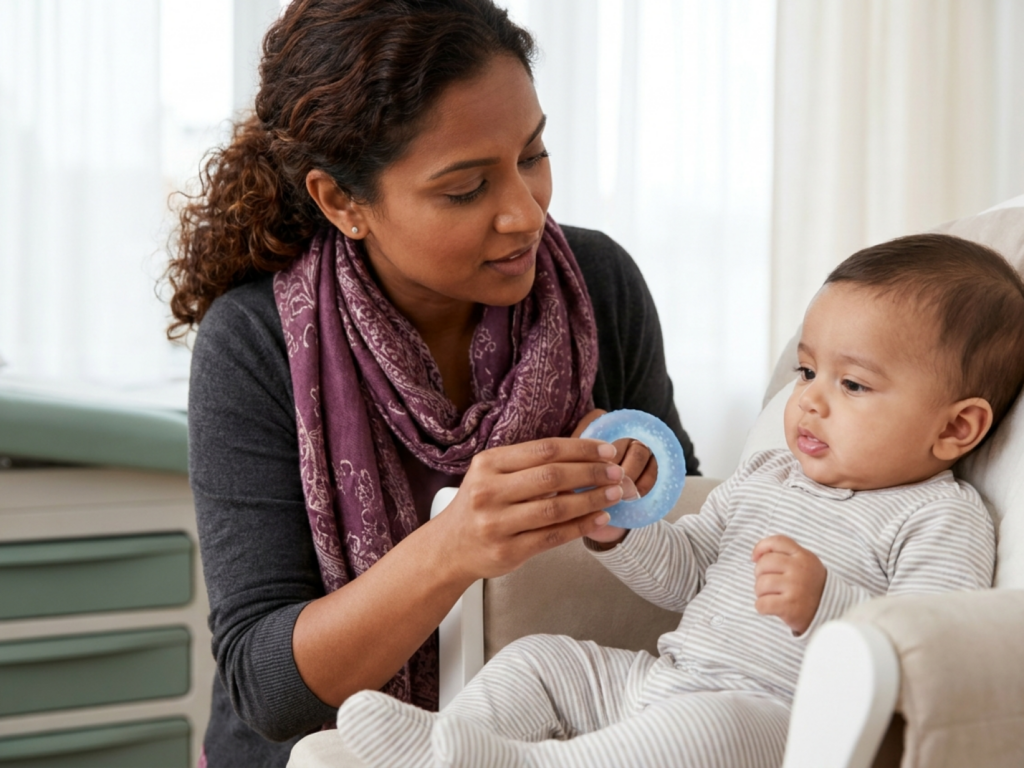
Chewing is a common response to pressure from erupting teeth. Offer a clean, age-appropriate teether that is designed to be held and used safely. A refrigerator-chilled teething ring may feel soothing, but it should not be frozen hard, because an excessively cold or rigid item can injure tender oral tissue. A clean finger used for gentle gum pressure may also help briefly, provided the caregiver’s hands are clean and the baby is supervised.
Heavy drooling can accompany this stage, especially as babies gain oral motor control. Saliva around the mouth and neck can cause drool-related skin irritation, typically redness or chapping. Patting the skin dry, changing damp bibs or clothing, and using a clinician-approved protective approach when needed can reduce friction and moisture exposure. A spreading rash, blisters, pustules, or signs of infection should be assessed rather than attributed to saliva alone.
A baby who persistently refuses fluids, has substantially fewer wet diapers, cries during every feed, or seems unable to swallow comfortably needs medical advice. Those findings can occur with conditions affecting the mouth, throat, ears, or gastrointestinal tract and should not be dismissed as routine teething.
Comfort measures and medication safety
During the period when discomfort appears worst, simple measures are generally the first place to start. Calm holding, a clean cool washcloth to chew under close supervision, gentle gum massage, and an appropriately chilled teether are common safe teething comfort measures. They address pressure and provide sensory distraction without exposing the baby to medication risks. Inspect teethers regularly and follow the manufacturer’s age and cleaning guidance; discard damaged products.
Topical numbing gels are not automatically benign. Products containing benzocaine or lidocaine can pose significant risks in infants and young children, and gels can be swallowed or quickly washed away by saliva, limiting any benefit. Homeopathic teething tablets or gels are also not a substitute for evidence-based medical guidance because product composition and safety may be uncertain. Avoid teething jewelry, including necklaces and bracelets, because of choking and strangulation hazards.
For a baby who seems very uncomfortable, speak with a pediatric clinician, pharmacist, or other qualified healthcare professional before using medicine. They can advise whether medication is appropriate for the child’s age, medical history, and current symptoms, and explain weight-based pain reliever dosing if indicated. Do not estimate a dose, combine products with overlapping ingredients, or use an adult medicine formulation without professional direction.
It is also worth considering whether a remedy is treating a clear problem. A mildly irritable baby with a swollen gum may need comfort and observation. A baby with an unexplained fever or poor intake may need assessment, not stronger teething treatment. Sound medication safety begins with separating likely localized gum discomfort from signs of a possible illness.
When it is not safe to assume teething
Teething may coincide with many everyday illnesses because it occurs during a period of rapid infant development and expanding contact with people and environments. Coincidence can be misleading. Mild gum soreness, drooling, chewing, and temporary fussiness are plausible teething features; high or persistent fever, marked lethargy, repeated vomiting, significant diarrhea, breathing difficulty, or a baby who looks acutely unwell require a different level of attention.
Contact a healthcare professional promptly if a young infant has a fever, if any baby has signs of dehydration such as notably reduced wet diapers or a dry mouth, or if feeding has fallen off significantly. Seek urgent care for trouble breathing, bluish color, unresponsiveness, a seizure, a rapidly spreading rash, or any symptom that makes the baby seem seriously ill. Follow local emergency guidance when urgent symptoms are present.
Teething symptoms versus illness is often the central question, not whether a tooth can be seen. Consider the whole child: alertness between episodes, fluid intake, urine output, temperature, stool and vomit pattern, breathing, and the duration of symptoms. This broader assessment is especially valuable when caregivers are sleep deprived and focused on a gum that looks swollen.
Dental advice can also be appropriate when there is unusual bleeding, a persistent mouth lesion, trauma to a tooth or gum, or concern about the way teeth are erupting. Most teething episodes pass without intervention, but seeking professional assessment is prudent when the pattern falls outside a baby’s normal state or a caregiver’s concern remains unresolved.
Seek advice promptly when needed
- Do not attribute a high or persistent fever to teething without clinical advice.
- Get medical help for poor fluid intake, substantially fewer wet diapers, or signs of dehydration.
- Seek urgent care for breathing difficulty, unresponsiveness, seizure, bluish color, or a rapidly spreading rash.
- Avoid benzocaine and lidocaine teething gels unless a qualified clinician specifically directs their use.
- Do not use teething necklaces, bracelets, or other items that can create choking or strangulation hazards.
Tools & Assistance
- Contact the child's pediatric healthcare professional or family clinician
- Ask a pharmacist about age- and weight-appropriate medicine guidance
- Use a clean refrigerator-chilled teething ring designed for the child's age
- Track feeds, wet diapers, temperature, and sleep changes for clinical discussions
FAQ
How long is teething pain usually worst?
Discomfort is often most apparent in the days just before a tooth breaks through the gum and may settle soon afterward. The duration varies, so prolonged or severe distress should be discussed with a healthcare professional.
Are molars always more painful than front teeth?
No. Some children seem more unsettled with molars, but there is no reliable rule that one tooth type is always more painful. Each child's response can differ from one tooth to the next.
Can teething cause fever or diarrhea?
Do not assume fever or significant diarrhea is due to teething. These symptoms can signal infection or another illness, particularly if they are persistent, severe, or accompanied by poor feeding or reduced wet diapers.
What can I do at night when my baby seems to be teething?
Use calm comfort, gentle gum massage, or a safe age-appropriate chilled teether before sleep, while maintaining a clear, flat, firm sleep space. Contact a clinician if night distress is severe, persistent, or paired with illness symptoms.
Sources
- MedlinePlus — Teething: MedlinePlus Medical Encyclopedia
- Mayo Clinic — Teething: Tips for soothing sore gums
- NHS — Baby teething symptoms
Disclaimer
This article provides general educational information and is not a diagnosis or a substitute for medical advice. Consult a qualified healthcare professional for concerns about your baby's symptoms or treatment.















Please log in to leave a comment.