
Intro
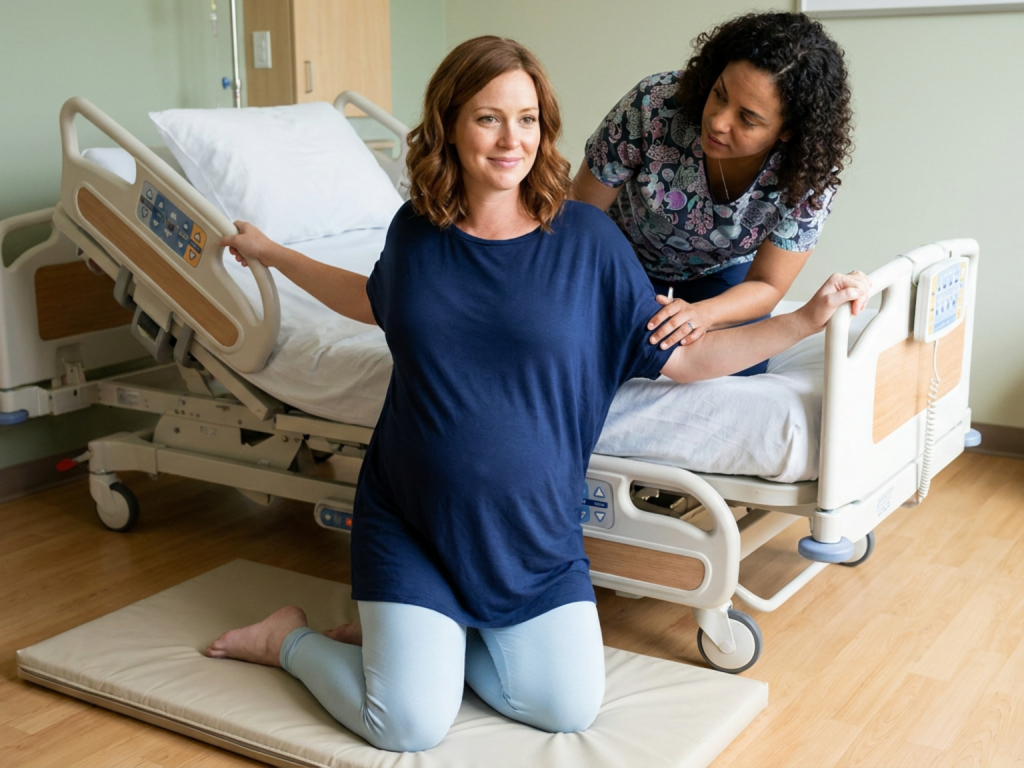
Gravity is not a magic solution for labor, but it is one of the simplest physiologic forces available to a birthing person. When the body is upright or forward-leaning, gravity can work with uterine contractions, fetal descent, pelvic mobility, and the urge to push rather than against them.
Highlights
Upright and forward-leaning positions can help the fetus descend through the pelvis by aligning uterine force with gravity.
Squatting, kneeling, standing, lunging, and supported sitting may increase pelvic mobility and give the sacrum more room to move.
Research summarized in obstetric literature suggests upright positions may shorten the second stage of labor and reduce some interventions in appropriate circumstances.
Position choice should always be individualized, especially when epidural analgesia, fetal monitoring, bleeding, hypertension, malpresentation, or other clinical concerns are present.
The physiology of gravity in labor
Labor is powered primarily by coordinated uterine contractions, cervical remodeling, fetal position, maternal hormones, and pelvic soft-tissue compliance. Gravity does not replace any of these processes, but it can influence how efficiently they interact. In an upright position, the long axis of the uterus is more likely to align with the maternal pelvis, allowing the contracting uterus to apply downward pressure toward the cervix and pelvic outlet. This is why many people instinctively prefer standing, swaying, kneeling, sitting upright, or leaning forward during contractions.
During the first stage of labor, the presenting fetal part, usually the head in a cephalic birth, applies pressure to the cervix. This pressure contributes to cervical effacement and dilation through mechanical stretch and neurohormonal feedback, including oxytocin release. When the birthing person is upright, gravity may help maintain that pressure between and during contractions. This can support the natural feedback loop in which cervical stretch, uterine activity, and maternal sensation inform each other.
In the second stage, after full cervical dilation, gravity can assist fetal descent through the midpelvis and outlet. The effect is not simply that the baby “falls downward.” Rather, descent occurs through a complex combination of uterine force, maternal expulsive efforts, fetal flexion, rotation, and soft-tissue stretch. Gravity adds a constant vector in the same general direction as birth, especially when the pelvis is positioned so the outlet is open and the sacrum can move.
Upright positions and the shape of the pelvis
The pelvis is not a rigid tunnel. The sacroiliac joints, pubic symphysis, coccyx, pelvic floor, fascia, and surrounding muscles all contribute to dynamic movement. Upright positions during labor may help the pelvis adapt as the fetus descends. Squatting during childbirth, for example, can widen aspects of the pelvic outlet and allow the sacrum and coccyx to move posteriorly, provided the birthing person has adequate balance, leg strength, and support.
One commonly cited advantage of squatting is that it may increase the functional space available at the outlet compared with lying flat. This does not mean every person should squat continuously, nor does it mean that squatting is safe or comfortable for everyone. But it helps explain why supported squats, birth stools, toilet sitting, and partner-assisted positions can feel productive when the baby is low and the urge to bear down is strong.
Gravity also changes the relationship between the uterus and the maternal spine. In a supine position, the uterus may fall backward against the spine and major blood vessels, and the sacrum may have less freedom to move. In contrast, standing, kneeling, hands-and-knees, and supported forward-leaning positions can reduce direct pressure on the sacrum and allow more pelvic mobility. This is one reason many maternity teams encourage changing positions in active labor when it is clinically safe.
Pelvic opening is position-specific. A lunge can create asymmetry that may help the fetus navigate the pelvic brim. Hands-and-knees can relieve posterior pressure and may help with back labor. Side-lying can be useful when fatigue, epidural analgesia, or fetal heart rate concerns make fully upright positions less practical. The goal is not one perfect posture, but a responsive sequence of positions that matches labor progress, maternal comfort, and fetal tolerance.
Gravity, fetal positioning, and rotation
For vaginal birth, the fetus usually needs to flex the head, descend, and rotate through the pelvis. Gravity may assist this sequence when maternal posture gives the uterus a favorable angle and allows the fetal back, head, and shoulders to settle into a more efficient relationship with the pelvic inlet. Upright birthing positions can also encourage the abdomen to hang forward rather than compress backward, which may help some babies find a more favorable path.
Optimal fetal positioning is not entirely under maternal control. Placental location, uterine shape, amniotic fluid volume, fetal tone, parity, pelvic anatomy, and contraction pattern all matter. Still, maternal movement can influence the space available for fetal adjustment. Forward-leaning inversions, side-lying release techniques, lunges, pelvic rocking, and hands-and-knees positions are often used by trained professionals or educators to encourage balance in the soft tissues around the pelvis. These approaches should be adapted to the individual and avoided when a clinician advises against them.
Gravity may be especially noticeable when labor feels stalled because the baby is high, asynclitic, or not well-applied to the cervix. In such cases, simply pushing harder is not always useful. A change in maternal position may alter the pelvic diameters, relieve a tight area, or help the fetus rotate. A supported lunge during contractions, standing with one foot elevated, or kneeling over a birth ball can create subtle asymmetry that invites movement. For back labor, hands-and-knees for back labor may reduce pressure on the sacrum and give the fetus more room to rotate from an occiput posterior position.
It is important to hold this information gently. If labor requires intervention, that does not mean the birthing person failed to use gravity correctly. Birth physiology is powerful, but it is not fully controllable. Gravity is a tool, not a test of effort or worth.
How gravity can support pushing
The second stage of labor involves a transition from cervical dilation to fetal expulsion. In many unmedicated births, the fetal head descends enough to trigger a spontaneous urge to bear down. Upright positions may strengthen this sensory feedback because the fetal head presses more directly on the pelvic floor, rectum, and vaginal tissues. Some research discussions describe active pushing signals occurring spontaneously in upright positions, allowing the birthing person to follow physiologic cues rather than relying only on coached timing.
Gravity-supported pushing can take many forms. A person may push while squatting with support, kneeling upright, leaning over the raised head of the bed, sitting on a birth stool, standing with support, or using a supported semi-sitting position. These positions can align expulsive forces downward and may reduce the sense of pushing “uphill” that some people feel when flat on their back.
Open-glottis pushing, in which the person exhales or vocalizes while bearing down, may pair naturally with upright positions. It may reduce excessive breath-holding and allow the pelvic floor to release between efforts. Directed closed-glottis pushing can still be appropriate in some clinical situations, particularly with epidural analgesia or specific fetal heart rate concerns, but it should be guided by the care team. Breathing during pushing is most helpful when it supports oxygenation, maternal control, and effective coordination with contractions.
Upright pushing is not automatically better in every circumstance. Some people need rest after a long labor. Some have dense epidural blockade, leg weakness, dizziness, or continuous monitoring needs. Others have fetal heart rate patterns that improve in a lateral position. A side-lying pushing position can preserve some pelvic mobility while reducing maternal fatigue and allowing close fetal assessment. The best pushing position is the one that balances physiology, safety, comfort, and clinical response in real time.
Evidence on upright labor and birth positions
Clinical evidence on birth position is complex because studies differ in parity, epidural use, definitions of upright posture, provider practices, and outcome measures. Still, the overall physiologic rationale is strong: gravity can align uterine force with fetal descent, improve pelvic outlet mechanics, and support spontaneous pushing cues. A scientific review in PubMed Central discussing the role of gravity in the delivery room describes evidence that upright delivery positions can shorten the second stage of labor and naturally dilate the vaginal outlet.
The same review refers to broader trial evidence, including a Cochrane review and multiple trials, suggesting that upright positions may reduce labor duration, cesarean risk, and epidural need in some populations. These findings should be interpreted carefully. A population-level reduction in risk does not guarantee a specific outcome for an individual birth. The benefit may also depend on whether the birthing person is encouraged to move freely, whether staff are comfortable assisting non-supine birth, and whether the clinical environment supports mobility.
Educational and childbirth preparation sources also emphasize gravity’s role in uterine alignment and fetal descent. The principle is practical: when the uterus, pelvis, and baby are better aligned, contractions may feel more purposeful and descent may become easier. This is consistent with what many clinicians, midwives, doulas, and birthing people observe: labor positions often evolve instinctively as the body searches for less resistance.
However, evidence-based care also means recognizing limits. Upright positions should not delay urgent treatment for hemorrhage, severe hypertension, cord prolapse, persistent fetal bradycardia, shoulder dystocia, or other emergencies. They should be integrated into skilled maternity care, not used as a substitute for monitoring and clinical judgment.
When lying down may be necessary or helpful
Although gravity can be useful, lying down is not inherently wrong. A reclined, lateral, or semi-recumbent position may be medically necessary, emotionally reassuring, or simply what the body wants at a certain moment. Birth is dynamic, and rest can be therapeutic. A person who has labored upright for hours may need side-lying rest to restore energy and reduce muscular tension.
There are also clinical reasons to modify or avoid fully upright positions. Epidural analgesia can reduce leg strength and proprioception, making unsupported standing or squatting unsafe. Continuous fetal monitoring, intravenous medications, magnesium sulfate, significant bleeding, preeclampsia, suspected fetal compromise, or operative birth planning may limit mobility. In these situations, the care team may still be able to use gravity-informed modifications, such as throne position, supported sitting, peanut ball side-lying, or hands-and-knees with close assistance.
Supine positioning can sometimes worsen aorto-caval compression, in which the gravid uterus compresses major maternal blood vessels and may reduce venous return. This is why left or right lateral tilts are often used if someone must be on their back. If dizziness, nausea, shortness of breath, low blood pressure, or fetal heart rate changes occur in a position, the team may recommend repositioning promptly.
The most supportive approach is not to label positions as good or bad, but to ask: Is this position safe right now? Does it help the baby tolerate labor? Does it help the birthing person cope, rest, open, or push effectively? Does it allow the clinicians to provide necessary care?
Practical ways to use gravity safely
Using gravity well often begins before labor, with individualized birth planning. Discuss position preferences with an obstetrician, midwife, or labor nurse, especially if there are known risk factors such as placenta previa history, hypertension, breech presentation, prior cesarean birth, epidural plans, or need for continuous monitoring. Ask which upright options are available in the birth setting: birth balls, squat bars, wireless monitoring, birth stools, shower access, floor mats, or adjustable beds.
During early labor, gentle walking, swaying, slow dancing, stair climbing, or leaning over a counter can help contractions feel organized without exhausting the body. In active labor, upright positions in active labor may include standing, kneeling, supported sitting, lunging, or leaning forward over a ball. Between contractions, rest matters. Gravity is most helpful when paired with relaxation, hydration as permitted, emotional support, and efficient breathing.
For pushing, ask the team which positions are safe with the current fetal heart tracing, maternal energy level, analgesia, and stage of descent. If squatting feels too intense, supported kneeling or a birth stool may provide some of the same downward alignment with less strain. If the fetal heart rate improves in side-lying, that may be the best position for the moment, even if it is less upright.
A helpful mindset is “movement with feedback.” Try a position for several contractions, then reassess. More pressure, stronger urge to push, improved comfort, or visible descent may suggest the position is useful. Increased pain without progress, numbness, dizziness, loss of balance, or fetal heart rate concerns are reasons to change course with professional guidance. Gravity works best when it is part of respectful, responsive, medically attentive care.
When to get immediate clinical guidance
- Do not attempt unsupported standing, squatting, or walking if you feel faint, numb, weak, or unstable.
- Follow urgent instructions from your care team if there is heavy bleeding, severe pain, or concerning fetal heart rate changes.
- Ask for help before changing positions after epidural analgesia or sedating medication.
- Avoid positions your clinician has restricted because of placenta, blood pressure, fetal presentation, or other risk factors.
- If something feels wrong or suddenly different, call your maternity care team promptly.
Tools & Assistance
- Discuss preferred labor positions during a prenatal visit with your obstetrician or midwife.
- Ask whether your birth setting offers wireless monitoring, birth balls, squat bars, showers, or birth stools.
- Practice supported upright positions with a qualified childbirth educator, physiotherapist, or doula.
- Create a flexible birth plan that includes rest positions as well as upright options.
- During labor, ask the nurse or midwife to help reassess position safety as conditions change.
FAQ
Does gravity make labor faster for everyone?
No. Upright positions may shorten labor for some people, especially in the second stage, but labor length depends on many maternal, fetal, and clinical factors.
Can I use upright positions with an epidural?
Often yes, but they may need modification. Depending on leg strength and monitoring needs, options may include supported sitting, side-lying with a peanut ball, throne position, or assisted kneeling.
Is giving birth on my back unsafe?
Not necessarily. Supine or semi-recumbent positions may be appropriate for rest, monitoring, epidural care, or urgent interventions. A lateral tilt can reduce aorto-caval compression when needed.
Is squatting always the best birth position?
No. Squatting can increase outlet space and use gravity, but it can also be tiring or unsafe without support. The best position depends on comfort, fetal response, balance, analgesia, and clinical guidance.
Can gravity help if the baby is posterior?
It may help when combined with position changes such as hands-and-knees, lunging, or forward-leaning postures, but fetal rotation is not fully controllable and should be guided by skilled care.
Sources
- National Center for Biotechnology Information / PubMed Central — Inviting Newton to Visit the Delivery Room. The Role of Gravity
- WellPregnancy — In Labor, Gravity Is Your Friend
- Spinning Babies — 3 Principles of Spinning Babies - Prepare for Easier Birth
Disclaimer
This article is for general educational purposes and does not replace individualized medical advice. Always consult your obstetrician, midwife, or qualified maternity care professional about labor positions and safety.















Please log in to leave a comment.