
Intro
A visiting relative or friend may bring warmth, practical help, and a much-needed adult conversation. They may also arrive carrying prescription medicines, over-the-counter products, vitamins, nicotine products, or supplements in a purse, backpack, jacket pocket, or travel bag. For a baby who is beginning to roll, crawl, pull to stand, or explore by mouthing objects, an unattended bag can become an urgent poisoning risk in seconds.
This is not about blaming visitors or making your home feel unwelcoming. It is about treating medication storage as a predictable part of baby safety, much like handwashing, safe holding, and keeping hot drinks away from the edge of a table. A brief, routine request can protect your baby while allowing everyone to focus on the visit.
Highlights
Visitor bags can contain medicines in containers that are easy for an infant to grasp, open, or mouth.
Child-resistant packaging reduces risk but is not childproof; medicines still need to be stored high, out of sight, and preferably locked.
A calm, universal house rule for every guest is easier to apply than trying to identify which visitors may carry medication.
Why visitor belongings create a rapid exposure risk
Babies investigate their environment through touch and taste long before they understand danger. A purse placed on the floor, an open tote beside a sofa, or a coat draped over a low chair can put unfamiliar substances directly in the exploration zone. The risk increases as mobility changes: rolling can bring a baby closer to a dropped item, crawling broadens access, and pulling to stand makes tables, chair seats, and open bags newly reachable.
Medications and supplements may look appealing or harmless to a child. Gummies, chewables, colorful tablets, gel capsules, and small bottles can be mistaken for food or candy. Even a single dose of some products can be harmful to a baby because infants have small body mass and limited physiologic reserve. Potential consequences vary substantially by substance and amount, ranging from sedation, hypoglycemia, vomiting, or altered heart rhythm to respiratory depression or organ injury.
The contents of a bag are often less predictable than a household medicine cabinet. Visitors may carry daily prescriptions, loose tablets, travel-size pain relievers, sleep aids, inhalers, topical preparations, vitamins, or herbal products. Medication may also be stored in a weekly pill organizer rather than its original labeled container. That makes identification harder if an exposure occurs.
It helps to assume that every visitor bag, purse, backpack, briefcase, jacket pocket, and suitcase could contain a potentially dangerous item. This neutral, universal assumption supports safety without asking guests to disclose private health information.
Use a simple medication storage rule for every visit
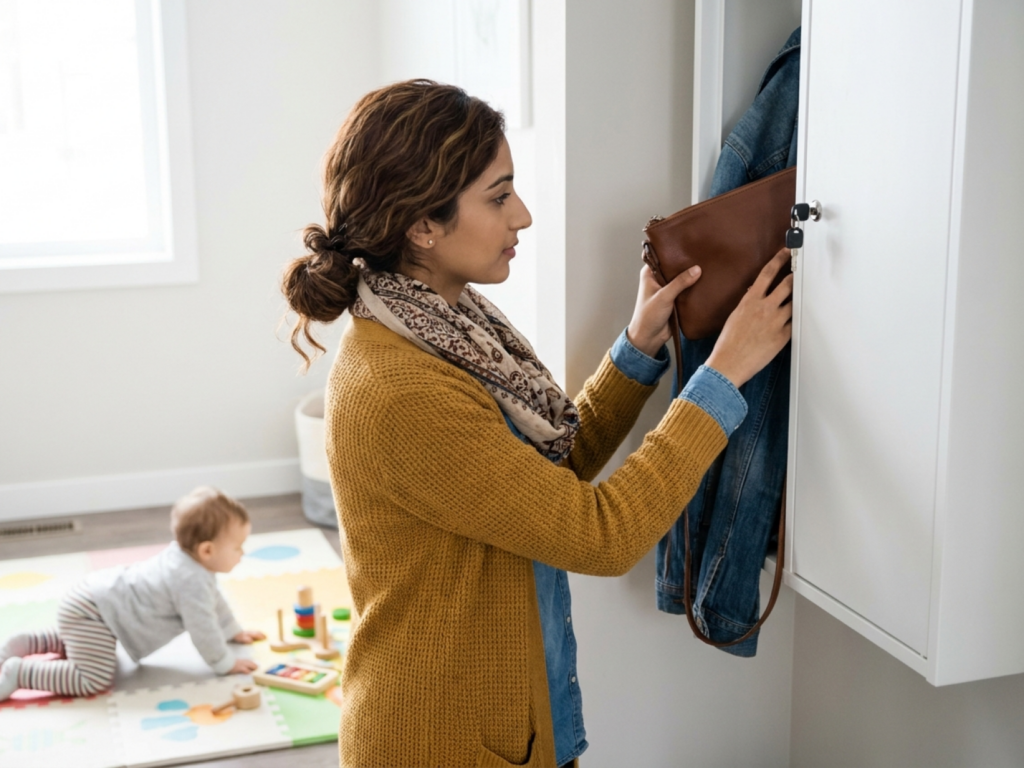
The most reliable approach is to make secure storage part of the arrival routine. Before visitors enter, designate one location that is inaccessible to a baby: a high, closed cupboard; a locked room; or another secure area that the baby cannot reach even when supervised. A high surface alone may be insufficient if a baby can later pull up near it or if an item can be knocked down.
A straightforward request is usually enough: “Please keep your purse, bag, and any medicines in the designated room while the baby is out.” This wording is specific, practical, and applies to everyone. State it before a guest sets a bag down, especially during busy arrivals when adults are greeting one another and a baby may be nearby.
Consider visitor medication storage as one of your newborn visitor safety rules, even if your child is not yet mobile. Establishing the routine early prevents a sudden policy change once developmental milestones increase access. It also accounts for older siblings or other young children who may visit and can retrieve items within the baby’s reach.
- Ask guests to place bags up and away immediately on arrival.
- Keep coats, jackets, and pocketed garments in the same secure area.
- Offer a chair, hook, shelf, or closed room so the request is easy to follow.
- Repeat the rule when visitors move to another room, leave a bag open, or change bags.
The goal is not perfect vigilance. It is designing the environment so one distracted moment does not create access.
Address medicines, supplements, and nicotine products specifically
When people hear “medication,” they may think only of prescription bottles. In practice, prevention should include all products that can cause toxicity or injury if a baby ingests, inhales, or applies them. Over-the-counter medicines such as pain relievers, cold products, allergy medicines, and cough preparations can be hazardous. So can iron-containing vitamins, prenatal vitamins, melatonin products, cannabis-containing products, concentrated essential oils, and dietary supplements.
Gummy vitamins deserve particular attention because their appearance and flavor may increase a child’s interest. A visitor may view a supplement as low risk and carry it loosely in a purse or snack bag. However, supplement dosing is not designed for infants, and some ingredients, including iron or fat-soluble vitamins, can be dangerous in excessive amounts. Treat supplements with the same storage precautions as prescription medicines.
Nicotine pouches, gum, lozenges, vaping liquids, and tobacco products should also be secured. Nicotine can be highly toxic to young children, and small packages may be easily overlooked in a bag or jacket pocket. Dispose of used products safely and do not leave them on tables, counters, or outdoor surfaces where a child could find them.
Ask visitors to keep medicines in their original child-resistant containers whenever possible. Original containers preserve the product name, strength, directions, and other identifying information that may be critical during an emergency. Child-resistant does not mean childproof: a determined or unsupervised child may still open packaging, and some medication may be dispensed in non-child-resistant containers at the patient’s request.
Reduce risk during the less obvious moments
Medication exposures often happen outside the moments adults expect. A guest may take a dose after breakfast, put a bottle on a coffee table “just for a minute,” or remove tablets from a bag while preparing to leave. Grandparents and caregivers may use pill organizers to organize a day’s doses. Travelers may have medicines in bedside bags, toiletry kits, or luggage. These are normal routines, but they need a baby-safe location and a deliberate reset afterward.
Focus on transitions. At arrival, secure belongings. During the visit, keep a medication container in hand or return it immediately to the secure storage location after use. Before departure, check the floor, sofa cushions, bedside tables, and diaper-changing area for dropped pills, gummies, packaging, or small containers. A single tablet can be hard to see against carpeting and may be discovered by a crawling infant first.
Do not transfer adult medicines into a baby’s diaper bag for convenience. Diaper bags are frequently placed on the floor, opened near the child, handed to other caregivers, and carried through changing routines. Keep baby supplies separate from adult medicines, and use a secure adult-controlled location when medication must travel.
Visitors should never describe medicine as candy to persuade a child to take it or leave it near food and drinks. This language can blur a child’s understanding of medicines as substances handled only by an adult. The same applies to offering a baby any medication, supplement, or herbal remedy without the parent’s knowledge and the guidance of the baby’s healthcare professional.
Respond promptly to a possible ingestion or exposure
If you find an open container, a chewed packet, a missing tablet, residue around your baby’s mouth, or an unexplained change in behavior, treat the situation seriously even if you are not certain ingestion occurred. Do not wait for symptoms. Many potentially harmful exposures initially cause no obvious signs, and early expert advice depends on knowing as much as possible about the product and timing.
Move the item away from the baby and remove any remaining material from the mouth if it is easily visible. Keep the original container, blister pack, or package with you. Do not induce vomiting, give food or drink to “dilute” a substance, or administer home remedies unless a poison expert or clinician specifically instructs you to do so. These actions can complicate care or increase aspiration risk.
Contact your local poison control service promptly for individualized guidance. Be ready to provide the baby’s age, approximate weight, the product name and strength, the possible amount, the time of exposure, and any current symptoms. If the baby has trouble breathing, is difficult to wake, has a seizure, collapses, or has other severe symptoms, call emergency services immediately.
A suspected exposure is also an opportunity to review the setting without shame. Determine how access occurred, then improve the barrier: move bags into a locked space, change where guests store coats, or add a pre-visit reminder. A near miss can be valuable information for preventing a future event.
Make prevention respectful, repeatable, and shared
Parents can feel uncomfortable asking a visitor to move a purse or secure medication, especially when the visitor is older, is helping with childcare, or has a medical condition that requires ready access to treatment. Yet clear safety boundaries are compatible with respect. The request concerns your baby’s developmental stage and the environment, not the visitor’s health choices.
Use consistent language for all guests. You might include a short note in an invitation, mention the routine in a family group message, or say it at the door. Consistency prevents anyone from feeling singled out and reduces the chance that you must decide in the moment whether an individual bag is likely to contain medication.
Some medicines need to remain immediately available for the visitor, such as rescue inhalers or emergency allergy medication. In those circumstances, the visitor can keep the item on their person, in a closed pocket that remains inaccessible to the baby, or in another secure adult-controlled place. The visitor should not leave it on a low surface. Discuss practical arrangements without handling or relocating someone else’s medication unnecessarily.
Everyone who cares for the baby should understand the routine, including partners, babysitters, relatives, and childcare visitors. Locked medication storage at home is the foundation, while visitor belongings require the same attention during social gatherings, holidays, and overnight stays. A short routine, applied every time, is more sustainable than relying on memory during a busy visit.
These precautions can feel like one more responsibility in an already demanding period. They are also a concrete way to protect a child who cannot yet recognize danger or tell you what they found. Small environmental changes give your baby space to explore more safely and let visitors participate in that protection.
Act Quickly After Possible Exposure
- Do not wait for symptoms if a baby may have swallowed, chewed, or handled a medicine or supplement.
- Do not induce vomiting or give food, drink, or home remedies unless a poison expert or clinician tells you to do so.
- Call emergency services immediately for breathing difficulty, seizure, collapse, unresponsiveness, or severe symptoms.
- Keep the original container or packaging available for poison control or emergency clinicians.
- Child-resistant containers are not childproof and do not replace secure, inaccessible storage.
Tools & Assistance
- Choose a locked or inaccessible arrival spot for every visitor bag and coat
- Save the local poison control contact information in caregivers’ phones
- Use a brief pre-visit reminder for family members and overnight guests
- Review locked medication storage with babysitters and frequent caregivers
FAQ
Is it rude to ask visitors to put their purses away?
No. A universal house rule for bags, coats, and medicines is a reasonable child-safety measure. Present it as part of the normal arrival routine rather than as a judgment about a specific visitor.
Are gummy vitamins safe to leave in a visitor’s bag?
No. Gummies and other supplements should be treated like medicines because a baby may mistake them for food and excessive ingestion can be harmful.
What if a visitor needs an inhaler or emergency allergy medicine close by?
The visitor can keep it directly on their person or in another secure adult-controlled place that remains inaccessible to the baby. Do not leave it on a low surface.
Should I call poison control if I am not sure my baby swallowed anything?
Yes. Contact poison control promptly when medication access is possible, such as a missing pill, chewed package, or open container. They can advise based on the specific product and circumstances.
Sources
- HealthyChildren.org / American Academy of Pediatrics — Medication Safety Tips for Families
- Centers for Disease Control and Prevention — Put Medicines and Supplements, Including Gummies, Up and Away
- Up and Away Campaign — Up & Away | Put your Medicines Up and Away and Out of Sight of Children
Disclaimer
This article provides general safety information and is not a substitute for medical advice. For a suspected ingestion or medication exposure, contact poison control, emergency services, or a qualified healthcare professional promptly.













Please log in to leave a comment.