
Intro
Changing a baby's clothes can feel awkward at first, particularly when the baby is sleepy, unsettled, or moving constantly. A calm routine, suitable clothing, and careful support of the head, neck, and limbs can make the process more efficient while protecting the baby's skin and joints.
The safest approach is to prepare everything before undressing the baby, use a stable changing surface, and move slowly without pulling on the arms or legs. The techniques below apply to newborns and young infants, but individual needs vary. Babies who have medical devices, orthopedic restrictions, or special handling instructions may require advice from a pediatrician, midwife, nurse, or occupational therapist.
Highlights
Prepare the new outfit and a secure, flat changing surface before removing the baby's current clothes.
Support the baby's head and neck, widen neck openings fully, and guide limbs through sleeves rather than pulling.
Choose simple, soft, seasonally appropriate garments with accessible fasteners and adequate room for movement.
Keep the baby's airway unobstructed and maintain continuous supervision throughout the clothing change.
Prepare before you undress the baby
Preparation is the most effective way to make a clothing change shorter and calmer. Select the complete outfit first, including the diaper if one may be needed, and place each item within reach. Open snaps, loosen fasteners, and turn sleeves right side out. Check that the clothing is clean, dry, and free of loose threads, damaged snaps, or rough seams that could irritate the skin.
Use a firm, flat changing surface away from stairs, heaters, pets, and other hazards. A changing table should have its safety straps used according to the manufacturer’s instructions, but a strap is not a substitute for a hand on the baby. Keep one hand on the baby whenever the baby is on an elevated surface. On the floor, place a clean mat under the baby and keep nearby objects from becoming choking hazards.
Consider the baby’s state. A clothing change immediately after a feed may be uncomfortable if the baby is prone to regurgitation, while waiting too long after a wet or soiled diaper can increase skin irritation. A quiet voice, predictable sequence, and brief pauses can help. For babies who become distressed when routines shift, consistent activity transitions for babies may be useful: give a calm verbal cue, make eye contact, and begin with a familiar step such as opening the fasteners.
Remove the existing clothes gently
Begin by supporting the baby’s head and neck if the baby cannot yet control them independently. Unfasten every snap, zip, or button before attempting to slide a garment over the body. If the fabric is tight, damp, or stuck to a skin fold, stop and loosen it rather than increasing traction. Clothing should never be pulled forcefully over the head, arms, or legs.
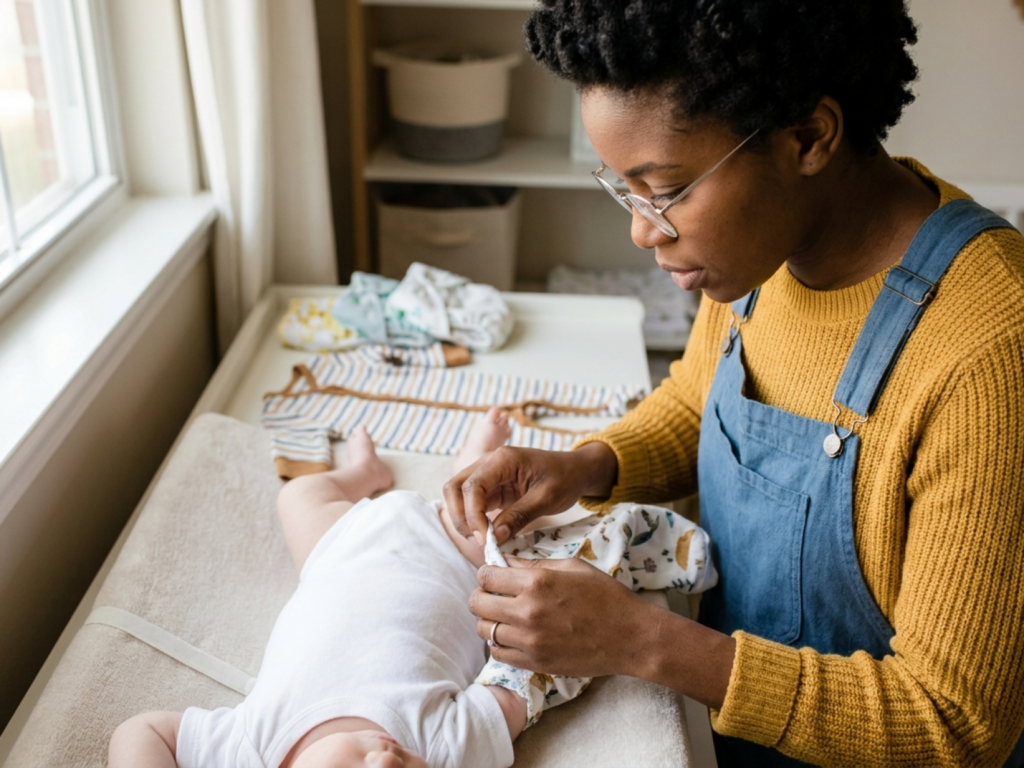
For a top or bodysuit, widen the neck opening with both hands. Bring the front or back of the garment away from the face and slide it over the crown of the head only when the opening is fully expanded. Keep the baby’s mouth and nose uncovered. Once the garment is past the head, place a hand inside one sleeve, gently grasp the baby’s hand or forearm through the fabric, and guide the arm out. Repeat on the other side.
When removing trousers, socks, or a one-piece garment, release the fasteners and support the lower leg rather than lifting by the foot. Move one limb at a time. If a diaper change is also required, clean and dry the area with a gentle diaper-area cleaning routine, paying attention to skin folds. Avoid rubbing irritated skin and seek clinical advice for persistent or worsening skin problems.
Put on tops and bodysuits without pulling
Lay the opened garment on the changing surface with the inside facing upward. For a bodysuit, position the baby’s torso over the garment and bring the lower portion between the legs only after the upper body is settled. For a shirt, you can place the baby on a flat surface or, when the baby is developmentally ready and well supported, hold the baby securely on your lap for the upper half of dressing. A flat surface is generally easier for the lower half and gives better control of the legs.
Stretch the neck opening wide with your fingers. Gently guide the back of the garment over the head, then pause to ensure that the fabric has not covered the nose or mouth. Insert your hand through one sleeve from the cuff toward the shoulder. Hold the baby’s hand through the sleeve and draw the fabric over the arm in one smooth movement. Do the same on the opposite side. This hand-inside-the-sleeve technique reduces twisting and avoids pulling the upper limb.
Once both arms are through, smooth the garment over the shoulders and trunk. Fasten snaps or zippers without catching skin. Zippers should be fully closed only when the zipper design allows safe clearance from the neck and chin. Check that the diaper area is covered comfortably but not compressed, and that the garment does not restrict hip flexion or leg movement.
Dress the lower body and feet comfortably
Before putting on trousers or leggings, gather each leg of the garment so the cuff is close to the waistband. Support the baby’s ankle or lower leg and guide the foot through the gathered opening. Then advance the fabric gradually over the calf and thigh. Do not pull from the toes, and do not force a leg into a narrow opening. If the garment catches at the knee, withdraw it slightly and reposition the limb.
For a one-piece outfit, guide one leg at a time and keep the baby’s pelvis supported on the surface. Avoid lifting both legs high or twisting the trunk. Newborns often have physiologic flexion at the hips and knees; clothing should accommodate this position rather than press the legs straight. Garments that are too tight around the thighs, abdomen, or ankles can leave pressure marks and make movement uncomfortable.
Socks should fit securely without leaving deep circumferential marks. Check that toes are not folded underneath one another and that no loose threads are wrapped around a toe. In many indoor settings, an appropriately layered outfit may be preferable to several tight layers. Monitor the baby’s temperature by observing the chest or back of the neck rather than relying only on the hands and feet, which can feel cool normally. Avoid overheating and follow local infant-sleep guidance about clothing and bedding.
Make the routine calmer and more efficient
Efficiency comes from repetition, not speed. Use the same sequence each time: prepare, unfasten, remove the top, remove the lower garment, check the skin, put on the clean outfit, and fasten it. Place frequently used clothes in a drawer or basket near the changing area, but keep supplies organized so that nothing has to be searched for while the baby is exposed.
Talk through the steps in a steady voice. A brief song, gentle touch, or simple verbal cue can provide sensory predictability. If the baby begins to cry intensely, pause to assess whether the baby is cold, hungry, tired, in pain, or overwhelmed. You can cover the torso with a clean lightweight cloth while preparing the next step, provided the face remains completely clear and the baby remains continuously observed.
Caregiver ergonomics matter. Keep the changing surface at a comfortable height, bend at the knees rather than rounding the back, and bring the baby close when lifting. If possible, alternate tasks with another caregiver during repeated changes. Never carry an unsettled baby while holding loose clothing, fasteners, or other supplies. Finish the change or place the baby in a safe location before gathering anything else.
Choose clothing that supports safety and skin health
Simple designs are usually easiest during the newborn period. Look for wide neck openings, envelope-style shoulders, front-opening garments, accessible snaps, and soft, breathable fabrics. Clothing should allow room for the diaper and unrestricted movement of the hips, knees, shoulders, and elbows. Avoid garments with tight elastic, scratchy labels, small detachable decorations, long cords, or loose threads.
Wash new clothing before use according to the care label, especially if the baby’s skin is sensitive. Fragrance-free laundering may reduce exposure to irritating residues, although individual reactions vary. Change wet, soiled, or sweaty clothing promptly and dry the skin gently by patting rather than rubbing. Inspect the neck, axillae, groin, and other folds for retained moisture or friction.
Dress for the environment rather than automatically adding many layers. A baby can become overheated in a warm room, while a cool environment may require an additional breathable layer. Keep hats and outer layers appropriate to the setting, and remove unnecessary head coverings indoors unless a healthcare professional has advised otherwise. Clothing is not a treatment for illness; if the baby seems unusually cold, hot, lethargic, or difficult to comfort, seek medical guidance rather than relying on extra layers alone.
Know when to ask for professional guidance
Most routine clothing changes can be managed at home, but some babies need individualized handling instructions. Ask a healthcare professional for guidance if the baby has a central or peripheral intravenous line, feeding tube, oxygen, cast, splint, postoperative wound, significant reflux-related positioning needs, or a condition affecting muscle tone or joint stability. Do not alter medical equipment or dress around it unless the treating team has shown you how.
Contact a clinician promptly if dressing consistently causes marked pain, a limb appears swollen or discolored, the baby has reduced movement on one side, or clothing leaves persistent deep marks. A healthcare professional should also assess concerns about temperature regulation, recurrent skin breakdown, or a rash that is extensive, weeping, blistered, infected-looking, or not improving with routine care.
For newborns, urgent medical advice is appropriate when there are breathing difficulties, bluish or gray coloration, unusual unresponsiveness, or a temperature concern according to local clinical guidance. During any clothing change, prioritize airway protection and safe positioning. If you are unsure how to move or dress the baby, stop and request hands-on instruction from a pediatric clinician, midwife, nurse, or other qualified professional.
Safety reminders
- Never leave a baby unattended on a bed, sofa, table, or changing station, even for a few seconds.
- Keep the baby's nose and mouth uncovered and remove clothing that interferes with breathing.
- Do not pull on the arms, legs, fingers, or feet to speed up dressing.
- Stop if a garment is tight, stuck, or causing pain; loosen it or choose a different item.
- Keep small fasteners, cords, and loose threads away from the baby's mouth and hands.
Tools & Assistance
- A firm, flat changing mat or correctly secured changing station
- A complete clean outfit opened and arranged before undressing
- A clean cloth for brief warmth and gentle drying
- A nearby laundry basket and organized clothing storage
- Advice from a pediatrician, midwife, nurse, or occupational therapist when handling is complex
FAQ
Should I change my baby's clothes on a changing table or the floor?
Either can be appropriate when the surface is clean and stable. A floor-level mat removes fall risk from height, while a changing table requires continuous hands-on supervision and correct use of any safety features.
How do I get a shirt over a newborn's head?
Support the head and neck, stretch the neck opening as widely as possible, keep the face clear, and move the garment gently over the head. Guide each arm through a sleeve with your hand inside the sleeve rather than pulling the arm.
How many layers should a baby wear?
The appropriate number depends on room temperature, outdoor conditions, the baby's age, and clinical circumstances. Use breathable layers that allow movement, check the chest or back of the neck, and avoid overheating.
What should I do if my baby cries during every clothing change?
Prepare everything first, keep the routine predictable, use a calm voice, and pause briefly to check for hunger, fatigue, cold, discomfort, or skin irritation. Seek professional advice if crying appears pain-related or is accompanied by other concerning signs.
Sources
- Pregnancy, Birth and Baby — Dressing a newborn — tips and safety advice
- HealthyChildren.org — Tips for Dressing Your Baby
- Health Service Executive — How to dress and undress your baby
Disclaimer
This article provides general educational information and is not a substitute for individualized medical advice, diagnosis, or treatment. Consult a qualified healthcare professional for concerns about your baby's health, handling, skin, temperature, or medical equipment.













Please log in to leave a comment.