
Intro
Parents and caregivers often wonder whether a baby who rolls, sits, walks, talks, or solves problems earlier than peers will have an advantage later in life. The question is understandable, especially when developmental comparisons are common. However, early achievement in one skill does not automatically mean better overall development, and a later milestone does not necessarily indicate a problem.
Development is multidimensional, variable, and influenced by biology, relationships, health, opportunities for learning, and the surrounding environment. The most useful goal is not to accelerate a baby toward a particular timetable, but to provide responsive care, monitor development thoughtfully, and seek professional advice when concerns arise.
Highlights
Earlier milestone attainment can reflect normal variation rather than superior overall development.
Responsive caregiving, safety, nutrition, sleep, and opportunities for play support development across domains.
Early childhood interventions may produce cognitive and motor benefits, but research findings are generally modest and evidence certainty varies.
Developmental surveillance focuses on patterns over time, not competition between babies.
A healthcare professional can help interpret milestones in the context of prematurity, medical history, and the child’s broader functioning.
What does early development mean?
“Early development” can refer to several different ideas. In everyday conversation, it often means reaching a milestone sooner than expected, such as crawling, using words, or showing advanced problem-solving. In clinical and public health contexts, early development more broadly describes the period in which infants and young children acquire motor, language, cognitive, social-emotional, and self-regulation skills.
These domains do not progress at identical rates. A baby may demonstrate strong social engagement while taking longer to develop gross-motor skills, or may move early while communication skills emerge more gradually. This uneven profile can be entirely typical. Developmental timing also reflects genetics, temperament, opportunity, sensory abilities, medical conditions, and the quality of interactions available to the child.
For babies born preterm, chronological age may not accurately represent developmental expectations during the first years. Clinicians may use corrected age when interpreting milestones. The appropriate comparison is therefore not simply with another baby of the same calendar age, but with the child’s own trajectory and relevant clinical context.
Is reaching milestones earlier an advantage?
Earlier attainment of an isolated milestone is not a reliable measure of overall developmental quality or future success. Milestones are useful observations, but they are not an intelligence ranking system. A child who walks early is not necessarily more cognitively advanced than a child who walks later within the typical range. Similarly, early vocabulary may coexist with slower development in another domain.
What tends to matter more clinically is the pattern, consistency, and functional meaning of development. Healthcare professionals consider whether a baby is making progress, using skills in increasingly flexible ways, interacting with caregivers, and maintaining abilities over time. They also look for broad concerns, such as a lack of expected progress across several domains, persistent asymmetry, unusual muscle tone, loss of previously acquired abilities, or difficulty responding to people and sounds.
Longitudinal research suggests that early developmental measures can be associated with later educational and economic outcomes, but association does not mean that an early score determines a child’s future. Early measures are affected by many factors, and predictive accuracy varies. A developmental assessment should guide support and follow-up rather than label a child’s potential.
Why responsive relationships matter more than speed
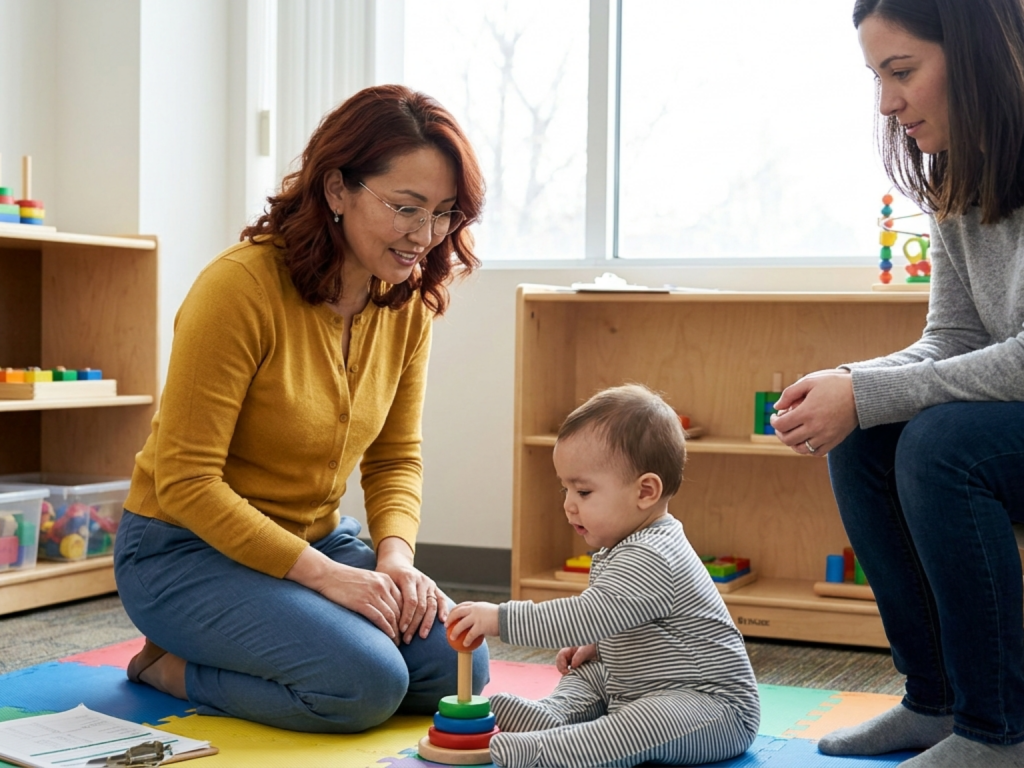
The strongest foundation for early learning is a stable, responsive relationship with a caregiver. Babies learn through repeated exchanges: an adult notices a gaze or vocalization, responds contingently, and gives the baby time to respond again. These interactions support early communication, attention, emotional regulation, and social understanding. They also help the infant experience the environment as predictable and safe.
Caregivers can support development through ordinary routines. Talking during feeding or bathing, imitating a baby’s sounds, sharing books, singing, naming objects, and following the child’s attention all create opportunities for language and cognitive learning. Safe floor play supports movement, while supervised tummy time can help build strength and postural control. The goal is active engagement without forcing a baby into a position or activity that causes distress.
Maternal and caregiver mental health is part of this developmental environment. Persistent depression, anxiety, trauma-related symptoms, or severe exhaustion can make responsive interaction more difficult, but these challenges are medical and social concerns rather than personal failures. Support from a clinician, mental health professional, family member, or community service can benefit both caregiver well-being and the caregiving relationship.
What does the evidence say about early interventions?
Early intervention is different from pushing a healthy baby to perform milestones prematurely. It refers to targeted support when a child or family may benefit from developmental evaluation, therapy, education, or enhanced caregiving support. Interventions may address communication, motor skills, feeding, hearing, vision, behavior, or the caregiver-child relationship.
A systematic review and meta-analysis of early childhood development interventions delivered by healthcare providers found possible improvements in cognitive and motor outcomes among children aged 0–36 months. The reported effects were generally small, and the certainty of evidence varied between outcomes and studies. This is an important balance: early support can be valuable, but research does not justify promising dramatic or uniform gains for every child.
The World Health Organization emphasizes integrated support that combines responsive caregiving, early learning, health and nutrition services, and attention to maternal mental health. This approach recognizes that development is not produced by a single toy, lesson, supplement, or program. Effective support is usually practical, relationship-based, culturally appropriate, and adapted to the child’s needs and the family’s circumstances.
When an intervention is recommended, caregivers can ask what specific concern it addresses, how progress will be measured, who provides the service, and when the plan will be reviewed. These questions help distinguish evidence-informed developmental support from commercial programs that make unsupported claims about accelerating intelligence.
How to support development without pressure
Caregivers do not need to turn infancy into a performance schedule. Babies benefit from repeated, enjoyable opportunities to explore, communicate, move, and recover from stimulation. A responsive approach follows the baby’s cues and adjusts the activity accordingly.
- Offer face-to-face interaction, conversation, songs, and shared books during calm, alert periods.
- Provide safe floor space for movement and exploration, with close supervision and age-appropriate safety precautions.
- Respond to attempts to communicate, including eye contact, gestures, sounds, changes in facial expression, and body movements.
- Use simple household objects and everyday routines for exploration rather than relying on expensive developmental products.
- Allow pauses and repetition. Learning often requires a baby to try, observe, rest, and try again.
- Protect sleep, feeding, and regulation needs. An overtired or overstimulated baby may not be ready to learn through play.
It is also reasonable to limit comparisons on social media and in parent groups. Comparisons rarely account for corrected age, opportunity, temperament, health history, or differences in how milestones are observed. Keeping brief notes or videos for a healthcare visit can be more informative than tracking every skill against another child.
When should developmental concerns be discussed?
Families should discuss concerns with a pediatrician, family physician, public health nurse, or other qualified healthcare professional whenever a baby seems to be losing skills, is not progressing, or interacts with the environment in a way that worries the caregiver. Caregiver concern itself is a valid reason to ask for guidance; waiting for a concern to become severe is not required.
Clinicians may use developmental surveillance at routine visits and standardized screening questionnaires at specific ages or when concerns arise. Screening is not a diagnosis. It identifies children who may need a more detailed assessment, such as hearing or vision testing, neurological examination, speech-language evaluation, physical or occupational therapy assessment, or referral to an early intervention service.
Urgent advice may be appropriate for sudden loss of abilities, new marked weakness, seizures, breathing difficulty, severe feeding problems, or a baby who appears acutely unwell. For less urgent concerns, record what you observe, when it occurs, whether it is consistent, and how it affects daily activities. Mention prematurity, birth complications, medical conditions, medications, hearing or vision concerns, and family history.
Early evaluation does not mean that a serious diagnosis is expected. It creates an opportunity to clarify normal variation, identify modifiable barriers, and connect the family with support. The purpose is to help the child participate and learn, not to enforce a rigid timetable.
When to seek medical advice
- Contact a healthcare professional if your baby loses a previously acquired skill.
- Ask for assessment when progress seems persistently limited across one or more developmental domains.
- Discuss persistent one-sided movement, unusual stiffness or floppiness, or marked coordination concerns.
- Arrange evaluation for possible hearing or vision problems, poor response to sound, or significant communication concerns.
- Seek urgent care for seizures, breathing difficulty, sudden weakness, severe feeding difficulty, or acute illness.
Tools & Assistance
- Routine pediatric or family medicine visits with developmental surveillance
- Validated developmental screening questionnaires
- Hearing and vision assessment when indicated
- Local early intervention, speech-language, physical, or occupational therapy services
- Caregiver mental health and family-support services
FAQ
Does walking or talking early mean a baby is more intelligent?
No. Early attainment of one milestone does not reliably measure overall intelligence or predict a fixed future outcome. Development across domains and over time provides a more useful picture.
Can parents make a baby develop faster?
Caregivers can create supportive conditions through responsive interaction, safe play, communication, sleep, nutrition, and healthcare. They should not force milestones or use unproven programs that promise accelerated intelligence.
Is early intervention only for children with a diagnosis?
No. Early intervention may support children with identified delays, risk factors, or functional concerns before a definitive diagnosis is available. Eligibility and services vary by location.
Should I worry if my baby is later than another baby?
Not necessarily. Developmental timing varies, and babies often develop unevenly. Discuss the pattern with a healthcare professional if progress is absent, concerns persist, or skills are lost.
Sources
- World Health Organization — Improving early childhood development
- PubMed — Effect of early childhood development interventions delivered by healthcare providers on child cognition and maternal mental health: a systematic review and meta-analysis
- PubMed — Early Child Development Assessments and Their Associations with Long-Term Academic and Economic Outcomes: A Systematic Review
Disclaimer
This article is for general educational purposes and does not diagnose, treat, or replace advice from a qualified healthcare professional. Seek individualized medical guidance for concerns about a baby’s development or health.













Please log in to leave a comment.