
Intro
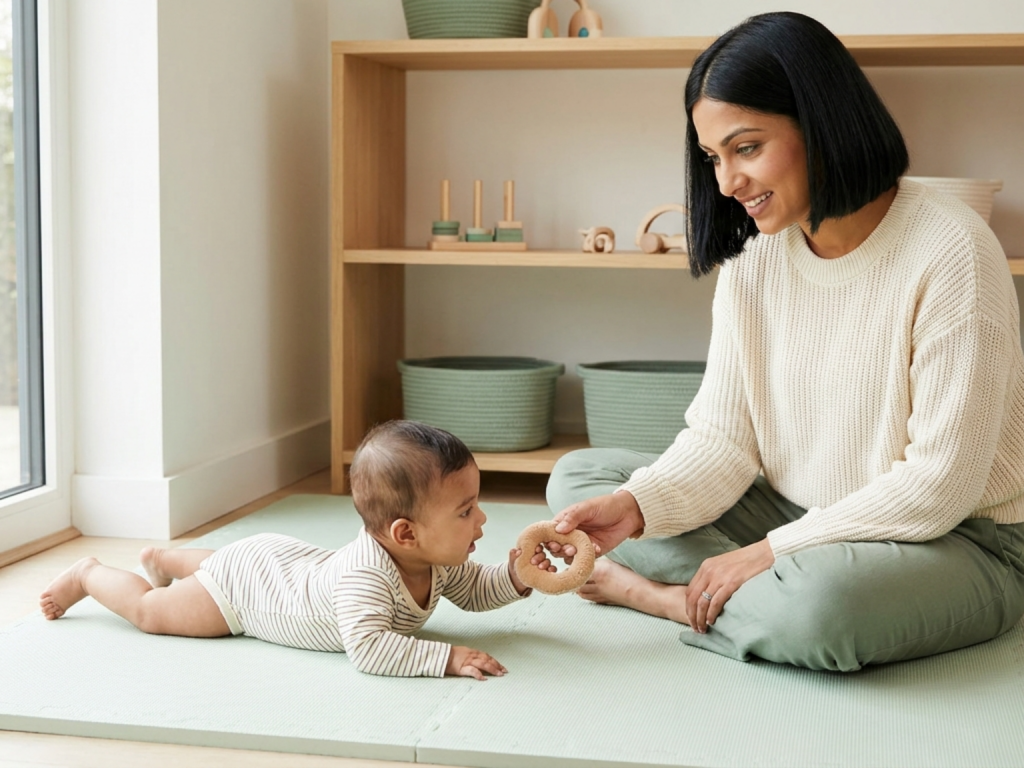
Floor time is often discussed as a setting for tummy time, but it is broader than one prone exercise. When an infant has a safe, supervised opportunity to move freely on the floor, they can practice changing positions, reaching, turning, sensing their environment, and communicating with a caregiver. These experiences support physical, sensory, cognitive, and social development through ordinary play.
Floor time does not need to look polished or follow a rigid schedule. A few minutes at a time, adjusted to the baby's alertness and tolerance, can be meaningful. The goal is responsive interaction and varied movement while the baby is awake, rather than forcing a particular position or comparing one infant's performance with another's.
Highlights
Floor time gives babies opportunities to strengthen the trunk, neck, shoulders, arms, and legs through varied movement, not only prone positioning.
Reaching, pivoting, rolling, and shifting weight help integrate balance, coordination, visual attention, and hand control.
Open-ended floor play supports sensory exploration, early problem-solving, autonomy, and confidence.
Safe positioning matters: prone play should occur only when the baby is awake and directly supervised, while sleep should follow current safe-sleep guidance.
Floor Time Is a Broader Developmental Experience
Tummy time is a specific form of floor play in which an infant is positioned on the stomach while awake and supervised. It places a useful challenge on the extensor muscles of the neck, back, and trunk and encourages the baby to lift the head, bear weight through the forearms, and look around. Floor time includes tummy time but also encompasses back-lying play, side-lying, supported sitting when developmentally appropriate, rolling attempts, and the transitions between positions.
This distinction matters because motor development is not a sequence of isolated exercises. Infants learn through repeated opportunities to perceive their bodies, respond to gravity, and adjust their movements. On a firm, open surface, a baby can move an arm or leg without being confined by a seat or carrier. Those small movements provide proprioceptive information, meaning feedback about body position, as well as vestibular input related to balance and head movement.
Caregivers can find ideas in Simple baby activities by age, but age ranges should be treated as general guides rather than performance targets. A baby’s temperament, medical history, birth status, and opportunities for practice all influence how floor play looks from day to day.
Strength, Postural Control, and Motor Foundations
Floor-based movement develops strength through functional effort. In prone, an infant gradually practices lifting and stabilizing the head, propping on the forearms, and later extending through the arms. In supine, the baby may bring the hands toward the midline, lift the legs, grasp the feet, or turn the head toward a voice or toy. Side-lying can make it easier to bring the hands together and can provide a transition point between back and tummy positions.
These activities contribute to postural control: the ability to maintain and adjust the body’s alignment during movement. Postural control supports later skills such as rolling, sitting, crawling, and reaching from a stable base. It also supports hand control because the arms and hands work more effectively when the trunk and shoulder girdle are organized. A baby who reaches for an object while shifting weight is practicing several systems at once: visual tracking, motor planning, balance, and grasp preparation.
Variation is more useful than insisting on one ideal posture. A caregiver might place an interesting but safe object slightly to one side, speak from a different location, or lie nearby at the baby’s eye level. The baby can then choose whether to look, reach, turn, or pause. This is one reason clinicians and developmental educators describe floor play as a source of safe movement opportunities for babies.
Sensory Exploration and Cognitive Learning
The floor is a rich learning environment because it allows infants to connect action with consequence. A hand brushes a cloth and feels its texture. A foot presses against a firm surface. A toy moves when it is kicked or pulled. A caregiver’s face becomes easier to see when the baby turns the head. These experiences build an early understanding that movements can change the environment.
Sensory exploration is not simply entertainment. Tactile, visual, auditory, proprioceptive, and vestibular information must be coordinated by the developing nervous system. Safe, manageable variation helps the infant learn what different sensations mean and how to respond. For example, looking toward a sound and then reaching toward its source combines auditory orientation, visual attention, and motor planning.
Floor play also supports early problem-solving. A baby may try several movements to reach a nearby object, discover that turning the body changes the view, or pause to study an item before touching it. These attempts are valuable even when they do not result in a successful grasp. Using age-appropriate objects with different shapes, weights, and textures can invite exploration, provided the items are large enough to avoid choking and are inspected for loose parts.
Caregivers should allow brief pauses and repetition. Infants often need time to process a new sensation or movement. Excessive toys, noise, or rapid adult direction can make it harder to notice the baby’s own initiative.
Independence, Confidence, and Social Connection
Supervised floor time can support emerging autonomy because the infant has room to initiate movement. A caregiver may offer an object, respond to a vocalization, or reposition a toy without completing the task for the baby. This balance gives the infant a chance to experiment while maintaining emotional security. Repeated experiences of trying, pausing, and trying again can contribute to confidence in movement.
Floor play is also a social activity. Face-to-face positioning encourages eye contact, vocal turn-taking, imitation, and shared attention. A caregiver can narrate what the baby is doing in simple language: “You turned toward the rattle,” or “You reached with both hands.” These comments connect movement with language without turning play into a test. Smiling, singing, and responding to gestures provide additional opportunities for early communication.
Independence does not mean leaving a baby alone. It means allowing developmentally appropriate choice within a safe environment. Responsive caregiving includes noticing whether the infant is engaged, tired, hungry, frustrated, or overstimulated. The interaction can end before distress becomes intense. Short, repeated sessions are often more practical and more positive than one long session.
Creating a Safe and Flexible Floor Environment
Choose a clean, firm, level surface away from stairs, cords, pets, hot liquids, unstable furniture, and small objects. Stay close enough to intervene immediately. As mobility increases, reassess the room because a baby who previously stayed in one place may begin rolling, pivoting, or pushing backward unexpectedly. Floor time should occur on a surface that does not permit the infant to become trapped between cushions or furniture.
Prone play should be supervised while the baby is awake. If the infant falls asleep, follow current safe-sleep recommendations and move the baby to an appropriate sleep surface rather than treating the floor as a sleep location. This distinction is essential: the developmental benefits of tummy time do not change the requirement for a safe sleep environment.
Begin with the baby’s current abilities. A young infant may spend much of the session looking at a caregiver, moving the limbs, or briefly lifting the head. Another infant may roll frequently and need a larger cleared area. Place toys within view and vary their position without placing them so far away that the baby becomes repeatedly distressed. A thin play mat can improve comfort, but excessively soft surfaces may make pushing and weight-bearing more difficult.
For practical routines, combine floor play with ordinary care rather than waiting for a perfect block of time. A short period after a diaper change, when the baby is alert and not immediately after a feed, may work well. The timing should remain flexible and guided by the infant’s cues.
Reading Cues and Supporting Individual Differences
Some infants initially dislike prone positioning or become frustrated when movement is difficult. Caregivers can try shorter intervals, chest-to-chest play while fully awake, a rolled towel placed appropriately to support the upper chest under professional guidance, or engaging from the baby’s eye level. These adaptations should make the experience more tolerable, not force the baby into a position they cannot manage.
Signs that the baby may need a break include turning away repeatedly, frantic movements, yawning, hiccupping, escalating fussing, color change, or a loss of organized movement. A calm pause, a change of position, feeding, or soothing may be appropriate. Persistent difficulty tolerating movement is not something caregivers need to interpret alone.
Developmental variation is expected, but families should discuss concerns with a pediatrician, family physician, pediatric physical therapist, or other qualified clinician when a baby consistently uses one side, appears unusually stiff or floppy, loses a previously acquired skill, has difficulty lifting or controlling the head, or shows marked asymmetry. Babies born preterm may be assessed using corrected age, and medical conditions may require individualized positioning advice. Professional assessment is preferable to online comparison or an attempt to diagnose from play behavior.
Turning Floor Play Into a Sustainable Routine
Consistency matters more than elaborate equipment. Several brief opportunities distributed across the day can expose the baby to more movement than a single formal session. A caregiver can rotate between back, side, and tummy positions when the baby is awake, use a familiar voice as a motivation to turn, and offer one or two simple objects at a time. Everyday items should be clean, intact, and free of choking, strangulation, or sharp-edge hazards.
Keep the adult role observant and responsive. Notice which positions the baby chooses, what captures visual attention, and whether the infant prefers a quiet or more interactive setting. Follow the baby’s lead while providing gentle variation. These principles also fit within Daily activities for baby development, because developmental practice is distributed through ordinary routines rather than confined to a special lesson.
Floor time should complement, not replace, sleep, feeding, comforting, and human interaction. It is one part of a balanced day. The most meaningful outcome is not a particular number of minutes or an early milestone; it is repeated access to safe movement and a caregiver who notices, supports, and enjoys the infant’s efforts.
Safety reminders
- Use tummy time and other prone play only when the baby is awake and directly supervised.
- Place sleeping infants on an appropriate firm, flat sleep surface according to current safe-sleep guidance.
- Clear the floor of small objects, cords, unstable items, and other hazards before every session.
- Do not force a position, continue through escalating distress, or use online milestones to diagnose a problem.
- Seek professional advice for persistent asymmetry, unusual tone, loss of skills, or difficulty controlling the head.
Tools & Assistance
- A clean, firm play mat in a cleared floor area
- A small selection of intact, age-appropriate objects
- A caregiver's face, voice, and hands for social engagement
- A pediatrician or pediatric physical therapist for individualized positioning guidance
- A simple observation log for noting tolerance, preferred positions, and new movements
FAQ
Is floor time the same as tummy time?
No. Tummy time is awake, supervised play on the stomach. Floor time is a broader category that can include prone, supine, side-lying, and developmentally appropriate transitional movement.
How long should a baby spend on the floor?
There is no single duration that fits every infant. Offer frequent, brief opportunities when the baby is alert and comfortable, and stop or change the activity when the baby shows fatigue or distress. Ask a healthcare professional for individualized guidance.
What if my baby strongly dislikes tummy time?
Try shorter sessions, chest-to-chest awake play, engaging at eye level, or another comfortable position that encourages movement. Persistent or severe difficulty should be discussed with a pediatric clinician.
Can a baby sleep during floor play?
If a baby falls asleep during play, move them to an appropriate safe sleep surface and follow current safe-sleep recommendations. Floor play is intended for awake, supervised periods.
Should preterm babies follow the same expectations?
Preterm infants may be evaluated using corrected age, and their medical needs can affect positioning and tolerance. Their pediatric healthcare team can provide more relevant guidance than chronological-age comparisons alone.
Sources
- Pathways.org — When and Why Baby Should Play on the Floor
- Cleveland Clinic — Tummy Time: What It Is and 6 Major Benefits
- National Institute of Child Health and Human Development (NICHD) — Benefits of Tummy Time
Disclaimer
This article is for general education and does not diagnose, treat, or replace advice from a qualified healthcare professional. Contact your baby's clinician with individual questions or concerns.












Please log in to leave a comment.