
Intro
Supporting a baby’s development does not require expensive equipment, formal lessons, or a tightly scheduled program. In infancy, ordinary moments such as feeding, bathing, cuddling, talking, and changing clothes can provide meaningful developmental input when they are warm, responsive, and appropriate for the baby’s current abilities.
Development unfolds across multiple domains, including motor skills, communication, cognition, sensory processing, emotional regulation, and social connection. The most effective approach is to offer safe opportunities for movement and exploration, notice the baby’s cues, and adapt activities when the baby is tired, hungry, distressed, or overstimulated.
Highlights
Responsive caregiving is itself a powerful form of developmental stimulation.
Short, frequent periods of supervised floor play are generally more useful than long, demanding sessions.
Talking, singing, reading, and face-to-face interaction support early communication and social development.
Tummy time should occur only when the baby is awake and directly supervised; infants should be placed on their backs for sleep.
A baby’s developmental trajectory is individual, and concerns should be discussed with a pediatric healthcare professional.
Start with responsive relationships
The foundation of infant development is a responsive relationship with a consistent caregiver. When an adult notices a baby’s facial expression, vocalization, body movement, or cry and responds appropriately, the baby experiences a predictable social exchange. These repeated exchanges help develop emotional regulation, attention, communication, and a sense of security.
Responsiveness does not mean preventing every cry or entertaining the baby continuously. It means observing, interpreting cautiously, and responding with appropriate comfort or practical care. A caregiver might pick up a distressed newborn, reduce noise, offer a feed when hunger cues are present, or pause an activity when the baby turns away. Over time, this back-and-forth interaction supports the infant’s emerging capacity to engage and recover from stress.
Skin-to-skin contact, gentle holding, eye contact, and a calm voice can be especially valuable during the newborn period. During routine care, describe what is happening in simple language: “I am lifting your arm,” or “Now we are putting on your clean diaper.” The words are not expected to be understood literally at first; the rhythm of speech, shared attention, and repetition are the important inputs.
Caregivers should also protect their own capacity to respond. Fatigue, postpartum mood symptoms, feeding difficulties, and limited social support can make interaction harder. Asking a healthcare professional, trusted family member, or community service for support is a responsible part of caring for a baby.
Support movement and motor learning
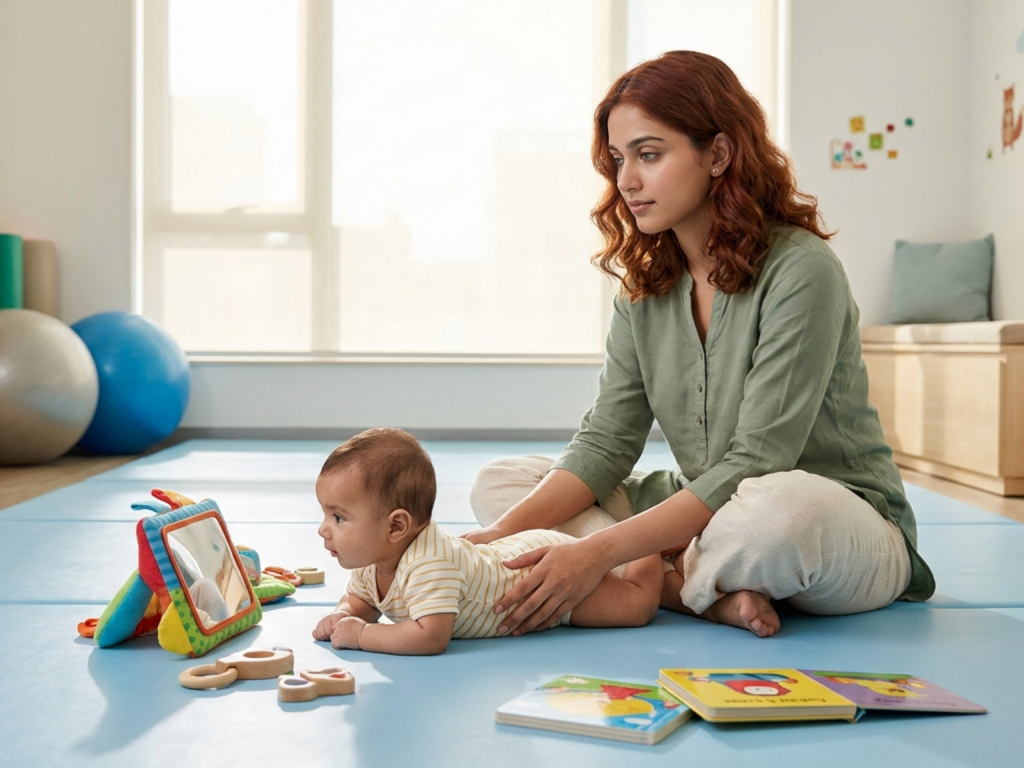
Infants learn through movement. Safe floor time allows a baby to practice head control, trunk stability, reaching, rolling, hand opening, and eventually crawling or other forms of mobility. Place the baby on a firm, clear surface while awake and remain close enough to supervise. Allowing time without restrictive equipment gives the infant opportunities to adjust posture and explore how the body works.
Supervised tummy time is an important early activity because it encourages activation of the neck, shoulder, back, and trunk muscles. Begin with brief periods when the baby is alert and content. Tummy time can occur on a caregiver’s chest or lap, provided the baby’s airway remains clear and the adult is awake and attentive. Gradually increase opportunities according to the infant’s tolerance rather than treating a recommended duration as a performance target.
Make movement motivating without physically forcing it. Lie in front of the baby, place a face or simple toy within view, and move it slowly from one side to the other. Pause to allow the infant to look, turn, reach, or vocalize. As skills change, move an object slightly farther away to encourage purposeful movement. Avoid pulling a baby into sitting, standing, or walking positions before the baby can achieve them independently, and avoid devices that confine movement for prolonged periods.
Safe sleep remains separate from awake play. Place infants on their backs for every sleep on a firm, flat sleep surface, following current guidance from the baby’s healthcare professional. Do not use tummy time as a sleep position, and do not leave an infant unattended on an elevated surface.
Build early communication through sound and shared attention
Speech and language stimulation begins long before a baby says a first word. Talk during feeding, dressing, bathing, and household activities. Use a varied but natural voice, pause frequently, and respond to coos, smiles, cries, and movements as meaningful attempts to communicate. This creates early language reciprocity: the infant makes a sound or gesture, the adult responds, and the infant learns that communication can influence another person.
Singing is useful because melody, rhythm, repetition, and exaggerated prosody can hold an infant’s attention. You do not need to sing perfectly. Repeating a short song during a routine may help the baby anticipate what comes next and notice patterns in sound. Reading aloud offers similar benefits even before the infant can follow a story. Choose sturdy books with clear images, describe pictures, and let the baby look away or handle the book when ready.
Face-to-face interaction is often more valuable than background audio. Position yourself where the baby can see you, imitate a sound or expression, then wait. These pauses give the infant time to process sensory information and attempt a response. As the baby becomes more vocal, expand the exchange with simple words and gestures. Label familiar people, objects, and actions without testing the baby or demanding a response.
Screen exposure is not a substitute for live interaction. A screen may provide visual and auditory stimulation, but it cannot reproduce the contingent timing, eye contact, touch, and emotional reciprocity of a responsive caregiver. Follow guidance from pediatric professionals regarding media use, and prioritize direct interaction, sleep, feeding, and physical activity.
Encourage sensory exploration and early thinking
Babies learn by looking, listening, touching, moving, and repeating actions. Offer a small number of safe, simple objects with different shapes, textures, weights, and sounds. A soft cloth, a lightweight rattle, a board book, or a clean household container may be sufficient. Present one item at a time and observe how the infant explores it. Reaching, mouthing, shaking, dropping, and staring are normal ways of gathering information.
Use high-contrast patterns and slow visual tracking activities with young infants. Hold an object at a comfortable distance, wait for the baby to focus, and move it gradually rather than rapidly. As visual attention develops, place an object just within reach and allow the baby to attempt contact. These activities encourage visual attention, hand-eye coordination, and early motor planning.
Cause-and-effect play becomes increasingly interesting during the first year. A baby may learn that shaking a rattle produces sound, kicking moves a hanging object, or dropping a spoon results in an adult retrieving it. Repeat the activity while naming the action, but avoid over-directing. The infant’s own experimentation is the central learning process.
Safety must govern sensory play. Check toys for small detachable parts, sharp edges, loose strings, toxic materials, and age-inappropriate components. Never leave a baby alone with an object that could obstruct the airway. Avoid placing food, powders, essential oils, or other substances on the skin or within reach for sensory purposes unless specifically recommended by a qualified professional.
Use play to support emotional regulation
Play should be pleasurable and flexible, not a test of performance. A baby may engage for only a few minutes before needing a break. Watch for cues such as turning the head away, stiffening, yawning, hiccupping, becoming unusually fussy, or losing coordinated attention. These may indicate fatigue or overstimulation rather than a lack of ability. Pause, lower the sensory intensity, hold the baby, or transition to a quiet routine.
Predictable games such as peekaboo, gentle singing, and imitation can help infants understand turn-taking and anticipate events. Keep the interaction simple and allow the baby to determine its pace. If the infant smiles or vocalizes, continue briefly; if the infant withdraws, respect the signal. This teaches that social interaction can be safe, enjoyable, and responsive to individual boundaries.
Emotional regulation develops through co-regulation before it develops independently. A calm adult voice, steady holding, reduced stimulation, and familiar routines can help a baby return to an organized state. This does not require constant silence or perfect routines. It requires repeated experiences in which a caregiver notices distress and offers appropriate support.
Developmental stimulation should fit into family life. A few attentive minutes during ordinary routines may be more sustainable than a demanding schedule. Rest, adequate feeding, and sleep opportunities are not interruptions to development; they are essential conditions for healthy growth and learning.
Adapt activities to the individual baby
There is substantial normal variation in when infants acquire particular skills. Developmental milestones are useful reference points, but they are not a rigid timetable or a measure of parental success. Consider the baby’s overall pattern of interaction, movement, alertness, and progress. A baby who was born preterm may need milestones interpreted using corrected age, so ask the pediatric clinician how to track development appropriately.
Adapt the environment to the baby’s current state and abilities. A newborn may benefit from brief eye contact, skin-to-skin contact, gentle talking, and supported positioning. An older infant may be ready for more floor mobility, reaching games, book sharing, reciprocal vocal play, and simple opportunities to choose between two safe objects. Activities should become more complex gradually, while remaining achievable and enjoyable.
Contact a healthcare professional if you are worried about hearing, vision, muscle tone, feeding, social engagement, movement, communication, or a loss of previously acquired skills. Developmental regression warrants prompt discussion with a clinician. Do not rely on online comparisons or attempt to diagnose a delay based on a single behavior. A pediatrician, family doctor, child health nurse, or developmental specialist can assess the infant in context and recommend early support when appropriate.
The goal is not to accelerate development beyond the baby’s biology. It is to provide secure relationships, safe movement, rich but manageable sensory experiences, and timely professional support when questions arise.
Safety and medical cautions
- Always supervise awake play, especially tummy time and any activity involving objects.
- Place infants on their backs for sleep on a firm, flat, uncluttered sleep surface.
- Stop an activity if the baby shows distress, exhaustion, breathing difficulty, color change, or poor coordination.
- Keep small objects, cords, plastic bags, loose bedding, and unsafe household materials out of reach.
- Discuss developmental concerns, feeding problems, persistent inconsolability, or loss of skills with a healthcare professional.
Tools & Assistance
- A firm, clear floor mat for supervised awake play
- A small selection of age-appropriate books and toys without detachable parts
- A daily observation note for new movements, sounds, preferences, and concerns
- Pediatric well-child visits and standardized developmental screening
- Local early-intervention, child health, or parenting-support services
FAQ
How much stimulation does a baby need each day?
There is no single required amount. Offer brief, frequent periods of attentive interaction throughout the day and follow the baby’s cues. Feeding, caregiving, talking, and cuddling all count as developmental experiences.
When should tummy time begin?
Healthy newborns can generally have brief supervised tummy time while awake from the early days of life, but follow individualized advice if the baby was premature or has a medical condition. Tummy time is never a sleep position.
What if my baby dislikes tummy time?
Start with very short periods on a caregiver’s chest or lap while the adult is awake, then try a firm floor surface later. Change the timing, use face-to-face contact, and stop when the baby is distressed. Ask a healthcare professional for tailored suggestions if difficulty persists.
Are educational videos helpful for infant development?
Live, responsive interaction is generally more developmentally meaningful than passive screen viewing. Prioritize talking, singing, reading, touch, and movement, and follow current pediatric guidance about media exposure.
When should I seek advice about development?
Speak with a pediatric healthcare professional whenever you have concerns about hearing, vision, feeding, movement, communication, social engagement, or loss of skills. Professional assessment is more reliable than comparing the baby with other infants.
Sources
- Centers for Disease Control and Prevention — Positive Parenting Tips: Infants (0–1 years)
- Mayo Clinic — Infant development: Birth to 3 months
- World Health Organization — Engaging and having fun with newborns and children under 5 years
Disclaimer
This article provides general educational information and is not a diagnosis or a substitute for medical advice. Consult your baby’s pediatric healthcare professional for individualized guidance, especially if you have developmental or safety concerns.

















Please log in to leave a comment.