
Intro
Body awareness is an infant’s gradually developing understanding of the body as a distinct, moving, and perceiving self. It includes recognizing body parts, sensing posture and movement, coordinating actions, and learning how touch, vision, balance, and muscle feedback relate to one another. This development begins before an infant can intentionally reach, crawl, or communicate about bodily experiences.
Body awareness develops through ordinary, repeated interactions: being held, moving against gravity, looking at hands, kicking, grasping, feeding, and exploring safe surfaces. Individual timing varies considerably. The goal is not to make an infant perform skills on demand, but to provide responsive care and opportunities for spontaneous movement while remaining attentive to comfort and safety.
Highlights
Body awareness emerges from the integration of tactile, visual, vestibular, and proprioceptive information.
Everyday caregiving and freely chosen movement provide meaningful learning experiences for the developing nervous system.
Motor milestones are useful observations, but they do not by themselves measure the quality of an infant’s body representation.
Gentle, responsive interaction is more appropriate than drills, forced positioning, or comparison with other babies.
What Body Awareness Means in Infancy
Body awareness is a broad neurodevelopmental capacity rather than a single milestone. It includes interoceptive information about internal bodily states, proprioceptive information about joint position and muscle activity, vestibular information about head movement and gravity, and exteroceptive information from touch and vision. An infant’s brain must gradually combine these streams into a usable representation of the body.
In the earliest weeks, movement is strongly influenced by reflexes, immature postural control, and the effects of sleep-wake state. A newborn may accidentally bring a hand into view or touch the face without yet understanding that the hand belongs to the same body. With repetition, the infant begins to detect regular relationships: a hand moves when the arm muscles activate, a leg can kick against a surface, and a caregiver’s touch corresponds to a particular body region.
This emerging body representation supports more than motor skill. It helps an infant orient toward sensory events, organize action, anticipate consequences, and participate in social interaction. For example, an infant who has increasing awareness of the mouth, hands, and trunk may become better able to coordinate reaching, bringing objects toward the mouth, and adjusting posture during feeding or play.
The Sensory and Neural Foundations
Proprioception is often described as the sense of body position and movement. Receptors in muscles, tendons, joints, and connective tissues provide the central nervous system with information about limb position, muscle tension, and the direction or force of movement. This information is not usually conscious in the way vision is, but it is essential for grading movements and maintaining posture.
Infants do not develop body awareness through proprioception alone. Visual input helps them observe hands, feet, and changes in position. Tactile input provides information about contact, pressure, temperature, and texture. The vestibular system contributes information about acceleration, head orientation, and gravity. The brain continually compares these signals with motor commands and their outcomes, a process known as multisensory integration.
Research has identified specialized cortical responses to body-related cues in infants, suggesting that neural processing of the body begins early. These responses should not be interpreted as evidence that an infant has an adult-like body concept. Rather, they indicate that the developing brain is already sensitive to bodily and social information, while experience gradually refines how those signals are associated and organized.
An associative learning account proposes that repeated sensorimotor experiences help link visual, tactile, and proprioceptive events. When an infant repeatedly sees a hand move while feeling the associated muscle and skin sensations, the nervous system can learn the regularity among them. Over time, such relationships contribute to a coherent sense of one’s own body.
How Awareness Changes Across the First Year
Development is continuous, and age ranges are approximate. In the newborn period, body awareness is expressed through reflexive movement, changes in tone, orientation to touch, and brief visual attention to nearby body parts. Skin-to-skin contact, being supported in different positions, and ordinary movement during caregiving provide varied sensory information.
During the first several months, many infants increasingly watch their hands, open and close the fingers, bring hands to the mouth, kick against gravity, and turn toward or away from sensory input. These actions are not merely exercises. They allow the infant to discover predictable relationships between intention, movement, contact, and visual feedback. Reaching becomes more purposeful as the infant learns to control the shoulder, arm, wrist, and hand in relation to a target.
As postural control improves, infants commonly become more active on the floor. They may lift the head and chest, shift weight, roll, pivot, reach from different positions, and use the legs to push or stabilize. These experiences challenge balance and require the nervous system to update the body map as the center of mass changes.
Later in the first year, many infants explore sitting, crawling or other forms of mobility, pulling to stand, and cruising. Some use atypical but effective movement strategies, and not every infant crawls in a conventional pattern. Increased mobility creates new proprioceptive and vestibular experiences, but the meaning of any single milestone depends on the overall pattern of movement, interaction, comfort, and progression.
Everyday Experiences That Support Learning
Responsive caregiving is a central context for body-awareness development. During dressing, bathing, lifting, and feeding, caregivers can move slowly enough for the infant to experience what is happening, pause when the infant signals discomfort, and name body parts in a calm voice. Language does not create body awareness by itself, but consistent words paired with touch and movement may help organize attention over time.
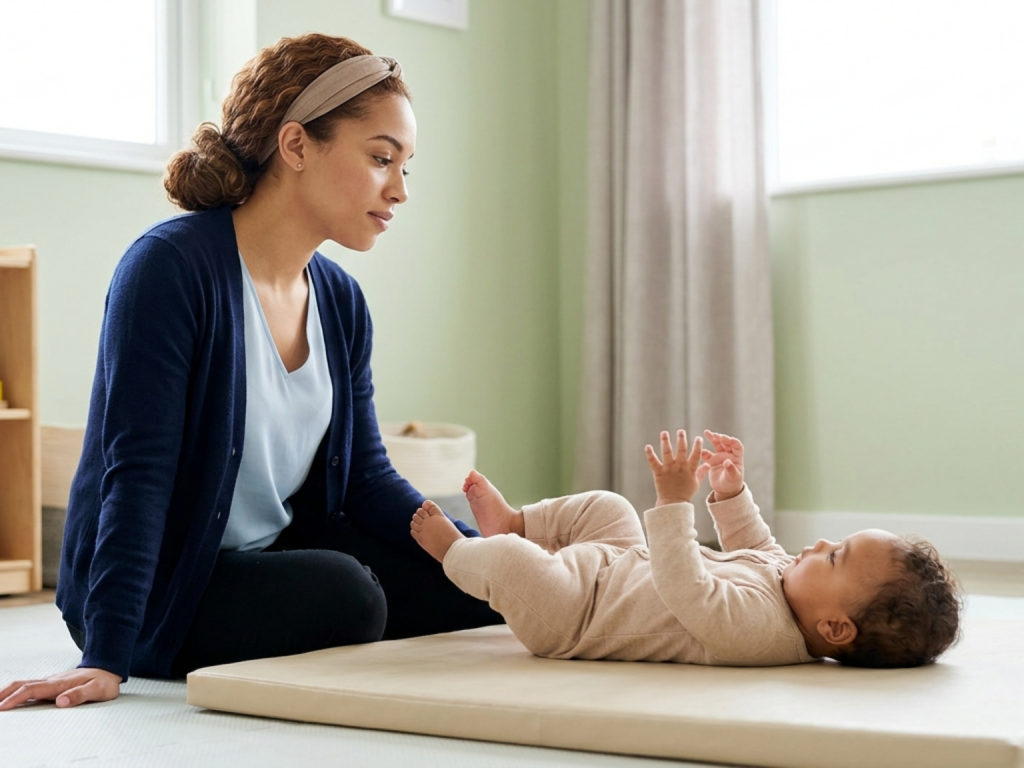
When the infant is awake and supervised, safe floor play provides opportunities to move without being placed in a fixed position for long periods. A firm, uncluttered surface allows an infant to shift weight, turn the head, reach, and experiment with balance. Tummy time can be introduced in developmentally appropriate, comfortable ways, including brief periods on a caregiver’s chest or lap when the infant is awake and directly observed.
Simple play can offer rich sensory variation. An infant may look at their hands, grasp a soft object, kick a lightweight toy, feel a caregiver’s hands during a song, or explore different safe textures. The activity should remain led by the infant’s cues. Repetition is useful, but novelty should be introduced gradually, particularly for infants who become easily fatigued or overstimulated.
Movement opportunities should be balanced with rest, sleep, feeding, and emotional regulation. Caregivers do not need specialized equipment to support body awareness. Holding, carrying, repositioning, and making space for spontaneous movement are already meaningful forms of sensorimotor experience.
Reading Infant Cues and Supporting Regulation
Body awareness is closely linked with regulation. Infants communicate their tolerance for sensory and motor experiences through changes in facial expression, breathing, muscle tone, vocalization, gaze, and movement. Turning away, stiffening, arching, frantic limb movement, yawning, or becoming unusually quiet may indicate fatigue, hunger, distress, or excessive stimulation. These signs are not specific diagnostic markers, but they are useful prompts to pause and observe.
A supportive response may involve reducing noise, slowing the movement, changing the position, offering containment through gentle holding, or allowing a rest period. Some infants enjoy vigorous kicking and active play, whereas others need shorter sessions and more predictable transitions. Temperament, prematurity, medical history, sleep, feeding, and the immediate environment can all influence how an infant responds.
Caregivers can encourage agency by waiting briefly before helping, placing interesting but safe objects within attainable reach, and allowing the infant to initiate movement. Assistance should preserve comfort and avoid forcing a roll, sitting position, standing posture, or stretch. An infant’s attempts, pauses, and recovery after a challenge are all informative parts of learning.
For families, this approach can reduce pressure around milestone comparison. Body awareness is built through thousands of ordinary interactions, not evaluated by a single performance. A warm, predictable relationship also gives the infant a secure base from which to explore unfamiliar sensations and movements.
Variation, Observation, and Professional Guidance
There is substantial normal variation in the sequence and timing of infant movement. Some babies spend more time observing before acting; others move constantly. Premature infants may need developmental age to be considered when progress is discussed. A healthcare professional may also interpret movement in the context of birth history, muscle tone, vision, hearing, growth, feeding, and general neurologic examination.
Caregivers should bring concerns to a pediatrician, family physician, child health nurse, or other qualified clinician when an infant loses a previously acquired skill, shows persistent marked asymmetry, seems consistently unable to use one side, has unusually limited or excessive movement, or appears to have difficulty tolerating ordinary handling. Concerns about vision, hearing, feeding, tone, pain, or interaction also merit professional discussion. These observations do not establish a diagnosis, but they can help determine whether an assessment is appropriate.
Medical evaluation is especially important when a change is sudden, accompanied by altered alertness, breathing difficulty, repeated vomiting, injury, fever, or an infant who is difficult to arouse. Emergency services may be needed for acute or severe symptoms. Families should follow local guidance and their clinician’s advice rather than relying on developmental checklists alone.
When assessment is indicated, early referral can clarify the infant’s strengths and needs and may connect the family with physiotherapy, occupational therapy, developmental services, or other supports. Professional guidance should be individualized and should respect the infant’s medical status, sensory preferences, and family circumstances.
When to Seek Medical Advice
- Seek prompt professional advice for loss of an acquired movement or skill.
- Discuss persistent marked asymmetry, very limited movement, or consistent use of only one side.
- Ask for assessment if handling, feeding, or ordinary movement repeatedly appears painful or intolerable.
- Seek urgent care for sudden changes in alertness, breathing, severe vomiting, significant injury, or difficulty waking the infant.
- Do not use online milestone comparisons to diagnose a developmental or neurologic condition.
Tools & Assistance
- Keep a brief dated log of new movements, positions, and any consistent asymmetry.
- Use a firm, uncluttered floor area for awake, supervised movement.
- Ask a pediatrician or child health nurse to review concerns during routine visits.
- Request referral to pediatric physiotherapy or occupational therapy when a clinician recommends developmental assessment.
FAQ
Is body awareness present at birth?
Basic sensory and neural mechanisms are present from early life, but a coherent body representation develops gradually through repeated movement, touch, vision, balance, and caregiving experiences.
Does tummy time directly teach body awareness?
Awake, supervised tummy time can provide useful experience with gravity, head control, weight shifting, and contact with a surface. It is one option among many, and it should be introduced comfortably and progressively.
Should caregivers be concerned if a baby does not crawl?
Conventional crawling is not universal. Clinicians consider the broader pattern, including progression, symmetry, strength, posture, and other developmental domains, rather than one milestone in isolation.
Can toys improve an infant’s body awareness?
Simple, age-appropriate objects can encourage looking, reaching, grasping, kicking, and changing position. The most useful toy is one that is safe and allows the infant to initiate exploration.
Who can help with concerns about movement or body awareness?
Start with a pediatrician, family physician, or child health nurse. When appropriate, they may refer the infant to pediatric physiotherapy, occupational therapy, or another developmental service.
Sources
- NIH PubMed Central — The development of body representations: an associative learning account
- PubMed — Neural Mechanisms of Body Awareness in Infants
- Pathways.org — Baby's Senses: Proprioception (Body Awareness)
Disclaimer
This article is for general educational purposes and does not diagnose, treat, or replace advice from a qualified healthcare professional. Seek individualized medical guidance for concerns about an infant’s development, movement, or health.














Please log in to leave a comment.