
Intro
Most babies adapt to life outside the uterus without significant intervention. When a newborn does need medical help, the maternity and neonatal teams follow a structured sequence: assess breathing, heart rate, tone, temperature, and circulation; provide immediate support; and escalate care when necessary.
Seeing clinicians move quickly can be frightening, especially if your baby is taken to a resuscitation area or neonatal unit. Understanding what the team is doing, why temporary separation may be needed, and how you can remain involved may make an unexpected situation feel more manageable.
Highlights
Most newborn support is brief and may involve warming, positioning, stimulation, or help establishing effective breathing.
Serious breathing difficulty, poor circulation, seizures, marked lethargy, or abnormal temperature requires prompt clinical assessment.
If specialized monitoring or treatment is needed, the baby may be admitted to a neonatal unit or transferred to another hospital.
Parents can ask for regular explanations, participate in care when appropriate, and request emotional or practical support.
The first assessment after birth
Immediately after delivery, clinicians assess how well the baby is transitioning from placental support to independent breathing and circulation. They observe respiratory effort, heart rate, muscle tone, responsiveness, and color while keeping the baby warm. Apgar scores may be recorded at one and five minutes, but these scores summarize the baby’s condition and response to support; they are not, by themselves, a diagnosis or a reliable prediction of long-term outcome.
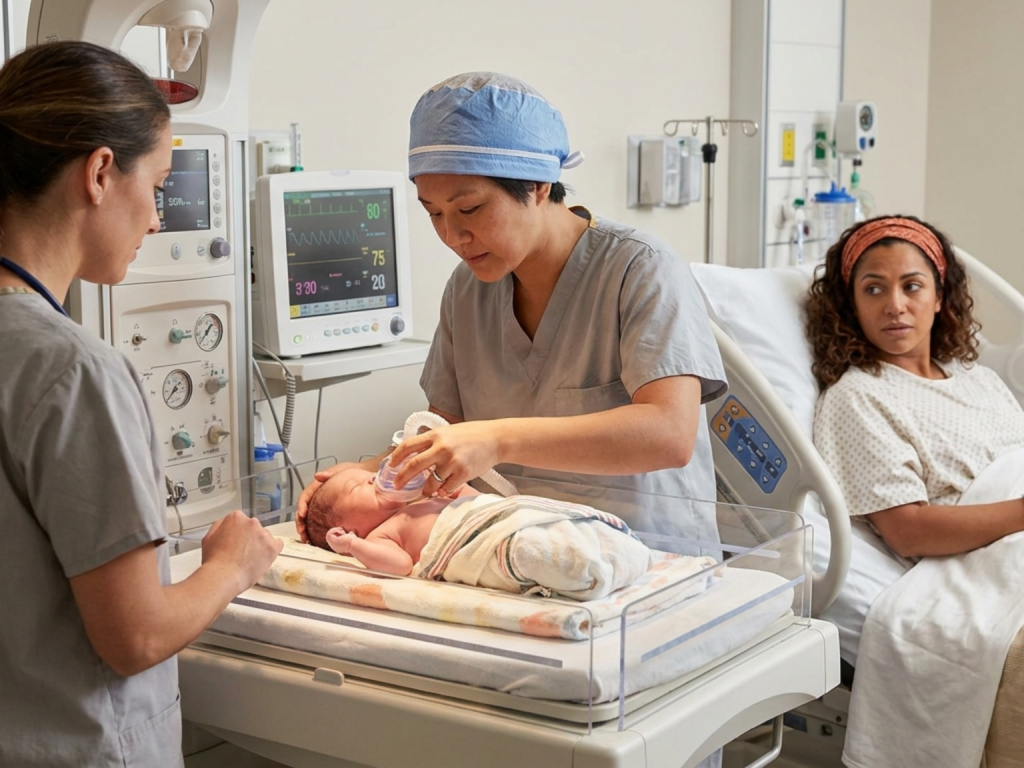
A vigorous baby who is breathing effectively can usually remain skin-to-skin while routine observations continue. If there is concern, the cord may be clamped according to the clinical situation and the baby moved to a nearby heated resuscitation platform. The team may dry and stimulate the baby, position the airway, monitor oxygen saturation, and reassess the heart rate repeatedly.
Some babies need only a few minutes of assistance before returning to a parent. Others require longer observation or specialist support. Whenever circumstances permit, a staff member should explain what is happening while the clinical team concentrates on stabilization.
Why a newborn might need extra help
A baby may need assistance because of prematurity, infection, meconium exposure, congenital anomalies, difficult delivery, placental complications, or the effects of maternal medication. Respiratory transition may also be delayed after cesarean birth because lung fluid can take longer to clear. In many cases, the initial problem is temporary and responds quickly to basic support.
Clinicians are particularly alert to apnea, gasping, grunting, chest recession, persistent central cyanosis, a low or very high heart rate, poor tone, seizures, abnormal temperature, or difficulty maintaining blood glucose. Risk factors identified before or during labor may allow neonatal personnel to be present at delivery. However, an apparently uncomplicated birth can occasionally be followed by unexpected deterioration, so routine observation remains important.
Needing medical help does not necessarily mean that a baby has a serious or lasting condition. The amount of intervention can range from additional warming and feeding support to intensive respiratory and cardiovascular care. The team will use examination findings, response to treatment, gestational age, and relevant investigations to determine the appropriate level of care.
Stabilization and resuscitation in the delivery room
Newborn resuscitation after birth follows a standardized sequence. The priorities are thermal care, opening and positioning the airway, supporting effective ventilation, and evaluating the heart rate. If the baby is not breathing adequately, clinicians may provide positive-pressure ventilation through a face mask or another airway device. Oxygen is adjusted using pulse oximetry and the baby’s response rather than given automatically at a high concentration.
If ventilation remains ineffective, the team may reposition the airway, improve the mask seal, suction when obstruction is suspected, or place an endotracheal tube. Chest compressions and emergency medicines are required only in a small minority of births, usually when the heart rate remains critically low despite effective ventilation. Monitoring may include electrocardiography, oxygen saturation, temperature, and blood gases.
These actions can look intense, but the team’s movements are deliberate and protocol driven. Immediate newborn care after birth focuses first on oxygen delivery to the brain and other organs. Once the baby is stable, clinicians assess whether observation beside the parent is safe or whether continued treatment in a neonatal unit is needed.
Admission or transfer to neonatal care
Babies who require ongoing respiratory support, intravenous treatment, close physiological monitoring, or specialist investigation may be admitted to a neonatal unit. The type of unit varies by hospital and may include transitional care, a special care nursery, a high-dependency area, or a neonatal intensive care unit. Admission does not always indicate critical illness; some babies need support mainly because they are premature, have low blood glucose, or cannot yet feed safely.
Monitoring may include continuous heart rate and oxygen saturation measurement, respiratory rate, temperature, blood pressure, glucose, fluid balance, and urine output. Incubators and heated cots reduce heat loss. Depending on the baby’s condition, breathing support may include supplemental oxygen, high-flow therapy, continuous positive airway pressure, or mechanical ventilation.
If the birth hospital cannot provide the required level of care, a neonatal transport team may transfer the baby to a regional center. The team should explain the reason, destination, anticipated treatment, and options for parental travel or accommodation. When separation occurs, ask how to receive updates, provide expressed colostrum or milk, share photographs, and visit as soon as clinically feasible.
Tests and treatments the baby may receive
Investigations are selected according to the clinical concern rather than performed routinely. Blood tests may evaluate glucose, blood count, infection markers, electrolytes, bilirubin, acid-base status, and blood gases. A blood culture may be taken if infection is suspected. Imaging can include a chest radiograph, ultrasound, echocardiography, or brain imaging. Clinicians should explain what each test is intended to clarify and how the result may influence care.
Treatment may involve warming, oxygen or ventilatory support, intravenous fluids, glucose, antibiotics, phototherapy for significant jaundice, or medicines supporting blood pressure and heart function. Feeding options include breastfeeding, expressed milk, donor human milk where available, formula, or temporary tube feeding. The most appropriate approach depends on gestational age, respiratory stability, swallowing coordination, and the family’s circumstances and preferences.
Before a procedure, parents can ask about its purpose, expected benefits, material risks, alternatives, pain relief, and urgency. In emergencies, clinicians may need to act immediately in the baby’s best interests. They should provide an explanation afterward and seek consent for continuing non-emergency treatment in accordance with local practice.
Your role while the baby receives care
Parents remain central to their baby’s care even when equipment and clinical routines dominate the environment. Depending on stability, you may be able to provide skin-to-skin contact, speak or sing to the baby, change diapers, take temperatures, help with mouth care, and participate in feeding. Nurses can show you how to touch or hold a medically fragile baby without disturbing lines or respiratory support.
Ask who is leading the baby’s care and when medical rounds occur. Useful questions include what the team thinks is happening, what remains uncertain, what improvement would look like, and what might trigger escalation or discharge. You may request simpler explanations, an interpreter, written information, or a meeting with the senior neonatal clinician. Keeping notes can help when information arrives quickly.
Fear, guilt, numbness, anger, and difficulty bonding can all occur after an unexpected neonatal emergency. These responses do not mean you have failed your baby. Tell staff if you are struggling, particularly after a traumatic delivery or prolonged separation. Maternity, neonatal, psychology, social work, lactation, spiritual care, and peer-support services may all be available.
Going home and knowing when to seek help
Before discharge, the team should explain feeding expectations, medicines if applicable, follow-up appointments, screening results, and any condition-specific warning signs. Ask whom to contact day and night. Premature babies and those treated for jaundice, infection, respiratory illness, cardiac concerns, or feeding problems may need earlier review or specialist follow-up.
Seek emergency help if the baby stops breathing, has severe difficulty breathing, turns blue or markedly pale, has a seizure, becomes unresponsive, sustains a serious injury, or cannot be awakened normally. A non-blanching rash, meaning spots that do not fade when pressed, also requires urgent assessment, especially when accompanied by fever or illness. Follow local emergency instructions rather than driving if the baby is critically unwell.
Contact a healthcare professional promptly for poor feeding, repeated vomiting, worsening jaundice, unusual sleepiness, persistent irritability, fewer wet diapers, or any significant departure from the baby’s usual behavior. Fever in a young infant requires particular caution; for a baby under three months, a rectal temperature of 38°C or higher generally warrants urgent medical assessment. Temperature thresholds and recommended routes of measurement may vary, so follow local guidance. Trust your concern: if the baby looks seriously unwell, seek care even when a measured value seems reassuring.
Get urgent help now
- Call emergency services if the baby is not breathing, is blue, is unresponsive, or is having a seizure.
- Seek immediate assessment for severe difficulty breathing, marked chest recession, grunting, or pauses in breathing.
- Treat a non-blanching rash in an unwell baby as an emergency.
- A temperature of 38°C or higher in a baby under three months generally requires urgent medical assessment.
- Promptly report poor feeding, repeated vomiting, worsening jaundice, unusual lethargy, or substantially fewer wet diapers.
Tools & Assistance
- Your maternity triage, neonatal unit, pediatrician, or primary care clinician
- Local emergency medical services for life-threatening signs
- A digital thermometer appropriate for infants
- A written feeding, diaper, temperature, and medication record
- Hospital interpreter, lactation, psychology, social work, or peer-support services
FAQ
Will I be separated from my baby if medical help is needed?
Not always. Brief support may be provided beside you, but temporary separation can be necessary when the baby requires intensive monitoring, respiratory support, or transfer. Ask how you can visit, receive updates, and participate in care.
Does resuscitation mean my baby will have long-term problems?
No. Many babies respond quickly and recover without lasting effects. Prognosis depends on the cause, duration and severity of compromise, response to treatment, gestational age, and investigation results; discuss the individual outlook with the neonatal team.
Can I provide breast milk while my baby is in neonatal care?
Often, yes. Staff may help you express colostrum or milk and explain storage and delivery. Whether the baby feeds directly, by tube, or later depends on respiratory and swallowing stability.
What if I feel that something is wrong after discharge?
Contact a healthcare professional promptly and clearly describe what has changed. If the baby has breathing difficulty, blue color, a seizure, unresponsiveness, or another life-threatening sign, call emergency services immediately.
Sources
- Mayo Clinic — Sick baby? When to seek medical attention
- NHS — When to get urgent medical help for babies and children under 5
- MedlinePlus — When to call your baby's doctor
Disclaimer
This article provides general information and cannot replace individualized medical assessment. Contact a qualified healthcare professional about concerns, and use emergency services for life-threatening signs.


















Please log in to leave a comment.