
Intro
Partner-assisted positioning can make labor, birth, and early postpartum care feel more coordinated, less isolating, and physically safer when it is done with consent and clinical guidance. In this context, a partner may be a spouse, family member, friend, doula, or another chosen support person who helps the birthing person change, maintain, or leave a position.
Assisted positioning is not about forcing a posture or replacing skilled maternity care. It is a practical support strategy: the partner helps with balance, leverage, comfort, communication, and emotional regulation while the healthcare team monitors maternal and fetal wellbeing, medical equipment, anesthesia effects, and safety limits.
Highlights
Partner assistance works best when it is consent-based, planned, and responsive to the birthing person’s changing sensations and clinical status.
Good body mechanics protect both people: the partner should avoid lifting with the back, twisting under load, or trying to catch sudden weight shifts alone.
Epidural analgesia, dizziness, fatigue, IV lines, fetal monitoring, and recent procedures can change which positions are safe.
The partner’s role is supportive, not clinical; nurses, midwives, physicians, and physical therapists should guide movement when risk is higher.
What assisted positioning means in birth
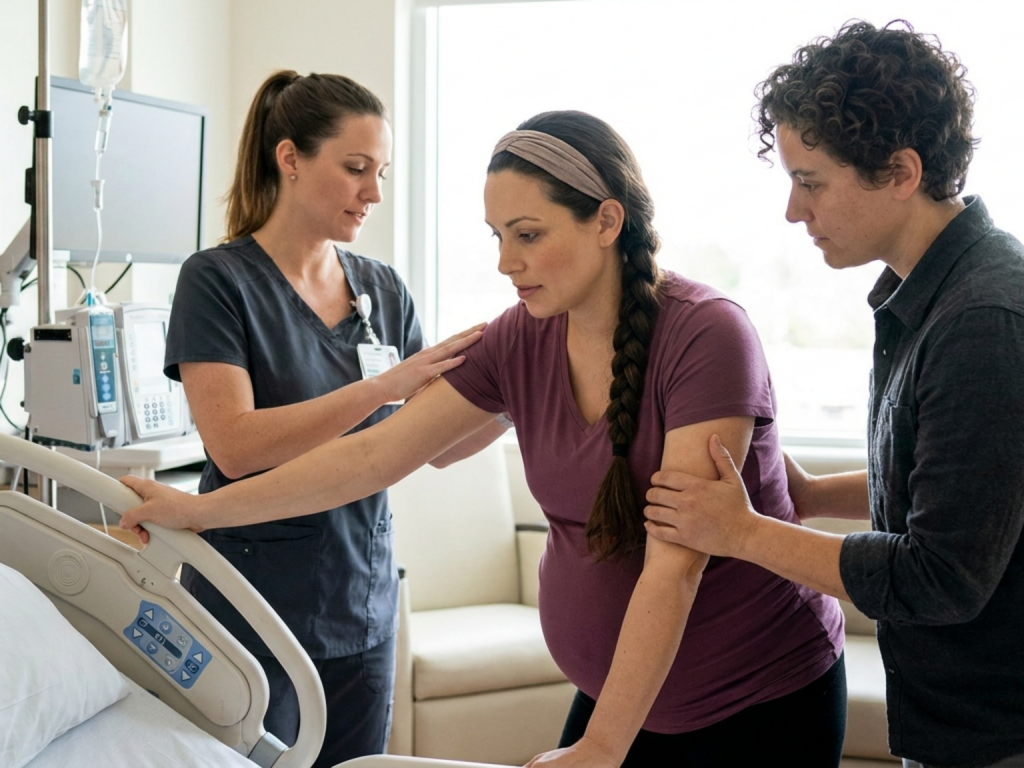
Assisted positioning means using another person’s steady hands, body weight, verbal cues, or physical support to help the birthing person move into, hold, or leave a position. During labor, this might include supported upright leaning in labor, sitting on a birth ball with a partner stabilizing the pelvis, side-lying with help placing pillows, or partner-assisted supported squatting when the clinical team agrees it is appropriate.
The aim is not to achieve a perfect labor posture. The aim is to improve comfort, reduce unnecessary muscular effort, support physiologic movement, and maintain safety. Labor positions may influence how the pelvis opens, how pressure is distributed, how contractions are tolerated, and how the birthing person rests between contractions. A partner can help make these transitions less exhausting by providing a reliable point of contact.
Assistance should always be active and responsive. The partner watches for signs of fatigue, shakiness, dizziness, nausea, pain that feels wrong, or emotional overwhelm. The birthing person remains the authority on what feels acceptable, while clinicians remain responsible for medical assessment and safety recommendations.
Consent, communication, and clinical boundaries
Consent-based touch during labor is essential. A position that feels helpful during one contraction may feel intolerable during the next. Before touching, lifting, bracing, counterbalancing, or applying pressure, the partner should ask briefly and specifically: whether touch is wanted, where support should be placed, how firm it should be, and when to stop.
Clear cues reduce confusion when contractions intensify. Many families use simple nonverbal cues during contractions, such as a hand squeeze meaning “hold steady,” a tap meaning “release,” or a head shake meaning “stop.” These cues should be discussed before labor if possible, because speech may become difficult during transition or pushing.
Clinical boundaries matter. The partner should not disconnect monitors, move IV poles without guidance, adjust epidural tubing, change bed settings without permission, or override staff instructions. If fetal monitoring, regional anesthesia, magnesium sulfate, significant bleeding risk, hypertension concerns, or operative birth planning is involved, positioning may require staff assistance. Partner support during birth interventions can still be valuable, but the partner’s role may shift toward reassurance, hand holding, helping the person breathe, and communicating preferences rather than physically moving the body.
Body mechanics that protect both people
Safe assisted positioning uses the same principles emphasized in clinical patient-handling guidance: assess before moving, keep the load close, avoid twisting, use the legs rather than the back, and ask for help when the movement exceeds one person’s capacity. A partner should never try to catch the birthing person during a fall or sudden collapse alone. The priority is to lower risk and call staff immediately.
Before a move, pause for a quick check: Is the floor dry? Are socks or footwear stable? Are cords, monitors, and tubing free from tension? Is the bed locked? Is the birthing person lightheaded, numb, sedated, or exhausted? Does the partner have enough strength and space to help without straining?
For standing or leaning positions, the partner should widen their stance, bend the knees slightly, and offer forearms, shoulders, or hips as stable contact points rather than pulling from the hands. For bed-based positions, pillows, wedges, rolled blankets, side rails used appropriately, and staff assistance can reduce strain. If the birthing person cannot participate actively in the move, manual assistance by a partner alone is usually not appropriate; clinicians may need additional staff or assistive devices.
Common partner-assisted labor positions
Many positions can be adapted to the room, pain management plan, and clinical situation. Supported upright leaning in labor may involve leaning over a raised bed, counter, birth ball on the bed, or partner’s shoulders while the partner stabilizes the torso or pelvis. This can help some people feel grounded during contractions and may allow rhythmic swaying.
Side-lying is often useful for rest, epidural care, fetal monitoring, or reducing fatigue. The partner may help the birthing person roll slowly, place a pillow between the knees, support the upper leg, or maintain shoulder and hip alignment. This is especially important when sensation or strength is reduced.
Hands-and-knees or forward-leaning positions may relieve back pressure for some people, but they can be tiring. The partner can place pillows under knees or wrists, offer water between contractions, and help the person transition out before arms or legs become shaky.
Partner-assisted supported squatting can create a strong sense of pelvic opening, but it places high demand on balance, knees, hips, and the partner’s body mechanics. It should be attempted only when the birthing person is alert, stable, able to bear weight, and cleared by the clinical team. In many settings, a squat bar, birth stool, bed adjustment, or staff-supported alternative is safer than a full unsupported squat.
Pushing, procedures, and higher-risk situations
During pushing, assisted positioning may become more structured. The clinical team may suggest side-lying, semi-recumbent, upright, hands-and-knees, or other positions depending on fetal status, maternal energy, anesthesia, pelvic mechanics, and the need for assessment. The partner can help maintain a chosen position, provide hands-on labor comfort skills, offer sips of fluid if allowed, and repeat the birthing person’s preferences when the room becomes busy.
Some circumstances require more caution. With epidural analgesia, leg strength and proprioception may be reduced even when the person feels mentally clear. After medications that affect alertness, during significant blood pressure changes, after rupture of membranes with cord concerns, with continuous fetal monitoring, or when operative vaginal birth or cesarean birth is being discussed, staff should direct positioning.
Partner assistance should never delay urgent care. If clinicians ask for a position change because fetal heart rate assessment, maternal bleeding, shoulder dystocia maneuvers, anesthesia placement, or surgical preparation is needed, the partner’s best contribution is calm cooperation. This can include stepping to a clear place, holding the birthing person’s hand, maintaining eye contact, and helping them understand what is happening when appropriate.
Preparing the partner before labor
Preparation makes partner-assisted positioning feel less improvised. In prenatal visits or childbirth education, ask which positions are encouraged in the planned birth setting, how staff support movement with epidural analgesia, whether birth balls or squat bars are available, and what the partner should do if the birthing person feels faint or unstable.
A useful birth plan can include labor positioning support preferences, limits around touch, preferred words or cues, and whether the partner should help advocate for position changes when medically appropriate. This is not a script; it is a communication aid. The birthing person may want firm sacral counterpressure during contractions, light touch only, no touch during transition, or repeated reminders to unclench the jaw and shoulders.
The partner should also protect their own body. Hydration, supportive shoes, breaks, and asking staff for help are practical safety measures. A strained partner cannot provide reliable support. In hospital, birth center, or home birth settings, the safest approach is team-based: the partner contributes familiarity and emotional steadiness, while trained professionals guide clinical risk, mobility limits, and emergency response.
When to stop and call for help
- Stop assisting if the birthing person feels faint, confused, weak, short of breath, or unable to bear weight.
- Call staff immediately for heavy bleeding, sudden severe pain, chest pain, seizure, or loss of consciousness.
- Do not move the birthing person alone after epidural placement unless the care team has confirmed it is safe.
- Avoid pulling on arms, lifting under the shoulders, or twisting the body around lines, monitors, or catheters.
- Ask for clinical guidance before squatting, standing, showering, or using a birth ball when monitoring or medication is in place.
Tools & Assistance
- Prenatal childbirth education focused on labor positioning and partner support
- Discussion with an obstetric clinician or midwife about mobility limits in the planned birth setting
- Birth plan notes for consent-based touch, preferred cues, and position preferences
- Hospital or birth center equipment such as pillows, birth ball, squat bar, adjustable bed, or shower chair
- Postpartum physical therapy referral if pain, weakness, or pelvic floor symptoms persist
FAQ
Can a partner help with positioning after an epidural?
Often yes, but only with staff guidance. Epidural analgesia can reduce leg strength and balance, so bed-based or staff-assisted positions may be safer than standing or squatting.
Is partner-assisted positioning safe in home birth?
It can be part of planned home birth support, but the midwife should guide safety, especially for standing, shower, tub, or pushing positions. A transfer plan should be clear before labor.
What if the birthing person changes their mind about touch?
The partner should stop immediately and adjust. Consent during labor is continuous, and preferences can change quickly as contractions, fatigue, or medical needs change.
Should the partner lift the birthing person?
Usually no. Partners should stabilize, guide, and support movement, not perform heavy lifting. If the person cannot participate actively, staff or assistive devices may be needed.
Sources
- LibreTexts — Safe Patient Handling, Positioning, and Transfers
- Winnipeg Regional Health Authority — Patient Positioning for Surgical Procedures
- Occupational Safety and Health Administration — Guidelines for Nursing Homes
Disclaimer
This article is for general medical education and does not replace care from an obstetric clinician, midwife, nurse, or emergency professional. Always follow individualized guidance from your healthcare team.

















Please log in to leave a comment.